



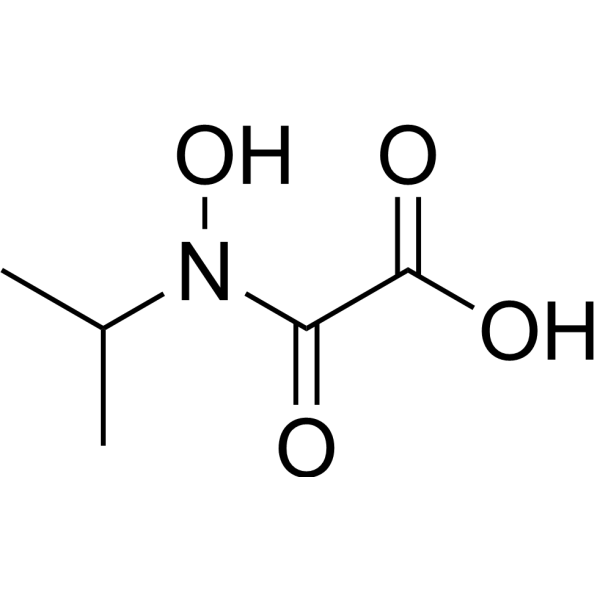
IpOHA

Based on 1 Customer Validation
IpOHA is a ketol-acid reductoisomerase (KARI) inhibitor with a Kd of 22 pM. IpOHA forms a spinach KARI-magnesium-NADPH complex. IpOHA binds bacterial KARI faster than plant KARI and inhibits the growth of E. coli and M. tuberculosis. IpOHA can be used in research related to infection by Escherichia coli and Mycobacterium tuberculosis.
For research use only. We do not sell to patients.
- Purity : 98.61%
- CAS No.: 132418-03-2
- Formula: C5H9NO4
- Molecular Weight:147.13
-
Storage:
4°C, sealed storage, away from moisture and light
* In solvent : -80°C, 6 months; -20°C, 1 month (sealed storage, away from moisture and light)

To place orders, for customer services and technical support, please contact: MedChemExpress USA
Tel: 609-228-6898 E-mail: [email protected] [email protected]


-
 Biological Activity
-
Chemical Information
-
Solvent & Solubility
- Protocols
- Purity & Documentation
- References
-
 Help & FAQs




Biological Activity
Description
In Vitro
IpOHA inhibits Escherichia coli KARI with an initial Ki of 160 nM and a final steady-state Ki of 22 pM[2].
IpOHA (60-1000 μM) shows weak growth inhibitory activity against three Mycobacterium tuberculosis strains[2].
IpOHA is a tightly binding competitive inhibitor of Staphylococcus aureus KARI, with a Ki of 7.95 nM[3].
IpOHA inhibits the growth of UPEC CFT073 in cell culture with an MIC of 78 nM[3].
IpOHA (62-1000 µM; 7-10 days) inhibits the growth of Mycobacterium tuberculosis strains ATCC 35801, P4145, and T13704 in vitro, with the minimum complete inhibitory concentration being strain-dependent[5].
IpOHA binds to bacterial KARI and plant KARI at rates of 1.9×10³ M-1 s-1 and 5.9×10⁴ M-1 s-1, respectively[1].
IpOHA (7 days) binds to the active site of SaKARI crystals and can be reduced to deoxy-IpOHA, whereas overnight crystals show only intact IpOHA[3].
IpOHA chelates two Mg2+ ions within the KARI active site, forming an enzyme-Mg2+-IpOHA ternary complex[3].
MedChemExpress (MCE) has not independently confirmed the accuracy of these methods. They are for reference only.


Chemical Information
-
CAS No. 132418-03-2
-
Appearance Solid
-
Molecular Weight 147.13
-
Formula C5H9NO4
-
Color Off-white to light yellow
-
SMILES
O=C(C(N(C(C)C)O)=O)O
-
Shipping
Room temperature in continental US; may vary elsewhere.
-
Storage
4°C, sealed storage, away from moisture and light
* In solvent : -80°C, 6 months; -20°C, 1 month (sealed storage, away from moisture and light)


Solvent & Solubility
In Vitro:
DMSO : 50 mg/mL (339.84 mM; Need ultrasonic; Hygroscopic DMSO has a significant impact on the solubility of product, please use newly opened DMSO)
Please refer to the solubility information to select the appropriate solvent. Once prepared, please aliquot and store the solution to prevent product inactivation from repeated freeze-thaw cycles.
Storage method and period of stock solution: -80°C, 6 months; -20°C, 1 month (sealed storage, away from moisture and light). When stored at -80°C, please use it within 6 months. When stored at -20°C, please use it within 1 month.
Concentration (start) × Volume (start) = Concentration (final) × Volume (final)
In Vivo:
Select the appropriate dissolution method based on your experimental animal and administration route.
- For the following dissolution methods, please ensure to first prepare a clear stock solution using an In Vitro approach and then sequentially add co-solvents:
- To ensure reliable experimental results, the clarified stock solution can be appropriately stored based on storage conditions. As for the working solution for In Vivo experiments, it is recommended to prepare freshly and use it on the same day.
- The percentages shown for the solvents indicate their volumetric ratio in the final prepared solution. If precipitation or phase separation occurs during preparation, heat and/or sonication can be used to aid dissolution.
Add each solvent one by one: 10% DMSO 40% PEG300 5% Tween-80 45% Saline
Solubility: ≥ 1.25 mg/mL (8.50 mM); Clear solution
This protocol yields a clear solution of ≥ 1.25 mg/mL (saturation unknown).
Taking 1 mL working solution as an example, add 100 μL DMSO stock solution (12.5 mg/mL) to 400 μL PEG300, and mix evenly; then add 50 μL Tween-80 and mix evenly; then add 450 μL Saline to adjust the volume to 1 mL.
Preparation of Saline: Dissolve 0.9 g sodium chloride in ddH₂O and dilute to 100 mL to obtain a clear Saline solution.
Add each solvent one by one: 10% DMSO 90% (20% SBE-β-CD in Saline)
Solubility: ≥ 1.25 mg/mL (8.50 mM); Clear solution
This protocol yields a clear solution of ≥ 1.25 mg/mL (saturation unknown).
Taking 1 mL working solution as an example, add 100 μL DMSO stock solution (12.5 mg/mL) to 900 μL 20% SBE-β-CD in Saline, and mix evenly.
Preparation of 20% SBE-β-CD in Saline (4°C, storage for one week): 2 g SBE-β-CD powder is dissolved in 10 mL Saline, completely dissolve until clear.
In Vivo Dissolution Calculator
Please enter the basic information of animal experiments:
-
-
-
-
Recommended: Prepare an additional quantity of animals to account for potential losses during experiments.
Please enter your animal formula composition:
-
%DMSO +
Recommended: Keep the proportion of DMSO in working solution below 2% if your animal is weak.
-
%+
-
+%Tween-80 + +
-
%Saline +
The co-solvents required include: DMSO, . All of co-solvents are available by MedChemExpress (MCE). , Tween 80. All of co-solvents are available by MedChemExpress (MCE).
Working solution concentration: 0.22 mg/mL
Method for preparing stock solution: mg drug dissolved in μL DMSO. Stock solution concentration: mg/mL. * In solvent : -80°C, 6 months; -20°C, 1 month (sealed storage, away from moisture and light)
1. Take μL DMSO stock solution;
2. Add μL .
μL , mix evenly;
3. Then add μL Tween 80, mix evenly;
4. Then add μL
Please ensure that the stock solution in the first step is dissolved to a clear state, and add co-solvents in sequence. You can use ultrasonic heating (ultrasonic cleaner, recommended frequency 20-40 kHz), vortexing, etc. to assist dissolution.


Purity & Documentation
-
Data Sheet (284 KB)
-
SDS (466 KB)
- English - EN (466 KB)
- Français - FR (466 KB)
- Deutsch - DE (466 KB)
- Norwegian - NO (466 KB)
- Español - ES (466 KB)
- Swedish - SV (466 KB)
- Italian - IT (466 KB)
- Korean - KR (466 KB)
- Portuguese - PT (466 KB)
-
Handling Instructions (2659 KB)
References
[2]. Kandale A, et al. Analogues of the herbicide, N-hydroxy-N-isopropyloxamate, inhibit mycobacterium tuberculosis ketol-acid reductoisomerase and their prodrugs are promising anti-TB drug leads. Journal of Medicinal Chemistry. 2021 Jan 29;64(3):1670-84. [Content Brief]
[3]. Patel K M. Ketol-acid reductoisomerase as a target for antimicrobial drug discovery[J]. 2021. [Content Brief]


Complete Stock Solution Preparation Table
Please refer to the solubility information to select the appropriate solvent. Once prepared, please aliquot and store the solution to prevent product inactivation from repeated freeze-thaw cycles.
Storage method and period of stock solution: -80°C, 6 months; -20°C, 1 month (sealed storage, away from moisture and light). When stored at -80°C, please use it within 6 months. When stored at -20°C, please use it within 1 month.
| Optional Solvent | Concentration Solvent Mass | 1 mg | 5 mg | 10 mg | 25 mg |
|---|---|---|---|---|---|
| DMSO | 1 mM | 6.7967 mL | 33.9836 mL | 67.9671 mL | 169.9178 mL |
| 5 mM | 1.3593 mL | 6.7967 mL | 13.5934 mL | 33.9836 mL | |
| 10 mM | 0.6797 mL | 3.3984 mL | 6.7967 mL | 16.9918 mL | |
| 15 mM | 0.4531 mL | 2.2656 mL | 4.5311 mL | 11.3279 mL | |
| 20 mM | 0.3398 mL | 1.6992 mL | 3.3984 mL | 8.4959 mL | |
| 25 mM | 0.2719 mL | 1.3593 mL | 2.7187 mL | 6.7967 mL | |
| 30 mM | 0.2266 mL | 1.1328 mL | 2.2656 mL | 5.6639 mL | |
| 40 mM | 0.1699 mL | 0.8496 mL | 1.6992 mL | 4.2479 mL | |
| 50 mM | 0.1359 mL | 0.6797 mL | 1.3593 mL | 3.3984 mL | |
| 60 mM | 0.1133 mL | 0.5664 mL | 1.1328 mL | 2.8320 mL | |
| 80 mM | 0.0850 mL | 0.4248 mL | 0.8496 mL | 2.1240 mL | |
| 100 mM | 0.0680 mL | 0.3398 mL | 0.6797 mL | 1.6992 mL |


IpOHA Related Classifications
HY-153351 Related Classifications
 Powered by Bioz