



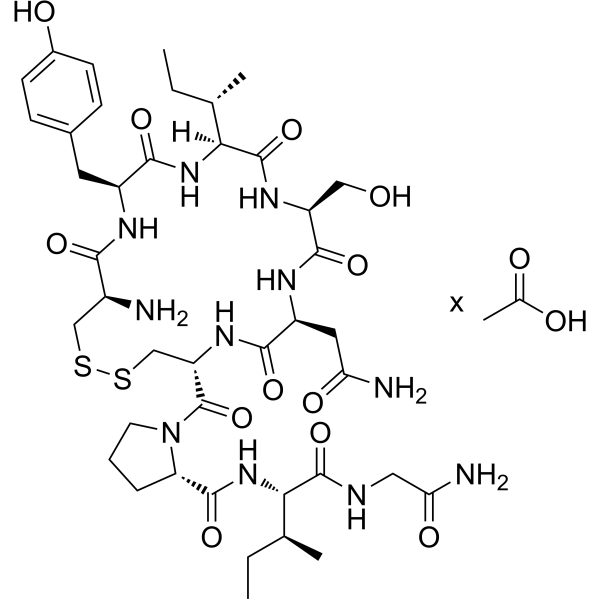
Isotocin acetate
Isotocin acetate is the homologue of mammalian oxytocin in teleost fish, belonging to the category of neurotransmitters/neuromodulators and peripheral hormones. Isotocin acetate exerts biological effects by binding to its homologous Isotocin acetate receptor (with EC50 = 1.58e-10 mol/L in gilthead seabream) and specific G-protein-coupled receptor subtypes. Isotocin acetate promotes paternal behavior in cichlids, regulates the expression of Foxi3a and P63, thereby controlling the differentiation of ionocyte progenitor cells and the proliferation of epidermal stem cells, and modulates whole-body ion content in zebrafish embryos. Isotocin acetate regulates social and reproductive behaviors, synchronizes the reproductive cycles of teleost fish, and its neuronal phenotypes can be used to classify the types of reproductive systems in cichlids.
Para uso exclusivo en investigación. No vendemos a pacientes.
- Fòrmula: C41H63N11O12S2.xC2H4O2
- Peso molecular:966.14 (free base)
-
Almacenamiento:
Please store the product under the recommended conditions in the Certificate of Analysis.

To place orders, for customer services and technical support, please contact: MedChemExpress USA
Tel: 609-228-6898 E-mail: [email protected] [email protected]


-
 Actividad biológica
-
Chemical Information
- Protocolo
- Pureza y Documentación
- Referencias
-
 Help & FAQs


Ver todos los productos específicos de isoformas Endogenous Metabolite
More

Actividad biológica
Descripciòn
In Vitro
Isotocin (10-12-10-6 mol/L; 15 min) acetate potently enhances Aqp1a-mediated water transport in Xenopus laevis oocytes co-expressing gilthead sea bream Aqp1a and ITR, with an EC50 of 10-9.8 mol/L[9].
MedChemExpress (MCE) has not independently confirmed the accuracy of these methods. They are for reference only.
In Vivo
Isotocin (1 ng/embryo; injection; single dose; 1-2-cell stage) acetate regulates zebrafish ion homeostasis by stimulating epidermal stem cell proliferation and ionocyte progenitor differentiation via modulation of P63 and foxi3a transcription factors, increasing ionocyte densities and ion uptake capacity[2].
Isotocin (1 μg/g body mass; i.p.; single injection) acetate increases sensitivity to opponent body size in staged territorial aggression contexts in Neolamprologus pulcher, with treated Neolamprologus pulcher adjusting aggression levels based on perceived opponent size rather than intrinsic aggressive propensity[4].
Isotocin (1 μg/g body mass; i.p.; single injection; repeated 7 days later with alternate treatment) acetate increases responsiveness to aggressive social feedback in established social groups of Neolamprologus pulcher, specifically increasing submissive displays without altering aggression, affiliation, or overall activity levels[4].
Isotocin (1 μg/g body mass; i.p.; single injection) acetate increases submissive behaviour in temporarily removed wild Neolamprologus pulcher subordinates, but also significantly increases aggression received from group members and eviction likelihood, with hiding behaviour increasing alongside neighbouring group density[5].
MedChemExpress (MCE) has not independently confirmed the accuracy of these methods. They are for reference only.
-
Animal Model:Amatitlania nigrofasciata (convict cichlid) (adult males, barred color morph)[1]
-
Dosage:0.5 μg/g body weight
-
Administration:i.p.; daily; 3 consecutive days starting on Day 0 post-spawning
-
Result:Blocked the normal rise in paternal care typically seen in biparental males on Day 2 post-spawning.
Showed no significant effect on paternal care on Day 1.
Did not alter affiliative behavior toward the mate.
Did not alter aggressive behavior directed toward juveniles.
-
Animal Model:AB strain (embryos, 1-2-cell stage to 72 hours post-fertilization)[2]
-
Dosage:1 ng/embryo (isotocin morpholino); 1 ng/embryo (isotocin cRNA)
-
Administration:injection; single dose; 1-2-cell stage (morpholino, cRNA); 24 hours (hypotonic treatment)
-
Result:Upregulated isotocin mRNA expression significantly in 72-hpf embryos after hypotonic double-deionized water treatment for 24 hours.
Reduced whole-body Cl-, Ca2+, and Na+ contents compared to mismatched MO controls after isotocin knockdown via 1 ng/embryo MO.
Lowered isotocin protein levels significantly in morphants than in wild-type or mismatched MO embryos after isotocin knockdown.
Reduced mRNA expression of ionocyte-related genes (atp6v1a, atp1b1b, trpv6, slc12a10.2, nhe3b), decreased density of atp6v1a-, trpv6-, and slc12a10.2-expressing ionocytes, and lowered density of Na+-K+-ATPase-rich cells (NaRC) and H+-ATPase-rich cells (HRC) at 72 hpf after isotocin knockdown.
Suppressed foxi3a mRNA expression and reduced density of foxi3a-expressing cells at the tail-bud stage and 3 dpf, and decreased density of P63+ epidermal stem cells at 72 hpf after isotocin knockdown.
Doubled isotocin protein levels compared to wild-type embryos after isotocin overexpression via 1 ng/embryo cRNA.
Increased density of NaRC and HRC at 72 hpf after isotocin overexpression.
Stimulated foxi3a mRNA expression and increased density of foxi3a-expressing cells at the tail-bud stage and 3 dpf, and increased density of P63+ epidermal stem cells at 72 hpf after isotocin overexpression.
-
Animal Model:Laboratory-reared descendants of wild-caught fish (18 females, 18 males; mean standard length 51.1 mm, range 39.4-62.8 mm)[4]
-
Dosage:1 μg/g body mass
-
Administration:i.p.; single injection
-
Result:Showed a positive correlation between aggression rate and own body size in mirror trials.
Showed a positive correlation between aggression rate and opponent body size in live rival trials, while aggression rate was unrelated to own body size.
Had no significant correlation between aggression rates against a mirror and against a live rival.
Had similar overall aggression rates against mirror images and live rivals compared to control fish.
-
Animal Model:Laboratory-reared descendants of wild-caught fish (10 females, 9 males; mean standard length 47.5 mm, range 40.1-56.8 mm; mid-ranked helpers from established social groups)[4]
-
Dosage:1 μg/g body mass
-
Administration:i.p.; single injection; repeated 7 days later with alternate treatment
-
Result:Showed a significantly greater increase in submission (measured as submissive behaviours per aggressive acts received) compared to saline-treated fish (GLMM effect of treatment: F1,35=7.05, P=0.01).
Showed no significant change in aggressive behaviour (GLMM effect of treatment: F1,35=2.15, P=0.15), affiliative behaviour (GLMM effect of treatment: F1,35=0.34, P=0.53), or overall activity (GLMM effect of treatment: F1,35=0.03, P=0.87) compared to controls.
-
Animal Model:Sexually mature individuals (>35 mm standard length; 23 males, 17 females)[5]
-
Dosage:1 μg/g body mass
-
Administration:i.p.; single injection
-
Result:Produced more frequent submissive displays and had a higher rate of submission per aggressive act received .
Received significantly more aggression from group-mates.
Had a significantly higher likelihood of eviction from the group.
Showed a significant interaction between treatment and neighbouring group density for post-return hiding time, with hiding time increasing as neighbouring group density increased.


Chemical Information
-
Peso molecular 966.14 (free base)
-
Fòrmula C41H63N11O12S2.xC2H4O2
-
Synonyms
(Ser4,Ile8)-Oxytocin acetate
-
Sequence
Cys-Tyr-Ile-Ser-Asn-Cys-Pro-Ile-Gly-NH2 (Disulfide bridge: Cys1-Cys6)
-
Sequence Shortening
CYISNCPIG-NH2 (Disulfide bridge: Cys1-Cys6)
-
Envío
Room temperature in continental US; may vary elsewhere.
-
Almacenamiento
Please store the product under the recommended conditions in the Certificate of Analysis.


Pureza y Documentación
Referencias
[1]. O'Connell LA, et al. Isotocin regulates paternal care in a monogamous cichlid fish. Hormones and behavior. 2012 May;61(5):725-33. [Content Brief]
[2]. Chou MY, et al. Isotocin controls ion regulation through regulating ionocyte progenitor differentiation and proliferation. Cellular and molecular life sciences : CMLS. 2011 Aug;68(16):2797-809. [Content Brief]
[3]. Kanda S, et al. Neuroanatomical evidence that kisspeptin directly regulates isotocin and vasotocin neurons. PloS one. 2013;8(4):e62776. [Content Brief]
[6]. Reddon AR, et al. Isotocin neuronal phenotypes differ among social systems in cichlid fishes. Royal Society open science. 2017 May;4(5):170350. [Content Brief]
[7]. Altmieme Z, et al. A reproductive role for the nonapeptides vasotocin and isotocin in male zebrafish (Danio rerio). Comparative biochemistry and physiology. Part B, Biochemistry & molecular biology. 2019 Dec;238:110333. [Content Brief]
[9]. Martos-Sitcha JA, et al. Vasotocin and isotocin regulate aquaporin 1 function in the sea bream. The Journal of experimental biology. 2015 Mar;218(Pt 5):684-93. [Content Brief]
[10]. Venkatesh B, et al. Transgenic rats reveal functional conservation of regulatory controls between the Fugu isotocin and rat oxytocin genes. Proceedings of the National Academy of Sciences of the United States of America. 1997 Nov 11;94(23):12462-6. [Content Brief]

Calculators
Concentration (start) × Volume (start) = Concentration (final) × Volume (final)


Isotocin acetate Related Classifications
HY-P4184A Related Classifications
 Powered by Bioz