



InsB (9-23)

Based on 1 Customer Validation
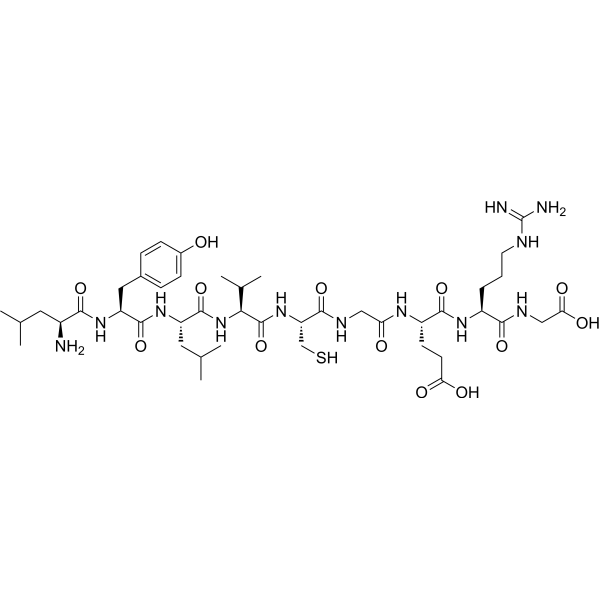
InsB (9-23) (Insulin B chain (9-23)) is an HLA-DQ8-restricted insulin B-chain peptide composed of amino acid residues 9-23. InsB (9-23) serves as a major MHC II class-restricted antigen. InsB (9-23) supports the recognition and activation of T cells, stimulates the secretion of IFN-γ and cytokines, and induces cross-reactive immune responses. InsB (9-23)-specific CD4 T cells can initiate diabetes. InsB (9-23) can be used in research related to type 1 diabetes and autoimmune diabetes.
For research use only. We do not sell to patients.
- Purity: 98.98%
- CAS No.: 163364-16-7
- Formula: C72H116N20O22S1
- Molecular Weight:1645.90
-
Storage:
Sealed storage, away from moisture.
Powder -80°C, 2 years , -20°C, 1 year* In solvent : -80°C, 6 months; -20°C, 1 month (sealed storage, away from moisture)


To place orders, for customer services and technical support, please contact: MedChemExpress USA
Tel: 609-228-6898 E-mail: [email protected] [email protected]


-
 Biological Activity
-
Chemical Information
-
Solvent & Solubility
- Purity & Documentation
- References
-
 Help & FAQs





Biological Activity
Description
IC50 & Target
[1]|
MHC II |
In Vitro
InsB (9-23) (2.5 μM; 48 h) stimulates IFN-γ secretion by the insB:11-23-specific T1D#3 C8 human T cell clone from a type 1 diabetes patient when presented by HLA-DQ8-expressing HEK293 APCs[2].
MedChemExpress (MCE) has not independently confirmed the accuracy of these methods. They are for reference only.
-
Cell Line:insB:11-23-specific human T cell clone (T1D#3 C8) and HLA-DQ8-cis- or DQ8-trans-expressing HEK293 antigen-presenting cells
-
Concentration:2.5 μM
-
Incubation Time:48 h
-
Result:Stimulated IFN-γ secretion by the insB:11-23-specific human T cell clone, with lower activity observed relative to the hyperactive InsB:9-23R22E peptide variant.
In Vivo
InsB (9-23) (100 μg; s.c.; once; 1 day after T-cell transfer) combined with adoptive transfer of InsB (9-23)-specific TCR-engineered human CD4+ T cells induces diabetes in 60% of streptozotocin-conditioned HLA-DQ8-Tg hu-mice, accompanied by pancreatic islet destruction and human T-cell infiltration[3].
MedChemExpress (MCE) has not independently confirmed the accuracy of these methods. They are for reference only.
-
Animal Model:HLA-DQ8-transgenic NSG (NOD.Cg-Prkdcscid Il2rgtm1Wjl/SzJ) (6-12 weeks old, type 1 diabetes model via low-dose streptozotocin conditioning + adoptive transfer of autologous InsB (9-23)-specific TCR-engineered human CD4+ T cells + immunization with InsB (9-23))[3]
-
Dosage:100 μg
-
Administration:s.c.; once (1 day after T-cell transfer)
-
Result:Induced hyperglycemia and diabetes in approximately 60% of mice by 28 days post-T-cell infusion.
Caused severe destruction of pancreatic islets and human CD3+ T-cell infiltration in diabetic mice.
Enabled detection of infused GFP+ InsB (9-23)-TCR-engineered CD4+ T cells in peripheral blood for at least 6 days, in spleen and liver for at least 3 weeks, in bone marrow for at least 5 weeks, and in pancreatic islets by 11 days post-infusion.


Chemical Information
-
CAS No. 163364-16-7
-
Appearance Solid
-
Molecular Weight 1645.90
-
Formula C72H116N20O22S1
-
Color White to off-white
-
Synonyms
Insulin B chain (9-23)
-
Sequence Shortening
SHLVEALYLVCGERG
-
Shipping
Room temperature in continental US; may vary elsewhere.
-
Storage
Sealed storage, away from moisture
Powder -80°C 2 years -20°C 1 year * In solvent : -80°C, 6 months; -20°C, 1 month (sealed storage, away from moisture)


Solvent & Solubility
In Vitro:
Acetic acid : 4 mg/mL (2.43 mM; Need ultrasonic)
Please refer to the solubility information to select the appropriate solvent. Once prepared, please aliquot and store the solution to prevent product inactivation from repeated freeze-thaw cycles.
Storage method and period of stock solution: -80°C, 6 months; -20°C, 1 month (sealed storage, away from moisture). When stored at -80°C, please use it within 6 months. When stored at -20°C, please use it within 1 month.
Please refer to the solubility information to select the appropriate solvent. Once prepared, please aliquot and store the solution to prevent product inactivation from repeated freeze-thaw cycles.
Storage method and period of stock solution: -80°C, 6 months; -20°C, 1 month (sealed storage, away from moisture). When stored at -80°C, please use it within 6 months. When stored at -20°C, please use it within 1 month.
Concentration (start) × Volume (start) = Concentration (final) × Volume (final)


Purity & Documentation
-
Data Sheet (272 KB)
-
SDS (254 KB)
- English - EN (254 KB)
- Français - FR (254 KB)
- Deutsch - DE (254 KB)
- Norwegian - NO (254 KB)
- Español - ES (254 KB)
- Swedish - SV (254 KB)
- Italian - IT (254 KB)
- Korean - KR (254 KB)
- Portuguese - PT (254 KB)
-
Handling Instructions (2659 KB)
References
[1]. Wenzlau JM, et al. Insulin B-chain hybrid peptides are agonists for T cells reactive to insulin B:9-23 in autoimmune diabetes. Front Immunol. 2022;13:926650. Published 2022 Aug 10. [Content Brief]
[2]. Girdhar K, et al. A gut microbial peptide and molecular mimicry in the pathogenesis of type 1 diabetes. Proc Natl Acad Sci U S A. 2022;119(31):e2120028119. [Content Brief]
[3]. Tan S, et al. Type 1 diabetes induction in humanized mice. Proc Natl Acad Sci U S A. 2017;114(41):10954-10959. [Content Brief]


Complete Stock Solution Preparation Table
Please refer to the solubility information to select the appropriate solvent. Once prepared, please aliquot and store the solution to prevent product inactivation from repeated freeze-thaw cycles.
Storage method and period of stock solution: -80°C, 6 months; -20°C, 1 month (sealed storage, away from moisture). When stored at -80°C, please use it within 6 months. When stored at -20°C, please use it within 1 month.
| Optional Solvent | Concentration Solvent Mass | 1 mg | 5 mg | 10 mg | 25 mg |
|---|---|---|---|---|---|
| Acetic acid | 1 mM | 0.6076 mL | 3.0379 mL | 6.0757 mL | 15.1893 mL |


InsB (9-23) Related Classifications
HY-P1745 Related Classifications
 Powered by Bioz