



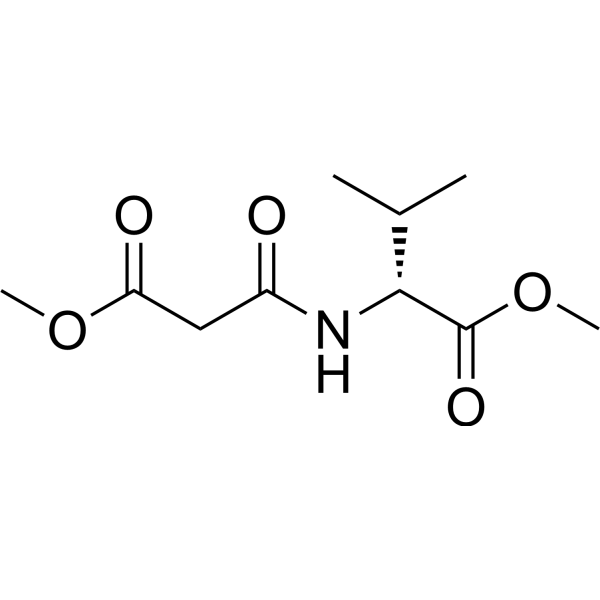
ZLc-002
ZLc-002 is a selective inhibitor of nNOS-Capon coupling. ZLc-002 suppresses inflammatory nociception and chemotherapy-induced neuropathic pain. ZLc-002 can be used for the research of anxiety disorder and inflammation.
For research use only. We do not sell to patients.
- CAS No.: 1446971-41-0
- Formula: C10H17NO5
- Molecular Weight:231.25
-
Storage:
Please store the product under the recommended conditions in the Certificate of Analysis.

To place orders, for customer services and technical support, please contact: MedChemExpress USA
Tel: 609-228-6898 E-mail: [email protected] [email protected]


-
 Biological Activity
-
Chemical Information
- Protocols
- Purity & Documentation
- References
-
 Help & FAQs




Biological Activity
Description
In Vitro
ZLc-002 (1 μM; 24 h) inhibits nNOS-CAPON in cultured hippocampal neurons from ICR mice[3].
MedChemExpress (MCE) has not independently confirmed the accuracy of these methods. They are for reference only. Further protocols information, click here.
-
Cell Line:ICR mice hppocampal neurons
-
Concentration:1 μM
-
Incubation Time:24 h
-
Result:Inhibited the nNOS-CAPON in cultured hippocampal neurons from ICR mice.
In Vivo
MedChemExpress (MCE) has not independently confirmed the accuracy of these methods. They are for reference only.
-
Animal Model:tMCAO mice[2]
-
Dosage:30 mg/kg
-
Administration:Intraperitoneal injection; 30 mg/kg per day; from 4–10 days until 46 days after stroke
-
Result:Signally ameliorated sroke-induced impairment of motor function and recovered from stroke in the delayed phase.
-
Animal Model:Adult male ICR mice with CMS exposure[2]
-
Dosage:40 mg/kg
-
Administration:Intravenous injection; 40 mg/kg once per day; from 21-27 days of CMS exposure for 7 days
-
Result:Showed a therapeutic effect in CMS-induced anxiety disorder.
-
Animal Model:Adult male ICR mice with CORT[2]
-
Dosage:10 μM 1 μL
-
Administration:Hippocampus injection; 10 μM 1 μL once per day; from 21-27 days of CORT reatmentfor 7 days
-
Result:Showed a therapeutic effect in chronic stress-induced anxiety disorders.


Chemical Information
-
CAS No. 1446971-41-0
-
Molecular Weight 231.25
-
Formula C10H17NO5
-
SMILES
COC(CC(N[C@H](C(C)C)C(OC)=O)=O)=O
-
Shipping
Room temperature in continental US; may vary elsewhere.
-
Storage
Please store the product under the recommended conditions in the Certificate of Analysis.

Protocols
-
Research Protocol for Inflammation-related Diseases
The NLRP3 inflammasome is a cytosolic innate immune signaling platform that integrates priming signals and danger-signal activation to promote caspase-1 activation, maturation of IL-1β and IL-18, and gasdermin D-mediated pyroptotic cell death. The core experimental logic is to determine whether inflammatory disease phenotypes are driven by increased NLRP3 expression, ASC-containing inflammasome assembly, caspase-1 cleavage, GSDMD cleavage, and extracellular release of IL-1β/IL-18 rather than by nonspecific cell injury alone. The pathway is strongly linked to inflammation-related disease phenotypes because monosodium urate crystals activate NALP3/NLRP3 inflammasome signaling in gout-like crystal inflammation, cholesterol crystals activate NLRP3 inflammasomes in atherogenesis models, and DSS-induced intestinal inflammation has been reported to involve NLRP3 inflammasome activity. However, experimental colitis studies also show context-dependent protective effects of NLRP3 inflammasome co


Purity & Documentation
References
[1]. Ni HY, et al.Dissociating nNOS (Neuronal NO Synthase)-CAPON (Carboxy-Terminal Postsynaptic Density-95/Discs Large/Zona Occludens-1 Ligand of nNOS) Interaction Promotes Functional Recovery After Stroke via Enhanced Structural Neuroplasticity. Stroke. 2019 Mar;50(3):728-737. [Content Brief]
[2]. Zhu LJ, et al. nNOS-CAPON blockers produce anxiolytic effects by promoting synaptogenesis in chronic stress-induced animal models of anxiety. Br J Pharmacol. 2020 Aug;177(16):3674-3690. [Content Brief]
[3]. Zhu LJ, et al.CAPON-nNOS coupling can serve as a target for developing new anxiolytics. Nat Med. 2014 Sep;20(9):1050-4. doi: 10.1038/nm.3644. Epub 2014 Aug 17. [Content Brief]

Calculators
Concentration (start) × Volume (start) = Concentration (final) × Volume (final)


ZLc-002 Related Classifications
HY-147306 Related Classifications
 Powered by Bioz