



Evolocumab
Based on 3 publication(s) in Google Scholar
Evolocumab (AMG 145) is a human monoclonal antibody that inhibits PCSK9. Evolocumab is used in the study of hypercholesterolemia and atherosclerotic cardiovascular disease. Evolocumab binds to circulating PCSK9 protein and inhibits its binding to LDLR. Evolocumab has antioxidant and cytoprotective activities against H2O2-induced oxidative damage to endothelial cells. Evolocumab may also negatively regulate activation of the TLR-4/NF-κB signaling pathway to prevent inflammation.
For research use only. We do not sell to patients.
- Purity : 98.4%
- CAS No.: 1256937-27-5
- Molecular Weight:141.8 kDa
-
Storage:
Please store the product under the recommended conditions in the Certificate of Analysis.


To place orders, for customer services and technical support, please contact: MedChemExpress USA
Tel: 609-228-6898 E-mail: [email protected] [email protected]


-
 Biological Activity
-
Chemical Information
- Protocols
- Purity & Documentation
- References
-
 Help & FAQs


-

HY-P9928
AlirocumabPCSK9 Inhibitor -

HY-P99187
BococizumabAnti-human PCSK9 Antibody -

HY-P9928A
Alirocumab (anti-PCSK9)PCSK9 Inhibitor -

HY-P9908
AdalimumabTNF-α Inhibitor -

HY-P9958
DenosumabRANKL Inhibitor -

HY-P9906
BevacizumabVEGF-A Inhibitor -

HY-P9902
PembrolizumabPD-1 Inhibitor -

HY-P9950
OmalizumabHuman IgE Antibody -

HY-132591
InclisiranPCSK9 Inhibitor -

HY-P9917
TocilizumabIL-6R Neutralizing Antibody -

HY-P9927
SecukinumabIL-17A Antagonist -
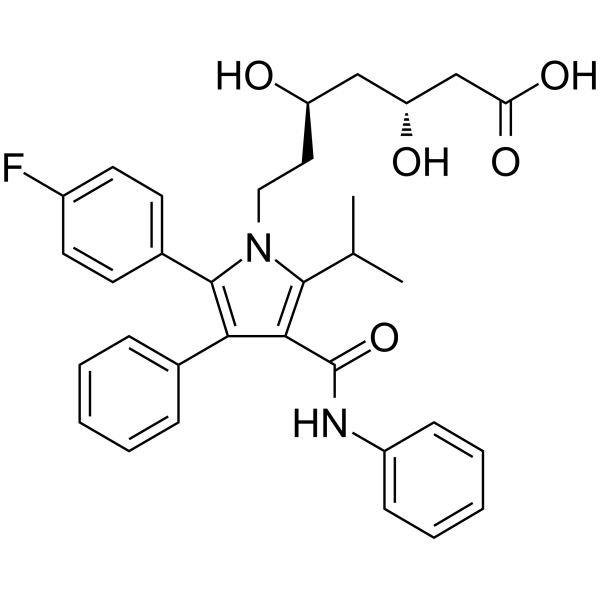
HY-B0589
AtorvastatinHMG-CoA Reductase Inhibitor
Publications Citing Use of MedChemExpress (MCE) Evolocumab
More Customer Validation & Images

-
Histological Imaging/Staining
-
Histological Imaging/Staining
-
WB
-
Histological Imaging/Staining
-
In Vivo Efficacy Study


Biological Activity
Description
Isotype
Human IgG2 lambda
Recommend Isotype Controls
Species Reactivity
Human
IC50 & Target
PCSK9
In Vitro
Evolocumab (5-100 μg/mL) can significantly prevent the cytotoxicity of H2O2 on human umbilical vein endothelial cells (HUVEC)[2].
Evolocumab (100 μg/mL) can reduce the expression and secretion of inflammatory factors increased by stimulation of rat retinal Müller cells (RMC)[3].
MedChemExpress (MCE) has not independently confirmed the accuracy of these methods. They are for reference only.
Clinical Trial
| NCT Number | Sponsor | Condition | Start Date |
Phase

|
|---|---|---|---|---|
| NCT01329991 | Plexxikon| | 2011-05 | PHASE1 |
Gene ID
Accession
Conjugated
Unconjugated
Reconsititution
The product can be reconstituted/diluted with sterile PBS or saline.
Format
-
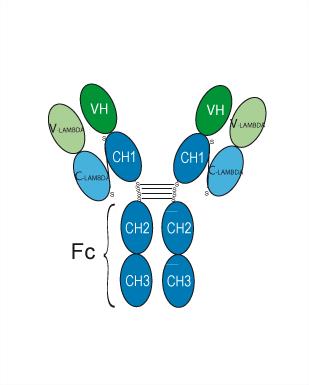
Human IgG2 lambda
Application
ELISA, FACS, Functional assay
Verified Bioactivity
-
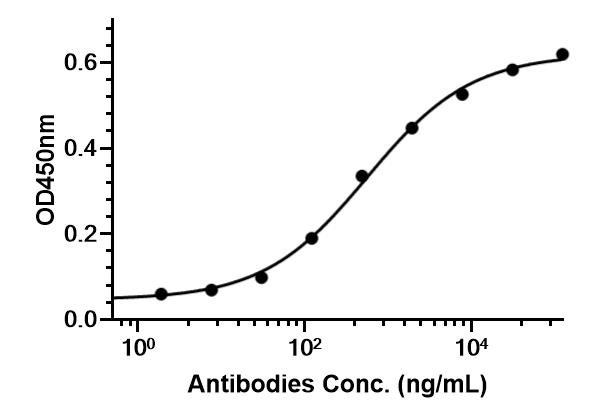 Immobilized PCSK9 Protein, Human can bind Evolocumab. The EC50 for this effect is 574 ng/mL.
 -
 Flow Cytometry analysis of Hela cells labelling PCSK9 (red) with Evolocumab (anti-PCSK9) (HY-P9930). Goat Anti-Human IgG (Alexa Fluor 488) (HY-P83776) at a dilution of 1/1000 was used as the secondary antibody. Blue-Human IgG2 lambda (HY-P991206). Black-Unlabelled control, cells without incubation with primary antibody.
 -
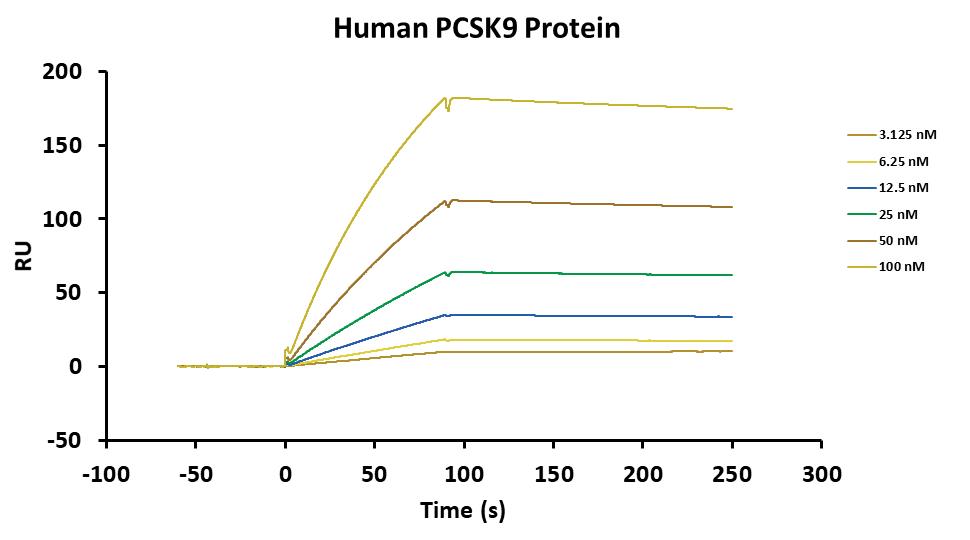 Loaded Evolocumab on Sensor Chip Protein A, can bind PCSK9 Protein, Human (HEK293, HY-P70545A) with an affinity constant of 9.35E-10 M as determined in SPR assay.


Chemical Information
-
CAS No. 1256937-27-5
-
Appearance Liquid
-
Molecular Weight 141.8 kDa
-
Color Colorless to light yellow
-
SMILES
[Evolocumab]
-
Synonyms
AMG 145
-
Formulation
Please refer to the lot-specific COA for specific buffer information.
-
Storage
Please store the product under the recommended conditions in the Certificate of Analysis.


Publications (3)
-
Journal Impact Factor
-
Most Recent
-
MedComm (2020)
Statins, but not proprotein convertase subtilisin-kexin type 9 inhibitors, lower chemerin in hypercholesterolemia via low-density lipoprotein receptor upregulation. [Abstract]2024 Aug 31;5(9):e681. PMID: 39220103 -
J Immunother Cancer
Blocking PCSK9 suppresses hepatocellular carcinoma immune escape by decreasing FLI1-mediated SPP1 and PD-L1 expression. [Abstract]2025 Nov 28;13(11):e012586. PMID: 41314977 -
Biochem Pharmacol
PCSK9 regulates myofibroblast transformation through the JAK2/STAT3 pathway to regulate fibrosis after myocardial infarction. [Abstract]2024 Feb:220:115996. PMID: 38154546
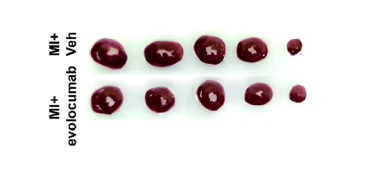
Evolocumab purchased from MedChemExpress. Usage Cited in: Biochem Pharmacol. 2024 Feb:220:115996. [Abstract]
There was no difference in the 24-hour myocardial infarct size between the Evolocumab (subcutaneously injected, 30 mg/kg, 30 min before operation) treatment group and the myocardial infarction (MI) group.
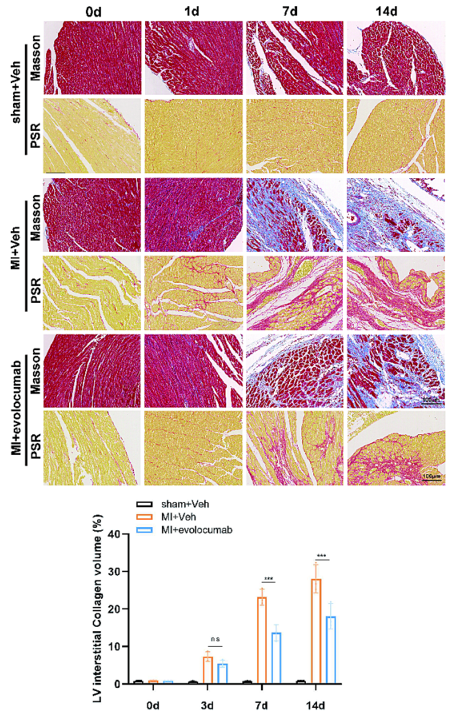
Evolocumab purchased from MedChemExpress. Usage Cited in: Biochem Pharmacol. 2024 Feb:220:115996. [Abstract]
The degree of myocardial fibrosis in the MI + evolocumab (subcutaneously injected, 30 mg/kg, 30 min before operation) group was lower than that in the MI + vehicle (Veh) group.
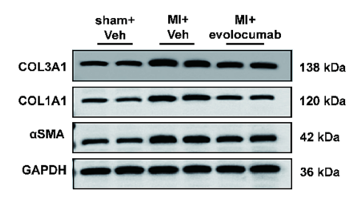
Evolocumab purchased from MedChemExpress. Usage Cited in: Biochem Pharmacol. 2024 Feb:220:115996. [Abstract]
Evolocumab (subcutaneously injected, 30 mg/kg, 30 min before operation) decreased the collagen I, collagen III, and α-SMA proteins induced by the myocardial infarction (MI) model in rats.
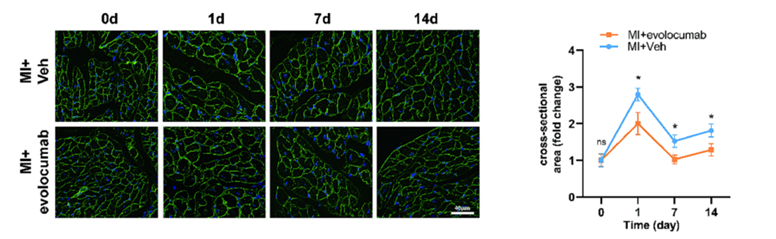
Evolocumab purchased from MedChemExpress. Usage Cited in: Biochem Pharmacol. 2024 Feb:220:115996. [Abstract]
WGA staining showed that evolocumab (subcutaneously injected, 30 mg/kg, 30 min before operation) treatment could reduce cardiomyocyte volume after myocardial infarction in a rat MI model.
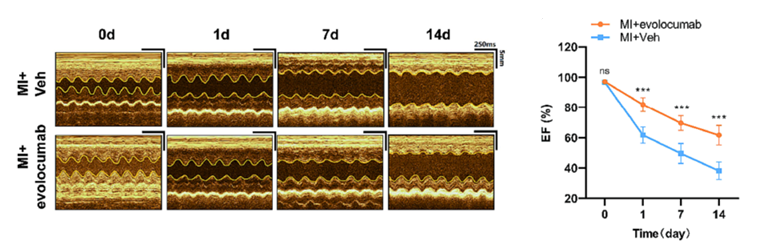
Evolocumab purchased from MedChemExpress. Usage Cited in: Biochem Pharmacol. 2024 Feb:220:115996. [Abstract]
Evolocumab (subcutaneously injected, 30 mg/kg, 30 min before operation) treatment improved cardiac function after myocardial infarction in myocardial infarction model rats.


Purity & Documentation
-
Data Sheet (298 KB)
-
SDS (251 KB)
- English - EN (251 KB)
- Français - FR (251 KB)
- Deutsch - DE (251 KB)
- Norwegian - NO (251 KB)
- Español - ES (251 KB)
- Swedish - SV (251 KB)
- Italian - IT (251 KB)
- Korean - KR (251 KB)
- Portuguese - PT (251 KB)
-
Inhibitory Antibodies User Guide (603 KB)
References
[1]. Fala L, et, al. Repatha (Evolocumab): Second PCSK9 Inhibitor Approved by the FDA for Patients with Familial Hypercholesterolemia. Am Health Drug Benefits. 2016 Mar;9(Spec Feature):136-9. [Content Brief]
[2]. Zhou Q, et al. Protective effect of evolocumab on Müller cells in the rat retina under hyperglycaemic and hypoxic conditions. J Diabetes Complications. 2023 Oct;37(10):108593. [Content Brief]
[3]. Safaeian L, et al. Evolocumab, a PCSK9 inhibitor, protects human endothelial cells against H2O2-induced oxidative stress. Arch Physiol Biochem. 2022 Dec;128(6):1681-1686. [Content Brief]

Calculators
Concentration (start) × Volume (start) = Concentration (final) × Volume (final)


Evolocumab Related Classifications
HY-P9930 Related Classifications
 Powered by Bioz