



Phorbol

Based on 1 Customer Validation
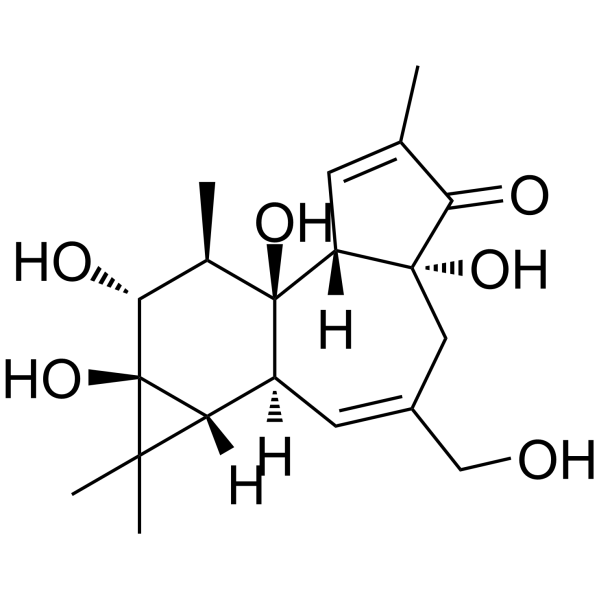
Phorbol is the flagship member of the tigliane diterpene family. Phorbol can be isolated from natural sources and through semisynthesis. Phorbol can form esters that have a wide array of biological properties, which includes the induction of angiogenesis in vitro and promoting tumor in vivo.
商品は「研究用試薬」です。人や動物の医療用・臨床診断用・食品用の製品ではありません。
研究用途以外に使用した場合、当社は一切の責任を負いかねます。
- 純度 : 98.17%
- CAS 番号: 17673-25-5
- 分子式: C20H28O6
- 分子量:364.43
-
保管条件:
4°C, stored under nitrogen
* In solvent : -80°C, 6 months; -20°C, 1 month (stored under nitrogen)

To place orders, for customer services and technical support, please contact: MedChemExpress USA
Tel: 609-228-6898 E-mail: [email protected] [email protected]


-
 生物活性
生物活性
-
化学情報
-
溶剤 & 溶解度
- プロトコル
- 純度とドキュメンテーション
- 参考文献
-
 Help & FAQs




生物活性
製品説明
Cellular Effect
|
Cell Line

|
Type | Value | Description | References |
|---|---|---|---|---|
| A549 | IC50 |
15.3 μM
Compound: 8
|
Cytotoxicity against human A549 cells after 72 hrs by CCK8 assay
Cytotoxicity against human A549 cells after 72 hrs by CCK8 assay
|
[PMID: 27623549] |
| Huh-7 | IC50 |
5.93 μM
Compound: 8
|
Cytotoxicity against human HuH7 cells after 72 hrs by CCK8 assay
Cytotoxicity against human HuH7 cells after 72 hrs by CCK8 assay
|
[PMID: 27623549] |
| K562 | IC50 |
0.1 μM
Compound: 8
|
Cytotoxicity against human K562 cells after 72 hrs by CCK8 assay
Cytotoxicity against human K562 cells after 72 hrs by CCK8 assay
|
[PMID: 27623549] |
| MT4 | EC50 |
>343 μM
Compound: 1
|
Antiviral activity against HIV1 3B infected in MT4 cells assessed as cell viability after 5 days by MTT assay
Antiviral activity against HIV1 3B infected in MT4 cells assessed as cell viability after 5 days by MTT assay
|
[PMID: 25970561] |
| MT4 | EC50 |
>343 μM
Compound: 1
|
Antiviral activity against HIV2 ROD infected in MT4 cells assessed as cell viability after 5 days by MTT assay
Antiviral activity against HIV2 ROD infected in MT4 cells assessed as cell viability after 5 days by MTT assay
|
[PMID: 25970561] |
| Vero | CC50 |
>343 μM
Compound: 3
|
Cytotoxicity against african green monkey Vero cells by MTS assay
Cytotoxicity against african green monkey Vero cells by MTS assay
|
[PMID: 23215460] |
| Vero | EC50 |
>274 μM
Compound: 3
|
Antiviral activity against Semliki forest virus infected in african green monkey Vero cells assessed as inhibition of virus-induced cytopathic effect incubated for 6 to 7 days by MTS assay
Antiviral activity against Semliki forest virus infected in african green monkey Vero cells assessed as inhibition of virus-induced cytopathic effect incubated for 6 to 7 days by MTS assay
|
[PMID: 23215460] |
| Vero | EC50 |
>274 μM
Compound: 3
|
Antiviral activity against Sindbis virus HRsp infected in african green monkey Vero cells assessed as inhibition of virus-induced cytopathic effect incubated for 6 to 7 days by MTS assay
Antiviral activity against Sindbis virus HRsp infected in african green monkey Vero cells assessed as inhibition of virus-induced cytopathic effect incubated for 6 to 7 days by MTS assay
|
[PMID: 23215460] |
| Vero | EC50 |
>343 μM
Compound: 1
|
Antiviral activity against chikungunya virus Indian ocean strain 899 infected in Vero cells assessed as virus-induced cytopathic effect after 6 to 7 days
Antiviral activity against chikungunya virus Indian ocean strain 899 infected in Vero cells assessed as virus-induced cytopathic effect after 6 to 7 days
|
[PMID: 25970561] |
| Vero | EC50 |
>343 μM
Compound: 3
|
Antiviral activity against Chikungunya virus 899 infected in african green monkey Vero cells assessed as inhibition of virus-induced cytopathic effect incubated for 6 to 7 days by MTS assay
Antiviral activity against Chikungunya virus 899 infected in african green monkey Vero cells assessed as inhibition of virus-induced cytopathic effect incubated for 6 to 7 days by MTS assay
|
[PMID: 23215460] |
体外実験
Phorbol can form phorbol myristate actate, which is a tumor promoter that markedly increases collagenase production and induces formation of capillary-like tubular structure networks, thereby inducing angiogenesis in bovine microvascular endothelial cells[2].
MedChemExpress (MCE) has not independently confirmed the accuracy of these methods. They are for reference only. Further protocols information, click here.
体内実験
MedChemExpress (MCE) has not independently confirmed the accuracy of these methods. They are for reference only.


化学情報
-
CAS 番号 17673-25-5
-
性状 Solid
-
分子量 364.43
-
分子式 C20H28O6
-
Color Off-white to light yellow
-
SMILES
O=C1C(C)=C[C@@]2([H])[C@]3(O)[C@@]([C@@](C4(C)C)([H])[C@@]4(O)[C@H](O)[C@H]3C)([H])C=C(CO)C[C@]12O
-
別名
4β-Phorbol
-
Structure Classification
-
Initial Source
-
輸送条件
Room temperature in continental US; may vary elsewhere.
-
保管条件
4°C, stored under nitrogen
* In solvent : -80°C, 6 months; -20°C, 1 month (stored under nitrogen)


溶剤 & 溶解度
体外:
DMSO : 50 mg/mL (137.20 mM; Need ultrasonic; Hygroscopic DMSO has a significant impact on the solubility of product, please use newly opened DMSO)
Please refer to the solubility information to select the appropriate solvent. Once prepared, please aliquot and store the solution to prevent product inactivation from repeated freeze-thaw cycles.
Storage method and period of stock solution: -80°C, 6 months; -20°C, 1 month (stored under nitrogen). When stored at -80°C, please use it within 6 months. When stored at -20°C, please use it within 1 month.
Please refer to the solubility information to select the appropriate solvent. Once prepared, please aliquot and store the solution to prevent product inactivation from repeated freeze-thaw cycles.
Storage method and period of stock solution: -80°C, 6 months; -20°C, 1 month (stored under nitrogen). When stored at -80°C, please use it within 6 months. When stored at -20°C, please use it within 1 month.
濃度 (開始) × 体積 (開始) = 濃度 (終了) × 体積 (終了)
体内:
Select the appropriate dissolution method based on your experimental animal and administration route.
- For the following dissolution methods, please ensure to first prepare a clear stock solution using an In Vitro approach and then sequentially add co-solvents:
- To ensure reliable experimental results, the clarified stock solution can be appropriately stored based on storage conditions. As for the working solution for In Vivo experiments, it is recommended to prepare freshly and use it on the same day.
- The percentages shown for the solvents indicate their volumetric ratio in the final prepared solution. If precipitation or phase separation occurs during preparation, heat and/or sonication can be used to aid dissolution.
Add each solvent one by one: 10% DMSO 40% PEG300 5% Tween-80 45% Saline
Solubility: ≥ 2.5 mg/mL (6.86 mM); Clear solution
This protocol yields a clear solution of ≥ 2.5 mg/mL (saturation unknown).
Taking 1 mL working solution as an example, add 100 μL DMSO stock solution (25.0 mg/mL) to 400 μL PEG300, and mix evenly; then add 50 μL Tween-80 and mix evenly; then add 450 μL Saline to adjust the volume to 1 mL.
Preparation of Saline: Dissolve 0.9 g sodium chloride in ddH₂O and dilute to 100 mL to obtain a clear Saline solution.
Add each solvent one by one: 10% DMSO 90% (20% SBE-β-CD in Saline)
Solubility: ≥ 2.5 mg/mL (6.86 mM); Clear solution
This protocol yields a clear solution of ≥ 2.5 mg/mL (saturation unknown).
Taking 1 mL working solution as an example, add 100 μL DMSO stock solution (25.0 mg/mL) to 900 μL 20% SBE-β-CD in Saline, and mix evenly.
Preparation of 20% SBE-β-CD in Saline (4°C, storage for one week): 2 g SBE-β-CD powder is dissolved in 10 mL Saline, completely dissolve until clear.
In Vivo Dissolution Calculator
Please enter the basic information of animal experiments:
-
-
-
-
Recommended: Prepare an additional quantity of animals to account for potential losses during experiments.
Please enter your animal formula composition:
-
%DMSO +
Recommended: Keep the proportion of DMSO in working solution below 2% if your animal is weak.
-
%+
-
+%Tween-80 + +
-
%Saline +
The co-solvents required include: DMSO, . All of co-solvents are available by MedChemExpress (MCE). , Tween 80. All of co-solvents are available by MedChemExpress (MCE).
Working solution concentration: 0.22 mg/mL
Method for preparing stock solution: mg drug dissolved in μL DMSO. Stock solution concentration: mg/mL. * In solvent : -80°C, 6 months; -20°C, 1 month (stored under nitrogen)
1. Take μL DMSO stock solution;
2. Add μL .
μL , mix evenly;
3. Then add μL Tween 80, mix evenly;
4. Then add μL
Please ensure that the stock solution in the first step is dissolved to a clear state, and add co-solvents in sequence. You can use ultrasonic heating (ultrasonic cleaner, recommended frequency 20-40 kHz), vortexing, etc. to assist dissolution.

プロトコル
-
Human pluripotent stem cell endothelial-cell differentiation
Human pluripotent stem cell endothelial differentiation is based on stepwise developmental patterning: early activation of WNT/GSK3β inhibition promotes mesodermal or vascular progenitor entry, followed by endothelial specification using VEGF-related signaling, BMP4, FGF2, Notch modulation, or cAMP depending on the published protocol. Endothelial differentiation is read out by acquisition of CD31, CD34, VE-cadherin/CD144, KDR/VEGFR2, vWF, Tie2, NOS3, acetylated LDL uptake, tube/network formation, barrier function, and in vivo vessel-forming capacity where tested.
-
Vascular/Branching Fractal Analysis
Vascular/branching fractal analysis quantifies the geometric complexity of vessel trees or vascular networks from segmented 2D images, commonly by converting vessels into binary and/or skeletonized maps and estimating fractal dimension using box-counting or related approaches. Fractal dimension is interpreted as an image-derived readout of vascular branching complexity, space filling, or density, and has been applied to retinal photographs, fluorescein angiography, OCT angiography, capillary perfusion maps, and in vitro Matrigel angiogenesis networks. The assay readout is generated from vessel-positive pixels after image preprocessing, vessel segmentation, binarization, and optional skeletonization; reported outputs include fractal dimension, vessel density, branchpoint density, endpoint density, vessel length density, tortuosity, and generation-based branching metrics when VESGEN-style analysis is used. The biological interpretation is limited to quantitative vascular patterning and s
-
Endothelial Tube Formation Assay
Endothelial tube formation assay evaluates the ability of endothelial cells to attach, migrate, align, and organize into capillary-like networks when cultured on gelled basement membrane extract or Matrigel; the readout is the morphology and quantity of tube-like networks, which reflects an in vitro endothelial morphogenesis step related to angiogenesis. Basement membrane extract/Matrigel provides laminin-rich extracellular matrix cues that support endothelial differentiation into capillary-like structures, but it can contain biologically active growth factors, so growth-factor-reduced matrix is preferred when testing defined angiogenic stimulators or inhibitors.
-
Endothelial Cell Migration/Angiogenic Sprouting Assay
Endothelial cell migration and angiogenic sprouting assays are in vitro (and partially ex vivo-adapted) functional models that quantify the ability of endothelial cells to undergo coordinated migration, extracellular matrix invasion, and multicellular organization into capillary-like sprouts in response to pro-angiogenic stimuli such as VEGF, bFGF, or conditioned microenvironments. These assays are used to model early angiogenic events including tip-cell formation, directional migration, and lumen-like sprout extension, which collectively reflect angiogenic activation and vascular morphogenesis processes observed in vivo.


純度とドキュメンテーション
-
データシート (280 KB)
-
SDS (393 KB)
- English - EN (393 KB)
- Français - FR (393 KB)
- Deutsch - DE (393 KB)
- Norwegian - NO (393 KB)
- Español - ES (393 KB)
- Swedish - SV (393 KB)
- Italian - IT (393 KB)
- Korean - KR (393 KB)
- Portuguese - PT (393 KB)
-
取扱説明書 (2659 KB)
参考文献
[1]. Kawamura, S., et al., (2016). Nineteen-step total synthesis of (+)-phorbol. Nature, 532(7597), 90–93. [Content Brief]
[2]. Montesano, R., & Orci, L. (1985). Tumor-promoting phorbol esters induce angiogenesis in vitro. Cell, 42(2), 469–477. [Content Brief]
[3]. Blumberg P. M. (1980). In vitro studies on the mode of action of the phorbol esters, potent tumor promoters: part 1. Critical reviews in toxicology, 8(2), 153–197. [Content Brief]


Complete Stock Solution Preparation Table
Please refer to the solubility information to select the appropriate solvent. Once prepared, please aliquot and store the solution to prevent product inactivation from repeated freeze-thaw cycles.
Storage method and period of stock solution: -80°C, 6 months; -20°C, 1 month (stored under nitrogen). When stored at -80°C, please use it within 6 months. When stored at -20°C, please use it within 1 month.
| Optional Solvent | Concentration Solvent Mass | 1 mg | 5 mg | 10 mg | 25 mg |
|---|---|---|---|---|---|
| DMSO | 1 mM | 2.7440 mL | 13.7201 mL | 27.4401 mL | 68.6003 mL |
| 5 mM | 0.5488 mL | 2.7440 mL | 5.4880 mL | 13.7201 mL | |
| 10 mM | 0.2744 mL | 1.3720 mL | 2.7440 mL | 6.8600 mL | |
| 15 mM | 0.1829 mL | 0.9147 mL | 1.8293 mL | 4.5734 mL | |
| 20 mM | 0.1372 mL | 0.6860 mL | 1.3720 mL | 3.4300 mL | |
| 25 mM | 0.1098 mL | 0.5488 mL | 1.0976 mL | 2.7440 mL | |
| 30 mM | 0.0915 mL | 0.4573 mL | 0.9147 mL | 2.2867 mL | |
| 40 mM | 0.0686 mL | 0.3430 mL | 0.6860 mL | 1.7150 mL | |
| 50 mM | 0.0549 mL | 0.2744 mL | 0.5488 mL | 1.3720 mL | |
| 60 mM | 0.0457 mL | 0.2287 mL | 0.4573 mL | 1.1433 mL | |
| 80 mM | 0.0343 mL | 0.1715 mL | 0.3430 mL | 0.8575 mL | |
| 100 mM | 0.0274 mL | 0.1372 mL | 0.2744 mL | 0.6860 mL |


Phorbol 関連分類
HY-N2147 関連分類
 Powered by Bioz