



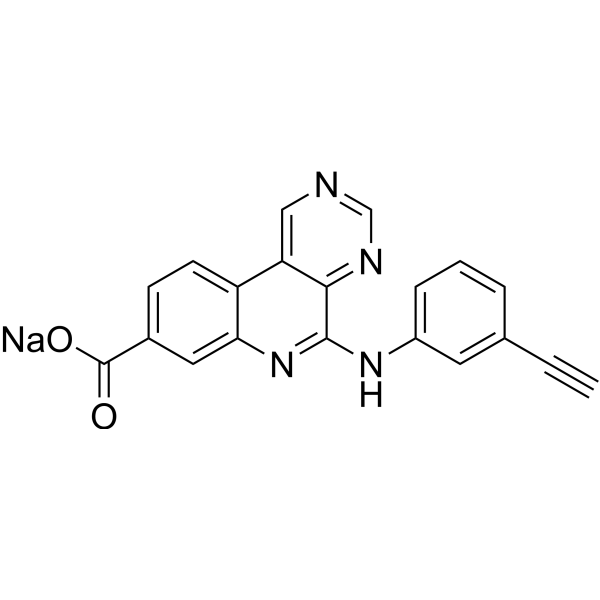
CX-5011

Based on 1 Customer Validation
CX-5011 is an ATP-competitive, selective CK2 inhibitor with an IC50 of 0.97 nM for nCK2. CX-5011 reduces Bin1, CKB, Tubb3, and Pxn levels. CX-5011 impairs myogenic differentiation, myotube formation, muscle markers, myofiber growth, and zebrafish muscle development/locomotion. CX-5011 can be used for breast cancer research.
商品は「研究用試薬」です。人や動物の医療用・臨床診断用・食品用の製品ではありません。
研究用途以外に使用した場合、当社は一切の責任を負いかねます。
- 純度 : 99.48%
- CAS 番号: 1333382-30-1
- 分子式: C20H11N4NaO2
- 分子量:362.32
-
保管条件:Powder -20°C, 3 years , 4°C, 2 years ; In solvent -80°C, 6 months , -20°C, 1 month

To place orders, for customer services and technical support, please contact: MedChemExpress USA
Tel: 609-228-6898 E-mail: [email protected] [email protected]


-
 生物活性
生物活性
-
化学情報
-
溶剤 & 溶解度
- プロトコル
- 純度とドキュメンテーション
- 参考文献
-
 Help & FAQs




生物活性
製品説明
IC50 & Target
[2]|
CK2 0.97 nM (IC50) |
Cellular Effect
|
Cell Line

|
Type | Value | Description | References |
|---|---|---|---|---|
| HCT-116 | IC50 |
5.6 μM
|
Antiproliferative activity against human HCT-116 cells assessed as viability reduction after 4 days incubation with CX-5011 by Alamar Blue fluorescence assay.
Antiproliferative activity against human HCT-116 cells assessed as viability reduction after 4 days incubation with CX-5011 by Alamar Blue fluorescence assay.
|
21870818 |
| MIA PaCa-2 | IC50 |
1.9 μM
|
Antiproliferative activity against human MIAPaCa-2 cells assessed as viability reduction after 4 days incubation with CX-5011 by Alamar Blue fluorescence assay.
Antiproliferative activity against human MIAPaCa-2 cells assessed as viability reduction after 4 days incubation with CX-5011 by Alamar Blue fluorescence assay.
|
21870818 |
| PANC-1 | IC50 |
9.2 μM
|
Antiproliferative activity against human PanC1 cells assessed as viability reduction after 4 days incubation with CX-5011 by Alamar Blue fluorescence assay.
Antiproliferative activity against human PanC1 cells assessed as viability reduction after 4 days incubation with CX-5011 by Alamar Blue fluorescence assay.
|
21870818 |
| BXPC-3 | IC50 |
5.9 μM
|
Antiproliferative activity against human BxPC3 cells assessed as viability reduction after 4 days incubation with CX-5011 by Alamar Blue fluorescence assay.
Antiproliferative activity against human BxPC3 cells assessed as viability reduction after 4 days incubation with CX-5011 by Alamar Blue fluorescence assay.
|
21870818 |
| PC-3 | IC50 |
2.9 μM
|
Antiproliferative activity against human PC3 cells assessed as viability reduction after 4 days incubation with CX-5011 by Alamar Blue fluorescence assay.
Antiproliferative activity against human PC3 cells assessed as viability reduction after 4 days incubation with CX-5011 by Alamar Blue fluorescence assay.
|
21870818 |
| Jurkat | IC50 |
2.3 μM
|
Antiproliferative activity against human Jurkat cells assessed as viability reduction after 4 days incubation with CX-5011 by Alamar Blue fluorescence assay.
Antiproliferative activity against human Jurkat cells assessed as viability reduction after 4 days incubation with CX-5011 by Alamar Blue fluorescence assay.
|
21870818 |
| K562 | IC50 |
1.6 μM
|
Antiproliferative activity against human K-562 cells assessed as viability reduction after 4 days incubation with CX-5011 by Alamar Blue fluorescence assay.
Antiproliferative activity against human K-562 cells assessed as viability reduction after 4 days incubation with CX-5011 by Alamar Blue fluorescence assay.
|
21870818 |
| NCI-H1299 | IC50 |
1.6 μM
|
Antiproliferative activity against human H1299 cells assessed as viability reduction after 4 days incubation with CX-5011 by Alamar Blue fluorescence assay.
Antiproliferative activity against human H1299 cells assessed as viability reduction after 4 days incubation with CX-5011 by Alamar Blue fluorescence assay.
|
21870818 |
| MDA-MB-453 | IC50 |
3.1 μM
|
Antiproliferative activity against human MDA-MB-453 cells assessed as viability reduction after 4 days incubation with CX-5011 by Alamar Blue fluorescence assay.
Antiproliferative activity against human MDA-MB-453 cells assessed as viability reduction after 4 days incubation with CX-5011 by Alamar Blue fluorescence assay.
|
21870818 |
| MDA-MB-231 | IC50 |
9.8 μM
|
Antiproliferative activity against human MDA-MB-231 cells assessed as viability reduction after 4 days incubation with CX-5011 by Alamar Blue fluorescence assay.
Antiproliferative activity against human MDA-MB-231 cells assessed as viability reduction after 4 days incubation with CX-5011 by Alamar Blue fluorescence assay.
|
21870818 |
体外実験
CX-5011 is a low-nanomolar ATP-competitive CK2 inhibitor that inhibits nCK2, recombinant CK2α, and the V66A/I174A CK2α mutant, with IC50 values of 0.97-2.50 nM[2].
CX-5011 (0.5 μM) is highly selective for CK2, with Gini coefficients of 0.735 (102 kinases) and 0.794 (235 kinases), respectively, and 11 kinases are inhibited by more than 50% at 0.5 μM[2].
CX-5011 (100 nM) significantly reduces CK2-dependent GST-HDGF phosphorylation in C2C12 WT myoblast lysates, while leaving a detectable residual phosphorylation band[3].
CX-5011 (3 μM; 24-48 h) decreases Bin1, CKB, Tubb3, and Pxn levels in C2C12 WT myoblasts, whereas CK2β and DecR1 remain unchanged[3].
CX-5011 impairs myogenic differentiation and cell fusion in primary mouse muscle precursor cells[4].
CX-5011 (2 μM; 2-6 d after transfection; WT proliferating cells 4 d), despite inhibiting CK2 activity, does not affect proliferation or MyoD expression in CK2β-silenced C2C12 myoblasts[4].
CX-5011 inhibits late muscle-specific gene expression in differentiating CK2α′−/− C2C12 myoblasts but does not affect MyoD[4].
CX-5011 is a potent and selective inhibitor of CK2 in cell-free kinase assays[5].
CX-5011 binds to CK2α and CK2α′ in cells with IC50 values of 350 nM and 66 nM, respectively[6].
CX-5011 (4 days) reduces the viability of the tested cancer cell lines after 4 days, with IC50 values ranging from 1.6 to 9.8 μM, among which K-562 and H1299 are the most sensitive (1.6 μM)[2].
CX-5011 (1-10 μM; 48 h) does not significantly reduce MDA-MB-231 cell viability[6].
CX-5011 (1 μM; 5 days) does not reduce the viability of AMO-1 or L363 parental multiple myeloma cells[6].
CX-5011 produces antiproliferative effects across a panel of 16 cancer cell lines and induces apoptosis in BXPC3 cells and G1 phase accumulation in MDA-MB-231 cells[5].
MedChemExpress (MCE) has not independently confirmed the accuracy of these methods. They are for reference only.
-
Cell Line:MDA-MB-231 cells
-
Concentration:1, 2, 5, and 10 µM
-
Incubation Time:48 h
-
Result:Compounds 7, CX-5011, and CX-4945 similarly did not exhibit cytotoxicity.
-
Cell Line:JJN3, AMO-1 (parental and pomalidomide-resistant), and L363 (parental, carfilzomib-resistant, and bortezomib-resistant) multiple myeloma cell lines
-
Concentration:1 μM
-
Incubation Time:5 days
-
Result:The viability of AMO-1 and L363 parental lines was not reduced by CX-5011.
JJN3 cells were not responsive to any compound.
体内実験
MedChemExpress (MCE) has not independently confirmed the accuracy of these methods. They are for reference only.
-
Animal Model:CD1 (male, 3 months of age)[4]
-
Dosage:90 µg per injection in 50 µl saline
-
Administration:intramuscular; starting at 3 d after injury; repeated every 3 d
-
Result:Reduced CK2 activity in regenerating muscles by approximately 70% up to 14 d without affecting expression of CK2 subunits.
At 7 d postinjury, expression of late muscle-specific markers was reduced.
MyoD and myogenin remained unchanged in CX-5011-exposed regenerating mouse muscle at 7 d.
Myofiber growth was impaired, with reduced fiber cross-sectional area in CX-5011-exposed regenerating muscles compared with vehicle-exposed contralateral muscles.
CX-5011-exposed regenerating fibers showed decreased myonuclei content at 14 d.
Inhibited regenerating fiber-type switching, with decreased mature regenerating fibers and persistence of embryonic myosin-heavy-chain-positive immature fibers at both 7 and 14 d postinjury.
At 4 d of regeneration, CX-5011 did not affect general cell proliferation (Ki67-positive nuclei) but reduced the percentage of Ki67-positive myonuclei within the basal lamina and shifted proliferating myonuclei distribution toward fibers with fewer than 3 nuclei.
Total (Pax7-positive) and activated (MyoD-positive) satellite cell numbers were not affected by CX-5011.


化学情報
-
CAS 番号 1333382-30-1
-
性状 Solid
-
分子量 362.32
-
分子式 C20H11N4NaO2
-
Color yellow
-
SMILES
O=C(C1=CC=C2C3=CN=CN=C3C(NC4=CC=CC(C#C)=C4)=NC2=C1)O[Na]
-
輸送条件
Room temperature in continental US; may vary elsewhere.
-
保管条件
Powder -20°C 3 years 4°C 2 years In solvent -80°C 6 months -20°C 1 month


溶剤 & 溶解度
体外:
DMSO : 3.64 mg/mL (10.05 mM; ultrasonic and warming and heat to 60°C; Hygroscopic DMSO has a significant impact on the solubility of product, please use newly opened DMSO)
Please refer to the solubility information to select the appropriate solvent. Once prepared, please aliquot and store the solution to prevent product inactivation from repeated freeze-thaw cycles.
Storage method and period of stock solution: -80°C, 6 months; -20°C, 1 month. When stored at -80°C, please use it within 6 months. When stored at -20°C, please use it within 1 month.
Please refer to the solubility information to select the appropriate solvent. Once prepared, please aliquot and store the solution to prevent product inactivation from repeated freeze-thaw cycles.
Storage method and period of stock solution: -80°C, 6 months; -20°C, 1 month. When stored at -80°C, please use it within 6 months. When stored at -20°C, please use it within 1 month.
濃度 (開始) × 体積 (開始) = 濃度 (終了) × 体積 (終了)
体内:
Select the appropriate dissolution method based on your experimental animal and administration route.
- For the following dissolution methods, please ensure to first prepare a clear stock solution using an In Vitro approach and then sequentially add co-solvents:
- To ensure reliable experimental results, the clarified stock solution can be appropriately stored based on storage conditions. As for the working solution for In Vivo experiments, it is recommended to prepare freshly and use it on the same day.
- The percentages shown for the solvents indicate their volumetric ratio in the final prepared solution. If precipitation or phase separation occurs during preparation, heat and/or sonication can be used to aid dissolution.
Add each solvent one by one: 10% DMSO 40% PEG300 5% Tween-80 45% Saline
Solubility: ≥ 0.36 mg/mL (0.99 mM); Clear solution
This protocol yields a clear solution of ≥ 0.36 mg/mL (saturation unknown).
Taking 1 mL working solution as an example, add 100 μL DMSO stock solution (3.6 mg/mL) to 400 μL PEG300, and mix evenly; then add 50 μL Tween-80 and mix evenly; then add 450 μL Saline to adjust the volume to 1 mL.
Preparation of Saline: Dissolve 0.9 g sodium chloride in ddH₂O and dilute to 100 mL to obtain a clear Saline solution.
Add each solvent one by one: 10% DMSO 90% (20% SBE-β-CD in Saline)
Solubility: ≥ 0.36 mg/mL (0.99 mM); Clear solution
This protocol yields a clear solution of ≥ 0.36 mg/mL (saturation unknown).
Taking 1 mL working solution as an example, add 100 μL DMSO stock solution (3.6 mg/mL) to 900 μL 20% SBE-β-CD in Saline, and mix evenly.
Preparation of 20% SBE-β-CD in Saline (4°C, storage for one week): 2 g SBE-β-CD powder is dissolved in 10 mL Saline, completely dissolve until clear.
In Vivo Dissolution Calculator
Please enter the basic information of animal experiments:
-
-
-
-
Recommended: Prepare an additional quantity of animals to account for potential losses during experiments.
Please enter your animal formula composition:
-
%DMSO +
Recommended: Keep the proportion of DMSO in working solution below 2% if your animal is weak.
-
%+
-
+%Tween-80 + +
-
%Saline +
The co-solvents required include: DMSO, . All of co-solvents are available by MedChemExpress (MCE). , Tween 80. All of co-solvents are available by MedChemExpress (MCE).
Working solution concentration: 0.22 mg/mL
Method for preparing stock solution: mg drug dissolved in μL DMSO. Stock solution concentration: mg/mL.
1. Take μL DMSO stock solution;
2. Add μL .
μL , mix evenly;
3. Then add μL Tween 80, mix evenly;
4. Then add μL
Please ensure that the stock solution in the first step is dissolved to a clear state, and add co-solvents in sequence. You can use ultrasonic heating (ultrasonic cleaner, recommended frequency 20-40 kHz), vortexing, etc. to assist dissolution.


純度とドキュメンテーション
-
データシート (288 KB)
-
SDS (251 KB)
- English - EN (251 KB)
- Français - FR (251 KB)
- Deutsch - DE (251 KB)
- Norwegian - NO (251 KB)
- Español - ES (251 KB)
- Swedish - SV (251 KB)
- Italian - IT (251 KB)
- Korean - KR (251 KB)
- Portuguese - PT (251 KB)
-
取扱説明書 (2659 KB)
参考文献
[2]. Battistutta R, et al. Unprecedented selectivity and structural determinants of a new class of protein kinase CK2 inhibitors in clinical trials for the treatment of cancer. Biochemistry. 2011 Oct 04;50(39):8478-88. [Content Brief]
[6]. Davis-Gilbert ZW, et al. Discovery of a Potent and Selective Naphthyridine-Based Chemical Probe for Casein Kinase 2. ACS medicinal chemistry letters. 2023 Apr 13;14(4):432-441. [Content Brief]


Complete Stock Solution Preparation Table
Please refer to the solubility information to select the appropriate solvent. Once prepared, please aliquot and store the solution to prevent product inactivation from repeated freeze-thaw cycles.
Storage method and period of stock solution: -80°C, 6 months; -20°C, 1 month. When stored at -80°C, please use it within 6 months. When stored at -20°C, please use it within 1 month.
| Optional Solvent | Concentration Solvent Mass | 1 mg | 5 mg | 10 mg | 25 mg |
|---|---|---|---|---|---|
| DMSO | 1 mM | 2.7600 mL | 13.8000 mL | 27.5999 mL | 68.9998 mL |
| 5 mM | 0.5520 mL | 2.7600 mL | 5.5200 mL | 13.8000 mL | |
| 10 mM | 0.2760 mL | 1.3800 mL | 2.7600 mL | 6.9000 mL |


CX-5011 関連分類
HY-50733A 関連分類
 Powered by Bioz