



ddTTP trisodium solution (100 mM)

Based on 1 Customer Validation
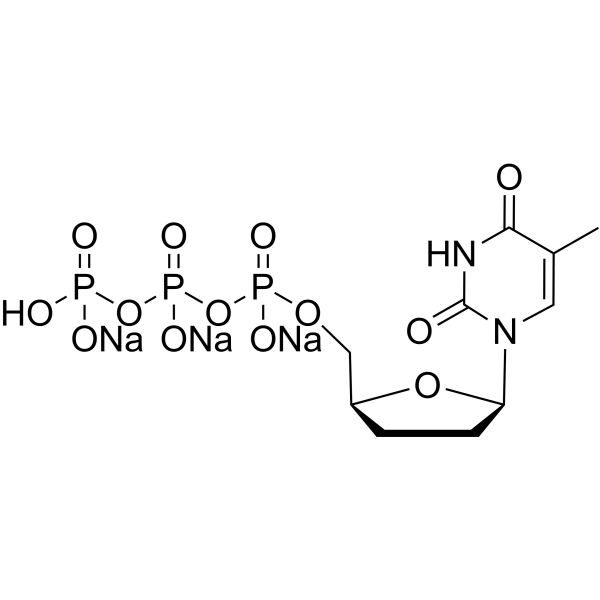
ddTTP trisodium solution (100 mM) is a DNA polymerase γ inhibitor, with Ki values of 0.05 μM and 0.4 μM against bovine testicular DNA polymerase γ. ddTTP trisodium solution (100 mM) can be incorporated into DNA to cause termination of the extended DNA strand. ddTTP trisodium solution (100 mM) can be used in the research of HIV infection.
商品は「研究用試薬」です。人や動物の医療用・臨床診断用・食品用の製品ではありません。
研究用途以外に使用した場合、当社は一切の責任を負いかねます。
- 純度 : 99.91%
- 分子式: C10H14N2Na3O13P3
- 分子量:532.11
-
保管条件:
Solution, -20°C, 2 years

To place orders, for customer services and technical support, please contact: MedChemExpress USA
Tel: 609-228-6898 E-mail: [email protected] [email protected]


-
 生物活性
生物活性
-
化学情報
- プロトコル
- 純度とドキュメンテーション
- 参考文献
-
 Help & FAQs


DNA/RNA Synthesis アイソフォーム固有の製品をすべて表示
More

生物活性
製品説明
体外実験
ddTTP trisodium solution (100 mM) (0-100 μM; 30 min) potently inhibits bovine testicular DNA polymerase γ in a competitive manner relative to dTTP, with a Ki value of 0.05 μM when poly (rA)-oligo (dT) serves as the template-primer[1].
trisodium solution (100 mM) ddTTP (0-100 μM; 30 min) potently inhibits bovine testicular DNA polymerase γ in a competitive manner relative to dTTP, with a Ki value of 0.4 μM when activated calf thymus DNA is used as the template-primer[1].
trisodium solution (100 mM) ddTTP (2.5-10 μM; 60 min) can be incorporated into DNA by bovine testicular DNA polymerase γ and induce chain termination, and this effect is independent of 3'-exonuclease proofreading activity (verified by treatment with 1 mM 5'-GMP)[1].
MedChemExpress (MCE) has not independently confirmed the accuracy of these methods. They are for reference only.


化学情報
-
性状 Liquid
-
分子量 532.11
-
分子式 C10H14N2Na3O13P3
-
Color Colorless to light yellow
-
SMILES
O=[P](O[P](O[P](O)(O[Na])=O)(O[Na])=O)(O[Na])OC[C@@H](O1)CC[C@@H]1N(C(NC2=O)=O)C=C2C
-
輸送条件
Room temperature in continental US; may vary elsewhere.
-
保管条件
Solution, -20°C, 2 years


純度とドキュメンテーション
-
データシート (271 KB)
-
SDS (251 KB)
- English - EN (251 KB)
- Français - FR (251 KB)
- Deutsch - DE (251 KB)
- Norwegian - NO (251 KB)
- Español - ES (251 KB)
- Swedish - SV (251 KB)
- Italian - IT (251 KB)
- Korean - KR (251 KB)
- Portuguese - PT (251 KB)
-
取扱説明書 (2659 KB)
参考文献

Calculators
濃度 (開始) × 体積 (開始) = 濃度 (終了) × 体積 (終了)


ddTTP trisodium solution (100 mM) 関連分類
HY-137694B 関連分類
 Powered by Bioz