



BPH-1086
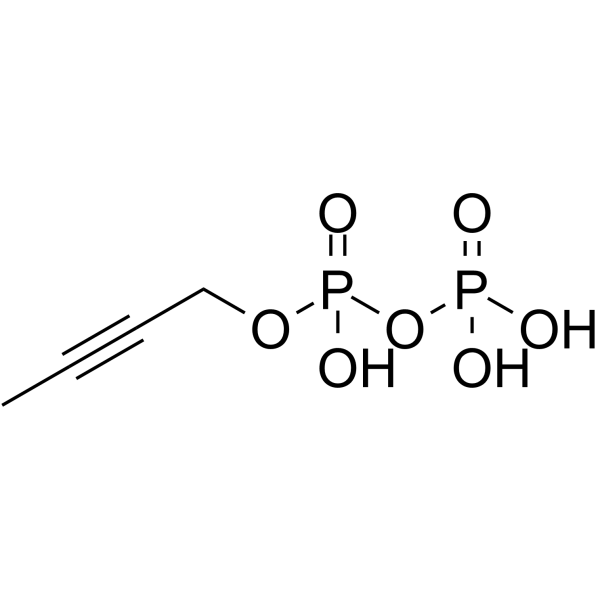
BPH-1086 (compound 10) is an IspH inhibitor, IspH domain fused with ribosomal protein S1 (RPS1) can bind to mRNA or form part of the bacterial ribosome.
연구목적의 판매만을 진행합니다. 환자를 대상으로 한 판매는 하지 않습니다.
- CAS No.: 1226901-43-4
- 화학식: C4H8O7P2
- 분자량:230.05
-
보관:
Please store the product under the recommended conditions in the Certificate of Analysis.

To place orders, for customer services and technical support, please contact: MedChemExpress USA
Tel: 609-228-6898 E-mail: [email protected] [email protected]


-
 Biological Activity
-
Chemical Information
- Protocol
- 순도&문서
- References
-
 Help & FAQs




Biological Activity
제품 설명
IC50 & Target
Target: IspH[1]
In Vitro
IspH (LytB) is the last enzyme in the nonmevalonate pathway, IspH domains can be fused to either the ribosomal protein S1 (RPS1), IspH–RPS1 binds to mRNA or forms part of the bacterial ribosome[1][2].
IspH–RPS1 proteins are present in anaerobes found in the human gut and some, such as Clostridium botulinum, C. tetani and Fusobacterium nucleatum, are pathogens[2].
IspH inhibitor will therefore kill bacteria directly, as with other antibiotics, but will also kill persistent bacteria by microptosis[3].
MedChemExpress (MCE) has not independently confirmed the accuracy of these methods. They are for reference only.


Chemical Information
-
CAS No. 1226901-43-4
-
분자량 230.05
-
화학식 C4H8O7P2
-
SMILES
O=P(O)(OP(O)(O)=O)OCC#CC
-
선적
Room temperature in continental US; may vary elsewhere.
-
보관
Please store the product under the recommended conditions in the Certificate of Analysis.


순도&문서
-
Data Sheet (268 KB)
-
SDS (252 KB)
- Français - FR (252 KB)
- Deutsch - DE (252 KB)
- Norwegian - NO (252 KB)
- Español - ES (252 KB)
- Swedish - SV (252 KB)
- Italian - IT (252 KB)
- Korean - KR (252 KB)
- Portuguese - PT (252 KB)
-
Handling Instructions (2659 KB)
References
[1]. Wang W, et al. Bioorganometallic mechanism of action, and inhibition, of IspH. Proc Natl Acad Sci U S A. 2010 Mar 9;107(10):4522-7. [Content Brief]
[2]. Rao G, et al. IspH-RPS1 and IspH-UbiA: "Rosetta Stone" Proteins. Chem Sci. 2015 Dec 1;6(12):6813-6822. [Content Brief]
[3]. Singh KS, et al. IspH inhibitors kill Gram-negative bacteria and mobilize immune clearance. Nature. 2021 Jan. 589(7843):597-602. [Content Brief]

Calculators
Concentration (start) × Volume (start) = Concentration (final) × Volume (final)


BPH-1086 Related Classifications
HY-147304 Related Classifications
 Powered by Bioz