11 Results for "

learning dysfunction

" in MedChemExpress (MCE) Product Catalog:
Products (11)

11 Results for "learning dysfunction" in MCE Product Catalog:

2
2 Cited Publications
Cat. No.: HY-13225B
Purity:  ≥95.0%
Synonyms: RJR-2403 hemioxalate; (E)-Metanicotine hemioxalate
Target:  

nAChR

연구분야:  

Neurological Disease

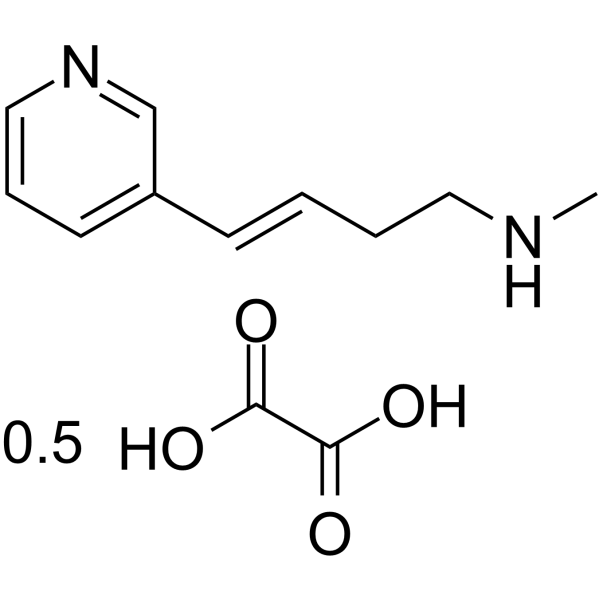
Rivanicline (RJR-2403) hemioxalate is a neuronal nicotinic receptor agonist. Rivanicline hemioxalate is highly selective for the rat brain cortex nAChRs (Ki = 26 nM, EC50 of 732 nM) and α4β2 subtype (Ki = 26 nM, EC50 = 16 μM). Rivanicline hemioxalate can significantly restore the learning impairment and cognitive dysfunction. Rivanicline hemioxalate can be used for the study of neurodegenerative diseases (such as schizophrenia or Alzheimer's disease) .
loading...
    loading...
Cat. No.: HY-B0978
CAS No.: 134-62-3
Synonyms: DEET; N,N-Diethyl-m-toluamide
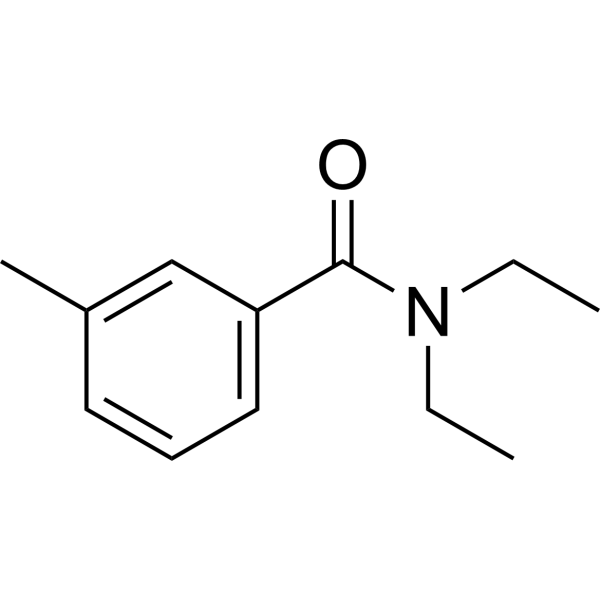
Diethyltoluamide (DEET) is the most common active ingredient in insect repellents. It is intended to provide protection against mosquitoes, ticks, fleas, chiggers, leeches, and many other biting insects. Diethyltoluamide is toxic to hepatocytes and can lead to many physiological, pharmacological, and behavioral abnormalities, particularly motor deficits and learning and memory dysfunction .
loading...
    loading...
Cat. No.: HY-B0978R
CAS No.: 134-62-3
Synonyms: DEET (Standard); N,N-Diethyl-m-toluamide (Standard)
Diethyltoluamide (Standard) is the analytical standard of Diethyltoluamide. This product is intended for research and analytical applications. Diethyltoluamide (DEET) is the most common active ingredient in insect repellents. It is intended to provide protection against mosquitoes, ticks, fleas, chiggers, leeches, and many other biting insects. Diethyltoluamide is toxic to hepatocytes and can lead to many physiological, pharmacological, and behavioral abnormal ities, particularly motor deficits and learning and memory dysfunction .
loading...
    loading...
Cat. No.: HY-W987949
CAS No.: 119737-52-9
Target:  

Others

연구분야:  

Neurological Disease

Z-4105 is an orally active nootropic agent. Z-4105 reverses the amnesic effects of electroconvulsive shock (ECS) and methylazoxymethanol acetate (MAM), and improves learning and memory functions. Z-4105 enhances the activity of the brain cholinergic system without affecting other neurotransmitter systems. Z-4105 significantly alleviates neuropathic pain in rats. Z-4105 can be used in the research of neuropathic pain and brain dysfunction .
loading...
    loading...
Cat. No.: HY-13225A
CAS No.: 15585-43-0
Synonyms: RJR-2403; (E)-Metanicotine
Target:  

nAChR

연구분야:  

Neurological Disease

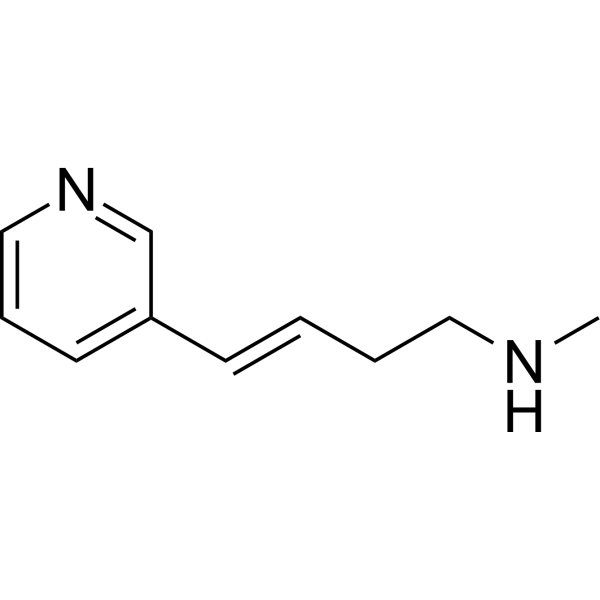
Rivanicline (RJR-2403) is a neuronal nicotinic receptor agonist. Rivanicline is highly selective for the rat brain cortex nAChRs (Ki = 26 nM, EC50 of 732 nM) and α4β2 subtype (Ki = 26 nM, EC50 = 16 μM). Rivanicline can significantly restore the learning impairment and cognitive dysfunction. Rivanicline can be used for the study of neurodegenerative diseases (such as schizophrenia or Alzheimer's disease) .
loading...
    loading...
Cat. No.: HY-13225
CAS No.: 220662-95-3
Synonyms: RJR-2403 oxalate; (E)-Metanicotine oxalate
Target:  

nAChR

연구분야:  

Neurological Disease

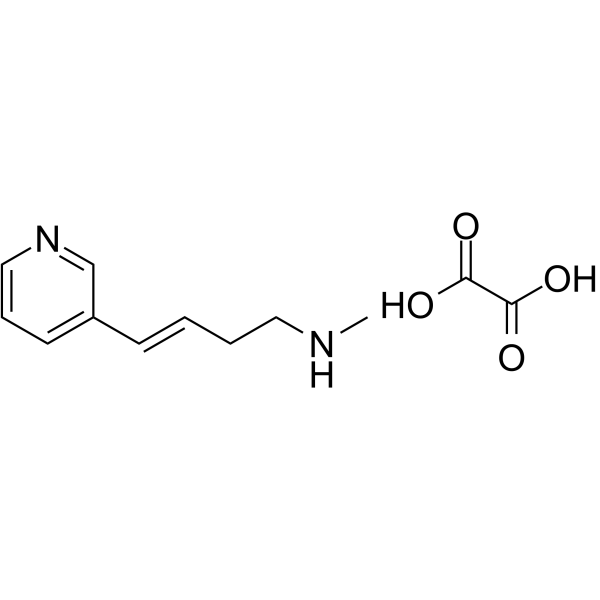
Rivanicline (RJR-2403) oxalate is a neuronal nicotinic receptor agonist. Rivanicline oxalate is highly selective for the rat brain cortex nAChRs (Ki = 26 nM, EC50 of 732 nM) and α4β2 subtype (Ki = 26 nM, EC50 = 16 μM). Rivanicline oxalate can significantly restore the learning impairment and cognitive dysfunction. Rivanicline oxalate can be used for the study of neurodegenerative diseases (such as schizophrenia or Alzheimer's disease) .
loading...
    loading...
Cat. No.: HY-13225H
Synonyms: RJR-2403 hydrochloride; Metanicotine hydrochloride
Target:  

nAChR

연구분야:  

Neurological Disease

Rivanicline (RJR-2403) hydrochloride is a neuronal nicotinic receptor agonist. Rivanicline hydrochloride is highly selective for the rat brain cortex nAChRs (Ki = 26 nM, EC50 of 732 nM) and α4β2 subtype (Ki = 26 nM, EC50 = 16 μM). Rivanicline hydrochloride can significantly restore the learning impairment and cognitive dysfunction. Rivanicline hydrochloride can be used for the study of neurodegenerative diseases (such as schizophrenia or Alzheimer's disease) .
loading...
    loading...
Cat. No.: HY-13225D
CAS No.: 183288-99-5
Synonyms: RJR-2403 fumarate; (E)-Metanicotine fumarate
Target:  

nAChR

연구분야:  

Neurological Disease

Rivanicline (RJR-2403) fumarate is a neuronal nicotinic receptor agonist. Rivanicline fumarate is highly selective for the rat brain cortex nAChRs (Ki = 26 nM, EC50 of 732 nM) and α4β2 subtype (Ki = 26 nM, EC50 = 16 μM). Rivanicline fumarate can significantly restore the learning impairment and cognitive dysfunction. Rivanicline fumarate can be used for the study of neurodegenerative diseases (such as schizophrenia or Alzheimer's disease) .
loading...
    loading...
Cat. No.: HY-N20637
CAS No.: 176182-04-0
Polygalasaponin XXXII is an orally active cognitive enhancer. Polygalasaponin XXXII promotes the phosphorylation of ERK, CREB, Synapsin I and TrkB. Polygalasaponin XXXII enhances basal synaptic transmission. Polygalasaponin XXXII attenuates Scopolamine (HY-N0296)-induced cognitive impairment and improves hippocampus-dependent learning and memory abilities. Polygalasaponin XXXII can be used in research related to cognitive dysfunction .
loading...
    loading...
Cat. No.: HY-P12411
CAS No.: 74105-03-6
Target:  

Others

연구분야:  

Others

Asn-Trp is an orally active antioxidant dipeptide. Asn-Trp inhibits oxidative stress, lipid peroxidation, and advanced glycation end product formation. Asn-Trp improves spatial memory and learning dysfunction. Asn-Trp can be obtained by computer-aided simulated hydrolysis of the yam tuber storage protein Dioscorin by pepsin (Pepsin) (HY-P1635), and can be detected in the pepsin hydrolysate by mass spectrometry after reversed-phase HPLC fractionation .
loading...
    loading...
Cat. No.: HY-P12411A
Target:  

Others

연구분야:  

Others

Asn-Trp TFA is an orally active antioxidant dipeptide. Asn-Trp TFA inhibits oxidative stress, lipid peroxidation, and advanced glycation end product formation. Asn-Trp TFA improves spatial memory and learning dysfunction. Asn-Trp TFA can be obtained by computer-aided simulated hydrolysis of the yam tuber storage protein Dioscorin by pepsin (Pepsin) (HY-P1635), and can be detected in the pepsin hydrolysate by mass spectrometry after reversed-phase HPLC fractionation .
loading...
    loading...
  • 1

