



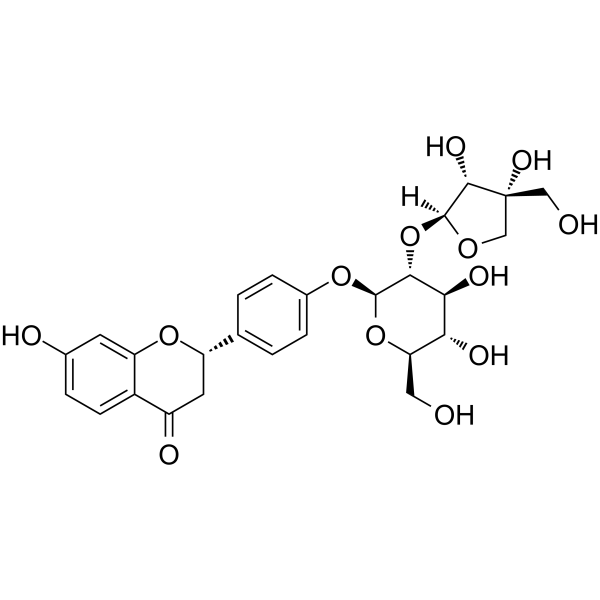
Liquiritin apioside
Based on 1 publication(s) in Google Scholar
Liquiritin apioside is an orally active inhibitor of TRPV1 receptor. Liquiritin apioside selectively inhibits laryngeal chemoreflex (LCR) and has no significant effect on mechanoreflex (LMR). Liquiritin apioside inhibits LCR by inhibiting reactive oxygen species (ROS) and NADPH oxidase, weakening the interaction between ROS and TRPV1. Liquiritin apioside can be used in the research of respiratory-related diseases.
For research use only. We do not sell to patients.
- Purity : 99.96%
- CAS No.: 74639-14-8
- Formula: C26H30O13
- Molecular Weight:550.51
-
Storage:
4°C, protect from light
* In solvent : -80°C, 6 months; -20°C, 1 month (protect from light)

To place orders, for customer services and technical support, please contact: MedChemExpress USA
Tel: 609-228-6898 E-mail: [email protected] [email protected]


-
 Biological Activity
-
Chemical Information
-
Solvent & Solubility
- Protocols
- Purity & Documentation
- References
-
 Help & FAQs


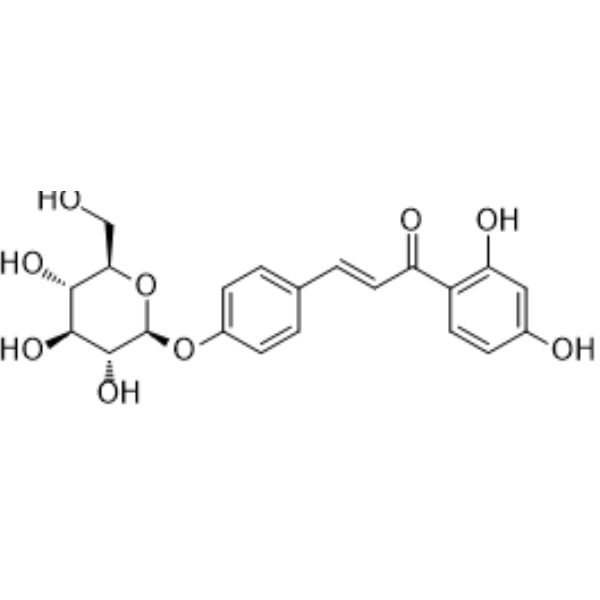
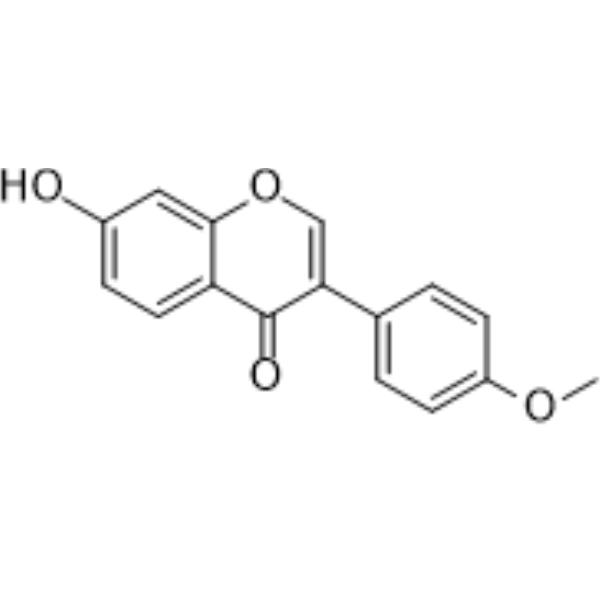
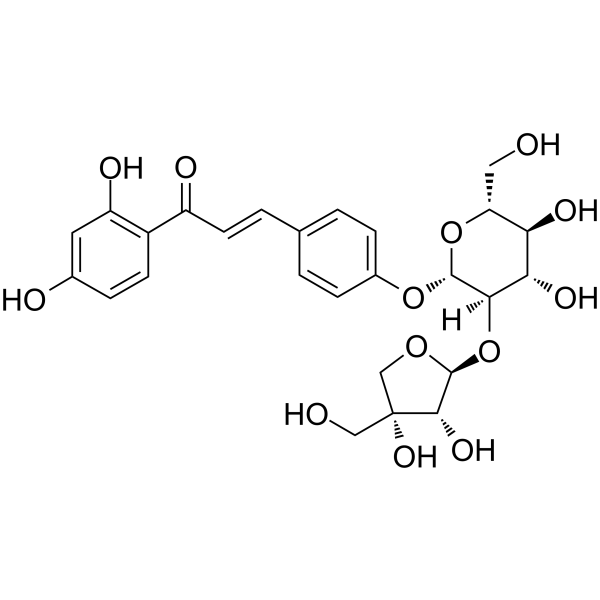
Publications Citing Use of MedChemExpress (MCE) Liquiritin apioside
More

Biological Activity
Description
In Vitro
Superior laryngeal nerve (SLN) related electrophysiological experiments: Liquiritin apioside (0.1 mM; overnight) can significantly change the electrophysiological kinetics of laryngeal C neuron currents induced by 1.5 μM Capsaicin (HY-10448P),reducing the current amplitude, increasing the rise time and prolonging the decay time[1].
MedChemExpress (MCE) has not independently confirmed the accuracy of these methods. They are for reference only. Further protocols information, click here.
-
Cell Line:Laryngeal C-neurons (isolated from nodose/jugular ganglia of rat pups)
-
Concentration:0.1 mM
-
Incubation Time:Overnight; with 1.5 μM Capsaicin
-
Result:Inhibited the CAP-induced currents in laryngeal C-neurons.
Reduced the current amplitudes, increased the rise times, and prolonged the decay times. Of the eighteen laryngeal C-neurons tested, three neurons (16%) were not CAP-responsive.
In Vivo
Liquiritin apioside (0.01 g/kg, 0.2 g/kg; po; once daily for 10 days) ameliorates DSS-induced colitis in mice, and modulates the gut microbial diversity and composition[2].
MedChemExpress (MCE) has not independently confirmed the accuracy of these methods. They are for reference only.
-
Animal Model:Laryngeal reflexe study in Sprague-Dawley rat (250-350 g) pups[1]
-
Dosage:10 μg/μL (diluted in saline)
-
Administration:Intralaryngeal perfusion for 10 minutes or peri-treatment for 20 minutes, single dose
-
Result:Significantly reduced the apneic responses to CAP, HCl, and DW, as well as attenuated the hypertension and bradycardia responses to these stimuli.
Did not change the cardiorespiratory responses to AP.
Peri-SLN treatment with Liquiritin apioside also suppressed the apnea, hypertension, and bradycardia responses to CAP, HCl, and DW, similar to the effect of intralaryngeal treatment.
-
Animal Model:DSS-induced colitis model in C57BL/6 mice (male, 18–22 g, 8–10 weeks)[2]
-
Dosage:0.01 g/kg, 0.02 g/kg (diluted in saline)
-
Administration:Oral gavaged for 10 days, once daily
-
Result:Exhibited the same pathological changes as that of the ABX (DSS) group mice, specifically, comparable weight loss, DAI score, colon length, and histology score.


Chemical Information
-
CAS No. 74639-14-8
-
Appearance Solid
-
Molecular Weight 550.51
-
Formula C26H30O13
-
Color White to light yellow
-
SMILES
O[C@H]([C@H]1O[C@]2([H])OC[C@](O)(CO)[C@H]2O)[C@H](O)[C@@H](CO)O[C@H]1OC(C=C3)=CC=C3[C@@H]4CC(C5=CC=C(O)C=C5O4)=O
-
Structure Classification
-
Initial Source
-
Shipping
Room temperature in continental US; may vary elsewhere.
-
Storage
4°C, protect from light
* In solvent : -80°C, 6 months; -20°C, 1 month (protect from light)


Publications (1)
-
Journal Impact Factor
-
Most Recent
-
J Ethnopharmacol
Neuroprotective effect of Geijigadaehwang-tang against trimethyltin-induced hippocampal neurodegeneration: An in vitro and in vivo study. [Abstract]2022 Oct 5:296:115451. PMID: 35724744


Solvent & Solubility
In Vitro:
DMSO : 100 mg/mL (181.65 mM; Need ultrasonic; Hygroscopic DMSO has a significant impact on the solubility of product, please use newly opened DMSO)
Please refer to the solubility information to select the appropriate solvent. Once prepared, please aliquot and store the solution to prevent product inactivation from repeated freeze-thaw cycles.
Storage method and period of stock solution: -80°C, 6 months; -20°C, 1 month (protect from light). When stored at -80°C, please use it within 6 months. When stored at -20°C, please use it within 1 month.
Please refer to the solubility information to select the appropriate solvent. Once prepared, please aliquot and store the solution to prevent product inactivation from repeated freeze-thaw cycles.
Storage method and period of stock solution: -80°C, 6 months; -20°C, 1 month (protect from light). When stored at -80°C, please use it within 6 months. When stored at -20°C, please use it within 1 month.
Concentration (start) × Volume (start) = Concentration (final) × Volume (final)
In Vivo:
Select the appropriate dissolution method based on your experimental animal and administration route.
- For the following dissolution methods, please ensure to first prepare a clear stock solution using an In Vitro approach and then sequentially add co-solvents:
- To ensure reliable experimental results, the clarified stock solution can be appropriately stored based on storage conditions. As for the working solution for In Vivo experiments, it is recommended to prepare freshly and use it on the same day.
- The percentages shown for the solvents indicate their volumetric ratio in the final prepared solution. If precipitation or phase separation occurs during preparation, heat and/or sonication can be used to aid dissolution.
Add each solvent one by one: 10% DMSO 40% PEG300 5% Tween-80 45% Saline
Solubility: ≥ 2.5 mg/mL (4.54 mM); Clear solution
This protocol yields a clear solution of ≥ 2.5 mg/mL (saturation unknown).
Taking 1 mL working solution as an example, add 100 μL DMSO stock solution (25.0 mg/mL) to 400 μL PEG300, and mix evenly; then add 50 μL Tween-80 and mix evenly; then add 450 μL Saline to adjust the volume to 1 mL.
Preparation of Saline: Dissolve 0.9 g sodium chloride in ddH₂O and dilute to 100 mL to obtain a clear Saline solution.
Add each solvent one by one: 10% DMSO 90% (20% SBE-β-CD in Saline)
Solubility: ≥ 2.5 mg/mL (4.54 mM); Clear solution
This protocol yields a clear solution of ≥ 2.5 mg/mL (saturation unknown).
Taking 1 mL working solution as an example, add 100 μL DMSO stock solution (25.0 mg/mL) to 900 μL 20% SBE-β-CD in Saline, and mix evenly.
Preparation of 20% SBE-β-CD in Saline (4°C, storage for one week): 2 g SBE-β-CD powder is dissolved in 10 mL Saline, completely dissolve until clear.
In Vivo Dissolution Calculator
Please enter the basic information of animal experiments:
-
-
-
-
Recommended: Prepare an additional quantity of animals to account for potential losses during experiments.
Please enter your animal formula composition:
-
%DMSO +
Recommended: Keep the proportion of DMSO in working solution below 2% if your animal is weak.
-
%+
-
+%Tween-80 + +
-
%Saline +
The co-solvents required include: DMSO, . All of co-solvents are available by MedChemExpress (MCE). , Tween 80. All of co-solvents are available by MedChemExpress (MCE).
Working solution concentration: 0.22 mg/mL
Method for preparing stock solution: mg drug dissolved in μL DMSO. Stock solution concentration: mg/mL. * In solvent : -80°C, 6 months; -20°C, 1 month (protect from light)
1. Take μL DMSO stock solution;
2. Add μL .
μL , mix evenly;
3. Then add μL Tween 80, mix evenly;
4. Then add μL
Please ensure that the stock solution in the first step is dissolved to a clear state, and add co-solvents in sequence. You can use ultrasonic heating (ultrasonic cleaner, recommended frequency 20-40 kHz), vortexing, etc. to assist dissolution.

Protocols
-
ROS/oxidative-stress fluorescent staining
ROS/oxidative-stress fluorescent staining uses cell-permeant fluorogenic probes that become fluorescent after oxidation inside cells or tissues; commonly used examples include DCFH-DA/DCFDA for broad cellular oxidant detection, DHE for superoxide-related signal detection, MitoSOX for mitochondrial superoxide-related signal detection, and CellROX probes for oxidative-stress-associated fluorescence readouts. The assay detects probe oxidation rather than a single ROS species unless the probe and analysis method have been chemically validated for that species. DCFH-DA enters cells, is deacetylated by intracellular esterases to DCFH, and produces fluorescent DCF after oxidation, so the readout is used as an operational measure of total cellular oxidative stress rather than a species-specific ROS measurement. DHE and MitoSOX can report superoxide-related oxidation, but red fluorescence alone can include non-specific ethidium-like oxidation products; HPLC or optimized spectral approaches are


Purity & Documentation
-
Data Sheet (279 KB)
-
SDS (252 KB)
- English - EN (252 KB)
- Français - FR (252 KB)
- Deutsch - DE (252 KB)
- Norwegian - NO (252 KB)
- Español - ES (252 KB)
- Swedish - SV (252 KB)
- Italian - IT (252 KB)
- Korean - KR (252 KB)
- Portuguese - PT (252 KB)
-
Handling Instructions (2659 KB)
References
[1]. Wei W, et al. Liquiritin apioside attenuates laryngeal chemoreflex but not mechanoreflex in rat pups. Am J Physiol Lung Cell Mol Physiol. 2020 Jan 1;318 (1) :L89-L97. [Content Brief]
[2]. Xia X, et al. Liquiritin apioside alleviates colonic inflammation and accompanying depression-like symptoms in colitis by gut metabolites and the balance of Th17/Treg. Phytomedicine. 2023 Nov;120:155039. [Content Brief]


Complete Stock Solution Preparation Table
Please refer to the solubility information to select the appropriate solvent. Once prepared, please aliquot and store the solution to prevent product inactivation from repeated freeze-thaw cycles.
Storage method and period of stock solution: -80°C, 6 months; -20°C, 1 month (protect from light). When stored at -80°C, please use it within 6 months. When stored at -20°C, please use it within 1 month.
| Optional Solvent | Concentration Solvent Mass | 1 mg | 5 mg | 10 mg | 25 mg |
|---|---|---|---|---|---|
| DMSO | 1 mM | 1.8165 mL | 9.0825 mL | 18.1650 mL | 45.4124 mL |
| 5 mM | 0.3633 mL | 1.8165 mL | 3.6330 mL | 9.0825 mL | |
| 10 mM | 0.1816 mL | 0.9082 mL | 1.8165 mL | 4.5412 mL | |
| 15 mM | 0.1211 mL | 0.6055 mL | 1.2110 mL | 3.0275 mL | |
| 20 mM | 0.0908 mL | 0.4541 mL | 0.9082 mL | 2.2706 mL | |
| 25 mM | 0.0727 mL | 0.3633 mL | 0.7266 mL | 1.8165 mL | |
| 30 mM | 0.0605 mL | 0.3027 mL | 0.6055 mL | 1.5137 mL | |
| 40 mM | 0.0454 mL | 0.2271 mL | 0.4541 mL | 1.1353 mL | |
| 50 mM | 0.0363 mL | 0.1816 mL | 0.3633 mL | 0.9082 mL | |
| 60 mM | 0.0303 mL | 0.1514 mL | 0.3027 mL | 0.7569 mL | |
| 80 mM | 0.0227 mL | 0.1135 mL | 0.2271 mL | 0.5677 mL | |
| 100 mM | 0.0182 mL | 0.0908 mL | 0.1816 mL | 0.4541 mL |


Liquiritin apioside Related Classifications
HY-N1471 Related Classifications
 Powered by Bioz