



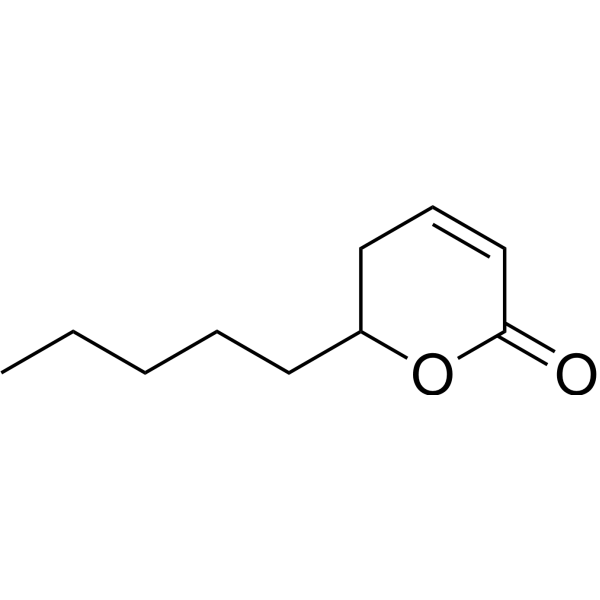
Massoia lactone
Based on 1 publication(s) in Google Scholar
Massoia lactone ((±)-Massoia lactone) is a natural lactone-based biosurfactant with antifungal (fungal), antibiofilm, and cytotoxic activities. Massoia lactone inhibits fungal hyphal growth and spore germination, and induces fungal cell necrosis by forming membrane pores, reducing ergosterol, elevating ROS, and causing leakage of intracellular components. Massoia lactone inhibits the viability and proliferation of tumor cells. Massoia lactone degrades the extracellular polymeric substances of polymicrobial biofilms, penetrates the biofilm matrix, inhibits the growth of planktonic oral bacteria (bacterial), and reduces surface tension through its amphiphilic properties. Massoia lactone is a low-toxicity, biodegradable food additive with a coconut cream aroma, which can be used for flavor improvement and also serves as a quality control marker for Cs-4 mycelium. Massoia lactone can be used for research on Fusarium head blight, malignant tumors, and oral polymicrobial biofilm-associated dental diseases.
For research use only. We do not sell to patients.
- Purity : 98.75%
- CAS No.: 54814-64-1
- Formula: C10H16O2
- Molecular Weight:168.23
-
Storage:Pure form -20°C, 3 years ; In solvent -80°C, 6 months , -20°C, 1 month

To place orders, for customer services and technical support, please contact: MedChemExpress USA
Tel: 609-228-6898 E-mail: [email protected] [email protected]


-
 Biological Activity
-
Chemical Information
-
Solvent & Solubility
- Protocols
- Purity & Documentation
- References
-
 Help & FAQs



Publications Citing Use of MedChemExpress (MCE) Massoia lactone
More

Biological Activity
Description
Cellular Effect
|
Cell Line

|
Type | Value | Description | References |
|---|---|---|---|---|
| HeLa | IC50 |
18.8 μg/mL
|
Cytotoxicity against human Hela cervical carcinoma cells incubated for 24 hr assessed by MTT assay measuring cell viability relative to untreated control.
Cytotoxicity against human Hela cervical carcinoma cells incubated for 24 hr assessed by MTT assay measuring cell viability relative to untreated control.
|
32713040 |
| HepG2 | IC50 |
49.8 μg/mL
|
Cytotoxicity against human HepG2 hepatoma cells incubated for 24 hr assessed by MTT assay measuring cell viability relative to untreated control.
Cytotoxicity against human HepG2 hepatoma cells incubated for 24 hr assessed by MTT assay measuring cell viability relative to untreated control.
|
32713040 |
| A-375 | IC50 |
7.3 μg/mL
|
Cytotoxicity against human A375 malignant melanoma cells incubated for 24 hr assessed by MTT assay measuring cell viability relative to untreated control.
Cytotoxicity against human A375 malignant melanoma cells incubated for 24 hr assessed by MTT assay measuring cell viability relative to untreated control.
|
32713040 |
| Caco-2 | IC50 |
6.0 μg/mL
|
Cytotoxicity against human Caco-2 colon carcinoma cells incubated for 24 hr assessed by MTT assay measuring cell viability relative to untreated control.
Cytotoxicity against human Caco-2 colon carcinoma cells incubated for 24 hr assessed by MTT assay measuring cell viability relative to untreated control.
|
32713040 |
| MCF7 | IC50 |
37.3 μg/mL
|
Cytotoxicity against human MCF-7 mammary carcinoma cells incubated for 24 hr assessed by MTT assay measuring cell viability relative to untreated control.
Cytotoxicity against human MCF-7 mammary carcinoma cells incubated for 24 hr assessed by MTT assay measuring cell viability relative to untreated control.
|
32713040 |
| PANC-1 | IC50 |
17.9 μg/mL
|
Cytotoxicity against human PANC-1 pancreatic carcinoma cells incubated for 24 hr assessed by MTT assay measuring cell viability relative to untreated control.
Cytotoxicity against human PANC-1 pancreatic carcinoma cells incubated for 24 hr assessed by MTT assay measuring cell viability relative to untreated control.
|
32713040 |
| HL-60 | IC50 |
16.3 μg/mL
|
Cytotoxicity against human HL-60 promyelocytic leukemia cells incubated for 24 hr assessed by CCK-8 assay measuring cell viability relative to untreated control.
Cytotoxicity against human HL-60 promyelocytic leukemia cells incubated for 24 hr assessed by CCK-8 assay measuring cell viability relative to untreated control.
|
32713040 |
| Daudi | IC50 |
23.5 μg/mL
|
Cytotoxicity against human Daudi lymphoma cells incubated for 24 hr assessed by CCK-8 assay measuring cell viability relative to untreated control.
Cytotoxicity against human Daudi lymphoma cells incubated for 24 hr assessed by CCK-8 assay measuring cell viability relative to untreated control.
|
32713040 |
| MCF-10A | IC50 |
>250 μg/mL
|
Cytotoxicity against human MCF10A normal mammary epithelial cells measured as cell viability relative to untreated control.
Cytotoxicity against human MCF10A normal mammary epithelial cells measured as cell viability relative to untreated control.
|
32713040 |
| A549 | IC50 |
7.4 μg/mL
|
Cytotoxicity against parental human A549 lung carcinoma cells incubated for 24 hr assessed by cell viability assay.
Cytotoxicity against parental human A549 lung carcinoma cells incubated for 24 hr assessed by cell viability assay.
|
32713040 |
| A549/TR | IC50 |
2.0 μg/mL
|
Cytotoxicity against paclitaxel-resistant human A549 lung carcinoma cells incubated for 24 hr assessed by cell viability assay.
Cytotoxicity against paclitaxel-resistant human A549 lung carcinoma cells incubated for 24 hr assessed by cell viability assay.
|
32713040 |
| A2780 | IC50 |
4.7 μg/mL
|
Cytotoxicity against parental human A2780 ovarian carcinoma cells incubated for 24 hr assessed by cell viability assay.
Cytotoxicity against parental human A2780 ovarian carcinoma cells incubated for 24 hr assessed by cell viability assay.
|
32713040 |
| A2780/Taxol | IC50 |
4.9 μg/mL
|
Cytotoxicity against paclitaxel-resistant human A2780 ovarian carcinoma cells incubated for 24 hr assessed by cell viability assay.
Cytotoxicity against paclitaxel-resistant human A2780 ovarian carcinoma cells incubated for 24 hr assessed by cell viability assay.
|
32713040 |
In Vitro
Massoia lactone (2.0 mg/mL; 72 h) exhibits broad-spectrum in vitro antifungal activity against pathogenic fungi, with inhibition zone diameters ranging from 0.9 cm (A. porri) to 4.8 cm (P. nicotianae)[1].
Massoia lactone (0.2-0.8 mg/mL; 72 h) inhibits the growth of V. dahliae, A. tenuissima, and F. graminearum[1].
Massoia lactone (0.1-2.5 mg/mL; 7 days) inhibits the mycelial growth of V. dahliae, A. tenuissima, and F. graminearum on solid medium in a concentration-dependent manner[1].
Massoia lactone (0.1-1.0 mg/mL; 7 days) reduces cellular biomass accumulation of V. dahliae, A. tenuissima, and F. graminearum in liquid PDB culture[1].
Massoia lactone (0.1-1.0 mg/mL; 24 h) inhibits the spore germination of V. dahliae, A. tenuissima, and F. graminearum in a concentration-dependent manner[1].
Massoia lactone (0.5-1.0 mg/mL; 24 h) disrupts the cell membranes of V. dahliae and F. graminearum spores, leading to loss of membrane integrity and PI uptake even in non-germinated spores[1].
Massoia lactone (72 h) causes cell wall invagination and pore formation in the hyphae of V. dahliae, A. tenuissima, and F. graminearum, thereby disrupting the integrity of cellular structures[1].
Massoia lactone (0.5 mg/mL; 24 h) induces necrotic cell death in V. dahliae and F. graminearum cells[1].
Massoia lactone (0.1-0.5 mg/mL; 4 days) treatment reduces ergosterol content in V. dahliae, A. tenuissima, and F. graminearum cells in a concentration-dependent manner[1].
Massoia lactone (0.2 mg/mL; 24 h) significantly increases intracellular ROS levels in V. dahliae, A. tenuissima, and F. graminearum, thereby leading to oxidative damage and cell death[1].
Massoia lactone (10-50 μg/mL; 24 h) exerts dose-dependent cytotoxic effects on Hela, HepG2, A375, Caco-2, MCF-7, PANC-1, HL-60, and Daudi human tumor cell lines, with IC50 values ranging from 6.0 to 49.8 μg/mL, while exhibiting lower cytotoxicity against MCF10A normal breast epithelial cells (IC50 >250 μg/mL)[2].
Massoia lactone (24 h) retains potent cytotoxic activity against A549 and A2780, with IC50 values of 2.0 and 4.9 μg/mL, respectively[2].
MedChemExpress (MCE) has not independently confirmed the accuracy of these methods. They are for reference only. Further protocols information, click here.
-
Cell Line:Hela cervical carcinoma, HepG2 hepatoma, A375 malignant melanoma, Caco-2 colon carcinoma, MCF-7 mammary carcinoma, PANC-1 pancreatic carcinoma, HL-60 promyelocytic leukemia, Daudi lymphoma, MCF10A normal mammary epithelial cells
-
Concentration:10, 20, 30, 40, 50 μg/mL
-
Incubation Time:24 h
-
Result:Exhibited dose-dependent cytotoxicity against all eight tested tumor cell lines.
Had an IC50 value of 18.8 μg/mL for Hela cells.
Had an IC50 value of 49.8 μg/mL for HepG2 cells.
Had an IC50 value of 7.3 μg/mL for A375 cells.
Had an IC50 value of 6.0 μg/mL for Caco-2 cells.
Had an IC50 value of 37.3 μg/mL for MCF-7 cells.
Had an IC50 value of 17.9 μg/mL for PANC-1 cells.
Had an IC50 value of 16.3 μg/mL for HL-60 cells.
Had an IC50 value of 23.5 μg/mL for Daudi cells.
Had an IC50 value of >250 μg/mL for MCF10A normal mammary epithelial cells.


Chemical Information
-
CAS No. 54814-64-1
-
Appearance Liquid (Density: 0.9787 g/cm3)
-
Molecular Weight 168.23
-
Formula C10H16O2
-
Color Light yellow to light brown
-
SMILES
O=C1C=CCC(CCCCC)O1
-
Synonyms
(±)-Massoia lactone
-
Structure Classification
-
Initial Source
-
Shipping
Room temperature in continental US; may vary elsewhere.
-
Storage
Pure form -20°C 3 years In solvent -80°C 6 months -20°C 1 month


Publications (1)
-
Journal Impact Factor
-
Most Recent
-
Nat Prod Res
α-Pyrone and decalin derivatives from the marine-derived fungus Trichoderma harzianum PSU-MF79. [Abstract]2022 Nov;36(21):5462-5469. PMID: 34894887


Solvent & Solubility
In Vitro:
DMSO : 100 mg/mL (594.42 mM; Need ultrasonic; Hygroscopic DMSO has a significant impact on the solubility of product, please use newly opened DMSO)
Please refer to the solubility information to select the appropriate solvent. Once prepared, please aliquot and store the solution to prevent product inactivation from repeated freeze-thaw cycles.
Storage method and period of stock solution: -80°C, 6 months; -20°C, 1 month. When stored at -80°C, please use it within 6 months. When stored at -20°C, please use it within 1 month.
Please refer to the solubility information to select the appropriate solvent. Once prepared, please aliquot and store the solution to prevent product inactivation from repeated freeze-thaw cycles.
Storage method and period of stock solution: -80°C, 6 months; -20°C, 1 month. When stored at -80°C, please use it within 6 months. When stored at -20°C, please use it within 1 month.
Concentration (start) × Volume (start) = Concentration (final) × Volume (final)
In Vivo:
Select the appropriate dissolution method based on your experimental animal and administration route.
- For the following dissolution methods, please ensure to first prepare a clear stock solution using an In Vitro approach and then sequentially add co-solvents:
- To ensure reliable experimental results, the clarified stock solution can be appropriately stored based on storage conditions. As for the working solution for In Vivo experiments, it is recommended to prepare freshly and use it on the same day.
- The percentages shown for the solvents indicate their volumetric ratio in the final prepared solution. If precipitation or phase separation occurs during preparation, heat and/or sonication can be used to aid dissolution.
Add each solvent one by one: 10% DMSO 40% PEG300 5% Tween-80 45% Saline
Solubility: ≥ 5 mg/mL (29.72 mM); Clear solution
This protocol yields a clear solution of ≥ 5 mg/mL (saturation unknown).
Taking 1 mL working solution as an example, add 100 μL DMSO stock solution (50.0 mg/mL) to 400 μL PEG300, and mix evenly; then add 50 μL Tween-80 and mix evenly; then add 450 μL Saline to adjust the volume to 1 mL.
Preparation of Saline: Dissolve 0.9 g sodium chloride in ddH₂O and dilute to 100 mL to obtain a clear Saline solution.
Add each solvent one by one: 10% DMSO 90% (20% SBE-β-CD in Saline)
Solubility: ≥ 5 mg/mL (29.72 mM); Clear solution
This protocol yields a clear solution of ≥ 5 mg/mL (saturation unknown).
Taking 1 mL working solution as an example, add 100 μL DMSO stock solution (50.0 mg/mL) to 900 μL 20% SBE-β-CD in Saline, and mix evenly.
Preparation of 20% SBE-β-CD in Saline (4°C, storage for one week): 2 g SBE-β-CD powder is dissolved in 10 mL Saline, completely dissolve until clear.
In Vivo Dissolution Calculator
Please enter the basic information of animal experiments:
-
-
-
-
Recommended: Prepare an additional quantity of animals to account for potential losses during experiments.
Please enter your animal formula composition:
-
%DMSO +
Recommended: Keep the proportion of DMSO in working solution below 2% if your animal is weak.
-
%+
-
+%Tween-80 + +
-
%Saline +
The co-solvents required include: DMSO, . All of co-solvents are available by MedChemExpress (MCE). , Tween 80. All of co-solvents are available by MedChemExpress (MCE).
Working solution concentration: 0.22 mg/mL
Method for preparing stock solution: mg drug dissolved in μL DMSO. Stock solution concentration: mg/mL.
1. Take μL DMSO stock solution;
2. Add μL .
μL , mix evenly;
3. Then add μL Tween 80, mix evenly;
4. Then add μL
Please ensure that the stock solution in the first step is dissolved to a clear state, and add co-solvents in sequence. You can use ultrasonic heating (ultrasonic cleaner, recommended frequency 20-40 kHz), vortexing, etc. to assist dissolution.

Protocols
-
ROS/oxidative-stress fluorescent staining
ROS/oxidative-stress fluorescent staining uses cell-permeant fluorogenic probes that become fluorescent after oxidation inside cells or tissues; commonly used examples include DCFH-DA/DCFDA for broad cellular oxidant detection, DHE for superoxide-related signal detection, MitoSOX for mitochondrial superoxide-related signal detection, and CellROX probes for oxidative-stress-associated fluorescence readouts. The assay detects probe oxidation rather than a single ROS species unless the probe and analysis method have been chemically validated for that species. DCFH-DA enters cells, is deacetylated by intracellular esterases to DCFH, and produces fluorescent DCF after oxidation, so the readout is used as an operational measure of total cellular oxidative stress rather than a species-specific ROS measurement. DHE and MitoSOX can report superoxide-related oxidation, but red fluorescence alone can include non-specific ethidium-like oxidation products; HPLC or optimized spectral approaches are
-
Filamentous Fungal Mold Culture and Sporulation
Filamentous fungal mold culture and sporulation assays grow hyphae under defined nutritional and environmental conditions until asexual spores, commonly conidia, are produced; the main readouts are colony growth, sporulation onset, conidial yield, conidial morphology, viability, and, when relevant, downstream infectivity or stress phenotype.
-
Cell Viability Determination by MTT Colorimetric Assay
The following protocol uses the MTT colorimetric assay as a classic literature-established method for assessing cell viability/metabolic activity in cultured mammalian cells. MTT[3-(4,5-dimethylthiazol-2-yl)-2,5-diphenyltetrazolium bromide] is reduced by metabolically active cells to a colored formazan product; the amount of formazan is quantified spectrophotometrically and provides an indirect measure of metabolically active viable cells. Importantly, MTT reduction reflects cellular oxidoreductase/metabolic activity rather than an absolute direct count of living cells, so changes in cellular metabolism can alter the signal independently of cell number.


Purity & Documentation
-
Data Sheet (276 KB)
-
SDS (393 KB)
- English - EN (393 KB)
- Français - FR (393 KB)
- Deutsch - DE (393 KB)
- Norwegian - NO (393 KB)
- Español - ES (393 KB)
- Swedish - SV (393 KB)
- Italian - IT (393 KB)
- Korean - KR (393 KB)
- Portuguese - PT (393 KB)
-
Handling Instructions (2659 KB)
References
[2]. Sang Q, et al. HPLC determination of massoia lactone in fermented Cordyceps sinensis mycelium Cs-4 and its anticancer activity in vitro. Journal of food biochemistry. 2020 Sep;44(9):e13336. [Content Brief]
[4]. Luepongpattana S, et al. Production of massoia lactone by Aureobasidium pullulans YTP6-14 isolated from the Gulf of Thailand and its fragrant biosurfactant properties. Journal of applied microbiology. 2017 Dec;123(6):1488-1497. [Content Brief]


Complete Stock Solution Preparation Table
Please refer to the solubility information to select the appropriate solvent. Once prepared, please aliquot and store the solution to prevent product inactivation from repeated freeze-thaw cycles.
Storage method and period of stock solution: -80°C, 6 months; -20°C, 1 month. When stored at -80°C, please use it within 6 months. When stored at -20°C, please use it within 1 month.
| Optional Solvent | Concentration Solvent Mass | 1 mg | 5 mg | 10 mg | 25 mg |
|---|---|---|---|---|---|
| DMSO | 1 mM | 5.9442 mL | 29.7212 mL | 59.4424 mL | 148.6061 mL |
| 5 mM | 1.1888 mL | 5.9442 mL | 11.8885 mL | 29.7212 mL | |
| 10 mM | 0.5944 mL | 2.9721 mL | 5.9442 mL | 14.8606 mL | |
| 15 mM | 0.3963 mL | 1.9814 mL | 3.9628 mL | 9.9071 mL | |
| 20 mM | 0.2972 mL | 1.4861 mL | 2.9721 mL | 7.4303 mL | |
| 25 mM | 0.2378 mL | 1.1888 mL | 2.3777 mL | 5.9442 mL | |
| 30 mM | 0.1981 mL | 0.9907 mL | 1.9814 mL | 4.9535 mL | |
| 40 mM | 0.1486 mL | 0.7430 mL | 1.4861 mL | 3.7152 mL | |
| 50 mM | 0.1189 mL | 0.5944 mL | 1.1888 mL | 2.9721 mL | |
| 60 mM | 0.0991 mL | 0.4954 mL | 0.9907 mL | 2.4768 mL | |
| 80 mM | 0.0743 mL | 0.3715 mL | 0.7430 mL | 1.8576 mL | |
| 100 mM | 0.0594 mL | 0.2972 mL | 0.5944 mL | 1.4861 mL |


Massoia lactone Related Classifications
HY-N7435 Related Classifications
 Powered by Bioz
Keywords
- Massoia lactone
- 54814-64-1
- (±)-Massoia lactone
- Fungal
- Bacterial
- Reactive Oxygen Species (ROS)
- spore germination
- fusarium head blight
- ROS
- polymicrobial biofilm extracellular polymeric substances
- Cordyceps sinensis mycelium Cs-4
- fungal hyphal growth
- MCF10A normal mammary epithelial cells
- Aureobasidium pullulans YTP6-14
- ergosterol
- paclitaxel-resistant
- Inhibitor
- inhibitor
- inhibit