



Melflufen hydrochloride (Standard)
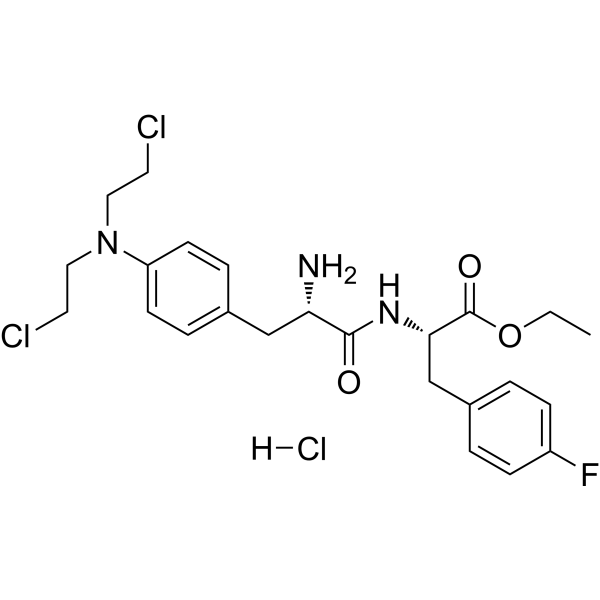
Melflufen hydrochloride (Standard) is the analytical standard of Melflufen hydrochloride (HY-105019A). This product is intended for research and analytical applications. Melflufen (Melphalan flufenamide) hydrochloride, a dipeptide proagent of Melphalan, is an alkylating agent. Melflufen hydrochloride shows antitumor activity against multiple myeloma (MM) cells and inhibits angiogenesis. Melflufen hydrochloride induces irreversible DNA damage and cytotoxicity in MM cells.
Nos produits utilisent uniquement pour la recherche. Nous ne vendons pas aux patients.
- Pureté : 98%
- CAS No.: 380449-54-7
- Formule: C24H31Cl3FN3O3
- Masse moléculaire:534.88
-
Stockage:
Please store the product under the recommended conditions in the Certificate of Analysis.


To place orders, for customer services and technical support, please contact: MedChemExpress USA
Tel: 609-228-6898 E-mail: [email protected] [email protected]


-
 Product Information
-
Chemical Information
- Pureté et documentation
-
 Help & FAQs




Product Information
Information
Application
The compound is the grade of analytical standard, which is the reference standard supplied assay. It is commonly used in qualitative, quantitative and methodological research experiments in HPLC, GC and MS.


Chemical Information
-
CAS No. 380449-54-7
-
Masse moléculaire 534.88
-
Formule C24H31Cl3FN3O3
-
SMILES
O=C(OCC)[C@H](CC1=CC=C(F)C=C1)NC([C@H](CC2=CC=C(N(CCCl)CCCl)C=C2)N)=O.[H]Cl
-
Synonyms
Melphalan flufenamide hydrochloride (Standard)
-
Livraison
Room temperature in continental US; may vary elsewhere.
-
Stockage
Please store the product under the recommended conditions in the Certificate of Analysis.


Pureté et documentation
Références
[1]. Chauhan D, et al. In vitro and in vivo antitumor activity of a novel alkylating agent, melphalan-flufenamide, against multiple myeloma cells. Clin Cancer Res. 2013;19(11):3019-3031. [Content Brief]
[2]. Ray A, et al. A novel alkylating agent Melflufen induces irreversible DNA damage and cytotoxicity in multiple myeloma cells. Br J Haematol. 2016;174(3):397-409. [Content Brief]
[3]. McAndrews KM, et, al. Mechanisms associated with biogenesis of exosomes in cancer. Mol Cancer. 2019 Mar 30;18(1):52. [Content Brief]

Calculators
Concentration (start) × Volume (start) = Concentration (final) × Volume (final)


Melflufen hydrochloride (Standard) Related Classifications
HY-105019AR Related Classifications
 Powered by Bioz