



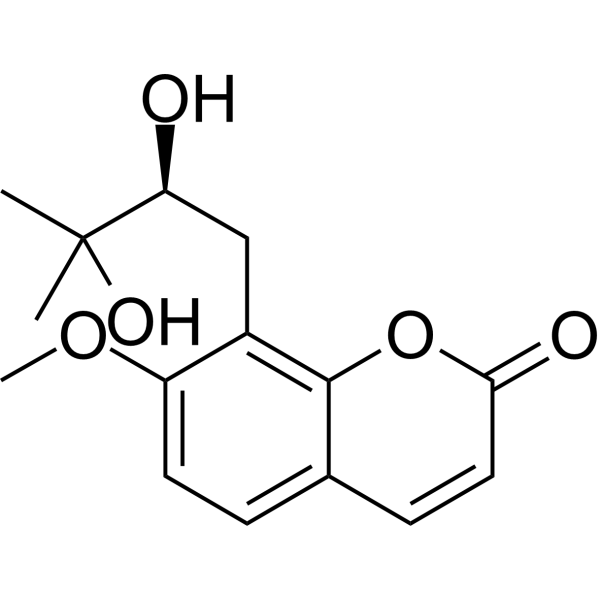
Meranzin hydrate
Based on 1 publication(s) in Google Scholar
Meranzin hydrate is an orally active antidepressant and GHSR modulator. Meranzin hydrate significantly upregulates the expression levels of brain-derived neurotrophic factor and p-mTOR in the hippocampus via the ghrelin-growth hormone secretagogue receptor pathway. Meranzin hydrate regulates blood oxygen level-dependent signals in the hippocampus-thalamus-basal ganglia circuit, attenuates reward system activation, and promotes the normalization of related hormone levels. Meranzin hydrate effectively ameliorates depression-like behaviors and gastrointestinal hypomotility, and can be used in research related to depression and major depressive disorder.
Nos produits utilisent uniquement pour la recherche. Nous ne vendons pas aux patients.
- Pureté : 99.89%
- CAS No.: 5875-49-0
- Formule: C15H18O5
- Masse moléculaire:278.30
-
Stockage:
4°C, sealed storage, away from moisture and light
* In solvent : -80°C, 6 months; -20°C, 1 month (sealed storage, away from moisture and light)

To place orders, for customer services and technical support, please contact: MedChemExpress USA
Tel: 609-228-6898 E-mail: [email protected] [email protected]


-
 Activité biologique
-
Chemical Information
-
Solvant et solubilité
- Protocole
- Pureté et documentation
- Références
-
 Help & FAQs


Publications Citing Use of MedChemExpress (MCE) Meranzin hydrate
More

Activité biologique
Description
In Vivo
Meranzin hydrate (18 mg/kg; single dose) does not reduce depression-like behavior in GHSR KO mice as measured by FST and TST outcomes[1].
Meranzin hydrate (10 mg/kg; i.g.; daily; 7 days) produces significant antidepressant- and anxiolytic-like effects in UCMS-induced depressed rats, normalizes HPA axis function, increases hippocampal BDNF expression, and repairs UCMS-induced aberrant BOLD activation in the reward and limbic systems[2].
MedChemExpress (MCE) has not independently confirmed the accuracy of these methods. They are for reference only.
-
Animal Model:Sprague-Dawley (8 rats per group; acute forced swimming-induced model)[1]
-
Dosage:9 mg/kg; 18 mg/kg
-
Administration:single dose
-
Result:Improved depression-like behavior (FST, OFT) and hypomotility (GE, IT) (all P<0.05).
Significantly stimulated BDNF and p-mTOR protein expressions in the hippocampus (both P<0.01).
Modulated activity in the hippocampus-thalamus-basal ganglia (HTB) circuits as measured by BOLD foci.
Had its effect on FST and GE inhibited by ghrelin antagonist [D-Lys3]-GHRP-6 (P<0.05).
Had its stimulation of hippocampal BDNF and p-mTOR expressions prevented by [D-Lys3]-GHRP-6 (P<0.01).
Had its modulation of HTB circuit activity inhibited by [D-Lys3]-GHRP-6.
-
Animal Model:Wild-type (8 mice per group)[1]
-
Dosage:18 mg/kg
-
Administration:single dose
-
Result:Alleviated depression-like behavior (FST, TST) in wild-type mice.
-
Animal Model:Growth hormone secretagogue receptor knockout (GHSR KO)[1]
-
Dosage:18 mg/kg
-
Administration:single dose
-
Result:Showed no antidepressant effects in GHSR KO mice, with no observed changes in FST or TST outcomes.
-
Animal Model:Wistar (adult male, 180−220 g, UCMS-induced depression model)[2]
-
Dosage:10 mg/kg
-
Administration:i.g.; daily; 7 days
-
Result:Significantly reduced immobility time in the forced swimming test (P < 0.001 vs UCMS group).
Significantly increased sucrose preference index (P < 0.01 vs UCMS group).
Significantly increased total distance travelled in the open-field test (P < 0.01 vs UCMS group).
Significantly reduced plasma adrenocorticotropic hormone (ACTH) (P < 0.05 vs UCMS group), corticosterone (CORT) (P < 0.01 vs UCMS group), and acylated ghrelin (AG) (P < 0.01 vs UCMS group) levels, normalizing them to near control levels.
Significantly increased brain-derived neurotrophic factor (BDNF) expression in the hippocampal dentate gyrus (P < 0.01 vs UCMS group).
Attenuated UCMS-induced increased BOLD activation in reward system and limbic system brain regions, including the striatum, septal area, thalamus lateral nucleus group, bed nucleus of stria terminalis, hippocampus, midbrain superior colliculus, nucleus accumbens, and third ventricle.
Increased BOLD activation in the right auditory cortex, right amygdaloid body, left sensory cortex, right third ventricle, and left temporal association cortex.
Reversed UCMS-induced changes in BOLD signals in the right amygdaloid body and right visual cortex, and decreased BOLD signals in bilateral hypothalamus preoptic regions.


Chemical Information
-
CAS No. 5875-49-0
-
Appearance Solid
-
Masse moléculaire 278.30
-
Formule C15H18O5
-
Color White to off-white
-
SMILES
CC(C)(O)[C@@H](O)CC1=C(O2)C(C=CC2=O)=CC=C1OC
-
Structure Classification
-
Initial Source
-
Livraison
Room temperature in continental US; may vary elsewhere.
-
Stockage
4°C, sealed storage, away from moisture and light
* In solvent : -80°C, 6 months; -20°C, 1 month (sealed storage, away from moisture and light)


Publications (1)
-
Journal Impact Factor
-
Most Recent


Solvant et solubilité
In Vitro:
DMSO : 100 mg/mL (359.32 mM; Need ultrasonic; Hygroscopic DMSO has a significant impact on the solubility of product, please use newly opened DMSO)
Please refer to the solubility information to select the appropriate solvent. Once prepared, please aliquot and store the solution to prevent product inactivation from repeated freeze-thaw cycles.
Storage method and period of stock solution: -80°C, 6 months; -20°C, 1 month (sealed storage, away from moisture and light). When stored at -80°C, please use it within 6 months. When stored at -20°C, please use it within 1 month.
Please refer to the solubility information to select the appropriate solvent. Once prepared, please aliquot and store the solution to prevent product inactivation from repeated freeze-thaw cycles.
Storage method and period of stock solution: -80°C, 6 months; -20°C, 1 month (sealed storage, away from moisture and light). When stored at -80°C, please use it within 6 months. When stored at -20°C, please use it within 1 month.
Concentration (start) × Volume (start) = Concentration (final) × Volume (final)
In Vivo:
Select the appropriate dissolution method based on your experimental animal and administration route.
- For the following dissolution methods, please ensure to first prepare a clear stock solution using an In Vitro approach and then sequentially add co-solvents:
- To ensure reliable experimental results, the clarified stock solution can be appropriately stored based on storage conditions. As for the working solution for In Vivo experiments, it is recommended to prepare freshly and use it on the same day.
- The percentages shown for the solvents indicate their volumetric ratio in the final prepared solution. If precipitation or phase separation occurs during preparation, heat and/or sonication can be used to aid dissolution.
Add each solvent one by one: 10% DMSO 40% PEG300 5% Tween-80 45% Saline
Solubility: ≥ 2.5 mg/mL (8.98 mM); Clear solution
This protocol yields a clear solution of ≥ 2.5 mg/mL (saturation unknown).
Taking 1 mL working solution as an example, add 100 μL DMSO stock solution (25.0 mg/mL) to 400 μL PEG300, and mix evenly; then add 50 μL Tween-80 and mix evenly; then add 450 μL Saline to adjust the volume to 1 mL.
Preparation of Saline: Dissolve 0.9 g sodium chloride in ddH₂O and dilute to 100 mL to obtain a clear Saline solution.
Add each solvent one by one: 10% DMSO 90% (20% SBE-β-CD in Saline)
Solubility: ≥ 2.5 mg/mL (8.98 mM); Clear solution
This protocol yields a clear solution of ≥ 2.5 mg/mL (saturation unknown).
Taking 1 mL working solution as an example, add 100 μL DMSO stock solution (25.0 mg/mL) to 900 μL 20% SBE-β-CD in Saline, and mix evenly.
Preparation of 20% SBE-β-CD in Saline (4°C, storage for one week): 2 g SBE-β-CD powder is dissolved in 10 mL Saline, completely dissolve until clear.
In Vivo Dissolution Calculator
Please enter the basic information of animal experiments:
-
-
-
-
Recommended: Prepare an additional quantity of animals to account for potential losses during experiments.
Please enter your animal formula composition:
-
%DMSO +
Recommended: Keep the proportion of DMSO in working solution below 2% if your animal is weak.
-
%+
-
+%Tween-80 + +
-
%Saline +
The co-solvents required include: DMSO, . All of co-solvents are available by MedChemExpress (MCE). , Tween 80. All of co-solvents are available by MedChemExpress (MCE).
Working solution concentration: 0.22 mg/mL
Method for preparing stock solution: mg drug dissolved in μL DMSO. Stock solution concentration: mg/mL. * In solvent : -80°C, 6 months; -20°C, 1 month (sealed storage, away from moisture and light)
1. Take μL DMSO stock solution;
2. Add μL .
μL , mix evenly;
3. Then add μL Tween 80, mix evenly;
4. Then add μL
Please ensure that the stock solution in the first step is dissolved to a clear state, and add co-solvents in sequence. You can use ultrasonic heating (ultrasonic cleaner, recommended frequency 20-40 kHz), vortexing, etc. to assist dissolution.


Pureté et documentation
-
Fiche technique (285 KB)
-
SDS (399 KB)
- English - EN (399 KB)
- Français - FR (399 KB)
- Deutsch - DE (399 KB)
- Norwegian - NO (399 KB)
- Español - ES (399 KB)
- Swedish - SV (399 KB)
- Italian - IT (399 KB)
- Korean - KR (399 KB)
- Portuguese - PT (399 KB)
-
Instruction de manipulation (2659 KB)
Références
[1]. Liu YL, et al. Meranzin Hydrate Improves Depression-Like Behaviors and Hypomotility via Ghrelin and Neurocircuitry. Chinese journal of integrative medicine. 2023 Jun;29(6):490-499. [Content Brief]
[2]. Liu X, et al. Meranzin hydrate elicits antidepressant effects and restores reward circuitry. Behavioural brain research. 2021 Feb 01;398:112898. [Content Brief]


Complete Stock Solution Preparation Table
Please refer to the solubility information to select the appropriate solvent. Once prepared, please aliquot and store the solution to prevent product inactivation from repeated freeze-thaw cycles.
Storage method and period of stock solution: -80°C, 6 months; -20°C, 1 month (sealed storage, away from moisture and light). When stored at -80°C, please use it within 6 months. When stored at -20°C, please use it within 1 month.
| Optional Solvent | Concentration Solvent Mass | 1 mg | 5 mg | 10 mg | 25 mg |
|---|---|---|---|---|---|
| DMSO | 1 mM | 3.5932 mL | 17.9662 mL | 35.9324 mL | 89.8311 mL |
| 5 mM | 0.7186 mL | 3.5932 mL | 7.1865 mL | 17.9662 mL | |
| 10 mM | 0.3593 mL | 1.7966 mL | 3.5932 mL | 8.9831 mL | |
| 15 mM | 0.2395 mL | 1.1977 mL | 2.3955 mL | 5.9887 mL | |
| 20 mM | 0.1797 mL | 0.8983 mL | 1.7966 mL | 4.4916 mL | |
| 25 mM | 0.1437 mL | 0.7186 mL | 1.4373 mL | 3.5932 mL | |
| 30 mM | 0.1198 mL | 0.5989 mL | 1.1977 mL | 2.9944 mL | |
| 40 mM | 0.0898 mL | 0.4492 mL | 0.8983 mL | 2.2458 mL | |
| 50 mM | 0.0719 mL | 0.3593 mL | 0.7186 mL | 1.7966 mL | |
| 60 mM | 0.0599 mL | 0.2994 mL | 0.5989 mL | 1.4972 mL | |
| 80 mM | 0.0449 mL | 0.2246 mL | 0.4492 mL | 1.1229 mL | |
| 100 mM | 0.0359 mL | 0.1797 mL | 0.3593 mL | 0.8983 mL |


Meranzin hydrate Related Classifications
HY-N3297 Related Classifications
 Powered by Bioz
Keywords
- Meranzin
- 5875-49-0
- mTOR
- GHSR
- GHSR KO mice
- acylated ghrelin
- wild-type mice
- adrenocorticotropic hormone
- Aurantii Fructus Immaturus
- corticosterone
- brain-derived neurotrophic factor
- phosphorylated mammalian target of rapamycin
- ghrelin-growth hormone secretagogue receptor pathway
- hippocampus-thalamus-basal ganglia
- Inhibitor
- inhibitor
- inhibit