



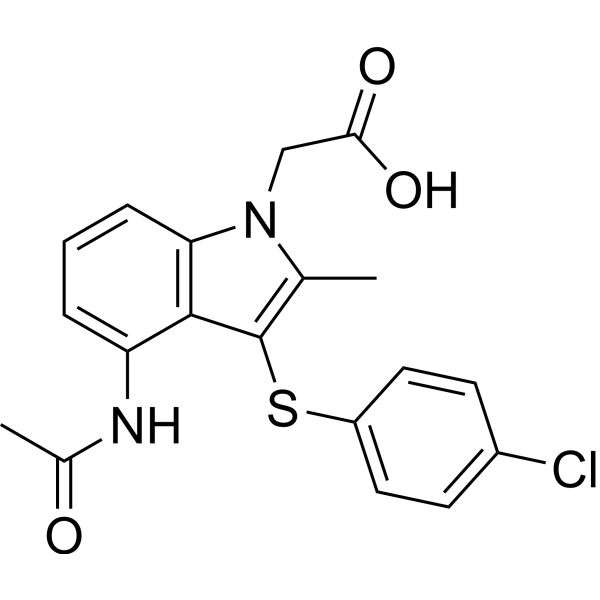
NVP-QAV680
NVP-QAV680 is a potent and selective CRTh2 receptor antagonist with low nanomolar (nM) functional potency to inhibit CRTh2-driven activation of human eosinophils and Th2 lymphocytes. NVP-QAV680 exhibits good oral bioavailability and demonstrates efficacy in CRTh2-dependent mechanisms and allergic disease models in rats.
For research use only. We do not sell to patients.
- CAS No.: 872365-16-7
- Formula: C18H18N2O4S
- Molecular Weight:358.41
-
Storage:
Please store the product under the recommended conditions in the Certificate of Analysis.


To place orders, for customer services and technical support, please contact: MedChemExpress USA
Tel: 609-228-6898 E-mail: [email protected] [email protected]


-
 Biological Activity
-
Chemical Information
- Protocols
- Purity & Documentation
- References
-
 Help & FAQs




Biological Activity
Description
Cellular Effect
|
Cell Line

|
Type | Value | Description | References |
|---|---|---|---|---|
| CHO | IC50 |
0.037 μM
Compound: 18
|
Antagonist activity at human CRTh2 receptor expressed in CHO cells assessed as inhibition of prostaglandin D2 and forskolin-induced cAMP accumulation after 45 mins
Antagonist activity at human CRTh2 receptor expressed in CHO cells assessed as inhibition of prostaglandin D2 and forskolin-induced cAMP accumulation after 45 mins
|
[PMID: 24021582] |
| CHO-K1 | IC50 |
0.094 μM
Compound: 18
|
Antagonist activity at mouse CRTh2 receptor expressed in CHO-K1 cells assessed as inhibition of [125S]-GTP-gamma-S binding after 50 mins by liquid scintillation counting
Antagonist activity at mouse CRTh2 receptor expressed in CHO-K1 cells assessed as inhibition of [125S]-GTP-gamma-S binding after 50 mins by liquid scintillation counting
|
[PMID: 24021582] |


Chemical Information
-
CAS No. 872365-16-7
-
Molecular Weight 358.41
-
Formula C18H18N2O4S
-
SMILES
O=C(O)CC1=C(C)N(CC2=CC=C(S(=O)(C)=O)C=C2)C3=NC=CC=C31
-
Shipping
Room temperature in continental US; may vary elsewhere.
-
Storage
Please store the product under the recommended conditions in the Certificate of Analysis.

Protocols
-
Naïve CD4+ T-cell subset differentiation/polarization
Naïve CD4+ T-cell subset differentiation/polarization is an in vitro assay in which purified naïve CD4+ T cells are activated through TCR and CD28 costimulation and cultured with defined cytokines and neutralizing antibodies to generate Th0, Th1, Th2, Th17, or induced Treg-like populations. Differentiation is detected by subset-associated cytokines and transcription factors: IFN-γ/T-bet for Th1, IL-4/GATA3 for Th2, IL-17A/RORγt for Th17, and Foxp3 for induced Treg cells. The assay readout is usually generated by intracellular cytokine staining after restimulation, transcription-factor staining by flow cytometry, ELISA of secreted cytokines, or gene-expression analysis. The result reflects cytokine-directed lineage commitment or polarization rather than antigen-specific immune protection by itself.
-
Protocol for Pharmacokinetic Study
Pharmacokinetic studies quantify how an organism handles a drug over time through absorption, distribution, metabolism, and excretion, and the core experimental readout is the concentration-time profile of parent drug and, when relevant, metabolites in biological matrices such as plasma, whole blood, urine, bile, or tissue. Pharmacokinetic analysis links dose, route, exposure, clearance, half-life, distribution, bioavailability, and systemic exposure to drug efficacy and toxicity hypotheses rather than measuring a signaling pathway directly. The literature links pharmacokinetics to drug-development phenotypes by showing that drug metabolism and pharmacokinetics influence compound progression, exposure-response interpretation, safety margins, dosing strategy, and failure risk during discovery and development. DMPK science contributes to compound optimization by integrating physicochemical properties, in vitro metabolism, transporter behavior, in vivo exposure, and pharmacodynamic contex


Purity & Documentation
References
[1]. Discovery and characterization of NVP-QAV680, a potent and selective CRTh2 receptor antagonist suitable for clinical testing in allergic diseases [Content Brief]
[2]. Sandham DA, et al. Discovery and characterization of NVP-QAV680, a potent and selective CRTh2 receptor antagonist suitable for clinical testing in allergic diseases. Bioorg Med Chem. 2013 Nov 1;21(21):6582-91. [Content Brief]

Calculators
Concentration (start) × Volume (start) = Concentration (final) × Volume (final)


NVP-QAV680 Related Classifications
HY-12284 Related Classifications
 Powered by Bioz