



Opicinumab

Based on 1 Customer Validation
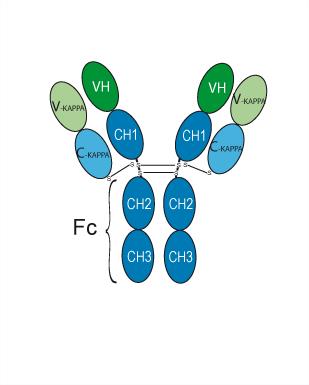
Opicinumab (BIIB033) is a human IgG1 monoclonal antibody targeting LINGO-1. Opicinumab binds LINGO-1 to block its negative regulatory signaling, suppress axonal degeneration, enhance axonal regeneration, promote remyelination, and exert neuroprotective effects. Opicinumab maintains axonal protective effects during co-administration with methylprednisolone. Opicinumab can be used for the research of multiple sclerosis, acute optic neuritis, and optic neuritis..
연구목적의 판매만을 진행합니다. 환자를 대상으로 한 판매는 하지 않습니다.
- Purity : 99.64%
- CAS No.: 1422268-07-2
- 분자량:145.2 kDa
-
보관:
Please store the product under the recommended conditions in the Certificate of Analysis.


To place orders, for customer services and technical support, please contact: MedChemExpress USA
Tel: 609-228-6898 E-mail: [email protected] [email protected]


-
 Biological Activity
-
Chemical Information
- 순도&문서
- References
-
 Help & FAQs




Biological Activity
제품 설명
Isotype
Human IgG1 kappa
Recommend Isotype Controls
Species Reactivity
Human
IC50 & Target
[1]|
LINGO-1 |
In Vivo
Opicinumab (BIIB033) (6 mg/kg; i.p.; once weekly; 3 doses) significantly reduces optic nerve axonal loss in Brown Norway rats with MOG-induced experimental autoimmune encephalomyelitis[3].
MedChemExpress (MCE) has not independently confirmed the accuracy of these methods. They are for reference only.
-
Animal Model:Brown Norway rats (8-10-week-old female; MOG-induced experimental autoimmune encephalomyelitis)[3]
-
Dosage:6 mg/kg
-
Administration:i.p.; once weekly; 3 doses
-
Result:Exhibited a five-fold higher number of βIII tubulin-positive axons compared to control when administered alone with vehicle.
Exhibited an eight-fold higher number of βIII tubulin-positive axons compared to control when administered in combination with Methylprednisolone.
Clinical Trial
| NCT Number | Sponsor | Condition | Start Date |
Phase

|
|---|---|---|---|---|
| NCT01329991 | 2011-05 | PHASE1 |
Gene ID
Accession
Conjugated
Unconjugated
Reconsititution
The product can be reconstituted/diluted with sterile PBS or saline.
Format
-
Human IgG1 kappa
신청
ELISA, FACS, Functional assay


Chemical Information
-
CAS No. 1422268-07-2
-
Appearance Liquid
-
분자량 145.2 kDa
-
Color Colorless to light yellow
-
SMILES
[Opicinumab]
-
Synonyms
BIIB033
-
선적
Shipping with dry ice.
-
Formulation
Please refer to the lot-specific COA for specific buffer information.
-
보관
Please store the product under the recommended conditions in the Certificate of Analysis.


순도&문서
-
Data Sheet (260 KB)
-
SDS (251 KB)
- English - EN (251 KB)
- Français - FR (251 KB)
- Deutsch - DE (251 KB)
- Norwegian - NO (251 KB)
- Español - ES (251 KB)
- Swedish - SV (251 KB)
- Italian - IT (251 KB)
- Korean - KR (251 KB)
- Portuguese - PT (251 KB)
-
Inhibitory Antibodies User Guide (603 KB)
References
[1]. Tran JQ, et al. Randomized phase I trials of the safety/tolerability of anti-LINGO-1 monoclonal antibody BIIB033. Neurol Neuroimmunol Neuroinflamm. 2014;1(2):e18. Published 2014 Aug 21. [Content Brief]
[2]. Cadavid D, et al. Safety and efficacy of opicinumab in acute optic neuritis (RENEW): a randomised, placebo-controlled, phase 2 trial. Lancet Neurol. 2017;16(3):189-199. [Content Brief]
[3]. Gresle MM, et al. Blocking LINGO-1 in vivo reduces degeneration and enhances regeneration of the optic nerve. Mult Scler J Exp Transl Clin. 2016;2:2055217316641704. Published 2016 Apr 19. [Content Brief]

Calculators
Concentration (start) × Volume (start) = Concentration (final) × Volume (final)


Opicinumab Related Classifications
HY-P99780 Related Classifications
 Powered by Bioz