



OVA-T4 Peptide
Based on 2 publication(s) in Google Scholar
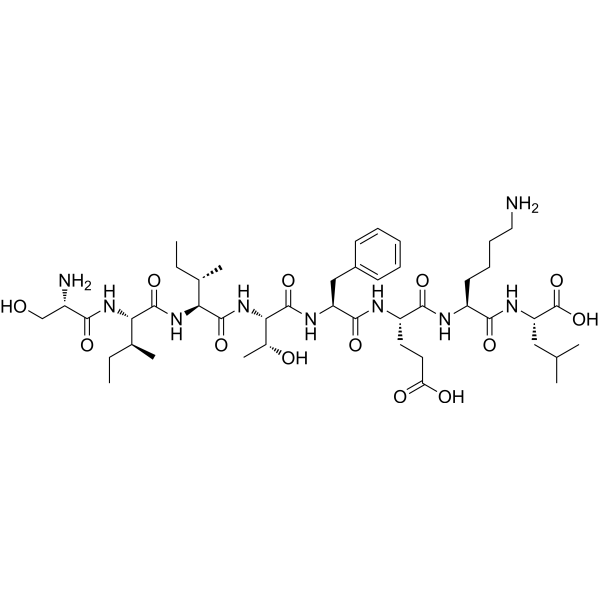
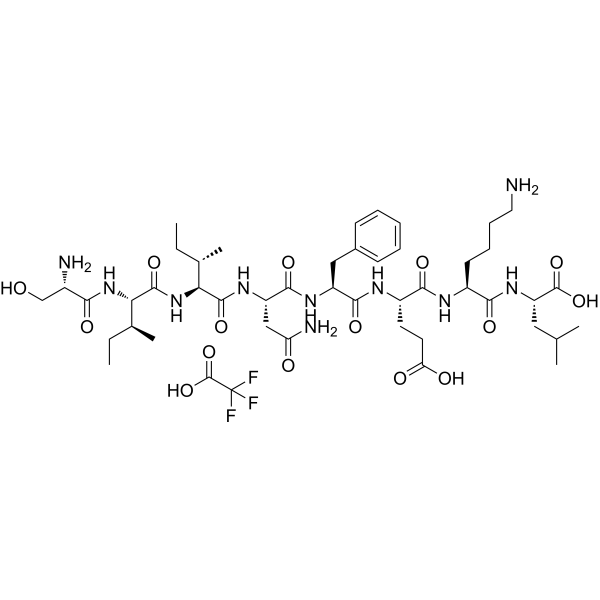
OVA-T4 Peptide (SIITFEKL; OVA (257-264) Variant) is a modified peptide ligand of OVA 257-264 that binds to mouse OT-I TCR with Kd = 1.22 μM, acts as a weaker agonist than the parental N4 peptide to modulate the strength of antigen-presenting cell-T lymphocyte interactions, and alters the amplitude of cytokine responses and NFAT1, p-Erk, and NF-κB signaling responses. OVA-T4 Peptide can be used for research on colon cancer and ovarian cancer.
For research use only. We do not sell to patients.
- Purity : 99.59%
- CAS No.: 148274-88-8
- Formula: C45H75N9O13
- Molecular Weight:950.13
-
Storage:
Sealed storage, away from moisture and light.
Powder -80°C, 2 years , -20°C, 1 year* In solvent : -80°C, 6 months; -20°C, 1 month (sealed storage, away from moisture and light)

To place orders, for customer services and technical support, please contact: MedChemExpress USA
Tel: 609-228-6898 E-mail: [email protected] [email protected]


-
 Biological Activity
-
Chemical Information
-
Solvent & Solubility
- Protocols
- Purity & Documentation
- References
-
 Help & FAQs



Publications Citing Use of MedChemExpress (MCE) OVA-T4 Peptide
More

Biological Activity
Description
In Vitro
OVA-T4 Peptide (SIITFEKL; OVA (257-264) Variant) (0.1 nM; 48 h) induced robust proliferation of OT-I CD8 T cells, and this proliferation was enhanced in the absence of ZFP36 and ZFP36L1[4].
OVA-T4 Peptide (0.1 nM; 24-48 h) induces CD25 expression and STAT5 phosphorylation in OT-I CD8 T cells, and this process is impaired in the absence of ZFP36 and ZFP36L1[4].
OVA-T4 Peptide (0.1 nM; 72 h)-induced OT-I CD8 T cell expansion depends on IL-2 availability, which is impaired in the absence of ZFP36 and ZFP36L1[4].
In OVA-T4 Peptide (100 nM; 24-48 h)-stimulated OT-I CD8+ T cells, ITK/RLK activity is dispensable for the switch-like induction of CD69 but is critical for regulating IRF4 expression and proliferative potential[6].
In naive OT-I CD8+ T cells stimulated with OVA-T4 Peptide (100 nM; 1-2 h), NF-κB (p65) activation showed a graded response that could be modulated by TCR signal strength and was selectively attenuated by ITK/RLK inhibition[6].
In naive OT-I CD8+ T cells stimulated with OVA-T4 Peptide (100 nM; 1 h), DAG signaling plays a dominant role in regulating NF-κB translocation, and supplementation with Phorbol 12-myristate 13-acetate (PMA) (HY-18739) can rescue the NF-κB signaling defect caused by ITK/RLK inhibition[6].
In OVA-T4 Peptide (100 nM; 30-120 min)-stimulated OT-I CD8+ T cells, ITK/RLK inhibition reduced the expression of cytokine- and effector-related transcripts (including IRF4) after 2 hours of stimulation[6].
OVA-T4 Peptide (0.1 nM; 1.5-16 h) induces transcriptional changes in OT-I CD8 T cells, in which ZFP36 and ZFP36L1 regulate a network of cytokine signaling pathway regulators including Socs1, Cish, Socs3, and Pim1[4].
OVA-T4 Peptide (6 h) only altered the magnitude of cytokine production in mouse OT-I effector CD8+ T cells without changing its kinetics[5].
MedChemExpress (MCE) has not independently confirmed the accuracy of these methods. They are for reference only. Further protocols information, click here.
-
Cell Line:Naïve OT-I CD8 T cells
-
Concentration:0.1 nM
-
Incubation Time:48 h
-
Result:Induced robust proliferation of OT-I CD8 T cells, which was enhanced in the absence of ZFP36 and ZFP36L1.


Chemical Information
-
CAS No. 148274-88-8
-
Appearance Solid
-
Molecular Weight 950.13
-
Formula C45H75N9O13
-
Color White to off-white
-
Synonyms
SIITFEKL, OVA (257-264) Variant
-
Sequence
Ser-Ile-Ile-Thr-Phe-Glu-Lys-Leu
-
Sequence Shortening
SIITFEKL
-
Shipping
Room temperature in continental US; may vary elsewhere.
-
Storage
Sealed storage, away from moisture and light
Powder -80°C 2 years -20°C 1 year * In solvent : -80°C, 6 months; -20°C, 1 month (sealed storage, away from moisture and light)


Publications (2)
-
Journal Impact Factor
-
Most Recent
-
Cell Rep
IL-33/TGF-β/IL-4-induced bone marrow-derived DC9 subset promotes Th9 differentiation and allergic airway inflammation. [Abstract]2026 Jun 4;45(6):117519. PMID: 42247295 -


Solvent & Solubility
In Vitro:
0.05 M HCl : 12.5 mg/mL (13.16 mM; Need ultrasonic)
DMSO : 1.96 mg/mL (2.06 mM; ultrasonic and adjust pH to 5 with HCl; Hygroscopic DMSO has a significant impact on the solubility of product, please use newly opened DMSO)
Please refer to the solubility information to select the appropriate solvent. Once prepared, please aliquot and store the solution to prevent product inactivation from repeated freeze-thaw cycles.
Storage method and period of stock solution: -80°C, 6 months; -20°C, 1 month (sealed storage, away from moisture and light). When stored at -80°C, please use it within 6 months. When stored at -20°C, please use it within 1 month.
Please refer to the solubility information to select the appropriate solvent. Once prepared, please aliquot and store the solution to prevent product inactivation from repeated freeze-thaw cycles.
Storage method and period of stock solution: -80°C, 6 months; -20°C, 1 month (sealed storage, away from moisture and light). When stored at -80°C, please use it within 6 months. When stored at -20°C, please use it within 1 month.
Concentration (start) × Volume (start) = Concentration (final) × Volume (final)

Protocols
-
Research Protocol for Inflammation-related Diseases
The NLRP3 inflammasome is a cytosolic innate immune signaling platform that integrates priming signals and danger-signal activation to promote caspase-1 activation, maturation of IL-1β and IL-18, and gasdermin D-mediated pyroptotic cell death. The core experimental logic is to determine whether inflammatory disease phenotypes are driven by increased NLRP3 expression, ASC-containing inflammasome assembly, caspase-1 cleavage, GSDMD cleavage, and extracellular release of IL-1β/IL-18 rather than by nonspecific cell injury alone. The pathway is strongly linked to inflammation-related disease phenotypes because monosodium urate crystals activate NALP3/NLRP3 inflammasome signaling in gout-like crystal inflammation, cholesterol crystals activate NLRP3 inflammasomes in atherogenesis models, and DSS-induced intestinal inflammation has been reported to involve NLRP3 inflammasome activity. However, experimental colitis studies also show context-dependent protective effects of NLRP3 inflammasome co


Purity & Documentation
-
Data Sheet (287 KB)
-
SDS (252 KB)
- English - EN (252 KB)
- Français - FR (252 KB)
- Deutsch - DE (252 KB)
- Norwegian - NO (252 KB)
- Español - ES (252 KB)
- Swedish - SV (252 KB)
- Italian - IT (252 KB)
- Korean - KR (252 KB)
- Portuguese - PT (252 KB)
-
Handling Instructions (2659 KB)
References


Complete Stock Solution Preparation Table
Please refer to the solubility information to select the appropriate solvent. Once prepared, please aliquot and store the solution to prevent product inactivation from repeated freeze-thaw cycles.
Storage method and period of stock solution: -80°C, 6 months; -20°C, 1 month (sealed storage, away from moisture and light). When stored at -80°C, please use it within 6 months. When stored at -20°C, please use it within 1 month.
| Optional Solvent | Concentration Solvent Mass | 1 mg | 5 mg | 10 mg | 25 mg |
|---|---|---|---|---|---|
| DMSO / 0.05 M HCl | 1 mM | 1.0525 mL | 5.2624 mL | 10.5249 mL | 26.3122 mL |
| 0.05 M HCl | 5 mM | 0.2105 mL | 1.0525 mL | 2.1050 mL | 5.2624 mL |
| 10 mM | 0.1052 mL | 0.5262 mL | 1.0525 mL | 2.6312 mL |


OVA-T4 Peptide Related Classifications
HY-P5411 Related Classifications
 Powered by Bioz