



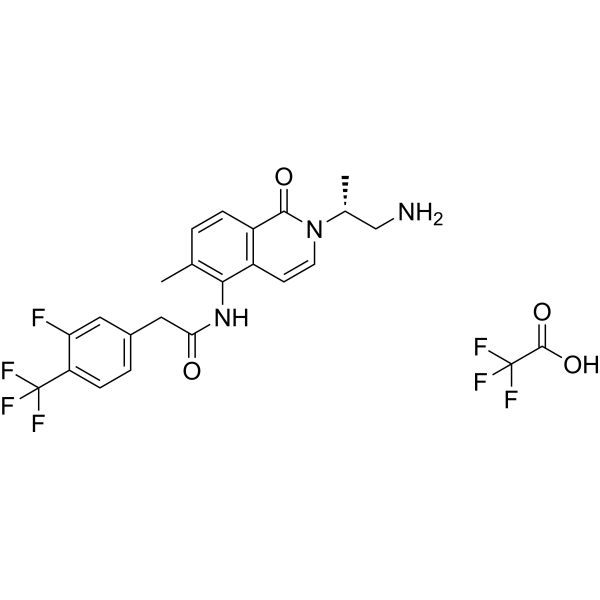
P2X7-IN-2 TFA
Based on 1 publication(s) in Google Scholar
P2X7-IN-2 TFA (compound 58) is a P2X7 receptor inhibitor. P2X7-IN-2 TFA inhibits IL-Iβ release with an IC50 value of 0.01 nM. P2X7-IN-2 TFA can be used for the research of autoimmunity, inflammation and cardiovascular disease.
For research use only. We do not sell to patients.
- Purity : 99.93%
- Formula: C24H22F7N3O4
- Molecular Weight:549.44
-
Storage:
4°C, protect from light, stored under nitrogen
* In solvent : -80°C, 6 months; -20°C, 1 month (protect from light, stored under nitrogen)

To place orders, for customer services and technical support, please contact: MedChemExpress USA
Tel: 609-228-6898 E-mail: [email protected] [email protected]


-
 Biological Activity
-
Chemical Information
-
Solvent & Solubility
- Protocols
- Purity & Documentation
- References
-
 Help & FAQs


Publications Citing Use of MedChemExpress (MCE) P2X7-IN-2 TFA
MoreAll P2X Receptor Isoforms
More

Biological Activity
Description
IC50 & Target
IC50: 0.01 nM (human whole blood IL-Iβ release)[1]
In Vitro
P2X7-IN-2 TFA (0-1 μM;30 min) inhibits human whole blood IL-Iβ release with an IC50 value of 0.01 nM[1].
MedChemExpress (MCE) has not independently confirmed the accuracy of these methods. They are for reference only. Further protocols information, click here.


Chemical Information
-
Appearance Solid
-
Molecular Weight 549.44
-
Formula C24H22F7N3O4
-
Color Off-white to pink
-
SMILES
O=C(NC1=C(C)C=CC2=C1C=CN([C@H](C)CN)C2=O)CC3=CC=C(C(F)(F)F)C(F)=C3.O=C(O)C(F)(F)F
-
Shipping
Room temperature in continental US; may vary elsewhere.
-
Storage
4°C, protect from light, stored under nitrogen
* In solvent : -80°C, 6 months; -20°C, 1 month (protect from light, stored under nitrogen)


Publications (1)
-
Journal Impact Factor
-
Most Recent
-
Int Immunopharmacol
CGRP alleviates epilepsy via JAK1-STAT1-P2RX7 signaling: a novel neuroprotective axis targeting neuronal damage. [Abstract]2026 Feb 1:170:116080. PMID: 41429063


Solvent & Solubility
In Vitro:
DMSO : 100 mg/mL (182.00 mM; ultrasonic and warming and heat to 60°C; Hygroscopic DMSO has a significant impact on the solubility of product, please use newly opened DMSO)
Please refer to the solubility information to select the appropriate solvent. Once prepared, please aliquot and store the solution to prevent product inactivation from repeated freeze-thaw cycles.
Storage method and period of stock solution: -80°C, 6 months; -20°C, 1 month (protect from light, stored under nitrogen). When stored at -80°C, please use it within 6 months. When stored at -20°C, please use it within 1 month.
Please refer to the solubility information to select the appropriate solvent. Once prepared, please aliquot and store the solution to prevent product inactivation from repeated freeze-thaw cycles.
Storage method and period of stock solution: -80°C, 6 months; -20°C, 1 month (protect from light, stored under nitrogen). When stored at -80°C, please use it within 6 months. When stored at -20°C, please use it within 1 month.
Concentration (start) × Volume (start) = Concentration (final) × Volume (final)

Protocols
-
Cell Cytotoxicity Assay
Cytotoxicity assays are usually based on the assessment of cell membrane damage, which can also be indirectly detected by measuring cell viability. Detection methods include MTT assay, CKK-8 assay, LDH assay and ATP assay, etc.
-
Research Protocol for Cardiovascular Diseases
Cardiovascular disease can be modeled as maladaptive cardiac remodeling, where ischemic injury or pressure overload activates inflammatory signaling, fibroblast activation, extracellular-matrix deposition, cardiomyocyte hypertrophy, vascular remodeling, and progressive ventricular dysfunction. The TGF-β/SMAD axis is a central profibrotic pathway after myocardial injury and pressure overload, while innate immune and cytokine pathways regulate leukocyte recruitment, scar formation, and adverse remodeling. Key unresolved questions include which inflammatory signals are reparative versus harmful, when fibrosis is protective versus maladaptive, and whether pathway inhibition improves function without weakening necessary infarct healing or compensatory remodeling.
-
Research Protocol for Inflammation-related Diseases
The NLRP3 inflammasome is a cytosolic innate immune signaling platform that integrates priming signals and danger-signal activation to promote caspase-1 activation, maturation of IL-1β and IL-18, and gasdermin D-mediated pyroptotic cell death. The core experimental logic is to determine whether inflammatory disease phenotypes are driven by increased NLRP3 expression, ASC-containing inflammasome assembly, caspase-1 cleavage, GSDMD cleavage, and extracellular release of IL-1β/IL-18 rather than by nonspecific cell injury alone. The pathway is strongly linked to inflammation-related disease phenotypes because monosodium urate crystals activate NALP3/NLRP3 inflammasome signaling in gout-like crystal inflammation, cholesterol crystals activate NLRP3 inflammasomes in atherogenesis models, and DSS-induced intestinal inflammation has been reported to involve NLRP3 inflammasome activity. However, experimental colitis studies also show context-dependent protective effects of NLRP3 inflammasome co


Purity & Documentation
-
Data Sheet (269 KB)
-
SDS (252 KB)
- English - EN (252 KB)
- Français - FR (252 KB)
- Deutsch - DE (252 KB)
- Norwegian - NO (252 KB)
- Español - ES (252 KB)
- Swedish - SV (252 KB)
- Italian - IT (252 KB)
- Korean - KR (252 KB)
- Portuguese - PT (252 KB)
-
Handling Instructions (2659 KB)
References


Complete Stock Solution Preparation Table
Please refer to the solubility information to select the appropriate solvent. Once prepared, please aliquot and store the solution to prevent product inactivation from repeated freeze-thaw cycles.
Storage method and period of stock solution: -80°C, 6 months; -20°C, 1 month (protect from light, stored under nitrogen). When stored at -80°C, please use it within 6 months. When stored at -20°C, please use it within 1 month.
| Optional Solvent | Concentration Solvent Mass | 1 mg | 5 mg | 10 mg | 25 mg |
|---|---|---|---|---|---|
| DMSO | 1 mM | 1.8200 mL | 9.1002 mL | 18.2003 mL | 45.5009 mL |
| 5 mM | 0.3640 mL | 1.8200 mL | 3.6401 mL | 9.1002 mL | |
| 10 mM | 0.1820 mL | 0.9100 mL | 1.8200 mL | 4.5501 mL | |
| 15 mM | 0.1213 mL | 0.6067 mL | 1.2134 mL | 3.0334 mL | |
| 20 mM | 0.0910 mL | 0.4550 mL | 0.9100 mL | 2.2750 mL | |
| 25 mM | 0.0728 mL | 0.3640 mL | 0.7280 mL | 1.8200 mL | |
| 30 mM | 0.0607 mL | 0.3033 mL | 0.6067 mL | 1.5167 mL | |
| 40 mM | 0.0455 mL | 0.2275 mL | 0.4550 mL | 1.1375 mL | |
| 50 mM | 0.0364 mL | 0.1820 mL | 0.3640 mL | 0.9100 mL | |
| 60 mM | 0.0303 mL | 0.1517 mL | 0.3033 mL | 0.7583 mL | |
| 80 mM | 0.0228 mL | 0.1138 mL | 0.2275 mL | 0.5688 mL | |
| 100 mM | 0.0182 mL | 0.0910 mL | 0.1820 mL | 0.4550 mL |


P2X7-IN-2 TFA Related Classifications
HY-18725A Related Classifications
 Powered by Bioz