



Phaseic acid
Based on 1 publication(s) in Google Scholar
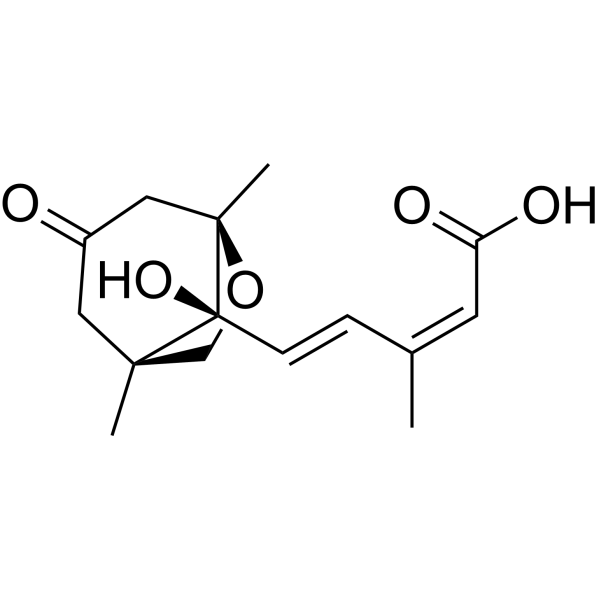
Phaseic acid is a Abscisic acid terpenoid catabolite that can able to activate a subset of Abscisic acid repectors. Phaseic acid is a plant hormone associated with photosynthesis arrest and abscission. Phaseic acid is the antagonist for NMDA-type glutamate receptor (NMDAR) that inhibits NMDAR currents with an IC50 of 34.37 μM. Phaseic acid reduces intracellular calcium influx, and exhibits neuroprotective effect.
For research use only. We do not sell to patients.
- Purity : 98.76%
- CAS No.: 24394-14-7
- Formula: C15H20O5
- Molecular Weight:280.32
-
Storage:
-20°C, protect from light
* In solvent : -80°C, 6 months; -20°C, 1 month (protect from light)

To place orders, for customer services and technical support, please contact: MedChemExpress USA
Tel: 609-228-6898 E-mail: [email protected] [email protected]


-
 Biological Activity
-
Chemical Information
- Protocols
- Purity & Documentation
- References
-
 Help & FAQs



Publications Citing Use of MedChemExpress (MCE) Phaseic acid
MoreAll Phytohormone Isoforms
MoreAll iGluR Isoforms
More

Biological Activity
Description
Cellular Effect
|
Cell Line

|
Type | Value | Description | References |
|---|---|---|---|---|
| BV-2 | IC50 |
>10 μM
Compound: 21
|
Antiinflammatory activity in C57BL6/J mouse BV2 cells assessed as inhibition of LPS-induced nitric oxide production after 24 hrs by Griess assay
Antiinflammatory activity in C57BL6/J mouse BV2 cells assessed as inhibition of LPS-induced nitric oxide production after 24 hrs by Griess assay
|
[PMID: 26110443] |
| MDCK | IC50 |
>35 μM
Compound: 21
|
Antiviral activity against Influenza A virus (A/FM/1/47(H1N1)) infected in MDCK cells assessed as inhibition of virus-induced cytopathic effect
Antiviral activity against Influenza A virus (A/FM/1/47(H1N1)) infected in MDCK cells assessed as inhibition of virus-induced cytopathic effect
|
[PMID: 26110443] |
| Vero | IC50 |
>35 μM
Compound: 21
|
Antiviral activity against Coxsackievirus B3 infected in African green monkey Vero cells assessed as inhibition of virus-induced cytopathic effect
Antiviral activity against Coxsackievirus B3 infected in African green monkey Vero cells assessed as inhibition of virus-induced cytopathic effect
|
[PMID: 26110443] |
In Vitro
Phaseic acid (10 µM, 3 h) promotes the stomatal closure, reduces water evaporation in Commelina communis leaves[3].
MedChemExpress (MCE) has not independently confirmed the accuracy of these methods. They are for reference only. Further protocols information, click here.
In Vivo
MedChemExpress (MCE) has not independently confirmed the accuracy of these methods. They are for reference only.
-
Animal Model:Mouse cerebral artery occlusion (MCAO) models[2]
-
Dosage:50 mg/mL
-
Administration:intraventricular injection, continuous infusion for 3 days
-
Result:Reduced the volume of ischemic brain lesions.


Chemical Information
-
CAS No. 24394-14-7
-
Appearance Solid
-
Molecular Weight 280.32
-
Formula C15H20O5
-
Color White to off-white
-
SMILES
O=C(O)/C=C(C)\C=C\[C@]1(O)[C@]2(C)CC(C[C@@]1(C)OC2)=O
-
Shipping
Room temperature in continental US; may vary elsewhere.
-
Storage
-20°C, protect from light
* In solvent : -80°C, 6 months; -20°C, 1 month (protect from light)


Publications (1)
-
Journal Impact Factor
-
Most Recent
-
J Agric Food Chem
Development of an Ultrahigh-Performance Liquid Chromatography-Triple Quadrupole Mass Spectrometry Method for Multiclass Phytohormone Quantification Via Multifunctional Chemical Derivatization. [Abstract]2026 May 27;74(20):15910-15920. PMID: 42145237

Protocols
-
Cell Cytotoxicity Assay
Cytotoxicity assays are usually based on the assessment of cell membrane damage, which can also be indirectly detected by measuring cell viability. Detection methods include MTT assay, CKK-8 assay, LDH assay and ATP assay, etc.
-
Research Protocol for Endocrine Diseases
Endocrine diseases often arise from disrupted hormone production, hormone signaling, or target-tissue responsiveness; for diabetes-focused endocrine disease models, insulin signaling regulates glucose uptake, hepatic glucose output, lipid metabolism, and β-cell compensation. Type 2 diabetes develops through interacting defects in insulin resistance, β-cell dysfunction, adipose inflammation, hepatic glucose overproduction, altered incretin signaling, and ectopic lipid metabolism. A major unresolved question is whether endocrine dysfunction is driven primarily by target-tissue insulin resistance, intrinsic β-cell failure, immune/inflammatory stress, or combined multi-organ failure that differs by disease stage.
-
Calcium Spark Assay
Calcium sparks are localized, transient increases in intracellular calcium concentration ([Ca2+]i) that occur in cardiac myocytes and represent elementary events underlying excitation-contraction coupling. These events are generated by the coordinated opening of clusters of ryanodine receptors (RyRs) on the sarcoplasmic reticulum membrane, leading to a brief release of Ca2+ into the cytosol. The detection and analysis of calcium sparks provide insights into the mechanisms of calcium handling and signaling in cardiac cells. Imaging techniques using fluorescent calcium indicators such as Fluo-3 are employed to visualize these subcellular calcium transients with high spatial and temporal resolution. The protocol is based on established methodologies described in primary literature for both experimental measurement and automated analysis of calcium sparks.
-
Ca2+ Staining Technique
Ca2+ staining is an experimental technique that utilizes specific fluorescent probes (such as Fluo-4 AM, Fura-2, etc.) to qualitatively or quantitatively detect dynamic changes in intracellular Ca2+ concentrations; this is achieved by monitoring the changes in fluorescent signals generated when these probes bind to free intracellular calcium ions. The underlying principle relies primarily on the presence of chelating groups within the probe's molecular structure that possess high affinity for calcium ions.


Purity & Documentation
-
Data Sheet (273 KB)
-
SDS (252 KB)
- English - EN (252 KB)
- Français - FR (252 KB)
- Deutsch - DE (252 KB)
- Norwegian - NO (252 KB)
- Español - ES (252 KB)
- Swedish - SV (252 KB)
- Italian - IT (252 KB)
- Korean - KR (252 KB)
- Portuguese - PT (252 KB)
-
Handling Instructions (2659 KB)
References
[1]. Pedro L Rodriguez, et al. Abscisic Acid Catabolism Generates Phaseic Acid, a Molecule Able to Activate a Subset of ABA Receptors. Mol Plant. 2016 Nov 7;9(11):1448-1450. [Content Brief]
[2]. Hou ST, et al., Phaseic Acid, an Endogenous and Reversible Inhibitor of Glutamate Receptors in Mouse Brain. J Biol Chem. 2016 Dec 30;291(53):27007-27022. [Content Brief]
[3]. Sharkey TD, et al., Effects of phaseic Acid and dihydrophaseic Acid on stomata and the photosynthetic apparatus. Plant Physiol. 1980 Feb;65(2):291-7. [Content Brief]

Calculators
Concentration (start) × Volume (start) = Concentration (final) × Volume (final)


Phaseic acid Related Classifications
HY-111973 Related Classifications
 Powered by Bioz