



Pitolisant
Based on 2 publication(s) in Google Scholar
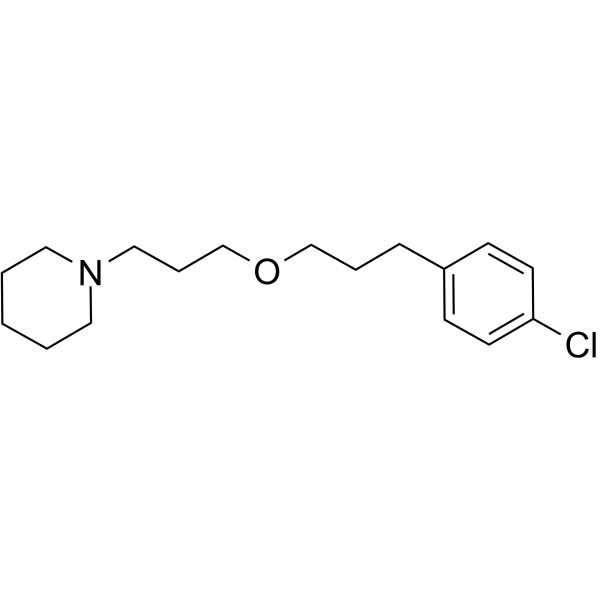
Pitolisant is a potent and selective nonimidazole inverse agonist at the recombinant human histamine H3 receptor (Ki=0.16 nM).
For research use only. We do not sell to patients.
- Purity : 99.54%
- CAS No.: 362665-56-3
- Formula: C17H26ClNO
- Molecular Weight:295.85
-
Storage:Pure form -20°C, 3 years , 4°C, 2 years ; In solvent -80°C, 6 months , -20°C, 1 month

To place orders, for customer services and technical support, please contact: MedChemExpress USA
Tel: 609-228-6898 E-mail: [email protected] [email protected]


-
 Biological Activity
-
Chemical Information
-
Solvent & Solubility
- Purity & Documentation
- References
-
 Help & FAQs


-
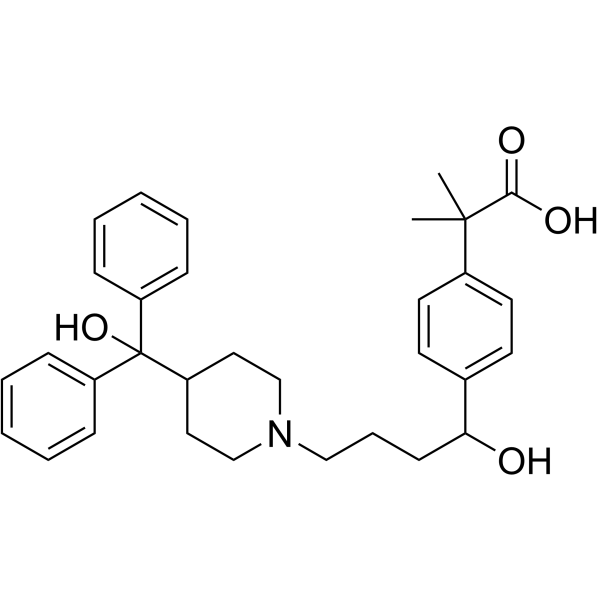
HY-B0801
FexofenadineH1R Antagonist -
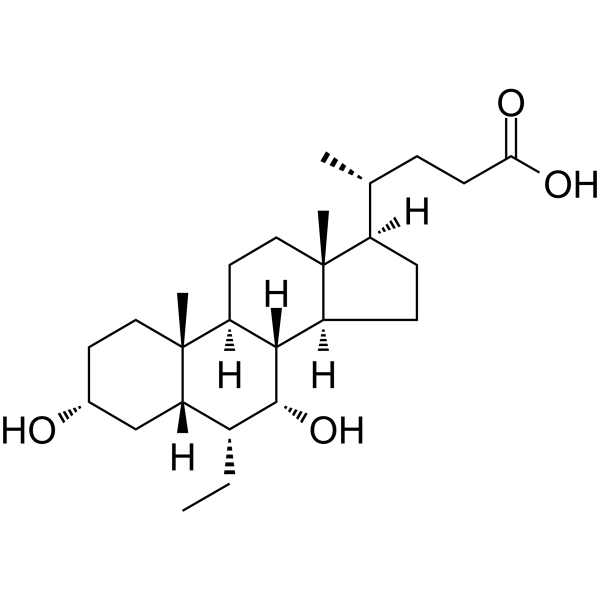
HY-12222
Obeticholic acidFXR Agonist -
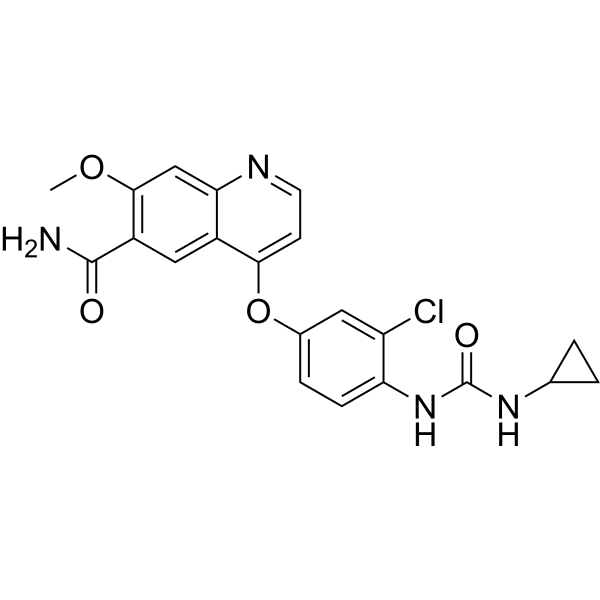
HY-10981
LenvatinibVEGFR/FGFR Inhibitor -
HY-10619
NiraparibPARP Inhibitor -
HY-B0281A
Ranitidine hydrochlorideHistamine H2-Receptor Antagonist -
HY-12532
AstemizoleH1 Receptor Antagonist -
HY-114370
SelpercatinibRET Kinase Inhibitor -
HY-109037
MavacamtenCardiac Myosin Modulator -
HY-12689
MitapivatPK Activator -
HY-14751
RolapitantNK1 Receptor Antagonist -
HY-A0095
FlibanserinSerotonin Modulator -
HY-14896
OpicaponeCOMT Inhibitor
Publications Citing Use of MedChemExpress (MCE) Pitolisant
MoreAll Histamine Receptor Isoforms
More

Biological Activity
Description
IC50 & Target
Cellular Effect
|
Cell Line

|
Type | Value | Description | References |
|---|---|---|---|---|
| CHO | IC50 |
1.7 μM
Compound: Pitolisant
|
Inhibition of human ERG expressed in CHO cells at holding potential of -90 mV by patch clamp method
Inhibition of human ERG expressed in CHO cells at holding potential of -90 mV by patch clamp method
|
[PMID: 28797771] |
| CHO-K1 | EC50 |
1.5 nM
Compound: BF2.649
|
Antagonist activity at human histamine H3 receptor expressed in CHO-K1 cells by [35S]GTPgammaS binding assay
Antagonist activity at human histamine H3 receptor expressed in CHO-K1 cells by [35S]GTPgammaS binding assay
|
[PMID: 19329325] |
| CHO-K1 | IC50 |
12 nM
Compound: 25, BF2.649
|
Antagonist activity at human cloned histamine H3 receptor expressed in CHO-K1 cells assessed as inhibition of R-alpha-methylhistamine-induced [35S]GTPgammaS binding
Antagonist activity at human cloned histamine H3 receptor expressed in CHO-K1 cells assessed as inhibition of R-alpha-methylhistamine-induced [35S]GTPgammaS binding
|
[PMID: 18841880] |
In Vitro
On the stimulation of guanosine 5′-O-(3-[35S]thio)triphosphate binding to this receptor, Pitolisant (BF2.649) behaves as a competitive antagonist with a Ki value of 0.16 nM and as an inverse agonist with an EC50 value of 1.5 nM and an intrinsic activity ~50% higher than that of ciproxifan. Pitolisant displaces [125I]iodoproxyfan binding from mouse brain cortical membranes with an IC50 value of 26.4±4.5 nM. Taking into account the Kd value of the radioligand (161±9 pM), the deduced Ki value for Pitolisant is 14±1 nM. Pitolisant displaces [125I]iodoproxyfan binding from membranes of rat glioma C6 cells stably expressing the human H3 receptor with an IC50 value of 4.2±0.2 nM. Taking into account the Kd value of the radioligand (50±4 pM), the deduced Ki value for Pitolisant is 2.7±0.5 nM. Pitolisant progressively reverses this response with a Hill coefficient close to unity and an IC50 value of 330±68 nM, leading to a Ki value of 17±4 nM. Pitolisant elicits a dose-dependent decrease of the basal-specific [35S]GTPγS binding to membranes with a maximal effect corresponding to 75±1% of the basal-specific binding and an EC50 value of 1.5±0.1 nM[1].
MedChemExpress (MCE) has not independently confirmed the accuracy of these methods. They are for reference only. .
In Vivo
MedChemExpress (MCE) has not independently confirmed the accuracy of these methods. They are for reference only.
Clinical Trial
| NCT Number | Sponsor | Condition | Start Date |
Phase
|
|---|---|---|---|---|
| NCT01329991 | Plexxikon| | 2011-05 | PHASE1 |


Chemical Information
-
CAS No. 362665-56-3
-
Appearance Liquid (Density: 1.056 g/cm3)
-
Molecular Weight 295.85
-
Formula C17H26ClNO
-
Color Colorless to light yellow
-
SMILES
ClC1=CC=C(CCCOCCCN2CCCCC2)C=C1
-
Synonyms
Tiprolisant
-
Shipping
Room temperature in continental US; may vary elsewhere.
-
Storage
Pure form -20°C 3 years 4°C 2 years In solvent -80°C 6 months -20°C 1 month


Publications (2)
-
Journal Impact Factor
-
Most Recent
-
CNS Neurosci Ther
Pitolisant Inhibits Alcohol Drinking and Improves Withdrawal Negative Affect Through Lateral Habenula Histaminergic Signaling in Mice. [Abstract]2026 Jan;32(1):e70732. PMID: 41492821 -
Brain Res
In vivo evaluation of effects of histamine H3 receptor antagonists on methamphetamine-induced hyperlocomotion in mice. [Abstract]2020 Aug 1:1740:146873. PMID: 32387137


Solvent & Solubility
In Vitro:
DMSO : 200 mg/mL (676.02 mM; Need ultrasonic; Hygroscopic DMSO has a significant impact on the solubility of product, please use newly opened DMSO)
Please refer to the solubility information to select the appropriate solvent. Once prepared, please aliquot and store the solution to prevent product inactivation from repeated freeze-thaw cycles.
Storage method and period of stock solution: -80°C, 6 months; -20°C, 1 month. When stored at -80°C, please use it within 6 months. When stored at -20°C, please use it within 1 month.
Please refer to the solubility information to select the appropriate solvent. Once prepared, please aliquot and store the solution to prevent product inactivation from repeated freeze-thaw cycles.
Storage method and period of stock solution: -80°C, 6 months; -20°C, 1 month. When stored at -80°C, please use it within 6 months. When stored at -20°C, please use it within 1 month.
Concentration (start) × Volume (start) = Concentration (final) × Volume (final)
In Vivo:
Select the appropriate dissolution method based on your experimental animal and administration route.
- For the following dissolution methods, please ensure to first prepare a clear stock solution using an In Vitro approach and then sequentially add co-solvents:
- To ensure reliable experimental results, the clarified stock solution can be appropriately stored based on storage conditions. As for the working solution for In Vivo experiments, it is recommended to prepare freshly and use it on the same day.
- The percentages shown for the solvents indicate their volumetric ratio in the final prepared solution. If precipitation or phase separation occurs during preparation, heat and/or sonication can be used to aid dissolution.
Add each solvent one by one: 10% DMSO 40% PEG300 5% Tween-80 45% Saline
Solubility: ≥ 2.5 mg/mL (8.45 mM); Clear solution
This protocol yields a clear solution of ≥ 2.5 mg/mL (saturation unknown).
Taking 1 mL working solution as an example, add 100 μL DMSO stock solution (25.0 mg/mL) to 400 μL PEG300, and mix evenly; then add 50 μL Tween-80 and mix evenly; then add 450 μL Saline to adjust the volume to 1 mL.
Preparation of Saline: Dissolve 0.9 g sodium chloride in ddH₂O and dilute to 100 mL to obtain a clear Saline solution.
Add each solvent one by one: 10% DMSO 90% (20% SBE-β-CD in Saline)
Solubility: ≥ 2.5 mg/mL (8.45 mM); Clear solution
This protocol yields a clear solution of ≥ 2.5 mg/mL (saturation unknown).
Taking 1 mL working solution as an example, add 100 μL DMSO stock solution (25.0 mg/mL) to 900 μL 20% SBE-β-CD in Saline, and mix evenly.
Preparation of 20% SBE-β-CD in Saline (4°C, storage for one week): 2 g SBE-β-CD powder is dissolved in 10 mL Saline, completely dissolve until clear.
In Vivo Dissolution Calculator
Please enter the basic information of animal experiments:
-
-
-
-
Recommended: Prepare an additional quantity of animals to account for potential losses during experiments.
Please enter your animal formula composition:
-
%DMSO +
Recommended: Keep the proportion of DMSO in working solution below 2% if your animal is weak.
-
%+
-
+%Tween-80 + +
-
%Saline +
The co-solvents required include: DMSO, . All of co-solvents are available by MedChemExpress (MCE). , Tween 80. All of co-solvents are available by MedChemExpress (MCE).
Working solution concentration: 0.22 mg/mL
Method for preparing stock solution: mg drug dissolved in μL DMSO. Stock solution concentration: mg/mL.
1. Take μL DMSO stock solution;
2. Add μL .
μL , mix evenly;
3. Then add μL Tween 80, mix evenly;
4. Then add μL
Please ensure that the stock solution in the first step is dissolved to a clear state, and add co-solvents in sequence. You can use ultrasonic heating (ultrasonic cleaner, recommended frequency 20-40 kHz), vortexing, etc. to assist dissolution.


Purity & Documentation
-
Data Sheet (278 KB)
-
SDS (396 KB)
- English - EN (396 KB)
- Français - FR (396 KB)
- Deutsch - DE (396 KB)
- Norwegian - NO (396 KB)
- Español - ES (396 KB)
- Swedish - SV (396 KB)
- Italian - IT (396 KB)
- Korean - KR (396 KB)
- Portuguese - PT (396 KB)
-
Handling Instructions (2659 KB)
References
[1]. Ligneau X, et al. BF2.649 [1-{3-[3-(4-Chlorophenyl)propoxy]propyl}piperidine, hydrochloride], a nonimidazole inverse agonist/antagonist at the human histamine H3 receptor: Preclinical pharmacology. J Pharmacol Exp Ther. 2007 Jan;320(1):365-75. [Content Brief]
[2]. Dudek M, et al. H3 histamine receptor antagonist pitolisant reverses some subchronic disturbances induced by olanzapine in mice. Metab Brain Dis. 2016 Oct;31(5):1023-9. [Content Brief]
[3]. Uguen M, et al. Preclinical evaluation of the abuse potential of Pitolisant, a histamine H? receptor inverse agonist/antagonist compared with Modafinil. Br J Pharmacol. 2013 Jun;169(3):632-44. [Content Brief]


Complete Stock Solution Preparation Table
Please refer to the solubility information to select the appropriate solvent. Once prepared, please aliquot and store the solution to prevent product inactivation from repeated freeze-thaw cycles.
Storage method and period of stock solution: -80°C, 6 months; -20°C, 1 month. When stored at -80°C, please use it within 6 months. When stored at -20°C, please use it within 1 month.
| Optional Solvent | Concentration Solvent Mass | 1 mg | 5 mg | 10 mg | 25 mg |
|---|---|---|---|---|---|
| DMSO | 1 mM | 3.3801 mL | 16.9005 mL | 33.8009 mL | 84.5023 mL |
| 5 mM | 0.6760 mL | 3.3801 mL | 6.7602 mL | 16.9005 mL | |
| 10 mM | 0.3380 mL | 1.6900 mL | 3.3801 mL | 8.4502 mL | |
| 15 mM | 0.2253 mL | 1.1267 mL | 2.2534 mL | 5.6335 mL | |
| 20 mM | 0.1690 mL | 0.8450 mL | 1.6900 mL | 4.2251 mL | |
| 25 mM | 0.1352 mL | 0.6760 mL | 1.3520 mL | 3.3801 mL | |
| 30 mM | 0.1127 mL | 0.5633 mL | 1.1267 mL | 2.8167 mL | |
| 40 mM | 0.0845 mL | 0.4225 mL | 0.8450 mL | 2.1126 mL | |
| 50 mM | 0.0676 mL | 0.3380 mL | 0.6760 mL | 1.6900 mL | |
| 60 mM | 0.0563 mL | 0.2817 mL | 0.5633 mL | 1.4084 mL | |
| 80 mM | 0.0423 mL | 0.2113 mL | 0.4225 mL | 1.0563 mL | |
| 100 mM | 0.0338 mL | 0.1690 mL | 0.3380 mL | 0.8450 mL |


Pitolisant Related Classifications
HY-12199 Related Classifications
 Powered by Bioz