



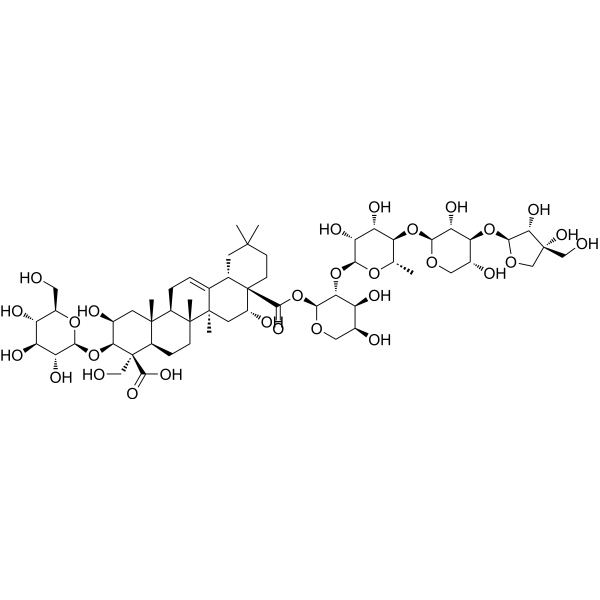
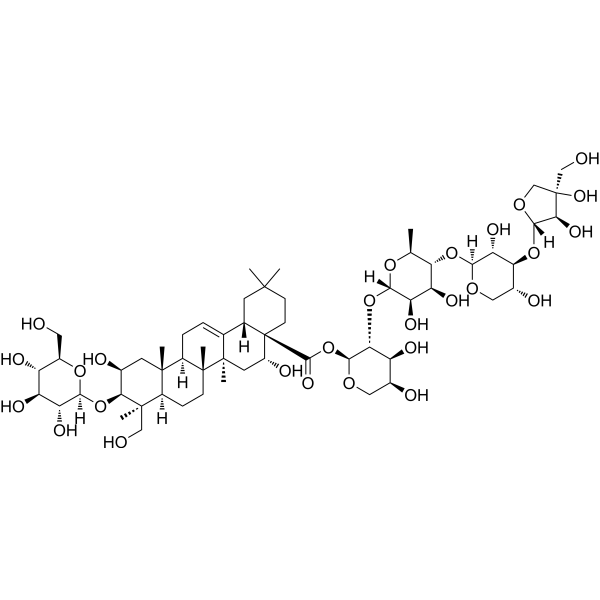
Platyconic acid A

Based on 1 Customer Validation
Platyconic Acid A is an active component of changkil saponins from platycodon grandiflorum and can be used for the research of reducing airway inflammation.
Nur für Forschungszwecke. Wir verkaufen nicht an Patienten.
- Reinheit : 99.57%
- CAS. Nr.: 68051-23-0
- Formel: C57H90O29
- Molecular Weight:1239.31
-
Speicherung:
4°C, protect from light
* In solvent : -80°C, 6 months; -20°C, 1 month (protect from light)

To place orders, for customer services and technical support, please contact: MedChemExpress USA
Tel: 609-228-6898 E-mail: [email protected] [email protected]


-
 Biologische Aktivität
-
Chemical Information
-
Lösungsmittel & Löslichkeit
- Protokoll
- Reinheit & Dokumentation
- Verweise
-
 Help & FAQs




Biologische Aktivität
Beschreibung
In Vitro
Platyconic Acid A (0.5~2 μM; 30 minutes; A549 cells) inhibits PMA-induced NF-κB p65 phosphorylation, IκBα phosphorylation and degradation and Akt phosphorylation in a concentration-dependent manner[1].
Platyconic Acid A (0.5~2 μM; 24 hours; A549 cells) decreases PMA-increased MUC5AC mRNA expression in a concentration-dependent manner[1].
MedChemExpress (MCE) has not independently confirmed the accuracy of these methods. They are for reference only.
-
Cell Line:A549 cells
-
Concentration:0.5~2 μM
-
Incubation Time:30 minutes
-
Result:Inhibited PMA-induced NF-κB p65 phosphorylation, IκBα phosphorylation and degradation and Akt phosphorylation in a concentration-dependent manner.
-
Cell Line:A549 cells
-
Concentration:0.5~2 μM
-
Incubation Time:24 hours
-
Result:Decreased PMA-increased MUC5AC mRNA expression in a concentration-dependent manner.


Chemical Information
-
CAS. Nr. 68051-23-0
-
Appearance Solid
-
Molecular Weight 1239.31
-
Formel C57H90O29
-
Color White to off-white
-
SMILES
C[C@H]1[C@H](O[C@H]2[C@H](O)[C@@H](O[C@H]3[C@H](O)[C@](CO)(O)CO3)[C@H](O)CO2)[C@@H](O)[C@@H](O)[C@H](O[C@@H]4[C@@H](O)[C@@H](O)CO[C@H]4OC([C@]56CCC(C)(C)C[C@H]5C7=CC[C@H]8[C@](CC[C@@H]9[C@]8(C)C[C@H](O)[C@H](O[C@H]%10[C@H](O)[C@@H](O)[C@H](O)[C@@H](CO)O%10)[C@@]9(C(O)=O)CO)(C)[C@]7(C)C[C@H]6O)=O)O1
-
Structure Classification
-
Versand
Room temperature in continental US; may vary elsewhere.
-
Speicherung
4°C, protect from light
* In solvent : -80°C, 6 months; -20°C, 1 month (protect from light)


Lösungsmittel & Löslichkeit
In Vitro:
H2O : 25 mg/mL (20.17 mM; Need ultrasonic)
Please refer to the solubility information to select the appropriate solvent. Once prepared, please aliquot and store the solution to prevent product inactivation from repeated freeze-thaw cycles.
Storage method and period of stock solution: -80°C, 6 months; -20°C, 1 month (protect from light). When stored at -80°C, please use it within 6 months. When stored at -20°C, please use it within 1 month.
* Note: If you choose water as the stock solution, please dilute it to the working solution, then filter and sterilize it with a 0.22 μm filter before use.
Please refer to the solubility information to select the appropriate solvent. Once prepared, please aliquot and store the solution to prevent product inactivation from repeated freeze-thaw cycles.
Storage method and period of stock solution: -80°C, 6 months; -20°C, 1 month (protect from light). When stored at -80°C, please use it within 6 months. When stored at -20°C, please use it within 1 month.
* Note: If you choose water as the stock solution, please dilute it to the working solution, then filter and sterilize it with a 0.22 μm filter before use.
Konzentration (Stammlösung) × Volumen (Stammlösung) = Konzentration (Ziellösung) × Volumen (Ziellösung)


Reinheit & Dokumentation
-
Data Sheet (274 KB)
-
SDS (252 KB)
- English - EN (252 KB)
- Français - FR (252 KB)
- Deutsch - DE (252 KB)
- Norwegian - NO (252 KB)
- Español - ES (252 KB)
- Swedish - SV (252 KB)
- Italian - IT (252 KB)
- Korean - KR (252 KB)
- Portuguese - PT (252 KB)
-
Handling Instructions (2659 KB)
Verweise


Complete Stock Solution Preparation Table
Please refer to the solubility information to select the appropriate solvent. Once prepared, please aliquot and store the solution to prevent product inactivation from repeated freeze-thaw cycles.
Storage method and period of stock solution: -80°C, 6 months; -20°C, 1 month (protect from light). When stored at -80°C, please use it within 6 months. When stored at -20°C, please use it within 1 month.
| Optional Solvent | Concentration Solvent Mass | 1 mg | 5 mg | 10 mg | 25 mg |
|---|---|---|---|---|---|
| H2O | 1 mM | 0.8069 mL | 4.0345 mL | 8.0690 mL | 20.1725 mL |
| 5 mM | 0.1614 mL | 0.8069 mL | 1.6138 mL | 4.0345 mL | |
| 10 mM | 0.0807 mL | 0.4035 mL | 0.8069 mL | 2.0173 mL | |
| 15 mM | 0.0538 mL | 0.2690 mL | 0.5379 mL | 1.3448 mL | |
| 20 mM | 0.0403 mL | 0.2017 mL | 0.4035 mL | 1.0086 mL |
* Note: If you choose water as the stock solution, please dilute it to the working solution, then filter and sterilize it with a 0.22 μm filter before use.


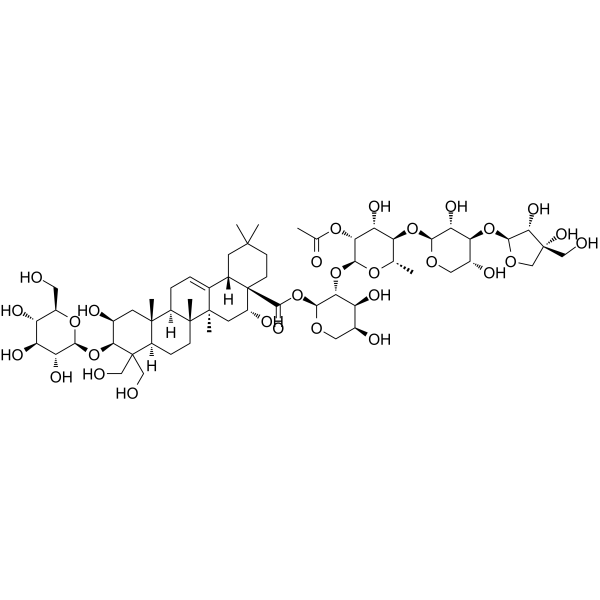
Platyconic acid A Related Classifications
HY-N9377 Related Classifications
 Powered by Bioz