



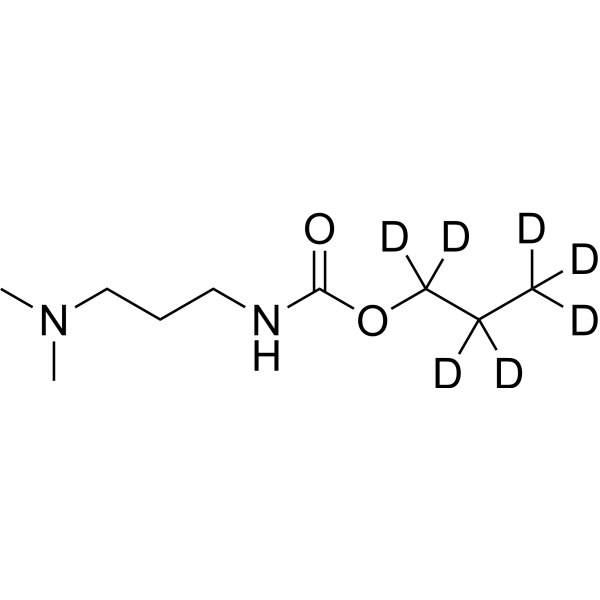
Propamocarb-d7

Based on 1 Customer Validation
Propamocarb-d7 is the deuterated-labeled Propamocarb (HY-B2026). Propamocarb is an orally active phenylalanine ammonia-lyase (PAL) inducer and oomycete membrane biosynthesis inhibitor that can be present in synthetic formulations. Propamocarb is used in research on blight, gut microbiota dysbiosis and metabolic disorders, cardiovascular diseases, and potato late blight.
For research use only. We do not sell to patients.
- CAS No.: 1398065-89-8
- Formula: C9H13D7N2O2
- Molecular Weight:195.31
-
Storage:Pure form -20°C, 3 years , 4°C, 2 years ; In solvent -80°C, 6 months , -20°C, 1 month

To place orders, for customer services and technical support, please contact: MedChemExpress USA
Tel: 609-228-6898 E-mail: [email protected] [email protected]


-
 Biological Activity
-
Chemical Information
- Protocols
- Purity & Documentation
- References
-
 Help & FAQs




Biological Activity
Description
Application
1. This compound can be used as a tracer
2. This compound can be used as an internal standard for quantitative analysis by NMR, GC-MS, or LC-MS.


Chemical Information
-
CAS No. 1398065-89-8
-
Unlabeled CAS 24579-73-5
-
Appearance Viscous Liquid
-
Molecular Weight 195.31
-
Formula C9H13D7N2O2
-
Color Colorless to light yellow
-
SMILES
[2H]C([2H])([2H])C([2H])([2H])C([2H])([2H])OC(NCCCN(C)C)=O
-
Shipping
Room temperature in continental US; may vary elsewhere.
-
Storage
Pure form -20°C 3 years 4°C 2 years In solvent -80°C 6 months -20°C 1 month


Purity & Documentation
References
[2]. Hu J, et al. Effects of Propamocarb Hydrochloride on Mycelial Growth, Sporulation, and Infection by Phytophthora nicotianae Isolates from Virginia Nurseries. Plant disease. 2007 Apr;91(4):414-420. [Content Brief]
[3]. Wu S, et al. Exposure to the fungicide propamocarb causes gut microbiota dysbiosis and metabolic disorder in mice. Environmental pollution (Barking, Essex : 1987). 2018 Jun;237:775-783. [Content Brief]
[4]. Wu S, et al. Chronic exposure to fungicide propamocarb induces bile acid metabolic disorder and increases trimethylamine in C57BL/6J mice. Sci Total Environ. 2018 Nov 15;642:341-348. [Content Brief]
[5]. Schmuck G, et al. Effects of the carbamates fenoxycarb, propamocarb and propoxur on energy supply, glucose utilization and SH-groups in neurons. Archives of toxicology. 2004 Jun;78(6):330-7. [Content Brief]

Calculators
Concentration (start) × Volume (start) = Concentration (final) × Volume (final)


Propamocarb-d7 Related Classifications
HY-B2026S Related Classifications
 Powered by Bioz
Keywords
- Propamocarb-d7
- 1398065-89-8
- Isotope-Labeled Compounds
- Fungal
- Biochemical Assay Reagents
- oomycete membrane biosynthesis inhibitor
- gut microbiota dysbiosis
- cardiovascular disease
- cucumber fruit peel
- late blight of potato
- Phytophthora nicotianae
- phenylpropanoid pathway
- phenylalanine ammonia-lyase (PAL) inducer
- lignin synthesis
- Phytophthora infestans
- Inhibitor
- inhibitor
- inhibit