



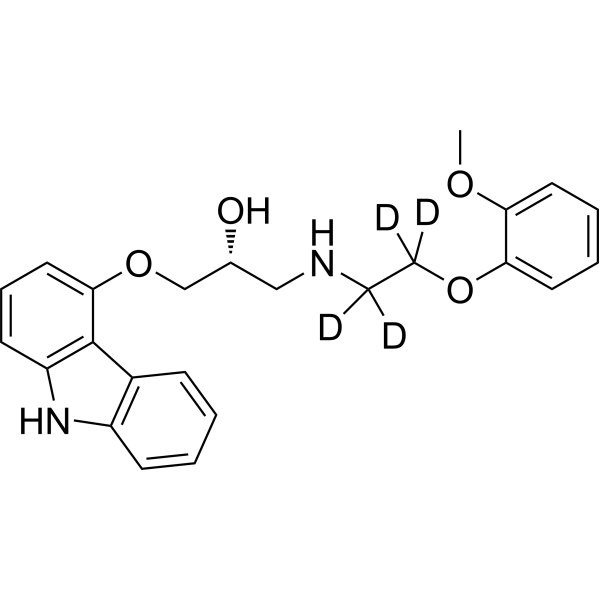
(R)-Carvedilol-d4
(R)-Carvedilol-d4 is deuterium labeled (R)-Carvedilol (HY-B0006C). (R)-Carvedilol ((R)-BM 14190) is the orally active R-isomer of Carvedilol (HY-B0006). (R)-Carvedilol has α-receptor blocking activity but no β-receptor blocking activity. (R)-Carvedilol inhibits spontaneous Ca2+ waves. (R)-Carvedilol inhibits stress-induced ventricular tachycardia and delays the development of UV-induced skin tumors and reduces their malignancy.
For research use only. We do not sell to patients.
- CAS No.: 2747915-92-8
- Formula: C24H22D4N2O4
- Molecular Weight:410.50
-
Storage:
Please store the product under the recommended conditions in the Certificate of Analysis.

To place orders, for customer services and technical support, please contact: MedChemExpress USA
Tel: 609-228-6898 E-mail: [email protected] [email protected]


-
 Biological Activity
-
Chemical Information
- Protocols
- Purity & Documentation
- References
-
 Help & FAQs




Biological Activity
Description
Application
1. This compound can be used as a tracer
2. This compound can be used as an internal standard for quantitative analysis by NMR, GC-MS, or LC-MS.


Chemical Information
-
CAS No. 2747915-92-8
-
Unlabeled CAS 95093-99-5
-
Molecular Weight 410.50
-
Formula C24H22D4N2O4
-
SMILES
O[C@H](CNC([2H])([2H])C([2H])([2H])OC1=CC=CC=C1OC)COC2=CC=CC(N3)=C2C4=C3C=CC=C4
-
Synonyms
(R)-BM 14190-d4
-
Shipping
Room temperature in continental US; may vary elsewhere.
-
Storage
Please store the product under the recommended conditions in the Certificate of Analysis.

Protocols
-
Ca2+ Staining Technique
Ca2+ staining is an experimental technique that utilizes specific fluorescent probes (such as Fluo-4 AM, Fura-2, etc.) to qualitatively or quantitatively detect dynamic changes in intracellular Ca2+ concentrations; this is achieved by monitoring the changes in fluorescent signals generated when these probes bind to free intracellular calcium ions. The underlying principle relies primarily on the presence of chelating groups within the probe's molecular structure that possess high affinity for calcium ions.


Purity & Documentation
References
[1]. Russak EM, et al. Impact of Deuterium Substitution on the Pharmacokinetics of Pharmaceuticals. Ann Pharmacother. 2019;53(2):211-216. [Content Brief]
[2]. Wu T, et al. Protective effects of S-carvedilol on doxorubicin-induced damages to human umbilical vein endothelial cells and rats. J Appl Toxicol. 2019 Aug;39(8):1233-1244. [Content Brief]
[3]. Zhang J, et al. Non-β-blocking R-carvedilol enantiomer suppresses Ca2+ waves and stress-induced ventricular tachyarrhythmia without lowering heart rate or blood pressure. Biochem J. 2015 Sep 1;470(2):233-42. [Content Brief]
[4]. Sardar PK, et al. Oral delivery of the non-β-blocking R-carvedilol enantiomer for skin cancer chemoprevention in SKH-1 mice. AAPS Open. 2025;11:1. [Content Brief]

Calculators
Concentration (start) × Volume (start) = Concentration (final) × Volume (final)


(R)-Carvedilol-d4 Related Classifications
HY-B0006CS Related Classifications
 Powered by Bioz