



EGF Protein, Rat
Based on 4 publication(s) in Google Scholar
EGF Protein, Rat is a potent epidermal growth factor, promotes epithelial proliferation and migration, and increases epithelial wound closure and shortens healing time.
- Species: Rat
- Source: E. coli
-
Storage:Stored at -20°C for 2 years from date of receipt. After reconstitution, it is stable at 4°C for 1 week or -20°C for longer (with carrier protein). It is recommended to freeze aliquots at -20°C or -80°C for extended storage.


To place orders, for customer services and technical support, please contact: MedChemExpress USA
Tel: 609-228-6898 E-mail: [email protected] [email protected]


-
 Biological Activity
-
Technical Parameters
-
Product Properties
- Documentation
- References
- Help & FAQs


-

HY-P7091
FGF-2 Protein, Rat -
HY-P7109
EGF Protein, Human -
HY-P7006
BMP-2 Protein, Human/Mouse/Rat -
HY-P7203
IGF-I/IGF-1 Protein, Rat -

HY-P5321
bFGF (119-126)bFGF/FGFR1 Ligand -
HY-P7048
KGF-2/FGF-10 Protein, Human (169a.a) -
HY-P7114
RSPO1/R-spondin-1 Protein, Human (CHO, His) -
HY-P7051A
Noggin Protein, Human (CHO) -
HY-P73101
HGF Protein, Rat (HEK293)


Biological Activity
Description
EGF Protein, Rat is a potent epidermal growth factor, promotes epithelial proliferation and migration, and increases epithelial wound closure and shortens healing time.
Background
Epidermal Growth Factor is secreted by epithelial cells, promotes epithelial proliferation and migration in a variety of tissues, and increases epithelial wound closure and shortens healing time[1]. Epidermal Growth Factor plays a key role in skin development and homeostasis, shows a protective function in the epidermal barrier. Epidermal Growth Factor also displays an immunomodulatory activity in the inflamed skin tissue[2].
Verified Bioactivity
Measured in a cell proliferation assay using BALB/c 3T3 mouse fibroblasts. The ED50 for this effect is 30-90 pg/mL.
MCE Validation Data
-
Purity - SDS-PAGE
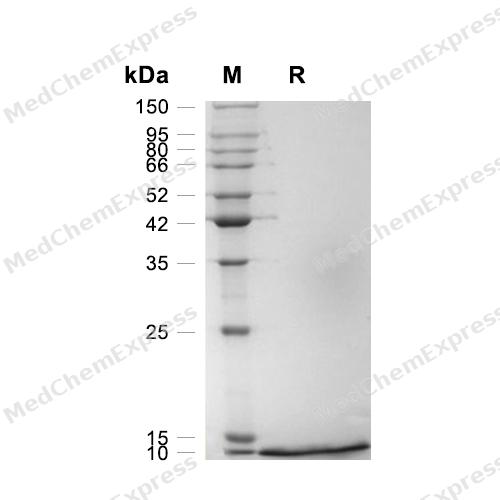
Purity - SDS-PAGE
-
Bioactivity - Cell-Based Assay
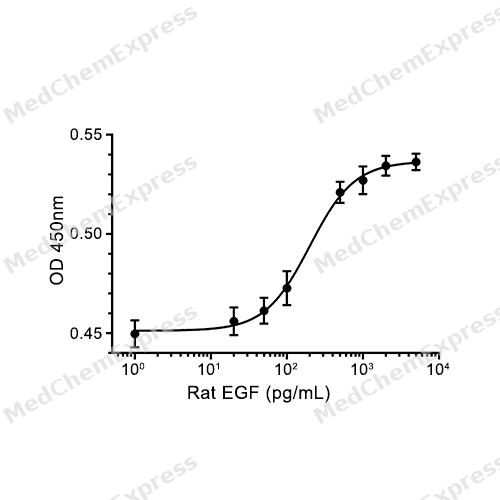
Bioactivity - Cell-Based Assay


Publications (4)
-
Journal Impact Factor
-
Most Recent
-
Int J Nanomedicine
Fabrication and Properties of a Biomimetic Dura Matter Substitute Based on Stereocomplex Poly(Lactic Acid) Nanofibers. [Abstract]2020 May 27:15:3729-3740. PMID: 32547025 -
Int Immunopharmacol
Central amygdala HDAC6 contributes to visceral hypersensitivity and affective comorbidities in IBS-like rats. [Abstract]2026 May 1:176:116466. PMID: 41797088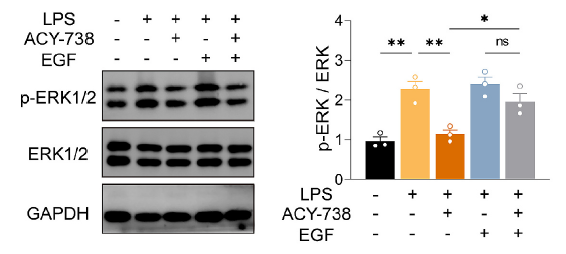
EGF Protein, Rat purchased from MedChemExpress. Usage Cited in: Int Immunopharmacol. 2026 May 1:176:116466. [Abstract]
EGF Protein, Rat (100 ng/mL; 5 min) reversed the reduction in ERK1/2 phosphorylation in PC12 cells under ACY-738 treatment.
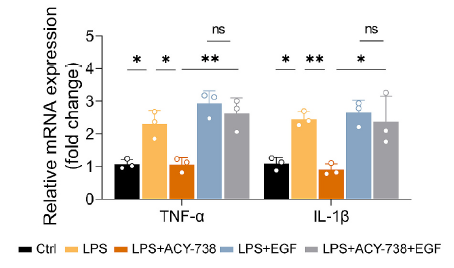
EGF Protein, Rat purchased from MedChemExpress. Usage Cited in: Int Immunopharmacol. 2026 May 1:176:116466. [Abstract]
EGF Protein, Rat (100 ng/mL; 5 min) reversed the reduction in TNF-α and IL-1β mRNA expression levels in PC12 cells under ACY-738 treatment.
-
Int J Mol Sci
The Retinoic-Acid-Related Orphan Receptor Alpha May Be Highly Involved in the Regulation of Seasonal Hair Molting. [Abstract]2025 Feb 13;26(4):1579. PMID: 40004044 -
FASEB J
2024 Feb 29;38(4):e23469. PMID: 38358361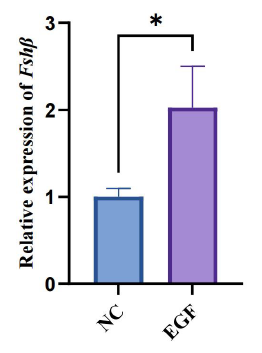
EGF Protein, Rat purchased from MedChemExpress. Usage Cited in: FASEB J. 2024 Feb 29;38(4):e23469. [Abstract]
EGF Protein, Rat (2.5 μg/mL; 200 μL; i.p.) significantly upregulated Fshβ mRNA expression in adenopituitary tissues of Sprague-Dawley rats.
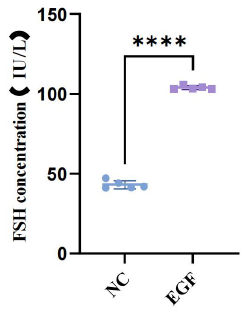
EGF Protein, Rat purchased from MedChemExpress. Usage Cited in: FASEB J. 2024 Feb 29;38(4):e23469. [Abstract]
EGF Protein, Rat (2.5 μg/mL; 200 μL; i.p.) significantly increased FSH content within the serum of Sprague-Dawley rats.
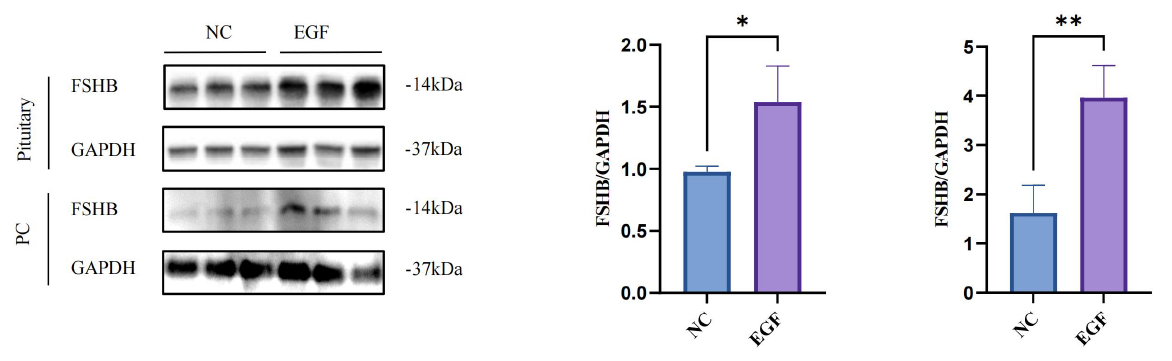
EGF Protein, Rat purchased from MedChemExpress. Usage Cited in: FASEB J. 2024 Feb 29;38(4):e23469. [Abstract]
EGF Protein, Rat (2.5 μg/mL; 200 μL; i.p.) significantly upregulated FSHB protein expression in adenopituitary tissues and adenopituitary progenitor cells of Sprague-Dawley rats.


Technical Parameters
-
Species Rat
-
Source E. coli
-
Tag Tag Free
-
Accession
P07522/NP_036974.1 (N974-R1026)
-
Molecular Construction
-
N-term
-
EGF (N974-R1026)
Accession # P07522 -
C-term
-
-
Protein Length
Partial Extracellular Domain
-
Synonyms
EGF; Alternative Protein EGF; Epidermal Growth Factor; Beta-Urogastrone; Pro-Epidermal Growth Factor; HOMG4; Epidermal Growth Factor (Beta-Urogastrone); URG
-
AA Sequence
NSNTGCPPSYDGYCLNGGVCMYVESVDRYVCNCVIGYIGERCQHRDLRWWKLR
-
Predicted Molecular Mass
6.3 kDa
-
Molecular Weight
Approximately 6-9 kDa, based on SDS-PAGE under reducing conditions.
-
Purity
≥ 95%, as determined by reducing SDS-PAGE.


Product Properties
Lyophilized powder
1.Lyophilized from a 0.22 μm filtered solution of 20 mM PB, 150 mM NaCl, pH 7.4.
2.Lyophilized from a 0.22 μm filtered solution of PBS, pH 7.4.
3.Lyophilized from a 0.22 μm filtered solution of PBS, pH 7.4, 5% trehalose, 5% mannitol, 0.01% Tween 80.
4.Lyophilized from a 0.22 μm filtered solution of PBS, pH 7.4, 8% trehalose.
Please refer to the lot-specific COA for specific buffer information.
<1 EU/μg, determined by LAL method.
It is not recommended to reconstitute to a concentration less than 100 μg/mL in ddH2O. For long term storage it is recommended to add a carrier protein (0.1% BSA, 5% HSA, 10% FBS or 5% Trehalose).
Stored at -20°C for 2 years from date of receipt. After reconstitution, it is stable at 4°C for 1 week or -20°C for longer (with carrier protein). It is recommended to freeze aliquots at -20°C or -80°C for extended storage.
Room temperature in continental US; may vary elsewhere.


Documentation
-
Data Sheet (261 KB)
-
SDS (251 KB)
- English - EN (251 KB)
- Français - FR (251 KB)
- Deutsch - DE (251 KB)
- Norwegian - NO (251 KB)
- Español - ES (251 KB)
- Swedish - SV (251 KB)
- Italian - IT (251 KB)
- Korean - KR (251 KB)
- Portuguese - PT (251 KB)
-
Handling Instructions (2659 KB)


References
[1]. Palencia L, et al. Epidermal growth factor mediated healing in stem cell-derived vocal fold mucosa. J Surg Res. 2015 Jul;197(1):32-8. [Content Brief]
[2]. Choi SY, et al. Epidermal Growth Factor Relieves Inflammatory Signals in Staphylococcus aureus-Treated Human Epidermal Keratinocytes and Atopic Dermatitis-Like Skin Lesions in Nc/Nga Mice. Biomed Res Int. 2018 May 15;2018:9439182. [Content Brief]

Calculators
Concentration (start) × Volume (start) = Concentration (final) × Volume (final)


 Powered by Bioz

