



Santalene

Based on 1 Customer Validation
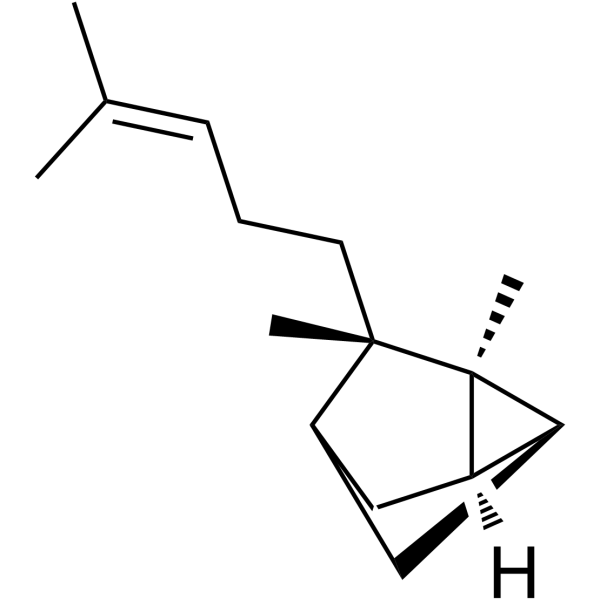
Santalene is a bicyclic sesquiterpene and a major component of sandalwood oil found in the heartwood of Santalum album. Santalene exhibits antibacterial, antioxidant and antitumor pharmacological activities.
For research use only. We do not sell to patients.
- Purity : 97.0%
- CAS No.: 512-61-8
- Formula: C15H24
- Molecular Weight:204.35
-
Storage:Pure form -20°C, 3 years ; In solvent -80°C, 6 months , -20°C, 1 month

To place orders, for customer services and technical support, please contact: MedChemExpress USA
Tel: 609-228-6898 E-mail: [email protected] [email protected]


-
 Biological Activity
-
Chemical Information
- Protocols
- Purity & Documentation
- References
-
 Help & FAQs




Biological Activity
Description
In Vitro
Santalene in engineered Komagataella phaffii STE-1, with a single copy of TEF1p-driven SAS, produces α-santalene at a titer of 90.2 mg/L in shake flask two-phase fermentation, with no observed cytotoxicity or metabolic burden[1].
Santalene (20 g/L peptone additives) in Komagataella phaffii STE-9 cultured in YP1D medium (with peptone P1) increases α-santalene production to a titer of 829.8 mg/L in shake flask two-phase fermentation[1].
MedChemExpress (MCE) has not independently confirmed the accuracy of these methods. They are for reference only.


Chemical Information
-
CAS No. 512-61-8
-
Appearance Liquid (Density: 0.9075 g/cm³)
-
Molecular Weight 204.35
-
Formula C15H24
-
Color Colorless to light yellow
-
SMILES
C[C@]12[C@@H](C3)[C@@]1([H])CC3[C@@](C)2CC/C=C(C)/C
-
Synonyms
α-Santalene
-
Structure Classification
-
Initial Source
-
Shipping
Room temperature in continental US; may vary elsewhere.
-
Storage
Pure form -20°C 3 years In solvent -80°C 6 months -20°C 1 month


Purity & Documentation
-
Data Sheet (272 KB)
-
SDS (251 KB)
- English - EN (251 KB)
- Français - FR (251 KB)
- Deutsch - DE (251 KB)
- Norwegian - NO (251 KB)
- Español - ES (251 KB)
- Swedish - SV (251 KB)
- Italian - IT (251 KB)
- Korean - KR (251 KB)
- Portuguese - PT (251 KB)
-
Handling Instructions (2659 KB)
References

Calculators
Concentration (start) × Volume (start) = Concentration (final) × Volume (final)


Santalene Related Classifications
HY-127033 Related Classifications
 Powered by Bioz