



Isoxanthopterin

Based on 1 Customer Validation
Isoxanthopterin is a pteridine marker used to indicate xanthine oxidase activity. Isoxanthopterin is used in research on type 1 diabetes, breast cancer, and hyperphenylalaninemia.
For research use only. We do not sell to patients.
- Purity : 99.85%
- CAS No.: 529-69-1
- Formula: C6H5N5O2
- Molecular Weight:179.14
-
Storage:Powder -20°C, 3 years ; In solvent -80°C, 6 months , -20°C, 1 month


To place orders, for customer services and technical support, please contact: MedChemExpress USA
Tel: 609-228-6898 E-mail: [email protected] [email protected]


-
 Biological Activity
-
Chemical Information
-
Solvent & Solubility
- Protocols
- Purity & Documentation
- References
-
 Help & FAQs


-
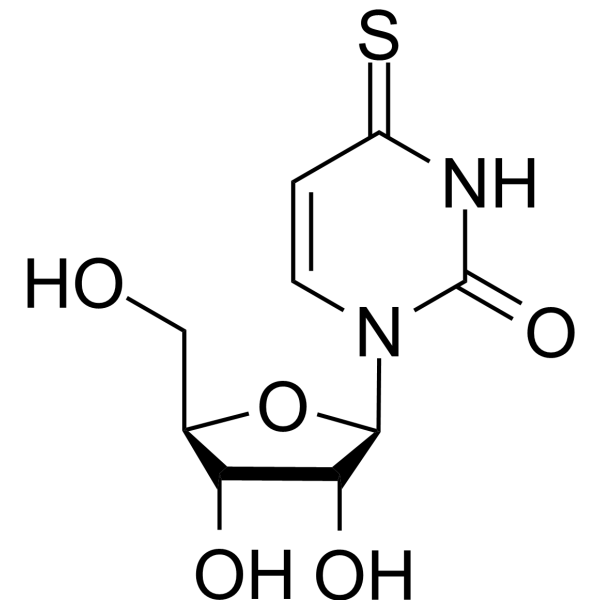
HY-W011793
4-ThiouridineRibonucleoside Analog -
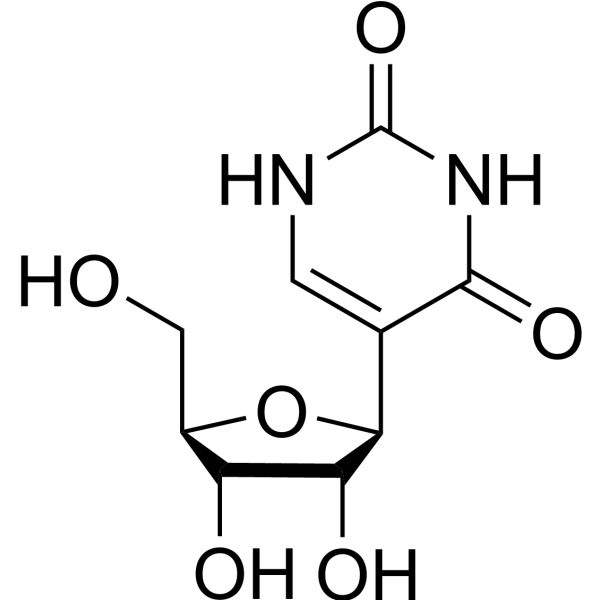
HY-113061
PseudouridineNucleoside -

HY-113061R
Pseudouridine (Standard)Nucleoside -
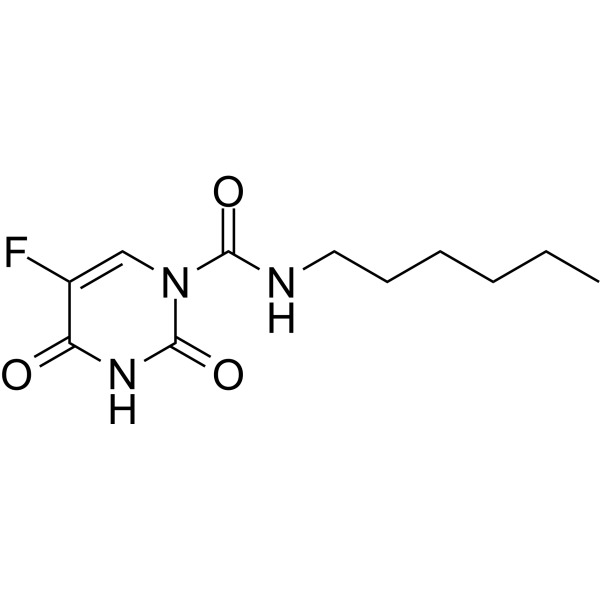
HY-B0182
CarmofurAcid Ceramidase/SARS-CoV-2 Mpro/FAAH/NAAA Inhibitor -

HY-W011793R
4-Thiouridine (Standard)Ribonucleoside Analog -

HY-B0182R
Carmofur (Standard)Acid Ceramidase/SARS-CoV-2 Mpro/FAAH/NAAA Inhibitor
All Endogenous Metabolite Isoforms
More

Biological Activity
Description
In Vitro
The UV-vis spectrum of Isoxanthopterin (50 μM) shows absorption maxima at 282 and 340.01 nm, which are attributed to π→π and n→π transitions[3].
Isoxanthopterin effectively supports the growth of Alcaligenes faecalis as a sole nitrogen source[5].
Isoxanthopterin (7.8-250 μM; 24 h) exhibits cytotoxicity against confluent MCF-7 human mammary carcinoma cells, with IC50 values of 109 μM (full-range least squares fit), 119 μM (62.5-250 μM range), and 103 μM (abstract), as measured by the MTS assay[7].
MedChemExpress (MCE) has not independently confirmed the accuracy of these methods. They are for reference only. Further protocols information, click here.
-
Cell Line:MCF-7
-
Concentration:7.8-500 μM
-
Incubation Time:24 h
-
Result:Exhibited cytotoxicity against MCF-7 human breast cancer cells.


Chemical Information
-
CAS No. 529-69-1
-
Appearance Solid
-
Molecular Weight 179.14
-
Formula C6H5N5O2
-
Color Light yellow to brown
-
SMILES
O=C1C(N=C2)=C(NC(N)=N1)NC2=O
-
Structure Classification
-
Initial Source
Morpho sulkowskyi
-
Shipping
Room temperature in continental US; may vary elsewhere.
-
Storage
Powder -20°C 3 years In solvent -80°C 6 months -20°C 1 month


Solvent & Solubility
In Vitro:
H2O : 9.09 mg/mL (50.74 mM; Need ultrasonic)
H2O : 4.17 mg/mL (23.28 mM; ultrasonic and warming and adjust pH to 12 with 1 M NaOH and heat to 60°C)
Please refer to the solubility information to select the appropriate solvent. Once prepared, please aliquot and store the solution to prevent product inactivation from repeated freeze-thaw cycles.
Storage method and period of stock solution: -80°C, 6 months; -20°C, 1 month. When stored at -80°C, please use it within 6 months. When stored at -20°C, please use it within 1 month.
* Note: If you choose water as the stock solution, please dilute it to the working solution, then filter and sterilize it with a 0.22 μm filter before use.
Please refer to the solubility information to select the appropriate solvent. Once prepared, please aliquot and store the solution to prevent product inactivation from repeated freeze-thaw cycles.
Storage method and period of stock solution: -80°C, 6 months; -20°C, 1 month. When stored at -80°C, please use it within 6 months. When stored at -20°C, please use it within 1 month.
* Note: If you choose water as the stock solution, please dilute it to the working solution, then filter and sterilize it with a 0.22 μm filter before use.
Concentration (start) × Volume (start) = Concentration (final) × Volume (final)

Protocols
-
Research Protocol for Metabolic Diseases
AMP-activated protein kinase, AMPK, is a conserved cellular energy sensor that responds to reduced cellular energy status and coordinates metabolism by increasing ATP-generating catabolic pathways while suppressing ATP-consuming anabolic processes. In metabolic disease research, the AMPK pathway is experimentally relevant because it regulates hepatic lipid synthesis, fatty acid oxidation, glucose production, skeletal-muscle glucose disposal, mTORC1-linked biosynthesis, autophagy, mitochondrial homeostasis, and whole-body energy balance. The central pathway logic is that energy stress, metformin, exercise-like stimulation, or direct AMPK activators increase AMPKα Thr172 phosphorylation and downstream substrate phosphorylation, including ACC and RAPTOR. Phosphorylation of ACC suppresses lipogenesis and supports fatty acid oxidation, whereas phosphorylation of RAPTOR suppresses mTORC1 signaling and links cellular energy status to growth and protein synthesis control. The pathway is linked
-
Breast Cancer Modeling
Breast cancer is a heterogeneous cancer, and it has been distinguished into four subtypes: luminal A, luminal B, HER2-positive and basal-like. Molecular mutations, epigenetic alterations, hormone exposure and immune microenvironment are related to the progression of breast cancer.


Purity & Documentation
-
Data Sheet (282 KB)
-
SDS (393 KB)
- English - EN (393 KB)
- Français - FR (393 KB)
- Deutsch - DE (393 KB)
- Norwegian - NO (393 KB)
- Español - ES (393 KB)
- Swedish - SV (393 KB)
- Italian - IT (393 KB)
- Korean - KR (393 KB)
- Portuguese - PT (393 KB)
-
Handling Instructions (2659 KB)
References


Complete Stock Solution Preparation Table
Please refer to the solubility information to select the appropriate solvent. Once prepared, please aliquot and store the solution to prevent product inactivation from repeated freeze-thaw cycles.
Storage method and period of stock solution: -80°C, 6 months; -20°C, 1 month. When stored at -80°C, please use it within 6 months. When stored at -20°C, please use it within 1 month.
| Optional Solvent | Concentration Solvent Mass | 1 mg | 5 mg | 10 mg | 25 mg |
|---|---|---|---|---|---|
| H2O / H2O | 1 mM | 5.5822 mL | 27.9111 mL | 55.8223 mL | 139.5557 mL |
| 5 mM | 1.1164 mL | 5.5822 mL | 11.1645 mL | 27.9111 mL | |
| 10 mM | 0.5582 mL | 2.7911 mL | 5.5822 mL | 13.9556 mL | |
| 15 mM | 0.3721 mL | 1.8607 mL | 3.7215 mL | 9.3037 mL | |
| 20 mM | 0.2791 mL | 1.3956 mL | 2.7911 mL | 6.9778 mL | |
| H2O | 25 mM | 0.2233 mL | 1.1164 mL | 2.2329 mL | 5.5822 mL |
| 30 mM | 0.1861 mL | 0.9304 mL | 1.8607 mL | 4.6519 mL | |
| 40 mM | 0.1396 mL | 0.6978 mL | 1.3956 mL | 3.4889 mL | |
| 50 mM | 0.1116 mL | 0.5582 mL | 1.1164 mL | 2.7911 mL |
* Note: If you choose water as the stock solution, please dilute it to the working solution, then filter and sterilize it with a 0.22 μm filter before use.


Isoxanthopterin Related Classifications
HY-W016568 Related Classifications
 Powered by Bioz