213 Results for "

MGL

" in MedChemExpress (MCE) Product Catalog:
Products (213)

213 Results for "MGL" in MCE Product Catalog:

Cat. No.: HY-P76265
Purity:  ≥ 95%, as determined by reducing SDS-PAGE.
Synonyms: CLEC10A; DC-Asialoglycoprotein Receptor; Prev. CLECSF13; MGL; Prev. CLECSF14; C-Type (Calcium Dependent, Carbohydrate-Recognition Domain) Lectin, Superfamily Member 13 (Macrophage-Derived); HML; CDNA FLJ78539, Highly Similar To Homo Sapiens C-Type Lectin
Species:  
Mouse
Source:  
HEK293
loading...
    loading...
Cat. No.: HY-P76266
Purity:  ≥ 95%, as determined by Bis-Tris PAGE.
Synonyms: CLEC10A; DC-Asialoglycoprotein Receptor; Prev. CLECSF13; MGL; Prev. CLECSF14; C-Type (Calcium Dependent, Carbohydrate-Recognition Domain) Lectin, Superfamily Member 13 (Macrophage-Derived); HML; CDNA FLJ78539, Highly Similar To Homo Sapiens C-Type Lectin
Species:  
Mouse
Source:  
HEK293
loading...
    loading...
Cat. No.: HY-173283
Target:  

Fungal

Research Areas:  

Infection

Antifungal agent 129 (Compound 4g) is an inhibitor targeting Rhizoctonia solani, with an EC50 value of 4.27 mg/L. It has a good control effect against rice sheath blight in in vitro and in vivo experiments. Preliminary exploration through scanning electron microscopy, molecular docking, enzyme activity determination, and cytotoxicity experiments has revealed that Antifungal agent 129 may exert its inhibitory activity by affecting the cell structure or physiological processes of Rhizoctonia solani. Antifungal agent 129 can be used in the research of plant diseases in the agricultural field, such as rice sheath blight, which are caused by Rhizoctonia solani .
loading...
    loading...
Cat. No.: HY-N8321R
CAS No.: 73263-62-4
Insect repellent M 3535 (Standard) is the analytical standard of Insect repellent M 3535. This product is intended for research and analytical applications. Insect repellent M 3535 (Ethyl butylacetylaminopropionate; IR-3535) is a novel potent anthelmintic that is toxic to zebrafish with a lethal concentration 50 (LC50) of 140 mg/L at 72 hours post fertilization (hpf). Insect repellent M 3535 causes morphological abnormalities and cardiac defects in early embryonic development of zebrafish by potentially inducing the production and accumulation of reactive oxygen species (Reactive Oxygen Species) and activating oxidative stress responses, thereby activating the endogenous apoptosis pathway .
loading...
    loading...
Cat. No.: HY-172777
CAS No.: 3052432-15-9
SDH-IN-25 is a succinate dehydrogenase (SDH) inhibitor (IC50 = 4.82 mg/L). SDH-IN-25 exhibited broad-spectrum and potent antifungal activity. SDH-IN-25 mimics the interaction pattern of commercial fungicide Fluxapyroxad (HY-135549) through binding to SDH amino acid residues (TRP173, TYR58, and ARG43). SDH-IN-25 can induce hyphal morphology, interfere with respiratory metabolism by binding to complex II, generate reactive oxygen species (ROS), and affect mitochondrial membrane potential (MMP) in mycelia. SDH-IN-25 can be studied in research for agricultural disease control .
loading...
    loading...
Cat. No.: HY-W775362
CAS No.: 3081-14-9
Synonyms: 77PD; DHPPD
Research Areas:  

Others

N,N'-Bis(1,4-dimethylpentyl)-p-phenylenediamine is a substituted p-phenylenediamine. N,N'-Bis(1,4-dimethylpentyl)-p-phenylenediamine scavenges ozone and forms nitroxyl radical. N,N'-Bis(1,4-dimethylpentyl)-p-phenylenediamine xhibits toxicity towards the aqatic bacterium V. fischeri (EC50 = 0.41 mg/L). N,N'-Bis(1,4-dimethylpentyl)-p-phenylenediamine can be used as an antiozonant. N,N'-Bis(1,4-dimethylpentyl)-p-phenylenediamine can be found in river water and sediment .
loading...
    loading...
Cat. No.: HY-168066
Target:  

Fungal

Research Areas:  

Infection

Antifungal agent 117 is a bis-pyrazole carboxamide derivative with antifungal activity, exhibiting an EC50 value of 11.58 mg/L against Sclerotinia sclerotiorum. Antifungal agent 117 increases cell membrane permeability, causing an imbalance in osmotic pressure inside and outside the cell, and induces the accumulation of reactive oxygen species (ROS), leading to oxidative damage to the cell membrane, resulting in leakage of cellular contents and eventually cell death. RNA sequencing analysis reveals that Antifungal agent 117 downregulates catalase genes and upregulates neutral ceramidase genes, disrupting cell membrane structure, accelerating sphingolipid metabolism, and promoting cell death. Antifungal agent 117 shows great potential in the fields of plant protection and antifungal infection .
loading...
    loading...
Cat. No.: HY-B0147AR
CAS No.: 70458-95-6
Synonyms: Pefloxacinium mesylate (Standard)
Pefloxacin mesylate (Standard) (Pefloxacinium mesylate (Standard)) is the analytical standard of Pefloxacin mesylate (HY-B0147A). This product is intended for research and analytical applications. Pefloxacin (Pefloxacinium) mesylate is a broad spectrum antibiotic. Pefloxacin blocks DNA replication by inhibiting DNA gyrase. Pefloxacin mesylate inhibits DNA relaxation catalyzed by topoisomerase I with an IC50 of 45 μg/mL. Pefloxacin mesylate exhibits antibacterial activity against Escherichia coli, Pseudomonas aeruginosa, and Bacteroides fragilis with MIC90s of 0.12, 4, and 16 mg/L, respectively. Pefloxacin mesylate has anti-Plasmodium yoelii infection activity. Pefloxacin mesylate increase UVA-induced edema and immunesuppression. Pefloxacin mesylate can be used for infection studies .
loading...
    loading...
Cat. No.: HY-B0147R
CAS No.: 70458-92-3
Synonyms: Pefloxacinium (Standard)
Pefloxacin (Standard) (Pefloxacinium (Standard)) is the analytical standard of Pefloxacin (HY-B0147). This product is intended for research and analytical applications. Pefloxacin (Pefloxacinium) is a broad spectrum antibiotic. Pefloxacin blocks DNA replication by inhibiting DNA gyrase. Pefloxacin inhibits DNA relaxation catalyzed by topoisomerase I with an IC50 of 45 μg/mL. Pefloxacin exhibits antibacterial activity against Escherichia coli, Pseudomonas aeruginosa, and Bacteroides fragilis with MIC90s of 0.12, 4, and 16 mg/L, respectively. Pefloxacin has anti-Plasmodium yoelii infection activity. Pefloxacin increase UVA-induced edema and immunesuppression. Pefloxacin can be used for infection studies .
loading...
    loading...
Cat. No.: HY-B0147S
CAS No.: 1228182-51-1
Synonyms: Pefloxacinium-d5
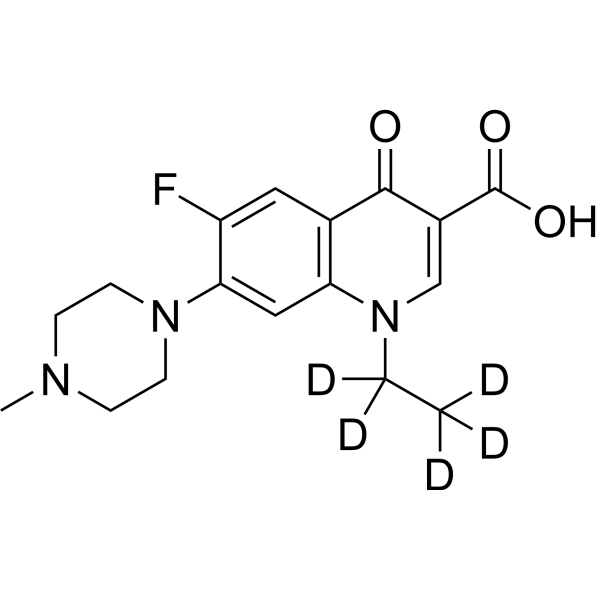
Pefloxacin-d5 (Pefloxacinium-d5) is the deuterium labeled Pefloxacin (HY-B0147). Pefloxacin (Pefloxacinium) is a broad spectrum antibiotic. Pefloxacin blocks DNA replication by inhibiting DNA gyrase. Pefloxacin inhibits DNA relaxation catalyzed by topoisomerase I with an IC50 of 45 μg/mL. Pefloxacin exhibits antibacterial activity against Escherichia coli, Pseudomonas aeruginosa, and Bacteroides fragilis with MIC90s of 0.12, 4, and 16 mg/L, respectively. Pefloxacin has anti-Plasmodium yoelii infection activity. Pefloxacin increase UVA-induced edema and immunesuppression. Pefloxacin can be used for infection studies .
loading...
    loading...
Cat. No.: HY-B0147S1
CAS No.: 2733455-58-6
Synonyms: Pefloxacinium-d3
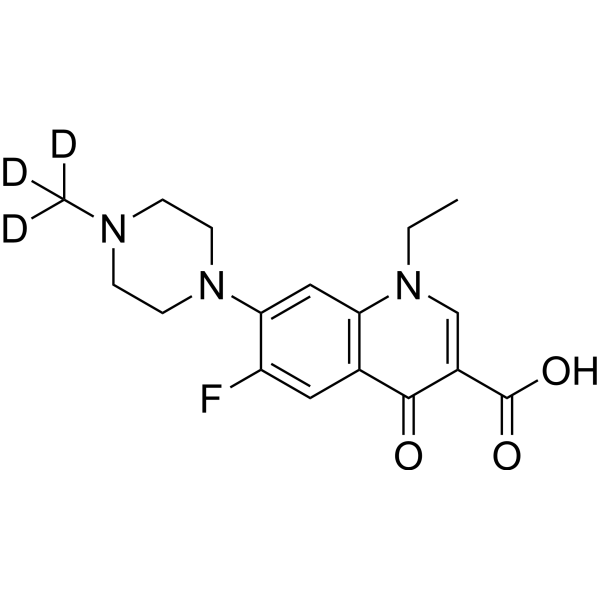
Pefloxacin-d3 (Pefloxacinium-d3) is the deuterium labeled Pefloxacin (HY-B0147). Pefloxacin (Pefloxacinium) is a broad spectrum antibiotic. Pefloxacin blocks DNA replication by inhibiting DNA gyrase. Pefloxacin inhibits DNA relaxation catalyzed by topoisomerase I with an IC50 of 45 μg/mL. Pefloxacin exhibits antibacterial activity against Escherichia coli, Pseudomonas aeruginosa, and Bacteroides fragilis with MIC90s of 0.12, 4, and 16 mg/L, respectively. Pefloxacin has anti-Plasmodium yoelii infection activity. Pefloxacin increase UVA-induced edema and immunesuppression. Pefloxacin can be used for infection studies .
loading...
    loading...
Cat. No.: HY-B0147BR
CAS No.: 149676-40-4
Synonyms: Pefloxacinium mesylate dihydrate (Standard)
Pefloxacin (Pefloxacinium) mesylate dihydrate (Standard) is the analytical standard of Pefloxacin mesylate dihydrate (HY-B0147B). This product is intended for research and analytical applications. Pefloxacin (Pefloxacinium) mesylate dihydrate is a broad spectrum antibiotic. Pefloxacin mesylate dihydrate blocks DNA replication by inhibiting DNA gyrase. Pefloxacin mesylate dihydrate inhibits DNA relaxation catalyzed by topoisomerase I with an IC50 of 45 μg/mL. Pefloxacin mesylate dihydrate exhibits antibacterial activity against Escherichia coli, Pseudomonas aeruginosa, and Bacteroides fragilis with MIC90s of 0.12, 4, and 16 mg/L, respectively. Pefloxacin mesylate dihydrate has anti-Plasmodium yoelii infection activity. Pefloxacin mesylate dihydrate increase UVA-induced edema and immunesuppression. Pefloxacin mesylate dihydrate can be used for infection studies .
loading...
    loading...
Cat. No.: HY-B1325
CAS No.: 64544-07-6
Target:  

Bacterial Antibiotic

Research Areas:  

Infection Inflammation/Immunology

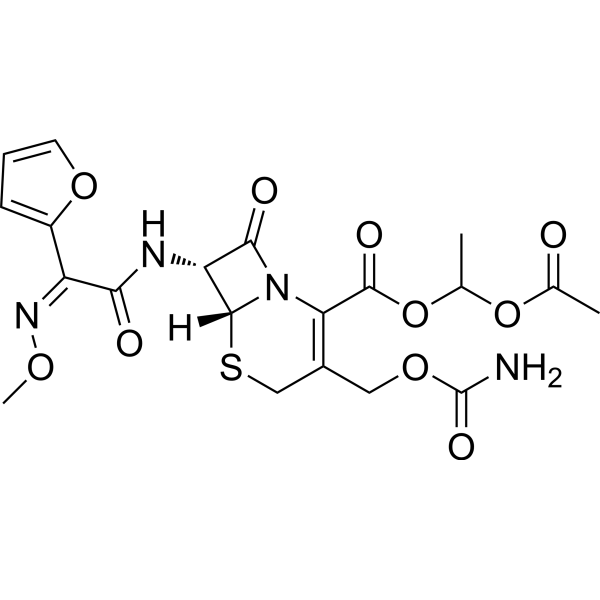
Cefuroxime axetil is an orally effective broad-spectrum β-lactam antibiotic that targets bacterial penicillin-binding proteins (PBPs, such as PBP3 and PBP1). Cefuroxime axetil inhibits cell wall synthesis, leading to bacterial lysis and death, with a minimum inhibitory concentration (MIC) of 0.12-4 mg/L for non-typeable Haemophilus influenzae (NTHi). Cefuroxime axetil is hydrolyzed by esterase to the active ingredient Cefuroxime (HY-B1256A) after oral absorption. Topical administration of Cefuroxime via bioadhesive nanoparticles (BNPs) can prolong the drug's retention time in the middle ear (≥7 days). Cefuroxime axetil can be used in the study of otitis media (especially NTHi infection). Cefuroxime axetil can achieve precise antibacterial effects through oral or topical nano-delivery systems, reducing systemic exposure and the risk of antibiotic resistance .
loading...
    loading...

