
41 Results for "

GPR120

" in MedChemExpress (MCE) Product Catalog:
Products (41)

41 Results for "GPR120" in MCE Product Catalog:

Cat. No.: HY-111353R
CAS No.: 1234844-11-1
GPR120 Agonist 2 (Standard) is the analytical standard of GPR120 Agonist 2 (HY-111353). This product is intended for research and analytical applications. GPR120 Agonist 2 (example 206) is a GPR120 agonist that can be uesd for the study of type II diabetes and diseases associated with poor glycemic control .
loading...
    loading...
Cat. No.: HY-15589R
CAS No.: 885101-89-3
GW9508 (Standard) is the analytical standard of GW9508. This product is intended for research and analytical applications. GW9508 is a potent and selective G protein-coupled receptors FFA1 (GPR40) and GPR120 agonist with pEC50s of 7.32 and 5.46, respectively. GW9508 shows ~100-fold selectivity for GPR40 over GPR120. GW9508 is inactive against other GPCRs, kinases, proteases, integrins and PPARs. GW9508 is a glucose-sensitive insulin secretagogue and an ATP-sensitive potassium (KATP) channels opener. Anti-inflammatory and anti-atherosclerotic activities .
loading...
    loading...
Cat. No.: HY-176838
CAS No.: 1609286-95-4
LXT34 (Example 2) is a GPR120 agonist. LXT34 has an anti-inflammatory activity. LXT34 promotes GLP-1 formation in the gastrointestinal tract and improves insulin resistance in macrophages and pancreas cells. LXT34 can be used for inflammatory diseases, such as type 2 diabetes, obesity and non-alcoholic fatty liver research .
loading...
    loading...
Cat. No.: HY-Y1624
CAS No.: 10465-81-3
Synonyms: ADDP; SR 4077
Research Areas:  

Metabolic Disease

1,1'-(Azodicarbonyl)-dipiperidine (ADDP) can be used in the condensation reaction of alcohols with acidic compounds. 1,1'-(Azodicarbonyl)-dipiperidine can also be used in the synthesis of GPR120 agonists with antidiabetic activity, as well as the synthesis of triple agonists for PPARα, PPARγ, and PPARδ. 1,1'-(Azodicarbonyl)-dipiperidine can be used in metabolic disease research .
loading...
    loading...
Cat. No.: HY-W770410
CAS No.: 2748638-71-1
9-PAHSA- 13C4 is 13C-labeled 9-PAHSA. 9-PAHSAis an orally active endogenous GPR120 agonist (EC50=18 μM). 9-PAHSAsignificantly inhibits LPS-induced inflammatory responses by blocking the NF-κB pathway. 9-PAHSAinduces adipocyte browning, enhances glucose uptake and reduces lipid accumulation, while improving mitochondrial function and the survival rate of steatotic hepatocytes. In terms of neuroprotection, 9-PAHSAregulates the expression of REST and BDNF in the prefrontal cortex of diabetic mice, and effectively prevents spatial working memory deficits and abnormal social behaviors. 9-PAHSAdoes not directly regulate insulin secretion or improve systemic insulin sensitivity, and possesses specific anti-inflammatory, metabolic regulatory and neuroprotective properties. 9-PAHSAcan be used in the research of diabetes-related cognitive impairment, obesity and non-alcoholic fatty liver disease .
loading...
    loading...
Cat. No.: HY-N0040R
CAS No.: 11021-13-9
Synonyms: Ginsenoside C (Standard)
Ginsenoside Rb2 (Standard) is the analytical standard of Ginsenoside Rb2. This product is intended for research and analytical applications. Ginsenoside Rb2 is one of the main bioactive components of ginseng extracts. Rb2 can upregulate GPR120 gene expression. Ginsenoside Rb2 has antiviral effects.
loading...
    loading...
Cat. No.: HY-W011303R
CAS No.: 554-62-1
Synonyms: 4-Hydroxysphinganine (Standard)
Phytosphingosine (Standard) is the analytical standard of Phytosphingosine. This product is intended for research and analytical applications. Phytosphingosine is a phospholipid with anti-inflammatory, antibacterial, and anti-cancer activities, which can induce apoptosis. Phytosphingosine is an immune regulator and can be used in the study of inflammatory skin diseases. Phytosphingosine is also an activator of GPR120 with an IC50 value of 33.4 μM and can be used in the study of type II diabetes[1][2][3][4].
loading...
    loading...
Cat. No.: HY-W727728
CAS No.: 1544739-75-4
Research Areas:  

Metabolic Disease

MK-8666 is a potent and selective partial GPR40 agonist (EC50 = 0.54 nM for human GPR40). MK-8666 shows selectivity over GPR119, GPR43, GPR41, GPR120, and other G-protein-coupled receptors (GPCRs). MK-8666 reduces glucose in the rodent. MK-8666 can be used for type 2 diabetes research [1][2].
loading...
    loading...
Cat. No.: HY-120657S
CAS No.: 2704278-85-1
9-PAHSA-d4 is the deuterium labeled 9-PAHSA. 9-PAHSA is an orally active endogenous GPR120 agonist (EC50=18 μM). 9-PAHSA significantly inhibits LPS-induced inflammatory responses by blocking the NF-κB pathway. 9-PAHSA induces adipocyte browning, enhances glucose uptake and reduces lipid accumulation, while improving mitochondrial function and the survival rate of steatotic hepatocytes. In terms of neuroprotection, 9-PAHSA regulates the expression of REST and BDNF in the prefrontal cortex of diabetic mice, and effectively prevents spatial working memory deficits and abnormal social behaviors. 9-PAHSA does not directly regulate insulin secretion or improve systemic insulin sensitivity, and possesses specific anti-inflammatory, metabolic regulatory and neuroprotective properties. 9-PAHSA can be used in the research of diabetes-related cognitive impairment, obesity and non-alcoholic fatty liver disease .
loading...
    loading...
Cat. No.: HY-100881R
CAS No.: 1374516-07-0
TUG-891 (Standard) is the analytical standard of TUG-891. This product is intended for research and analytical applications. TUG-891 is a potent and selective agonist for the long chain free fatty acid (LCFA) receptor 4 (FFA4/GPR120) .
loading...
    loading...
Cat. No.: HY-N2540R
CAS No.: 68745-38-0
Synonyms: (±)-5,7-Dihydroxyflavanone (Standard); NSC 43318 (Standard)
(±)-Pinocembrin (Standard) is the analytical standard of (±)-Pinocembrin. This product is intended for research and analytical applications. (±)-Pinocembrin ((±)-5,7-Dihydroxyflavanone) is a GPR120 ligand able to promote wound healing in HaCaT cell line .
loading...
    loading...
Cat. No.: HY-RS04877
Research Areas:  

Others

FFAR4 Human Pre-designed siRNA Set A contains three designed siRNAs for FFAR4 gene (Human), as well as a negative control, a positive control, and a FAM-labeled negative control.

loading...
    loading...
Cat. No.: HY-121212R
CAS No.: 1253909-57-7
Desmethyl Sibutramine (hydrochloride) (Standard) is the analytical standard of Desmethyl Sibutramine (hydrochloride). This product is intended for research and analytical applications. Icosabutate is an orally active engineered fatty acid and a dual FFAR1/FFAR4 (GPR40/GPR120) agonist with EC50 values of 10 μM and 15.5 μM, respectively. Icosabutate acts as a partial agonist of PPAR-α, with an EC50 of 208 nM. Icosabutate inhibits the arachidonic acid cascade and exhibits antioxidant and anti-apoptotic activities. Icosabutate can be used in the research of nonalcoholic steatohepatitis, metabolic dysfunction-associated steatohepatitis, and atherosclerosis .
loading...
    loading...
Cat. No.: HY-W011303S
Synonyms: 4-Hydroxysphinganine-d7
Phytosphingosine-d7 (4-Hydroxysphinganine-d7) is deuterium labeled Phytosphingosine. Phytosphingosine is a phospholipid with anti-inflammatory, antibacterial, and anti-cancer activities, which can induce apoptosis. Phytosphingosine is an immune regulator and can be used in the study of inflammatory skin diseases. Phytosphingosine is also an activator of GPR120 with an IC50 value of 33.4 μM and can be used in the study of type II diabetes .
loading...
    loading...
Cat. No.: HY-120657R
CAS No.: 1481636-31-0
Flumethrin (Standard) is the analytical standard of Flumethrin. This product is intended for research and analytical applications. 9-PAHSA is an orally active endogenous GPR120 agonist (EC50=18 μM). 9-PAHSA significantly inhibits LPS-induced inflammatory responses by blocking the NF-κB pathway. 9-PAHSA induces adipocyte browning, enhances glucose uptake and reduces lipid accumulation, while improving mitochondrial function and the survival rate of steatotic hepatocytes. In terms of neuroprotection, 9-PAHSA regulates the expression of REST and BDNF in the prefrontal cortex of diabetic mice, and effectively prevents spatial working memory deficits and abnormal social behaviors. 9-PAHSA does not directly regulate insulin secretion or improve systemic insulin sensitivity, and possesses specific anti-inflammatory, metabolic regulatory and neuroprotective properties. 9-PAHSA can be used in the research of diabetes-related cognitive impairment, obesity and non-alcoholic fatty liver disease .
loading...
    loading...
Cat. No.: HY-120657S1
CAS No.: 2748208-06-0
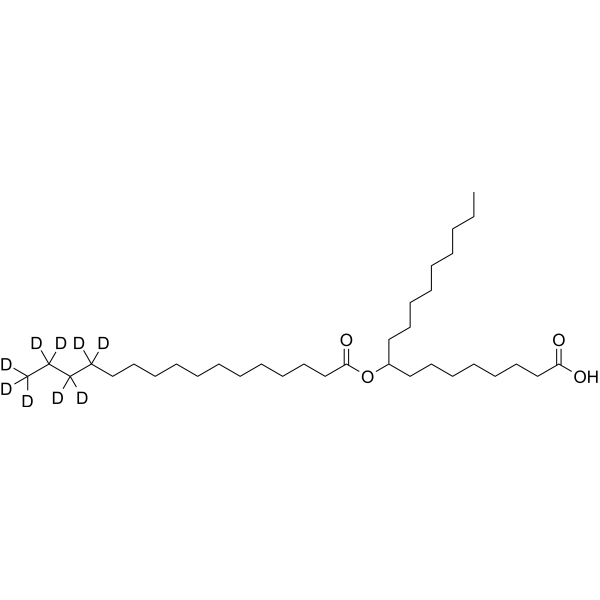
9-PAHSA-d31 is the deuterium labeled 9-PAHSA. 9-PAHSA is an orally active endogenous GPR120 agonist (EC50=18 μM). 9-PAHSA significantly inhibits LPS-induced inflammatory responses by blocking the NF-κB pathway. 9-PAHSA induces adipocyte browning, enhances glucose uptake and reduces lipid accumulation, while improving mitochondrial function and the survival rate of steatotic hepatocytes. In terms of neuroprotection, 9-PAHSA regulates the expression of REST and BDNF in the prefrontal cortex of diabetic mice, and effectively prevents spatial working memory deficits and abnormal social behaviors. 9-PAHSA does not directly regulate insulin secretion or improve systemic insulin sensitivity, and possesses specific anti-inflammatory, metabolic regulatory and neuroprotective properties. 9-PAHSA can be used in the research of diabetes-related cognitive impairment, obesity and non-alcoholic fatty liver disease .
loading...
    loading...
Cat. No.: HY-144026S
CAS No.: 1809222-43-2
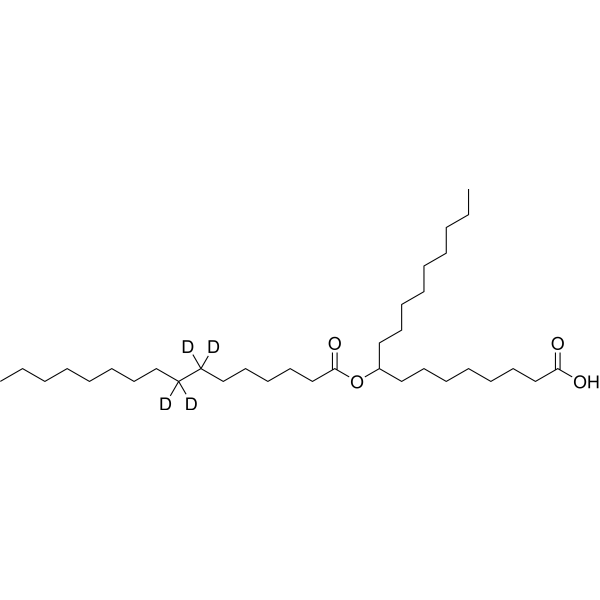
9-PAHSA-d9 is the deuterium labeled 9-PAHSA (HY-120657). 9-PAHSA is an orally active endogenous GPR120 agonist (EC50=18 μM). 9-PAHSA significantly inhibits LPS-induced inflammatory responses by blocking the NF-κB pathway. 9-PAHSA induces adipocyte browning, enhances glucose uptake and reduces lipid accumulation, while improving mitochondrial function and the survival rate of steatotic hepatocytes. In terms of neuroprotection, 9-PAHSA regulates the expression of REST and BDNF in the prefrontal cortex of diabetic mice, and effectively prevents spatial working memory deficits and abnormal social behaviors. 9-PAHSA does not directly regulate insulin secretion or improve systemic insulin sensitivity, and possesses specific anti-inflammatory, metabolic regulatory and neuroprotective properties. 9-PAHSA can be used in the research of diabetes-related cognitive impairment, obesity and non-alcoholic fatty liver disease .
loading...
    loading...
Cat. No.: HY-115643
CAS No.: 2896777-27-6
Research Areas:  

Metabolic Disease

AZ13581837 is an orally active GPR120 agonist with an EC50 of 5.2 nM for human GPR120. AZ13581837 signals through Gαq, Gαs, and β-arrestin pathways, reduces cAMP production, stimulates GLP-1 secretion, induces glucose lowering, and increases insulin secretion. AZ13581837 can be used for the research of type 2 diabetes .
loading...
    loading...
Cat. No.: HY-182404
CAS No.: 337495-81-5
Research Areas:  

Cancer

Anticancer agent 316 (Compound 1) is an anticancer agent. Anticancer agent 316 exerts anticancer activity against colorectal cancers expressing GPR120. Anticancer agent 316 can be used in the research of colorectal cancer .
loading...
    loading...
Cat. No.: HY-RS18817
Research Areas:  

Others

Ffar4 Mouse Pre-designed siRNA Set A contains three designed siRNAs for Ffar4 gene (Mouse), as well as a negative control, a positive control, and a FAM-labeled negative control.

loading...
    loading...

