32 Results for "

sub G1 phase

" in MedChemExpress (MCE) Product Catalog:
Products (32)

32 Results for "sub G1 phase" in MCE Product Catalog:

Cat. No.: HY-146227
CAS No.: 2459950-15-1
Target:  

Topoisomerase Apoptosis

Research Areas:  

Cancer

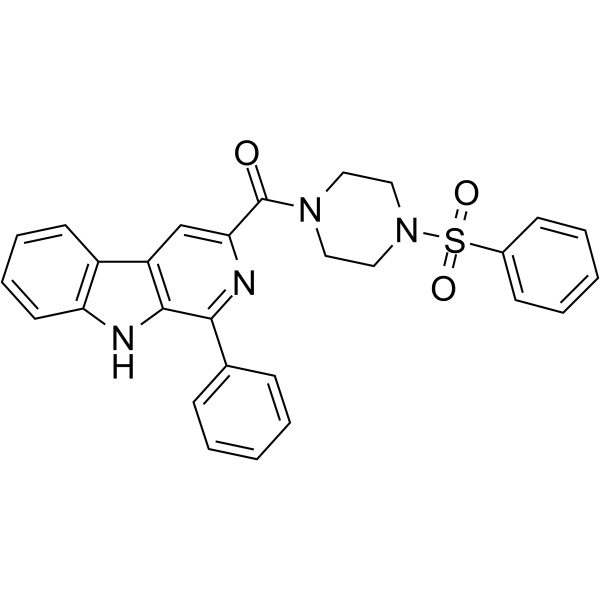
DNA topoisomerase II inhibitor 1 (compound 8ed) is a potent DNA topoisomerase II inhibitor. DNA topoisomerase II inhibitor 1 shows anti-proliferative activity. DNA topoisomerase II inhibitor 1 induces apoptosis and cell cycle arrest at sub G1 phase .
loading...
    loading...
Cat. No.: HY-151630
CAS No.: 2849348-38-3
Target:  

Carbonic Anhydrase

Research Areas:  

Cancer

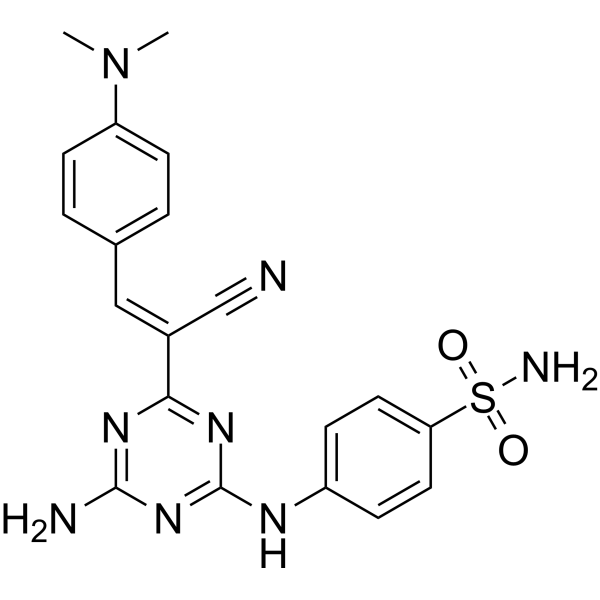
hCAIX-IN-16 (Compound 12d) is hCA IX inhibitor, with Ki values of 190.0 and 187.9 nM for hCA IX and hCA XII, respectively. hCAIX-IN-16 can arrest the cell cycle of breast cancer MDA-MB-468 in G0-G1 and S phase and induce apoptosis. hCAIX-IN-16 shows good broad-spectrum anticancer activity and can be used for cancer research .
loading...
    loading...
Cat. No.: HY-149540
Research Areas:  

Cancer

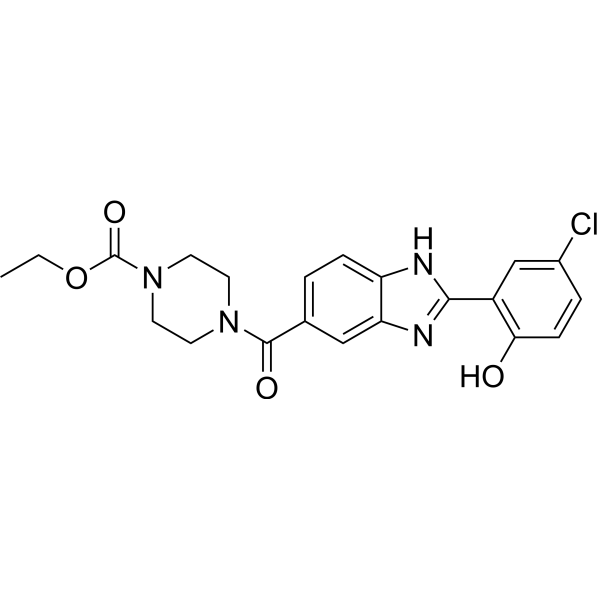
CTL-06 is an inhibitor of Fatty Acid Synthase (FASN) (IC50: 3 μM) and can induce apoptosis. CTL-12 blocks the cell cycle in the Sub-G1/S phase, upregulates the expression of caspase-9 and the apoptosis marker Bax, and downregulates the anti-apoptotic marker Bcl-xL. CTL-12 inhibits de novo lipogenesis, blocks the metabolic demands of tumor cells, and is commonly used in breast and colorectal cancer research .
loading...
    loading...
Cat. No.: HY-149541
Research Areas:  

Cancer

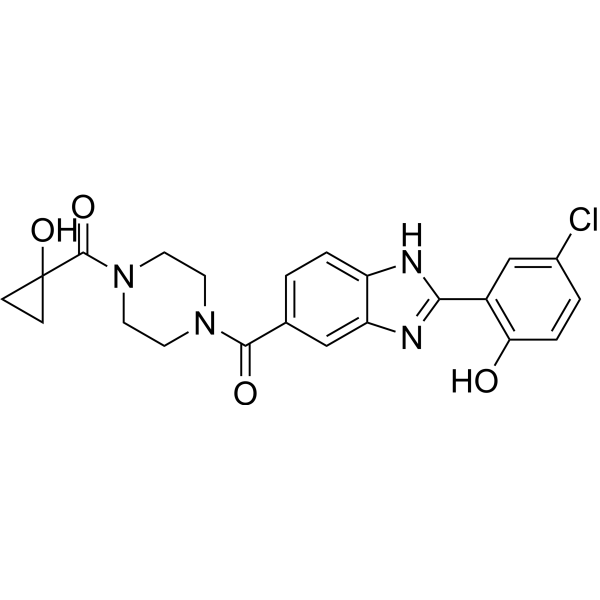
CTL-12 is an inhibitor of fatty acid synthase (FASN) (IC50: 2.5 μM) and can induce apoptosis. CTL-12 blocks the cell cycle in the Sub-G1/S phase, upregulates the expression of caspase-9 and the apoptosis marker Bax, and downregulates the anti-apoptotic marker Bcl-xL. CTL-12 inhibits de novo lipogenesis, blocks the metabolic demands of tumor cells, and is commonly used in breast and colorectal cancer research .
loading...
    loading...
Cat. No.: HY-B1751S1
Quinidine- 13C, d2 hydrochloride is the 13C, d2 labeled Quinidine hydrochloride (HY-W115674). Quinidine hydrochloride is an orally active antiarrhythmic agent. Quinidine hydrochloride reduces the expression level of P-gp, inhibits P-gp-mediated efflux, increases the intracellular accumulation of P-gp substrates, induces PARP cleavage and Caspase-3 activation, and elevates the proportion of Apoptotic cells at the sub-G1 phase. Quinidine hydrochloride exerts sustained block and open-channel block effects on IK(f). Quinidine hydrochloride alters the urinary metabolic ratio of Amphetamine, modulates the Pentylenetetrazol-induced seizure threshold, and regulates the anticonvulsant effect of Dextromethorphan. Quinidine hydrochloride can be used in studies related to uterine sarcoma and seizures .
loading...
    loading...
Cat. No.: HY-183262
CAS No.: 3126462-40-3
Research Areas:  

Infection

Antileishmanial agent-40 is an orally active and selective antileishmanial agent. Antileishmanial agent-40 elevates intracellular reactive oxygen species (ROS) levels in Leishmania donovani promastigotes. Antileishmanial agent-40 induces cell cycle arrest at the sub-G0/G1 phase in Leishmania donovani promastigotes, indicative of programmed-like parasite death. Antileishmanial agent-40 can be used for the research of leishmaniasis .
loading...
    loading...
Cat. No.: HY-108336
CAS No.: 1046859-34-0
Research Areas:  

Cancer

PF-4942847 is an orally active HSP90 inhibitor with an IC50 of approximately 50 nM. PF-4942847 induces apoptosis in osteosarcoma cells, increases the proportion of cells in the sub-G1 phase and PARP cleavage, reduces the expression of Akt, Erk, MYC, c-MET and STAT-3, and regulates HSP expression. PF-4942847 can be used in studies related to osteosarcoma and HSP90 .
loading...
    loading...
Cat. No.: HY-182073
Target:  

EGFR Apoptosis

Research Areas:  

Cancer

EGFR-IN-207 (Compound 5h) is an epidermal growth factor receptor (EGFR) kinase inhibitor with an IC50 of 0.21 μM. EGFR-IN-207 induces cell cycle arrest at the Sub-G1 phase and promotes Apoptosis. EGFR-IN-207 exhibits anticancer activity against lung cancer. EGFR-IN-207 shows extremely low toxicity in non-cancerous cell lines. EGFR-IN-207 can be used in lung cancer-related research .
loading...
    loading...
Cat. No.: HY-189289
CAS No.: 3107304-24-2
Research Areas:  

Cancer

PRMT5-IN-58 is an MTA-cooperative PRMT5 inhibitor and PRMT5-MTA complex binder (IC50 = 11.7 nM) that inhibits methyltransferase activity and SDMA (HY-101410) production by stabilizing the MTA-bound conformation, and induces apoptosis via sub-G1 phase accumulation, exhibiting selective antiproliferative activity against MTAP-deleted cancer cells over MTAP wild-type cells. PRMT5-IN-58 can be used for research on MTAP-deleted cancers .
loading...
    loading...
Cat. No.: HY-W115674
CAS No.: 1668-99-1
Quinidine hydrochloride is an orally active antiarrhythmic agent. Quinidine hydrochloride reduces the expression level of P-gp, inhibits P-gp-mediated efflux, increases the intracellular accumulation of P-gp substrates, induces PARP cleavage and Caspase-3 activation, and elevates the proportion of Apoptotic cells at the sub-G1 phase. Quinidine hydrochloride exerts sustained block and open-channel block effects on IK(f). Quinidine hydrochloride alters the urinary metabolic ratio of Amphetamine, modulates the Pentylenetetrazol-induced seizure threshold, and regulates the anticonvulsant effect of Dextromethorphan. Quinidine hydrochloride can be used in studies related to uterine sarcoma and seizures .
loading...
    loading...
Cat. No.: HY-123364
CAS No.: 856414-54-5
Sargachromanol E is an apoptosis inducer, anti-inflammatory agent, and anti-aging agent. Sargachromanol E activates caspase-3, mediates PARP cleavage, downregulates Bcl-xL and upregulates Bax levels, and drives sub-G1 phase cell cycle arrest, inhibits LPS-induced COX-2 and iNOS transcription and expression (NO: IC50 = 6.99 μg/mL), reduces p38 MAPK and ERK1/2 phosphorylation levels, and suppresses the release of pro-inflammatory mediators such as TNF-α, IL-1β, and prostaglandin E2 (PGE2). Sargachromanol E can be used for research on skin aging, leukemia, oral squamous cell carcinoma, and inflammation-related studies .
loading...
    loading...
Cat. No.: HY-137059
CAS No.: 1217503-60-0
GO-Y078 is a curcumin (HY-N0005) analog. GO-Y078 activates p38/JNK1/2. GO-Y078 activates the MAPK pathway, Caspase 3/8/9, PARP, AP-1, DR5, and TP53, while inhibiting cIAP-1, XIAP, and NF-κB. GO-Y078 induces sub-G1/G2/M phase arrest and Apoptosis. GO-Y078 impairs angiogenesis. GO-Y078 can be used in research related to osteosarcoma, cervical cancer, oral squamous cell carcinoma, and peritoneal metastasis of gastric cancer .
loading...
    loading...

