99 Results for "

silenced

" in MedChemExpress (MCE) Product Catalog:
Products (99)

99 Results for "silenced" in MCE Product Catalog:

Cat. No.: HY-176867
Target:  

HDAC

Research Areas:  

Neurological Disease

Rodin-B is a selective histone deacetylase (HDAC)-co-repressor of repressor element-1 silencing transcription factor (CoREST) complex inhibitor with an IC50 value of 0.50 μM for the CoREST complex, 0.27 μM for HDAC1, and 0.28 μM for HDAC2. Rodin-B increases the acetylation level of histone H3K9, upregulates the expression of neuron-related genes, thereby promoting the increase in dendritic spine density, the colocalization of synaptic proteins (SV2A and PSD95), and the improvement of hippocampal long-term potentiation (LTP), exerting synaptic protection and repair activity. Rodin-B is promising for research of neurodegenerative diseases related to synaptic dysfunction, especially Alzheimer’s disease .
loading...
    loading...
Cat. No.: HY-B0464R
CAS No.: 304-20-1
Hydralazine (hydrochloride) (Standard) is the analytical standard of Hydralazine (hydrochloride). This product is intended for research and analytical applications. Hydralazine hydrochloride is an orally active, blood-brain barrier-permeable DNA methyltransferase inhibitor with vasodilatory, arterial smooth muscle relaxant and hypotensive activities. Hydralazine hydrochloride reactivates silenced tumor suppressor genes via mediating DNA demethylation, while exerting neuroprotective and anti-inflammatory properties. Hydralazine hydrochloride inhibits NOS-2 (iNOS) and COX-2, and reduces the production of NO and PGEE2; meanwhile, Hydralazine hydrochloride scavenges reactive oxygen species and inhibits macrophage activation. Hydralazine hydrochloride alleviates motor dysfunction, neuropathic inflammatory pain, and formalin-induced somatic and emotional pain responses. In addition, Hydralazine hydrochloride directly induces DNA strand breaks and sister chromatid exchange, exhibiting certain mutagenic characteristics. Hydralazine hydrochloride has been widely used in studies on hypertension, various cancers (such as cervical cancer, leukemia), spinal cord injury and the mechanisms of inflammatory pain .
loading...
    loading...
Cat. No.: HY-B0364AR
CAS No.: 536-43-6
Synonyms: Dyclocaine hydrochloride (Standard)
Dyclonine hydrochloride (Standard) (Dyclocaine hydrochloride (Standard)) is the analytical standard of Dyclonine hydrochloride (HY-B0364A). This product is intended for research and analytical applications. Dyclonine hydrochloride (Dyclocaine hydrochloride) is an orally active, blood-brain barrier-permeable piperidine phenylacetone small molecule commonly used as a local anesthetic. Dyclonine hydrochloride acts as a highly selective allosteric antagonist of TRPV3; it also reversibly inhibits G9a, ALDH2 and ALDH3A1, non-competitively blocks AChE. Dyclonine hydrochloride activates the Nrf2/ARE pathway, relieves the epigenetic silencing of FXN, blocks Aβ42 aggregation, and promotes remyelination and reparative polarization of microglia. Dyclonine hydrochloride alleviates pruritus via TRPV3 inhibition; it is used in studies of neurodegenerative disease models based on its AChE inhibitory, antioxidant and remyelinating effects; it sensitizes drug-resistant tumors through ALDH inhibition, and combined use with protease inhibitors induces more tumor cell apoptosis; it inhibits Candida albicans in vitro. Dyclonine hydrochloride can be used for research on multiple diseases including neurodegenerative diseases, cancer and pruritic dermatitis .
loading...
    loading...
Cat. No.: HY-B0364AS
Synonyms: Dyclocaine-d9 hydrochloride
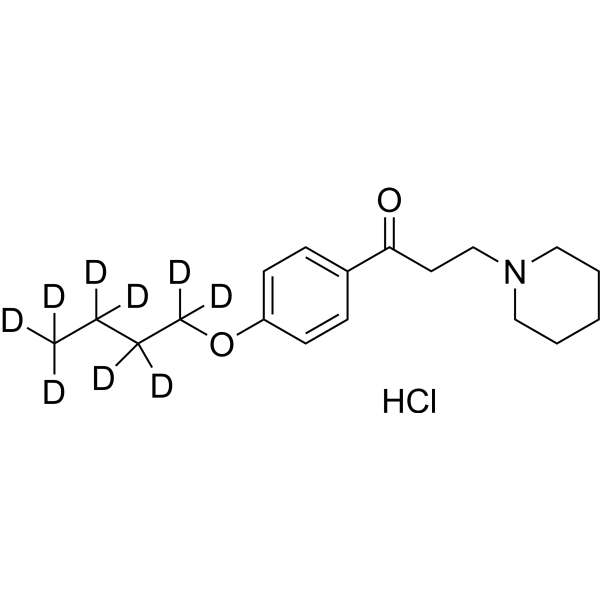
Dyclonine-d9 hydrochloride (Dyclocaine-d9 hydrochloride) is the deuterated-labeled Dyclonine hydrochloride (HY-B0364A). Dyclonine hydrochloride (Dyclocaine hydrochloride) is an orally active, blood-brain barrier-permeable piperidine phenylacetone small molecule commonly used as a local anesthetic. Dyclonine hydrochloride acts as a highly selective allosteric antagonist of TRPV3; it also reversibly inhibits G9a, ALDH2 and ALDH3A1, non-competitively blocks AChE. Dyclonine hydrochloride activates the Nrf2/ARE pathway, relieves the epigenetic silencing of FXN, blocks Aβ42 aggregation, and promotes remyelination and reparative polarization of microglia. Dyclonine hydrochloride alleviates pruritus via TRPV3 inhibition; it is used in studies of neurodegenerative disease models based on its AChE inhibitory, antioxidant and remyelinating effects; it sensitizes drug-resistant tumors through ALDH inhibition, and combined use with protease inhibitors induces more tumor cell apoptosis; it inhibits Candida albicans in vitro. Dyclonine hydrochloride can be used for research on multiple diseases including neurodegenerative diseases, cancer and pruritic dermatitis .
loading...
    loading...
Cat. No.: HY-153484D
Target:  

Fluorescent Dye

Research Areas:  

Others

FAM labled Bevasiranib sodiumis a FAM labled Bevasiranib sodium. Bevasiranib sodium is an siRNA that targets and silences VEGF-A. Bevasiranib sodium activates the RNA-induced silencing complex to degrade VEGF-A mRNA and can be used in research related to macular degeneration.
loading...
    loading...
Cat. No.: HY-153484E
Target:  

Fluorescent Dye

Research Areas:  

Others

Cy3-labeled Bevasiranib sodium is Bevasiranib sodium conjugated with the Cy3 fluorophore. Bevasiranib sodium is an siRNA that targets and silences VEGF-A. Bevasiranib sodium activates the RNA-induced silencing complex (RISC) to degrade VEGF-A mRNA and can be used in research related to macular degeneration.
loading...
    loading...
Cat. No.: HY-187051
CAS No.: 1953147-04-0
Target:  

Phosphoramidites

Research Areas:  

Metabolic Disease

AdemG Phosphoramidite is a ligand-conjugated phosphoramidite synthon. AdemG Phosphoramidite can be used for the synthesis of GalNAc-conjugated siRNA and DsiRNA for liver-targeted gene silencing .
loading...
    loading...
Cat. No.: HY-N17786
CAS No.: 7434-28-8
2-O-Methyl-D-xylose is a derivative of Xylose (HY-N0537). 2-O-Methyl-D-xylose can be used as a biomarker for the cell wall polysaccharide RG-II, and changes in its content reveal the destructive effect of gene silencing on the cell wall structure .
loading...
    loading...
Cat. No.: HY-P991940

Target:  

ADC Antibodies CCR

Research Areas:  

Cancer

JBH492 Antibody is a humanized, Fc-silenced anti-CCR7 IgG1 antibody. JBH492 Antibody can generate antibody drug conjugate (ADC) (JBH492) with a maytansinoid microtubule DM4 (HY-12454). JBH492 Antibody can be used for the study of lymphoma .
loading...
    loading...
Cat. No.: HY-177640C
FAM labled Lepodisiran (LY3819469) sodiumis a FAM labled Lepodisiran sodium. Lepodisiran sodium is a GalNAc-conjugated small interfering RNA lipid-lowering agent. Lepodisiran sodium targets the hepatic LPA gene and degrades apolipoprotein (a) mRNA to silence its expression, thereby effectively reducing the production of apolipoprotein (a) and serum lipoprotein (a) in a dose-dependent manner. Lepodisiran sodium can be used in studies related to atherosclerotic cardiovascular disease .
loading...
    loading...
Cat. No.: HY-177640D
Cy3 labled Lepodisiran (LY3819469) sodium is a Cy3 labled Lepodisiran sodium. Lepodisiran sodium is a GalNAc-conjugated small interfering RNA lipid-lowering agent. Lepodisiran sodium targets the hepatic LPA gene and degrades apolipoprotein (a) mRNA to silence its expression, thereby effectively reducing the production of apolipoprotein (a) and serum lipoprotein (a) in a dose-dependent manner. Lepodisiran sodium can be used in studies related to atherosclerotic cardiovascular disease .
loading...
    loading...
Cat. No.: HY-P991922
AKIR001 is a high-affinity human IgG1 antibody targeting CD44v6. AKIR001 carries LALA-silencing mutations in its FcγR-binding domain to reduce FcγR and C1q interactions, minimizing tissue interactions and limiting CDC and ADCC risks. [ 177Lu] radiolabeled AKIR001, namely [ 177Lu]Lu-AKIR001, has anticancer activity against epidermoid carcinoma .
loading...
    loading...
Cat. No.: HY-124961
CAS No.: 927019-63-4
Target:  

Monoamine Oxidase

Research Areas:  

Cancer

LSD1-IN-2 is a LSD1 inhibitor with an IC50 of 0.5 μM. LSD1-IN-2 increases the levels of monomethylated and dimethylated histone H3 lysine 4 (H3K4me1/2) in cells. LSD1-IN-2 reactivates epigenetically silenced tumor suppressor genes. LSD1-IN-2 can be used in the research of colon cancer .
loading...
    loading...
Cat. No.: HY-188138
Research Areas:  

Cancer

BP1002 is an antisense oligonucleotide targeting BCL-2. BP1002 silences BCL-2 expression by targeting the translation initiation site of Bcl-2 mRNA. Its backbone carries ethoxy modifications, which confer nuclease resistance, reduce off-target effects, and lower toxicity. BP1002 prolongs survival in non-Hodgkin's lymphoma xenograft models. BP1002 can be used in studies of acute myeloid leukemia, aggressive non-Hodgkin's lymphoma, and Venetoclax (HY-15531)-resistant hematological malignancies .
loading...
    loading...
Cat. No.: HY-181134
CAS No.: 2715104-46-2
Target:  

PROTACs

Research Areas:  

Cancer

PROTAC HMGCR Degrader-2 is a HMGCR PROTAC degrader with an IC50 value of 0.25 μM. PROTAC degrades HMGCR-2 in Insig-silenced HepG2 cells with a DC50 of 0.12 μM. PROTAC HMGCR Degrader-2 takes PROTAC HMGCR Degrader-1 (HY-171823) as the oral prodrug. PROTAC HMGCR Degrader-2 degrades HMGCR by the VHL-dependent ubiquitin-proteasome system and reduces cellular cholesterol in HepG2 cells. PROTAC CDK2/4/6 Degrader-2 can be used for hyperlipidemia research .
loading...
    loading...
Cat. No.: HY-189230
CAS No.: 3108114-67-3
Target:  

Ligands for E3 Ligase

Research Areas:  

Infection

NEP48 is a small-molecule antagonist targeting the ZER1 (E3 ubiquitin ligase)-E7 oncogenic axis. NEP48 binds to the MHGD/N-degron binding pocket within the ARM repeat domain of ZER1, competitively blocking E7-ZER1 binding and ZER1-mediated substrate degradation. NEP48 disrupts the ZER1-E7 interaction, leading to Rb stabilization and silencing of E2F-driven transcriptional programs. NEP48 inhibits the proliferation of HPV-positive cancer cells and can be used for research on HPV-positive cervical cancer .
loading...
    loading...
Cat. No.: HY-181877
Target:  

HDAC Adenosine Receptor

Research Areas:  

Cancer

IHCH-3185 is an orally active class I HDAC inhibitor (HDAC1 IC50 =102.9 nM) and A2AR antagonist (A2AR Ki =7.6 nM). IHCH-3185 reverses immune gene silencing by inducing histone acetylation and blocks the adenosine signaling pathway to relieve T-cell suppression. IHCH-3185 exhibits antiproliferative activity, induces cell cycle arrest, and significantly improves the tumor microenvironment. IHCH-3185 reduces the proportion of regulatory T cells, increases the CD8 +/Treg ratio, and upregulates the expression of key factors such as H2-K1, Cxcl9 and Cxcl10. IHCH-3185 shows significant antitumor potential in CT26 and MC38 mouse tumor models and is suitable for related cancer research .
loading...
    loading...
Cat. No.: HY-184776
CAS No.: 586-60-7
Synonyms: Dyclocaine
Dyclonine (Dyclocaine) is an orally active, blood-brain barrier-permeable piperidine phenylacetone small molecule commonly used as a local anesthetic. Dyclonine acts as a highly selective allosteric antagonist of TRPV3; it also reversibly inhibits G9a, ALDH2 and ALDH3A1, non-competitively blocks AChE. Dyclonine activates the Nrf2/ARE pathway, relieves the epigenetic silencing of FXN, blocks Aβ42 aggregation, and promotes remyelination and reparative polarization of microglia. Dyclonine alleviates pruritus via TRPV3 inhibition; it is used in studies of neurodegenerative disease models based on its AChE inhibitory, antioxidant and remyelinating effects; it sensitizes drug-resistant tumors through ALDH inhibition, and combined use with protease inhibitors induces more tumor cell apoptosis; it inhibits Candida albicans in vitro. Dyclonine can be used for research on multiple diseases including neurodegenerative diseases, cancer and pruritic dermatitis .
loading...
    loading...
Cat. No.: HY-179499
CAS No.: 2978620-84-5
Research Areas:  

Cancer

PROTAC EZH2 Degrader-9 is orally active EZH2 PROTAC degrader degrading EZH2 via the ubiquitin-proteasome pathway. PROTAC EZH2 Degrader-9 downregulates PRC2 core subunits and potent inhibition of H3K27me3 without affecting common CRBN neosubstrates while it was selective over GSp'T1 and ikZF1/3. PROTAC EZH2 Degrader-9 exhibits potent antiproliferative activity against multiple cancer cell lines by inducing cell cycle and apoptosis. PROTAC EZH2 Degrader-9 reverses PRC2-mediated gene silencing and inhibiting EZH2 non-catalytic target gene activation. PROTAC EZH2 Degrader-9 can be used for leukemia, lymphoma, and non-small cell lung cancer research .
loading...
    loading...

