116 Results for "

transferrin

" in MedChemExpress (MCE) Product Catalog:
Products (116)

116 Results for "transferrin" in MCE Product Catalog:

Cat. No.: HY-P11919
CAS No.: 2422045-23-4
D-T7-cys is a D-T7 (HY-P11918) peptide with a C-terminal D-cysteine (HY-W018555). Nanoparticles modified with D-T7-cys serve as effective carriers for the delivery of compounds targeting the transferrin receptor (TfR). D-T7-cys reacts with DOX-SS-Pyr to form the DT7-SS-DOX conjugate. D-T7-cys is applicable to research related to glioma, autism spectrum disorder, glioblastoma, hepatocellular carcinoma, and lung cancer .
loading...
    loading...
Cat. No.: HY-168943
PLGA nanoparticles, 100nm, are biodegradable tumor-targeting nanocarriers that can serve as drug delivery enhancers and multidrug resistance inhibitors. PLGA nanoparticles, 100nm, passively enriched through the EPR effect and actively targeted via ligand-mediated endocytosis, can encapsulate various antitumor active molecules. PLGA nanoparticles, 100nm can specifically recognize multiple types of tumor cells and improve cellular uptake, cytotoxicity and antiproliferative effects after modification with ligands such as transferrin, folic acid, and RGD. PLGA nanoparticles, 100nm can encapsulate various therapeutic drugs and can be surface modified to achieve targeting, imaging, and prolonged circulation time, making them suitable for cancer-related research .
loading...
    loading...
Cat. No.: HY-168943A
PLGA nanoparticles, 200nm, are biodegradable tumor-targeting nanocarriers that can serve as drug delivery enhancers and multidrug resistance inhibitors. PLGA nanoparticles, 200nm, passively enriched through the EPR effect and actively targeted via ligand-mediated endocytosis, can encapsulate various antitumor active molecules. PLGA nanoparticles, 200nm can specifically recognize multiple types of tumor cells and improve cellular uptake, cytotoxicity and antiproliferative effects after modification with ligands such as transferrin, folic acid, and RGD. PLGA nanoparticles, 200nm can encapsulate various therapeutic drugs and can be surface modified to achieve targeting, imaging, and prolonged circulation time, making them suitable for cancer-related research .
loading...
    loading...
Cat. No.: HY-168943B
PLGA nanoparticles, 500nm, are biodegradable tumor-targeting nanocarriers that can serve as drug delivery enhancers and multidrug resistance inhibitors. PLGA nanoparticles, 500nm, passively enriched through the EPR effect and actively targeted via ligand-mediated endocytosis, can encapsulate various antitumor active molecules. PLGA nanoparticles, 500nm can specifically recognize multiple types of tumor cells and improve cellular uptake, cytotoxicity and antiproliferative effects after modification with ligands such as transferrin, folic acid, and RGD. PLGA nanoparticles, 500nm can encapsulate various therapeutic drugs and can be surface modified to achieve targeting, imaging, and prolonged circulation time, making them suitable for cancer-related research .
loading...
    loading...
Cat. No.: HY-P10323
Synonyms: Tumstatin (74-98), human
Target:  

Integrin FAK mTOR Apoptosis

Research Areas:  

Cancer

T7 Peptide is a protein synthesis inhibitor and anti-angiogenic agent, with a Kd of 10 nM for human transferrin receptor. T7 Peptide inhibits the phosphorylation of focal adhesion kinase, the activation of phosphatidylinositol 3-kinase and Akt, the kinase activity of mTOR, as well as the phosphorylation of 4E-BP1 in endothelial cells. T7 Peptide induces G0/G1 cell cycle arrest, apoptosis and protective autophagy in hepatocellular carcinoma cells, and suppresses tumor growth in mouse models. T7 Peptide is applicable to research related to cancer, glioblastoma, hepatocellular carcinoma and glioma .
loading...
    loading...
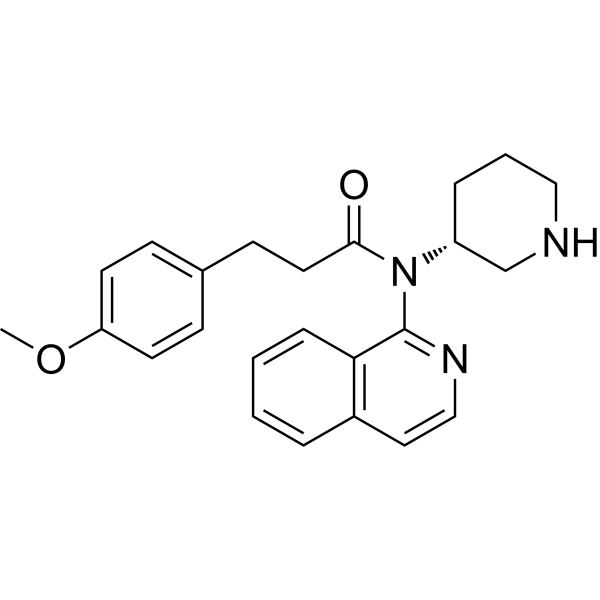
Cat. No.: HY-101354
CAS No.: 2133832-83-2
Purity:  98.76%
Synonyms: PF-00932239
Target:  

PCSK9 Ras MEK ERK NF-κB LDLR

R-IMPP (PF-00932239) is a PCSK9 translation inhibitor and a selective 80S ribosome binder. R-IMPP inhibits the KRAS/MEK/ERK signaling cascade. R-IMPP reduces LPS-induced nuclear translocation of NFkB P65. R-IMPP increases LDL-R levels in cells, promotes LDL-C uptake, and does not alter the secretion of transferrin or albumin. R-IMPP inhibits the growth of colorectal cancer (CRC) cells, organoids and xenografts carrying APC/KRAS mutations, as well as the number and burden of spontaneous mouse tumors. R-IMPP can be used in research related to colorectal cancer with APC/KRAS mutations, hepatic ischemia-reperfusion injury and hypercholesterolemia .
loading...
    loading...
Cat. No.: HY-101354A
CAS No.: 2173005-10-0
Synonyms: PF-00932239 hydrochloride
R-IMPP hydrochloride (PF-00932239 hydrochloride) is a PCSK9 translation inhibitor and a selective 80S ribosome binder. R-IMPP hydrochloride inhibits the KRAS/MEK/ERK signaling cascade. R-IMPP hydrochloride reduces LPS-induced nuclear translocation of NFkB P65. R-IMPP hydrochloride increases LDL-R levels in cells, promotes LDL-C uptake, and does not alter the secretion of transferrin or albumin. R-IMPP hydrochloride inhibits the growth of colorectal cancer (CRC) cells, organoids and xenografts carrying APC/KRAS mutations, as well as the number and burden of spontaneous mouse tumors. R-IMPP hydrochloride can be used in research related to colorectal cancer with APC/KRAS mutations, hepatic ischemia-reperfusion injury and hypercholesterolemia .
loading...
    loading...
Cat. No.: HY-168943C
PLGA nanoparticles, 1μm, are biodegradable tumor-targeting nanocarriers that can serve as drug delivery enhancers and multidrug resistance inhibitors. PLGA nanoparticles, 1μm, passively enriched through the EPR effect and actively targeted via ligand-mediated endocytosis, can encapsulate various antitumor active molecules. PLGA nanoparticles, 1μm can specifically recognize multiple types of tumor cells and improve cellular uptake, cytotoxicity and antiproliferative effects after modification with ligands such as transferrin, folic acid, and RGD. PLGA nanoparticles, 1μm can encapsulate various therapeutic drugs and can be surface modified to achieve targeting, imaging, and prolonged circulation time, making them suitable for cancer-related research .
loading...
    loading...
Cat. No.: HY-P10323A
Synonyms: Tumstatin (74-98), human TFA
Target:  

Integrin FAK mTOR Apoptosis

Research Areas:  

Cancer

T7 Peptide TFA is a protein synthesis inhibitor and anti-angiogenic agent, with a Kd of 10 nM for human transferrin receptor. T7 Peptide TFA inhibits the phosphorylation of focal adhesion kinase, the activation of phosphatidylinositol 3-kinase and Akt, the kinase activity of mTOR, as well as the phosphorylation of 4E-BP1 in endothelial cells. T7 Peptide TFA induces G0/G1 cell cycle arrest, apoptosis and protective autophagy in hepatocellular carcinoma cells, and suppresses tumor growth in mouse models. T7 Peptide TFA is applicable to research related to cancer, glioblastoma, hepatocellular carcinoma and glioma .
loading...
    loading...
Cat. No.: HY-P990791
Anti-Mouse CD71/TfR1 Antibody (R17 217.1.3) is a rat-derived IgG2a κ type antibody inhibitor, targeting to mouse CD71/TfR1. Anti-Mouse CD71/TfR1 Antibody (R17 217.1.3) can deplete CD71 + cells and inhibit transferrin receptor. Anti-Mouse CD71/TfR1 Antibody (R17 217.1.3) can be used for the researches of cancer, infection, inflammation and immunology, such as lung cancer, lymphocytic choriomeningitis virus (LCMV) infection and Cardiac allograft .
loading...
    loading...
Cat. No.: HY-D3377
CAS No.: 1616953-95-7
Synonyms: LysoRhoNox
Target:  

Fluorescent Dye

Research Areas:  

Others

HMRhoNox-M (LysoRhoNox) is a selective fluorescent probe for detecting Fe 2+ (ferrous iron ions), with excitation/emission wavelengths of Ex/Em = 550/575 nm. HMRhoNox-M exists in a non-fluorescent spirocyclic closed conformation under physiological pH conditions. Fe 2+ triggers the deoxidation of its N-oxide group, shifting the equilibrium toward the fluorescent quinone-type (TMHMR) open conformation. HMRhoNox-M shows selectivity for Fe 2+ over other metal ions, as well as biologically relevant reactive oxygen species, reactive sulfur species, reactive nitrogen species and reducing agents. HMRhoNox-M can penetrate cell membranes and localize to lysosomes, enabling the imaging of intracellular Fe 2+ fluctuations, transferrin-mediated labile iron accumulation, and lysosomal Fe 2+ changes associated with ferroptosis .
loading...
    loading...
Cat. No.: HY-W581820
CAS No.: 10030-90-7
Synonyms: Ferrous succinate
Research Areas:  

Cardiovascular Disease

Iron(II) succinate (Ferrous succinate) is an orally active and organic acid iron supplement (ferrous salt). Iron(II) succinate improves hematological parameters in iron-deficiency anemia rats, including hemoglobin, red blood cells, hematocrit, mean corpuscular volume, mean corpuscular hemoglobin, and mean corpuscular hemoglobin concentration. Iron(II) succinate increases serum ferritin, serum iron levels, and transferrin saturation, while decreasing total iron-binding capacity in iron-deficiency anemia rats. Iron(II) succinate reduces the elevated heart, spleen, and kidney coefficients, and increases the decreased liver coefficient in iron-deficiency anemia rats. Iron(II) succinate replenishes the depleted iron content in the liver and spleen of iron-deficiency anemia rats. Iron(II) succinate can be used for the research of iron-deficiency anemia .
loading...
    loading...
Cat. No.: HY-P76495
Purity:  ≥ 90%, as determined by reducing SDS-PAGE.
Synonyms: MELTF; Antigen P97 (Melanoma Associated) Identified By Monoclonal Antibodies 133.2 And 96.5; Prev. MFI2; FLJ38863; MAP97; MGC4856; CD228; Melanoma-Associated Antigen P97; MTF1; CD228 Antigen; MTf; Melanotransferrin; Membrane-Bound transferrin-Like Protein
Species:  
Mouse
Source:  
HEK293
loading...
    loading...
Cat. No.: HY-P76496
Purity:  ≥ 95%, as determined by reducing SDS-PAGE.
Synonyms: MELTF; Antigen P97 (Melanoma Associated) Identified By Monoclonal Antibodies 133.2 And 96.5; Prev. MFI2; FLJ38863; MAP97; MGC4856; CD228; Melanoma-Associated Antigen P97; MTF1; CD228 Antigen; MTf; Melanotransferrin; Membrane-Bound transferrin-Like Protein
Species:  
Mouse
Source:  
HEK293
loading...
    loading...
Cat. No.: HY-P700671
Purity:  ≥ 95%, as determined by reducing SDS-PAGE.
Synonyms: MELTF; Antigen P97 (Melanoma Associated) Identified By Monoclonal Antibodies 133.2 And 96.5; Prev. MFI2; FLJ38863; MAP97; MGC4856; CD228; Melanoma-Associated Antigen P97; MTF1; CD228 Antigen; MTf; Melanotransferrin; Membrane-Bound transferrin-Like Protein
Species:  
Human
Source:  
HEK293
loading...
    loading...
Cat. No.: HY-P704784
Purity:  ≥ 95%, as determined by Bis-Tris PAGE.
Synonyms: MELTF; Antigen P97 (Melanoma Associated) Identified By Monoclonal Antibodies 133.2 And 96.5; Prev. MFI2; FLJ38863; MAP97; MGC4856; CD228; Melanoma-Associated Antigen P97; MTF1; CD228 Antigen; MTf; Melanotransferrin; Membrane-Bound transferrin-Like Protein
Species:  
Human
Source:  
HEK293
loading...
    loading...

