368 Results for "

limb perfusion method

" in MedChemExpress (MCE) Product Catalog:
Products (368)

368 Results for "limb perfusion method" in MCE Product Catalog:

Cat. No.: HY-DY2042
Target:  

Fluorescent Dye

Research Areas:  

Others

Plant Cell Acidity Indicator Solution (Neutral Red Method) is a basic vital stain solution using neutral red, used to indicate plant cell acidity. Plant Cell Acidity Indicator Solution (Neutral Red Method) accumulates in vacuoles via the ion trap mechanism in empty cell saps and exhibits distinct color changes based on cell sap type and pH .
loading...
    loading...
Cat. No.: HY-DY2043
Target:  

Fluorescent Dye

Research Areas:  

Others

Plant Cell Acidity Indicator Solution (Methyl Red Method) is a synthetic acid-base indicator and vital staining solution containing Methyl red (HY-Y0699), which can be used to indicate the pH value in plant tissues or cells. Plant Cell Acidity Indicator Solution (Methyl Red Method) exhibits a yellow-to-red color change in acid-base titrations, with a linear relationship .
loading...
    loading...
Cat. No.: HY-DY2035
Target:  

Fluorescent Dye

Research Areas:  

Others

Plant Tissue Staining Solution (Toluidine Blue Method) is suitable for staining paraffin sections and freehand sections of higher plant stems and leaves; it offers a short staining time, stable results, and high contrast.
loading...
    loading...
Cat. No.: HY-DY2040
Target:  

Fluorescent Dye

Research Areas:  

Others

Mucilage Staining Solution (Ruthenium Red Method) is a staining solution used to localize mucopolysaccharides in plant tissues. In the staining of plant disease and pest tissue sections, pathogens decompose mucilage substances, which thus cannot be stained, while the cell walls of healthy tissues stain red .
loading...
    loading...
Cat. No.: HY-DY2039
Target:  

Fluorescent Dye

Research Areas:  

Others

Starch Staining Solution (Iodine Method), also known as Iodine Starch Staining Solution, stains starch in plants blue or dark blue-purple within a few minutes of staining with iodine solution. Glycogen accumulated in fungal cells turns red after staining with iodine solution. Starch appears blue or purplish-red when hydrolyzed into dextrins, and turns red when further decomposed into smaller-molecular-weight dextrins .
loading...
    loading...
Cat. No.: HY-184628
PEGylated ultrasmall iron oxide nanoparticles (high-temperature pyrolysis method) are magnetic nanomaterials synthesized by high-temperature pyrolysis. These nanoparticles typically have a diameter of less than 10 nanometers (<10 nm), and the size observed by TEM is usually in the range of 5-10 nm.
loading...
    loading...
Cat. No.: HY-184624
Carboxylated iron oxide nanoparticles (high-temperature pyrolysis method) are obtained by modifying DMSA on the basis of XFJ67 to obtain carboxyl groups, which converts oil-soluble nanoparticles into water-soluble nanoparticles, making them more suitable for applications in the biological field.
loading...
    loading...
Cat. No.: HY-125347
CAS No.: 150591-06-3
Target:  

Drug Derivative

Research Areas:  

Others

TA-993 is a compound that increases limb blood flow. Its effect of increasing limb blood flow is mediated through the sympathetic nervous system, but not through adrenergic receptors, and its mechanism of action on heart rate may be different.
loading...
    loading...
Cat. No.: HY-180344
CAS No.: 863888-33-9
Research Areas:  

Cardiovascular Disease

Flurpiridaz is a positron emission tomography (PET) myocardial perfusion imaging tracer. Flurpiridaz can bind to mitochondrial complex I with high affinity. Flurpiridaz demonstrates high heart uptake in multiple species with clear delineation of perfusion deficits. Flurpiridaz shows rapid uptake in the myocardium. Flurpiridaz can be studied in research on coronary artery disease .
loading...
    loading...
Cat. No.: HY-L0103V
680,000 compounds
UORSY Screening Compounds Library contains about 680,000 compounds. The library has extensively developed a polymerization synthesis method that provides a highly diverse chemical structure. More than 85% of the compounds in the library have drug-like physicochemical properties, and more than 35% of the compounds have lead-like properties.
Cat. No.: HY-184648
Gold nanoparticles, also known as gold nanoparticle colloids, are colloidal systems formed by dispersing gold nanoparticles in a solution. Common methods for preparing gold nanoparticle colloids include the sodium citrate reduction of chloroauric acid method, also called the seed growth method or electrochemical synthesis method. The color of gold nanoparticle colloids changes with the size of the gold nanoparticles. Generally, the larger the diameter of the gold nanoparticles, the more the wavelength of light absorbed by the solution shifts towards longer wavelengths, and the particles will exhibit the complementary color of the absorbed light.
loading...
    loading...
Cat. No.: HY-14835
CAS No.: 537034-22-3
Synonyms: SSR240600
Target:  

Others

Research Areas:  

Others

Burapitant (SSR240600) is a compound that modulates cholinergic transmission and regulates acetylcholine release in the limbic/prefrontal region of the rat striatum, with its effects being influenced by the interaction of 5-HT? and 5-HT? receptors.
loading...
    loading...
Cat. No.: HY-106853
CAS No.: 104855-14-3
Synonyms: 10-Monoiodostearic acid
Research Areas:  

Others

10-Iodooctadecanoic acid (10-Monoiodostearic acid) is a long-chain fatty acid. 10-Iodooctadecanoic acid has potential as a cardiac perfusion and metabolic imaging agent. 10-Iodooctadecanoic acid can be used in research for the synthesis of intermediates or radiolabeling agents .
loading...
    loading...
Cat. No.: HY-174538
Target:  

mRNA

Research Areas:  

Cardiovascular Disease

Human TBX5 mRNA encodes the human T-box transcription factor 5 (TBX5) protein, a member of a phylogenetically conserved family. TBX5 is a DNA-binding protein that regulates the transcription of several genes and also involved in heart development and limb pattern formation.
loading...
    loading...
Cat. No.: HY-180422
CAS No.: 95999-11-4
Target:  

Dopamine Receptor

Research Areas:  

Neurological Disease

(-)-UH 232 is a central dopamine (DA) receptor agonist. (-)-UH 232 weakly decreases 3, 4-dihydroxyphenylalanine (DOPA) formation in striatal and limbic brain regions in rats. (-)-UH 232 can be used for the research of neurological diseases including parkinson's disease and schizophrenia .
loading...
    loading...
Cat. No.: HY-P87120
Synonyms: 72 kda Tat interacting Protein antibody; 72 kDa Tat-interacting protein antibody; BBS11 antibody; E3 ubiquitin-protein ligase TRIM32 antibody; HT2A antibody; LGMD2H antibody; limb girdle muscular dystrophy 2H (autosomal recessive) antibody; limb girdle muscular dystrophy 2H antibody; Muscular dystrophy Hutterite type antibody; TAT interactive protein 72KD antibody; 72 kda Tat interacting Protein antibody; 72 kDa Tat-interacting protein antibody; BBS11 antibody; E3 ubiquitin-protein ligase TRIM32 antibody; HT2A antibody; LGMD2H antibody; limb girdle muscular dystrophy 2H (autosomal recessive) antibody; limb girdle muscular dystrophy 2H antibody; Muscular dystrophy Hutterite type antibody; TAT interactive protein 72KD antibody; TAT; IP : antibody; TRI32_HUMAN antibody; Trim32 antibody; Tripartite Motif Containing Protein 32 antibody; Tripartite motif-containing protein 32 antibody; Zinc finger protein HT2A antibody;

Host:  

Rabbit

Application:  

WB

Reactivity:  

Human, Mouse

loading...
    loading...
Cat. No.: HY-160150
CAS No.: 172787-73-4
Research Areas:  

Metabolic Disease

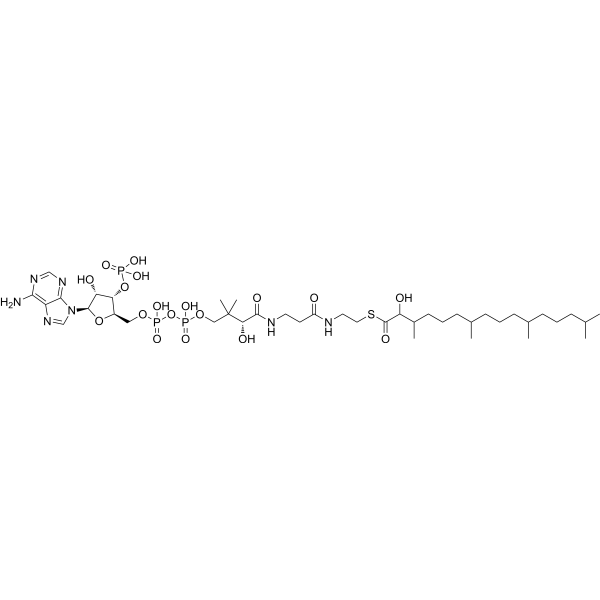
2-Hydroxyphytanoyl-CoA is synthesised from 2-hydroxyphytanic acid using the acid anhydride method .
loading...
    loading...
Cat. No.: HY-K0318

MCE Nitric Oxide Detection Kit employs a modified Griess method to detect the content of Nitric Oxide in various samples.

loading...
    loading...
Cat. No.: HY-K1098

MCE Exosome Isolation and Purification Kit (From Milk) provides a simple and effective method to isolate and purify intact exosomes from milk.

loading...
    loading...
Cat. No.: HY-176961
CAS No.: 7170-94-7
Target:  

Drug Derivative

Research Areas:  

Metabolic Disease

Homocholic acid is a synthetic steroid analogue. Homocholic acid can be labeled with 75Se and is used for SeHCAT detection (a method for diagnosing bile acid malabsorption) .
loading...
    loading...

