2419 Results for "

decrease

" in MedChemExpress (MCE) Product Catalog:
Products (2419)

2419 Results for "decrease" in MCE Product Catalog:

Cat. No.: HY-169061
WQQ-345 is an orally active BCAT1 inhibitor with an IC50 values of 10.8 mM. WQQ-345 reduces cellular α-KG levels, upregulating H3K27me3 expression, decreasing glycolytic enzyme expression, and impairing glycolysis activity. WQQ-345 reduces colony formation, suppresses growth of BCAT1-high TKI-resistant lung cancer cells. WQQ-345 exerts in vitro and in vivo antitumor activity. WQQ-345 can be used for the research of TKI-resistant non-small cell lung cancer and TKI-resistant lung cancer .
loading...
    loading...
Cat. No.: HY-171099
CAS No.: 2245949-62-4
Synonyms: LI-2124
Target:  

IPK Superfamily

SC-919 is an orally active IP6K inhibitor, with an IC50 of < 5.2 nM against IP6K1, < 3.8 nM against IP6K2, and 0.65 nM against IP6K3. By inhibiting the activity of IP6K, SC-919 reduces intracellular IP7 levels, thereby suppressing XPR1-mediated cellular phosphate efflux. SC-919 increases intracellular phosphate and ATP levels while reducing phosphate entry into the bloodstream, thus decreasing plasma phosphate levels. SC-919 can be used in research related to chronic kidney disease and hyperphosphatemia .
loading...
    loading...
Cat. No.: HY-175857
Target:  

HDAC Apoptosis

Research Areas:  

Cancer

HDAC-IN-92 is a pan-HDAC inhibitor with an IC50 of 12.58 µM in A2780 cells. HDAC-IN-92 demonstrates broad-spectrum, notable cytotoxic activity against a range of human cancer cell lines, including ovarian, liver, and breast carcinomas. HDAC-IN-92 causes apoptosis and demonstrates a notable decrease in tumor cell colony formation. HDAC-IN-92 inhibits the formation of blood vessels in the chick chorioallantoic membrane (CAM). HDAC-IN-92 exhibits anti-tumor effect in a 4T1 tumor-bearing mouse model. HDAC-IN-92 can be used for research targeting solid tumor .
loading...
    loading...
Cat. No.: HY-17587R
CAS No.: 36861-47-9
Synonyms: 4-MBC (Standard); Enzacamene (Standard)
Research Areas:  

Metabolic Disease

4-Methylbenzylidene camphor (Standard) is the analytical standard of 4-Methylbenzylidene camphor. This product is intended for research and analytical applications. 4-Methylbenzylidene camphor (4-MBC) is an endocrine disrupter that produces estrogen-like effects. 4-Methylbenzylidene camphor decreases the proliferation of human trophoblast cells and induces apoptosis. 4-Methylbenzylidene camphor activates PI3K/AKT and ERK1/2 signaling pathways and elevates intracellular ROS production. 4-Methylbenzylidene camphor is a ultraviolet (UV) filter and may hamper normal placental formation during early pregnancy .
loading...
    loading...
Cat. No.: HY-178042
CAS No.: 2756257-56-2
Target:  

Ras Akt ERK

Research Areas:  

Cancer

SS-3091 is a pan-KRas inhibitor active across KRas G12D, KRas G12C, KRas G12V, KRas G12S mutants, with minimal effects on non-KRas-driven cancer cells. SS-3091 binds to the KRas·ARaf interaction interface, destabilizes the complex, and attenuates KRas activity. SS-3091 suppresses phosphorylation of S6K, Akt, and ERK. SS-3091 reduces proliferation and decreases colony formation of cancer cells bearing KRas G12 mutations. SS-3091 can be used for the research of KRas-driven cancers .
loading...
    loading...
Cat. No.: HY-178383
Target:  

Glycosidase

Research Areas:  

Metabolic Disease

α-Glucosidase-IN-98 is a potent orally active α-Glucosidase inhibitor with an IC50 of 18.1 μM. α-Glucosidase-IN-98 reversibly binds with α-Glucosidase via hydrogen bonds, electrostatic interactions and hydrophobic effects, which induces significant conformational alterations in the secondary structure of α-Glucosidase. α-Glucosidase-IN-98 decreases postprandial hyperglycemia in Starch (HY-B2225B)/Sucrose (HY-B1779)-challenged mice. α-Glucosidase-IN-98 can be used for type 2 diabetes mellitus (T2DM) research .
loading...
    loading...
Cat. No.: HY-179003
mTOR/GLS1-IN-1 (Compoud 9d) is a potent dual targeted mTOR/GLS1 inhibitor. Has anti proliferative activity against various tumor cells. mTOR/GLS1-IN-1 dose dependently induces ROS accumulation, induces autophagosome formation, and induces apoptosis. mTOR/GLS1-IN-1 can increase Fe 2+, decrease GPX4, and induce ferroptosis. mTOR/GLS1-IN-1 can inhibit cell migration, invasion, and angiogenesis. mTOR/GLS1-IN-1 can be used in the research of cancer, such as breast cancer .
loading...
    loading...
Cat. No.: HY-181818
4,5-Dehydro-6-oxoallosecurinine is a Keap1-Nrf2 pathway activator. 4,5-Dehydro-6-oxoallosecurinine promotes the nuclear translocation of Keap1-Nrf2, and induces the expression of antioxidant and cytoprotective genes. 4,5-Dehydro-6-oxoallosecurinine reduces the production of NO, and decreases the levels of iNOS, TNF-α, IL-6 and IL-1β in LPS-stimulated microglia. 4,5-Dehydro-6-oxoallosecurinine can be used for the research of neurodegenerative diseases .
loading...
    loading...
Cat. No.: HY-182300
CAS No.: 171092-64-1
Research Areas:  

Metabolic Disease

FE 999011 is an orally active dipeptidyl peptidase IV (DPP-IV) inhibitor with IC50 values of 7 nM and 3 nM against human and rat sources, respectively. FE 999011 acts as a glucose tolerance-improving agent and a GLP-1 receptor activator, which reduces blood glucose fluctuation, promotes GLP-1 release and decreases the insulin-glucose ratio. FE 999011 regulates lipid metabolism, delays the onset of diabetes, stabilizes food and water intake, reduces hypertriglyceridemia, prevents the elevation of free fatty acids, and delays the progression of impaired glucose tolerance to disease. FE 999011 can be used in relevant studies of type 2 diabetes .
loading...
    loading...
Cat. No.: HY-183057
CAS No.: 2234900-83-3
GRK2 modulator 1 is an orally active, brain-penetrant and selective GRK2 modulator. GRK2 modulator 1 enhances the active, non-phosphorylated GRK2 and prevents mitochondrial GRK2 and TOMM6 aggregation. GRK2 modulator 1 enhances the non-amyloidogenic processing of APP and prevent PHF-tau, neurodegeneration, and neuronal loss. GRK2 modulator 1 decreases the senescence marker, UPAR, reduces the Alzheimer disease (AD)-related mortality, and prolongs survival. GRK2 modulator 1 exerts neuroprotection by inhibiting HDAC6, and counteracts age-related cardiac dysfunction. GRK2 modulator 1 can be used for research on AD .
loading...
    loading...
Cat. No.: HY-18314B
CAS No.: 504433-24-3
(Z)-GW 441756 is a hepatocyte nuclear factor 4α (HNF4α) activator, with an EC50 of 9.2 μM and a Ka of 4.6 μM in human systems. (Z)-GW 441756 directly interacts with the ligand-binding domain of HNF4α via persistent hydrogen bonds and hydrophobic interactions within the binding pocket. (Z)-GW 441756 reduces the accumulation of triglycerides and total cholesterol. (Z)-GW 441756 inhibits ferroptosis through a non-antioxidant mechanism. (Z)-GW 441756 decreases plasma triglyceride and total cholesterol levels in animal models of hyperlipidemia. (Z)-GW 441756 can be used in studies related to hyperlipidemia .
loading...
    loading...
Cat. No.: HY-184312
CAS No.: 1031072-40-8
PPAR agonist 8 is an orally active pan-PPAR agonist, with KD values of 0.576 μM, 2.06 μM and 1.45 μM for PPARα, PPARγ and PPARδ, respectively. PPAR agonist 8 upregulates the expression of ATP-binding cassette transporter A1 (ABCA1) and promotes cholesterol efflux. PPAR agonist 8 reduces plasma cholesterol levels, decreases cholesterol accumulation in the liver and cholesterol deposition in pancreatic islets, regulates glucose and lipid metabolism, and causes no side effects of weight gain and obesity. PPAR agonist 8 can be used in the research of type 2 diabetes, hepatic steatosis and pancreatic islet dysfunction .
loading...
    loading...
Cat. No.: HY-187214
PROTAC G9a degrader-1 is a selective and orally active G9a PROTAC degrader with a DC50 of 1.29 μM. PROTAC G9a degrader-1 inhibits the NF-κB signaling pathway, suppresses the proliferation and migration of cancer cells, promotes apoptosis and cell cycle arrest, and reduces the expression level of H3K9me2. In in vivo models, PROTAC G9a degrader-1 alleviates skin inflammation, reduces epidermal hyperplasia, and decreases Ki67 expression. PROTAC G9a degrader-1 can be used for the research of triple-negative breast cancer and psoriasis .
loading...
    loading...
Cat. No.: HY-187219
CX-Se13 is an orally active pulmonary fibrosis inhibitor with anti-inflammatory and antioxidant activities. CX-Se13 regulates the Keap1/Nrf2/HO-1/NQO1, YAP/TAZ-TEAD, NF-κB p65 and TGF-β/Smads signaling pathways. CX-Se13 activates the cellular antioxidant defense system, restores redox balance, alleviates inflammatory responses, reduces collagen deposition, decreases pro-inflammatory cytokine levels and inhibits pathological progression. CX-Se13 can be used in studies related to pulmonary fibrosis .
loading...
    loading...
Cat. No.: HY-188400
CAS No.: 3138013-03-0
Research Areas:  

Cancer

P-SiaFNEtoc is a Sialyltransferase inhibitor that blocks sialic acid capping of glycans. P-SiaFNEtoc forms CMP-SiaFNEtoc, reduces endogenous CMP-Neu5Ac, feedback-inhibits GNE, and depletes sialylation on N-glycans and O-GalNAc glycans. P-SiaFNEtoc decreases cell surface sialoglycan levels, VEGF and DKK-1 secretion, Tn antigen levels, and cell cycle checkpoint/E2F target gene expression, while inducing p27/Kip1 and fucosylation. P-SiaFNEtoc can be used in research on prostate cancer, and melanoma .
loading...
    loading...
Cat. No.: HY-189128
CAS No.: 774546-16-6
Target:  

METTL3

Research Areas:  

Infection

AN-465 is a METTL3 inhibitor with an IC50 of 1.782 μM and a Kd of 8.75 μM against human METTL3. AN-465 reduces m6A modification of RNA, including EV71 2C region RNA, and disrupts the interaction between METTL3 and EV71 2C RNA. AN-465 decreases EV71-induced proinflammatory cytokine production, modulates immune cell phenotypes, alleviates EV71-induced apoptosis, restores autophagic flux, and reduces viral particle formation. AN-465 is used in the study of hand, foot and mouth disease .
loading...
    loading...
Cat. No.: HY-189933
CAS No.: 920836-30-2
ICB-7 is an orally active ILT3/LILRB4 inhibitor with a Kd of 156 nM for hILT3 and a Kd of 262 nM for mouse ILT3. ICB-7 reduces SCG2-induced phosphorylation of SHP1, SHP2, and STAT3. In a co-culture model, ICB-7 restores IFN-γ and IL-2 secretion and decreases cell viability under SCG2 stimulation. In a syngeneic cancer model, ICB-7 inhibits tumor progression and reduces final tumor weight. ICB-7 can be used for research on colorectal cancer and acute myeloid leukemia .
loading...
    loading...
Cat. No.: HY-208723
CAS No.: 2345648-39-5
Target:  

MAP3K IKK NF-κB

Research Areas:  

Cancer

MAP3K1-IN-1 is an orally active and selective MAP3K1 kinase inhibitor. MAP3K1-IN-1 blocks TNFα-induced phosphorylation of IKKβ and activation of NF-κB. MAP3K1-IN-1 inhibits the growth of cancer cells. MAP3K1-IN-1 induces a decrease in phosphorylation sites of NPM1. MAP3K1-IN-1 can be used in pancreatic cancer-related research .
loading...
    loading...
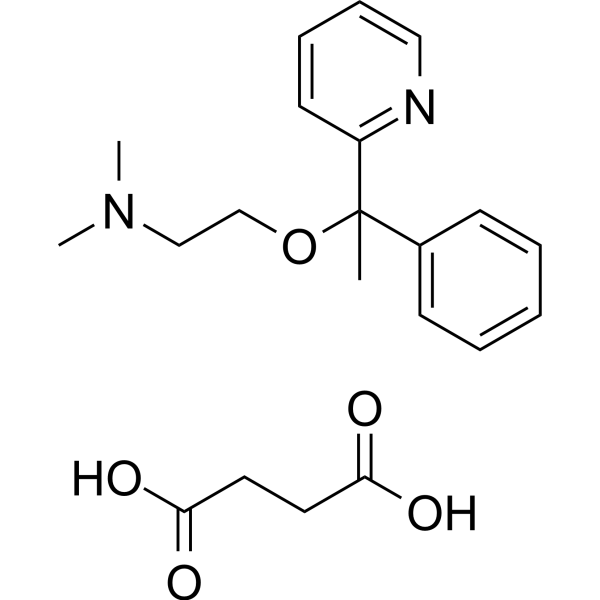
Cat. No.: HY-A0069
CAS No.: 562-10-7
Doxylamine succinate is a first-generation antihistamine and acts as a histamine H1 receptor antagonist. Doxylamine succinate is orally active, possessing analgesic and hypnotic activities. Doxylamine succinate enhances the activities of CYP2B, CYP2A, CYP3A and thyroxine-glucuronosyltransferase via promoting substrate hydroxylation and thyroxine metabolic pathways. Doxylamine succinate decreases serum thyroxine (T4) level and elevates serum thyroid-stimulating hormone (TSH) level. Doxylamine succinate induces liver enlargement and increases the activities of hepatic microsomal cytochrome P450, cytochrome b5 and NADPH-cytochrome c reductase. Doxylamine succinate can be used for the research of nausea, allergy, insomnia .
loading...
    loading...
Cat. No.: HY-B0011B
CAS No.: 700367-34-6
Synonyms: RP-56976 hydrate
Docetaxel hydrate (RP-56976 hydrate) is an orally active tubulin stabilizer with antitumor activity. Docetaxel hydrate is a P-glycoprotein substrate and is metabolized by CYP3A to inactive products. Docetaxel hydrate binds tubulin, promotes tubulin polymerization, and inhibits microtubule depolymerization. Docetaxel hydrate induces aberrant mitosis followed by necrotic-like cell death at low concentrations, and induces G2/M mitotic arrest and drives apoptosis at high concentrations. Docetaxel hydrate induces renal injury/renal alterations, sex-dependent granule toxicity/uptake, low cardiac delivery, and decreased hepatic SOD/increased catalase/hepatotoxicity. Docetaxel hydrate can be used in cancer-related research .
loading...
    loading...

