
1. Search Result
Search Result
Results for "

GluA2

" in MedChemExpress (MCE) Product Catalog:

19

Inhibitors & Agonists

7

Peptides

6

Antibodies

3

Oligonucleotides

Targets Recommended:
Cat. No. Product Name Target Research Areas Chemical Structure
  • HY-111751
    JNJ-61432059
    1 Publications Verification

    iGluR Neurological Disease
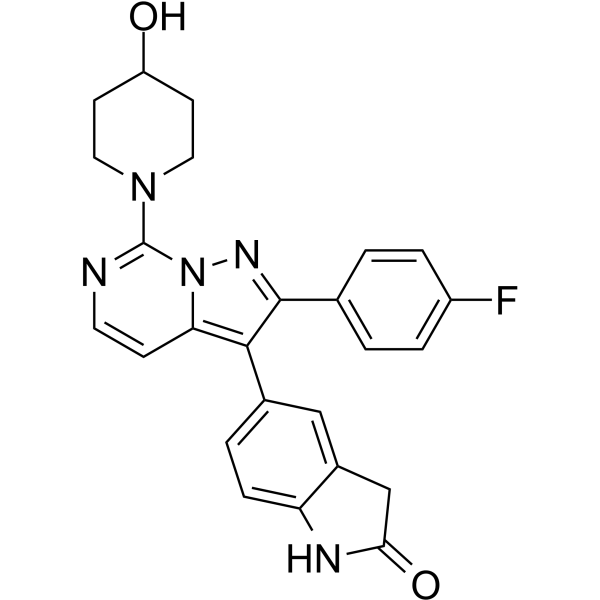
    JNJ-61432059 is a blood-brain barrier-permeable, orally active TARP γ-8-associated AMPAR modulator with anticonvulsant activity. JNJ-61432059 negatively regulates GluA1 and positively modulates GluA2-containing AMPARs. JNJ-61432059 exerts potent protective effects in rodent epilepsy models. JNJ-61432059 is applicable for epilepsy-related research [2].
    JNJ-61432059
  • HY-P2259
    TAT-GluA2 3Y
    2 Publications Verification

    iGluR HIV Integrase Adenosine Receptor Cardiovascular Disease Neurological Disease
    TAT-GluA2 3Y is a blood-brain barrier-permeable AMPA receptor inhibitory peptide that crosses cell membranes via the HIV-1 TAT protein domain. TAT-GluA2 3Y blocks the endocytosis of AMPA receptors, including the internalization of GluA1/GluA2 subunits, by disrupting interactions with the AP2, Brag2 and Syt3-GluA2 complexes, while also inhibiting long-term depression. TAT-GluA2 3Y blocks hypoxia-mediated AMPAR internalization, alleviates A1R-induced persistent synaptic inhibition, and reduces cerebral ischemic volume, neurological deficits and spatial memory deficits. TAT-GluA2 3Y blocks the effect of NLRP3 deficiency on fear generalization, inhibits amphetamine-induced behavioral/neurochemical sensitization, weakens the unconditioned stimulus-conditioned stimulus association of morphine, and promotes the extinction of morphine CPP. TAT-GluA2 3Y can be used in studies related to fear generalization, ischemic stroke, hypoxia, drug addiction and opioid addiction [2] .
    TAT-GluA2 3Y
  • HY-171844

    iGluR Neurological Disease Inflammation/Immunology
    CX1739 is an orally active, blood-brain barrier permeable, low-efficacy AMPA-glutamate receptor (AMPAR) potentiator. CX1739 enhances excitatory neurotransmission by potentiating glutamate-induced excitatory currents and promoting in vivo long-term potentiation. CX1739 eliminates amphetamine-induced locomotor activity, reverses opioid-, pentobarbital- and ethanol-induced respiratory depression, and exerts pro-cognitive effects in animals. CX1739 impairs motor function recovery and increases the risk of post-injury complications. CX1739 can be used in research related to attention-deficit/hyperactivity disorder, dementia, respiratory depression and spinal cord injury [2] .
    CX1739
  • HY-177873

    iGluR Neurological Disease
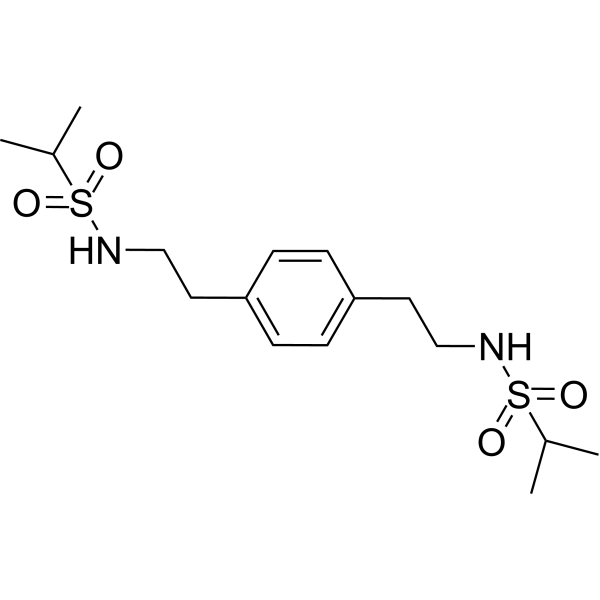
    AMPA receptor modulator-10 (Compound 9a) is an orally active AMPA receptor (AMPAR) positive allosteric modulator. AMPA receptor modulator-10 exhibits potent activity (pEC50 = 5.0) on the GluA2 subtype of AMPAR, significantly enhancing glutamate-induced calcium influx and current responses. AMPA receptor modulator-10 can reverse the memory impairment induced by Scopolamine (HY-N0296) and enhance cognitive function. AMPA receptor modulator-10 can be used for the research of neurological disease, such as schizophrenia .
    AMPA receptor modulator-10
  • HY-12508

    iGluR Neurological Disease
    CMPDA is a positive allosteric modulator of AMPA receptors with EC50s of 45.4 ± 4.2 nM/63.4 ± 5.6 nM for GluA2i/GluA2o receptor.
    CMPDA
  • HY-RS05792

    Small Interfering RNA (siRNA) Others

    GRIA2 Human Pre-designed siRNA Set A contains three designed siRNAs for GRIA2 gene (Human), as well as a negative control, a positive control, and a FAM-labeled negative control.

    GRIA2 Human Pre-designed siRNA Set A
    GRIA2 Human Pre-designed siRNA Set A
  • HY-161665

    iGluR Neurological Disease
    BDZ-P7 inhibits AMPA receptor GluA2, GluA1/2, GluA2/3, and GluA1 subunit with IC50s of 3.03 μM, 3.14 μM, 3.19 μM, 3.2 μM. BDZ-P7 has neuroprotective effect and reinstates locomotor abilities in a mouse model of Parkinson’s disease .
    BDZ-P7
  • HY-P3355

    iGluR Neurological Disease
    p-fin4 is a peptide inhibitor of STEP Phosphatase-GluA2 AMPA receptor interaction with a Ki of 0.4 μM. p-fin4 restores the memory deficits and displays anxiolytic and antidepressant effects in a scopolamine-treated rat model. p-fin4 is a promising lead compound for novel cognitive enhancers and/or behavioral modulators .
    p-fin4
  • HY-103231

    iGluR Neurological Disease
    (S)-CPW 399 is a subtype-selective full agonist of AMPA receptors, with a 20-fold higher selectivity for GluA1 and GluA2 subunits over GluA3 and GluA4 subunits. (S)-CPW 399 can significantly increase the spontaneous firing rate (FR) of LC noradrenergic neurons by activating AMPA receptors containing GluA1 subunits. (S)-CPW 399 can be used for the study of neurological diseases .
    (S)-CPW 399
  • HY-P3354

    iGluR Neurological Disease
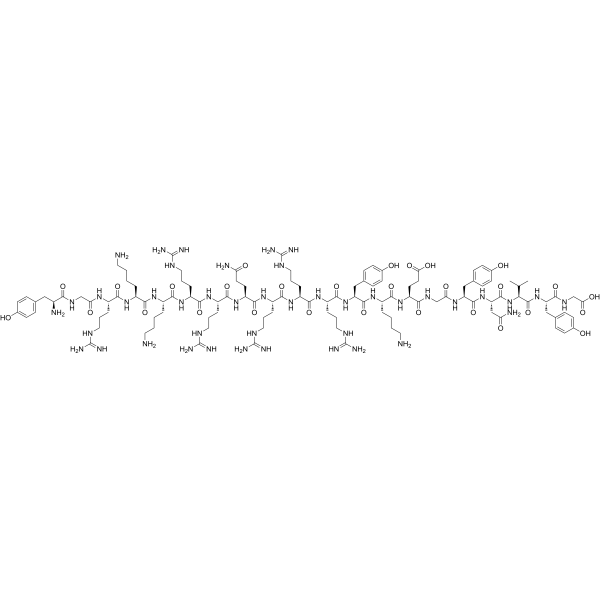
    p3Ysh-3 is a peptide inhibitor of STEP Phosphatase-GluA2 AMPA receptor interaction with a Ki of 1.09 μM. p3Ysh-3 restores the memory deficits and displays anxiolytic and antidepressant effects in a scopolamine-treated rat model. p3Ysh-3 is a promising lead compound for novel cognitive enhancers and/or behavioral modulators .
    p3Ysh-3
  • HY-P1057

    iGluR Neurological Disease
    Pep4c is an inactive control peptide for Pep2m (HY-P1058). Pep4c lacks functional activity to disrupt Protein Interacting with C Kinase 1 (PICK1)-AMPA receptor (GluA2) or N-ethylmaleimide-sensitive factor (NSF)-GluA2 interactions. Pep4c is used as a negative control in experiments to validate the specificity of Pep2m's effects on AMPA receptor trafficking and synaptic plasticity [1] [2] [3] [4] [5] [6].
    Pep4c
  • HY-165475

    iGluR Neurological Disease
    TDPAM02 is a positive allosteric modulator of AMPA receptor GluA2. TDPAM02 can specifically bind to the ligand-binding domain (LBD) of GluA2 and shows an IC50 of 1.4 nM for the GluA2 flop subtype. TDPAM02 can stabilize the activated conformation of GluA2 receptors, delay the receptor deactivation or desensitization process, maintaining the rapid excitatory synaptic transmission in the central nervous system .
    TDPAM02
  • HY-165474

    iGluR Neurological Disease
    TDPAM01 is a positive allosteric modulator of AMPA receptor GluA2. TDPAM01 can specifically bind to the ligand-binding domain (LBD) of GluA2 and shows an IC50 of 13.4 nM for the GluA2 flop subtype. TDPAM01 can stabilize the activated conformation of GluA2 receptors, delay the receptor deactivation or desensitization process, maintaining the rapid excitatory synaptic transmission in the central nervous system .
    TDPAM01
  • HY-P1058

    iGluR Neurological Disease
    Pep2m is a peptide receptor inhibitor. Pep2m inhibits the interaction between the C-terminus of the AMPA-type glutamate receptor (GluA2) subunit and N-ethylmaleimide-sensitive fusion protein (NSF). Pep2m prevents synaptic long-term depression (LTD). Pep2m can reduce postsynaptic currents in neurons, AMPA-mediated currents in cultured hippocampal neurons, and AMPA receptor surface expression [1] [2] [3] [4] [5].
    Pep2m
  • HY-P1059

    iGluR Neurological Disease
    Pep2-AVKI is a selective peptide inhibitor of the binding of the AMPA receptor subunit (GluR2) at the C-terminal PDZ site to C-kinase (PICK1). Pep2-AVKI does not affect the binding of (AMPA-type glutamate receptor) GluA2 to GRIP or ABP. Pep2-AVKI does not increase the amplitude of AMPA currents. pep2-AVKI can be used to study neurological diseases [2] .
    Pep2-AVKI
  • HY-P1056

    iGluR Neurological Disease
    pep2-SVKI is a selective peptide inhibitor. pep2-SVKI inhibits the binding of AMPA-type glutamate receptor (GluA2) (C-terminal PDZ site) to glutamate receptor interacting protein (GRIP), AMPA receptor binding protein (ABP), and C-kinase interacting protein (PICK1). pep2-SVKI increases the amplitude of AMPA receptor-mediated currents and blocks long-term depression (LTD). pep2-SVKI can be used to study neurological diseases [2] .
    pep2-SVKI
  • HY-180197

    PKC iGluR Reactive Oxygen Species (ROS) Cardiovascular Disease Neurological Disease
    PICK1 PDZ-IN-1 (Compound 6b) is a selective and brain-penetrant protein interacting with C kinase 1 (PICK1) PDZ domain inhibitor with a Ki of 27.73 μM. PICK1 PDZ-IN-1 can competitively inhibit the interaction between PICK1 and the GluA2 subunit of AMPA receptors. PICK1 PDZ-IN-1 can increase the survival rate of HT22 cells and primary cortical neuron cells induced by glutamate and inhibit ROS production. PICK1 PDZ-IN-1 exhibits neuroprotective effect and reduces the area of cerebral infarction. PICK1 PDZ-IN-1 can be used for the research of ischemic stroke .
    PICK1 PDZ-IN-1
  • HY-RS28107

    Small Interfering RNA (siRNA) Others
    Gria2 Rat Pre-designed siRNA Set A contains three designed siRNAs for Gria2 gene (Rat), as well as a negative control, a positive control, and a FAM-labeled negative control.
    Gria2 Rat Pre-designed siRNA Set A
    Gria2 Rat Pre-designed siRNA Set A
  • HY-RS21589

    Small Interfering RNA (siRNA) Others

    Gria2 Mouse Pre-designed siRNA Set A contains three designed siRNAs for Gria2 gene (Mouse), as well as a negative control, a positive control, and a FAM-labeled negative control.

    Gria2 Mouse Pre-designed siRNA Set A
    Gria2 Mouse Pre-designed siRNA Set A

Inquiry Online

Your information is safe with us. * Required Fields.

Salutation


Country or Region *

Applicant Name *


Organization Name *

Department *


Email Address *


Product Name *

Cat. No.


Requested quantity *

Phone Number *


Remarks

Inquiry Online

Inquiry Information

Product Name:
Cat. No.:
Quantity:
MCE Japan Authorized Agent:

