1. Search Result
Search Result
Results for "

Glycosylphosphatidylinositol

" in MedChemExpress (MCE) Product Catalog:

10

Inhibitors & Agonists

2

Natural
Products

2

Recombinant Proteins

1

Isotope-Labeled Compounds

Cat. No. 상품명 Target 연구분야 Chemical Structure
  • HY-18233
    Manogepix
    4 Publications Verification

    E1210; APX001A

    Fungal Infection
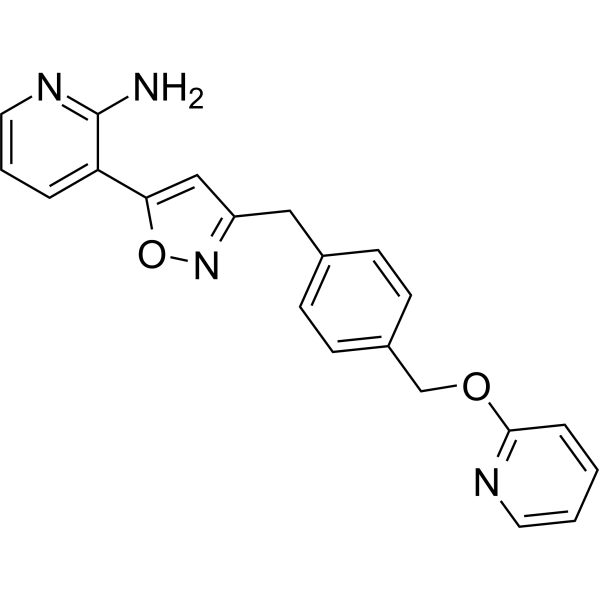
    Manogepix (E1210) is a first-in-class, broad-spectrum and orally active antifungal. Manogepix has a mechanism of action-inhibition of fungal glycosylphosphatidylinositol (GPI) biosynthesis .
    Manogepix
  • HY-119726

    APX001; E1211

    Fungal Infection Inflammation/Immunology Cancer
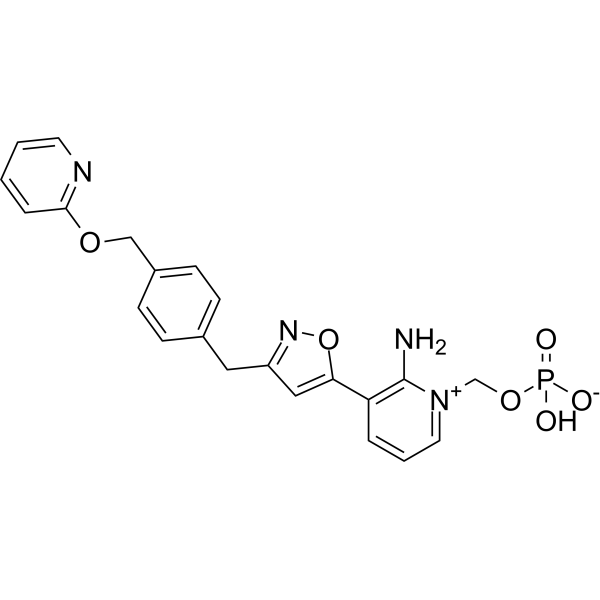
    Fosmanogepix (APX001) is a broad-spectrum agent against invasive fungal infections. Fosmanogepix (APX001) targets the conserved Gwt1 enzyme required for the localization of glycosylphosphatidylinositol-anchored mannoproteins in fungi. This inhibition prevents the appropriate localization of cell wall mannoproteins, which compromises cell wall integrity, biofilm formation, germ tube formation, and fungal growth. Fosmanogepix (APX001) can be used for invasive fungal infections research .
    Fosmanogepix
  • HY-147110

    Fungal Infection Inflammation/Immunology
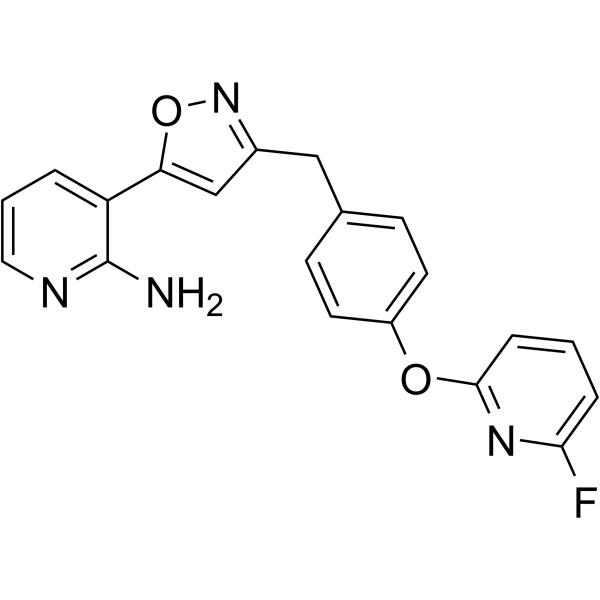
    APX2039 is a brain-penetrant and orally active Gwt1 protein inhibitor. APX2039 inhibits an early step in fungal glycosylphosphatidylinositol anchor biosynthesis. APX2039 can be used for the research of cryptococcal meningitis and invasive mycosis caused by Talaromyces marneffei .
    APX2039
  • HY-148978

    Exosomes Endogenous Metabolite Liposome Metabolic Disease
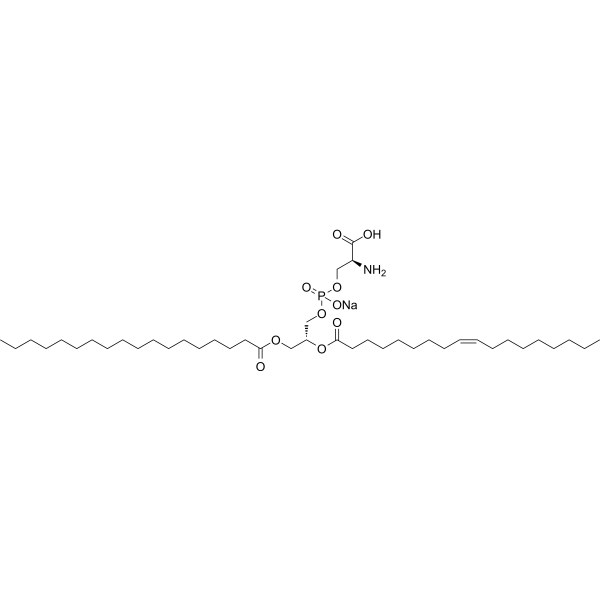
    18:0,18:1 PS sodium is the dominant phosphatidylserine subtype in cells, exosomes and HIV particles. It is abundant in the brain and is essential for maintaining membrane structure, lipid raft organization and intracellular trafficking. 18:0,18:1 PS sodium mediates interleaflet membrane coupling through cholesterol-dependent interactions with very long-chain sphingolipids, and can induce the clustering of glycosylphosphatidylinositol-anchored proteins. In addition, clusters formed by the binding of 18:0,18:1 PS sodium to cholesterol not only facilitate the proper distribution of cholesterol in lipid bilayers, but also effectively protect cholesterol from oxidative damage .
    18:0,18:1 PS sodium
  • HY-119726A

    APX001 (tautomerism); E1211 (tautomerism)

    Fungal Infection Inflammation/Immunology
    Fosmanogepix tautomerism (APX001 tautomerism) is a broad-spectrum and orally active anti-invasive fungal compound. Fosmanogepix tautomerism targets the conserved Gwt1 enzyme required for the localization of glycosylphosphatidylinositol-anchored mannoproteins in fungi, and inhibition prevents proper localization of cell wall mannoproteins, thereby impairing cell wall integrity, biofilm formation, germ tube formation, and fungal growth. Fosmanogepix tautomerism can be used to study invasive fungal infections .
    Fosmanogepix (tautomerism)
  • HY-148978A

    Exosomes Liposome Endogenous Metabolite Metabolic Disease
    18:0,18:1 PS is the dominant phosphatidylserine subtype in cells, exosomes and HIV particles. It is abundant in the brain and is essential for maintaining membrane structure, lipid raft organization and intracellular trafficking. 18:0,18:1 PS mediates interleaflet membrane coupling through cholesterol-dependent interactions with very long-chain sphingolipids, and can induce the clustering of glycosylphosphatidylinositol-anchored proteins. In addition, clusters formed by the binding of 18:0,18:1 PS to cholesterol not only facilitate the proper distribution of cholesterol in lipid bilayers, but also effectively protect cholesterol from oxidative damage .
    18:0,18:1 PS
  • HY-148978R

    Reference Standards Exosomes Endogenous Metabolite Liposome Metabolic Disease
    Resorantel (Standard) is the analytical standard of Resorantel. This product is intended for research and analytical applications. 18:0,18:1 PS sodium is the dominant phosphatidylserine subtype in cells, exosomes and HIV particles. It is abundant in the brain and is essential for maintaining membrane structure, lipid raft organization and intracellular trafficking. 18:0,18:1 PS sodium mediates interleaflet membrane coupling through cholesterol-dependent interactions with very long-chain sphingolipids, and can induce the clustering of glycosylphosphatidylinositol-anchored proteins. In addition, clusters formed by the binding of 18:0,18:1 PS sodium to cholesterol not only facilitate the proper distribution of cholesterol in lipid bilayers, but also effectively protect cholesterol from oxidative damage .
    18:0,18:1 PS sodium (Standard)
  • HY-18233S

    E1210-d4; APX001A-d4

    Isotope-Labeled Compounds Fungal Infection
    Manogepix-d4 (E1210-d4) is the deuterium labeled Manogepix (HY-18233). Manogepix (E1210) is a first-in-class, broad-spectrum and orally active antifungal. Manogepix has a mechanism of action-inhibition of fungal glycosylphosphatidylinositol (GPI) biosynthesis .
    Manogepix-d4
  • HY-P2752A

    Endogenous Metabolite Metabolic Disease
    Lipoprotein lipase, Bovine (EC 3.1.1.34) belongs to the lipase gene family and is a water-soluble enzyme that hydrolyzes triglycerides in lipoproteins (such as those in chylomicrons and very low-density lipoproteins (VLDL)) into two free fatty acid molecules and one monoacylglycerol molecule. Lipoprotein also participates in promoting cellular uptake of chylomicron remnants, cholesterol-rich lipoproteins, and free fatty acids. Lipoprotein requires ApoC-II as a cofactor. Lipoprotein attaches to the luminal surface of capillary endothelial cells via glycosylphosphatidylinositol high-density lipoprotein-binding protein 1 (GPIHBP1) and heparan sulfate proteoglycan.
    Lipoprotein Lipase, Bovine
  • HY-P2752B

    Endogenous Metabolite Metabolic Disease
    Lipoprotein Lipase, Burkholderia sp. (EC 3.1.1.34) belongs to the lipase gene family and is a water-soluble enzyme that hydrolyzes triglycerides in lipoproteins (such as those in chylomicrons and very low-density lipoproteins (VLDL)) into two free fatty acid molecules and one monoacylglycerol molecule. Lipoprotein also participates in promoting cellular uptake of chylomicron remnants, cholesterol-rich lipoproteins, and free fatty acids. Lipoprotein requires ApoC-II as a cofactor. Lipoprotein attaches to the luminal surface of capillary endothelial cells via glycosylphosphatidylinositol high-density lipoprotein-binding protein 1 (GPIHBP1) and heparan sulfate proteoglycan.
    Lipoprotein Lipase, Burkholderia sp.

온라인 문의

Your information is safe with us. * Required Fields.

호칭


Country or Region *

고객명 *


회사명 *

Department *


메일주소 *


상품명 *

Cat. No.


Requested quantity *

전화번호 *


비고

온라인 문의

Inquiry Information

상품명:
Cat. No.:
수량:
MCE Japan Authorized Agent:

