1. Search Result
Search Result
Pathways Recommended: Stem Cell/Wnt Cell Cycle/DNA Damage
Results for "

NCI-H522 cells

" in MedChemExpress (MCE) Product Catalog:

7

Inhibitors & Agonists

1

Natural
Products

2

Click Chemistry

Cat. No. Product Name Target Research Areas Chemical Structure
  • HY-N4201

    EGFR Src Cancer
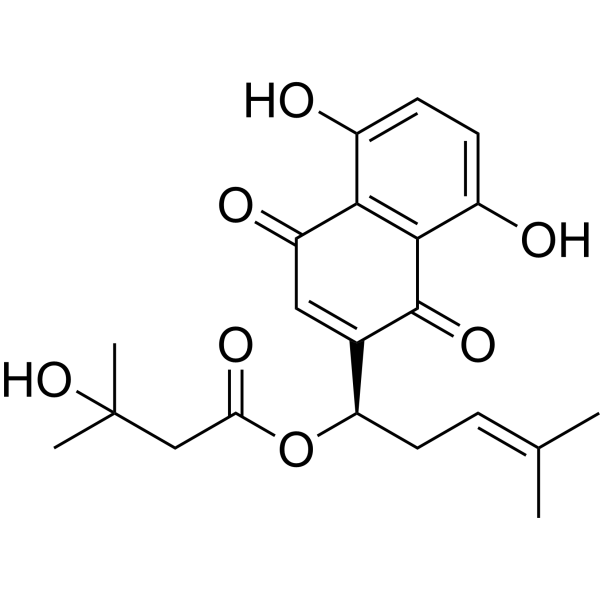
    Beta-hydroxyisovalerylshikonin is a natural product isolated from Lithospermum erythrorhizon, acts as a potent inhibitor of protein tyrosine kinases (PTK), with IC50s of 0.7μM and 1μM for EGFR and v-Src receptor, respectively. Beta-hydroxyisovalerylshikonin is effective against a wide variety of tumor cell lines, and most efficiently induces cell-death in NCI-H522 and DMS114 cells .
    β-Hydroxyisovalerylshikonin
  • HY-169021

    JNK Cancer
    JNK-1-IN-3 (Compound 9e) is an inhibitor of JNK1 that downregulates JNK1 gene expression and inhibits the protein levels of its phosphorylated form, concurrently reducing the expression of its downstream targets, c-Jun and c-Fos, in tumors while restoring p53 activity. JNK-1-IN-3 exhibits broad-spectrum antiproliferative activity, particularly with high inhibitory activity against renal and breast cancer cell lines, demonstrating both in vivo and in vitro anticancer activity .
    JNK-1-IN-3
  • HY-168093

    Ferroptosis Cancer
    Cetzole (Compound 1) is a ferroptosis inducer that induces cell death through ROS accumulation. The CC50 values of Cetzole for NCI-H522, NCI-H522 GFP-SCL7A11 #8, NCI-H522 RV-GFP, HT-1080, NARF2, and MDA-MB-231 are 2.56, 10.31, 2.71, 3.07, 14.9, and 6.28 μM, respectively. Cetzole holds potential for research in the field of cancer .
    Cetzole
  • HY-173619

    EGFR Cancer
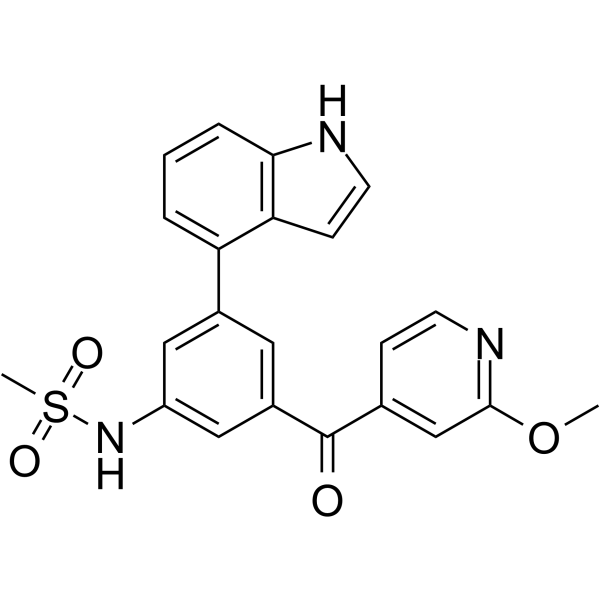
    EGFR-IN-160 (Compound R12) is an EGFR inhibitor (IC50 values are 1.62, 0.49 and 0.98 μM for EGFR WT, EGFR T790M and EGFR L858R/T790M/C797S, respectively). EGFR-IN-160 induces G2/M and S phase arrest and apoptosis in NCI-H522 cells, and has anticancer activity. EGFR-IN-160 has antioxidant effects against DPPH (IC50: 12.11 µM) and H2O2 (IC50: 8.89 µM) .
    EGFR-IN-160
  • HY-14389

    Microtubule/Tubulin Cancer
    LP-261 is a potent and orally active anti-mitotic agent and shows an inhibition of in vitro tubulin polymerization with an EC50 of 3.2 μM . LP-261 inhibits growth of a human non-small-cell lung tumor (NCI-H522) in vivo and can be used for cancer research .
    LP-261
  • HY-151872

    HDAC Ferroptosis Cancer
    HDAC-IN-48 is a potent HDAC inhibitor. HDAC-IN-48 is a hybrid molecule with great cytotoxic profile (GI50~20 nM). HDAC-IN-48 consists of harmacophores of SAHA and CETZOLE molecules. HDAC-IN-48 induces ferroptosis and inhibits HDAC proteins . HDAC-IN-48 is a click chemistry reagent, it contains an Alkyne group and can undergo copper-catalyzed azide-alkyne cycloaddition (CuAAc) with molecules containing Azide groups.
    HDAC-IN-48
  • HY-117208

    Glyoxalase (GLO) Apoptosis DNA/RNA Synthesis PARP Cancer
    TLSC702 is a human glyoxalase I (hGLO I) inhibitor with an IC50 of 2.0 μM. TLSC702 inhibits the activity of human glyoxalase I, thereby leading to the accumulation of methylglyoxal and its derived advanced glycation end products. TLSC702 inhibits tumor cell proliferation, induces apoptotic morphological changes, internucleosomal DNA fragmentation and PARP cleavage in tumor cells. TLSC702 can be used in research related to leukemia and lung cancer .
    TLSC702

Inquiry Online

Your information is safe with us. * Required Fields.

Salutation


Country or Region *

Applicant Name *


Organization Name *

Department *


Email Address *


Product Name *

Cat. No.


Requested quantity *

Phone Number *


Remarks

Inquiry Online

Inquiry Information

Product Name:
Cat. No.:
Quantity:
MCE Japan Authorized Agent:

