20 Results for "

PTGS2

" in MedChemExpress (MCE) Product Catalog:
Products (20)

20 Results for "PTGS2" in MCE Product Catalog:

3
3 Cited Publications
Cat. No.: HY-P80091
Synonyms: PTGS2; COX 2; COX2; COX-2; Cyclooxygenase; Cyclooxygenase2; Cyclooxygenase-2; hCox 2; PGG/HS; PGH synthase 2; PGHS 2; PGHS2; PHS 2; PHS II; PHS2 ; Prostaglandin endoperoxide synthase 2; Prostaglandin G/H synthase 2 precursor; Prostaglandin G/H synthase and cyclooxygenase; Prostaglandin G/H synthase 2; Prostaglandin H2 synthase 2; TIS10II; PGH2_HUMAN.

Host:  

Rabbit

Application:  

WB, ICC/IF, IHC-P

Reactivity:  

Human, Mouse, Rat

loading...
    loading...
3
3 Cited Publications
Cat. No.: HY-P80090

Host:  

Mouse

Application:  

WB, IHC-P, FC

Reactivity:  

Human, Mouse, Rat

loading...
    loading...
2
2 Cited Publications
Cat. No.: HY-P74222
Purity:  ≥ 90%, as determined by reducing SDS-PAGE.
Synonyms: Prostaglandin G/H synthase 2; COX-2; PGHS-2
Species:  
Source:  
loading...
    loading...
1
1 Cited Publications
Cat. No.: HY-N6929
CAS No.: 565-63-9
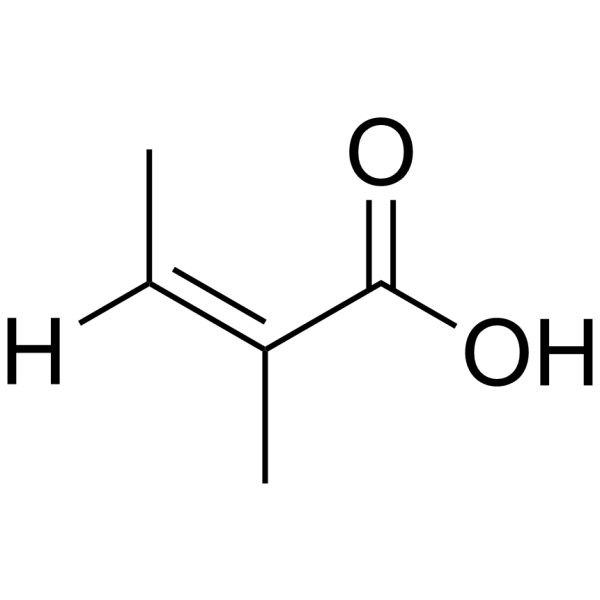
Angelic acid is a ferroptosis inducer, targeting NRF2 degradation. Angelic acid binds to NRF2 protein and promotes NRF2 degradation via ubiquitination-proteasome pathway, relieves the inhibitory effect of NRF2 on oxidative stress and lipid peroxidation. Then, Angelic acid induces ferroptosis in tumor cells. Angelic acid can enhance the accumulation of intracellular reactive oxygen species (ROS), upregulate ferroptosis-related markers CHAC1 and PTGS2, and synergize with ferroptosis inducers to enhance anti-tumor effects. Angelic acid also has the activity of scavenging UVA-induced ROS in vitro, inhibiting skin fibroblast senescence and extracellular matrix degradation. Angelic Acid helps wound healing with sedative activity [2].
loading...
    loading...
Cat. No.: HY-163897
CAS No.: 3098187-24-4
PROTAC NCOA4 degrader-1 is a VHL-based PROTAC NCOA4 degrader. PROTAC NCOA4 degrader-1 is a ferroptosis inhibitor. PROTAC NCOA4 degrader-1 reduces Fe 2+ elevation, ROS production, MDA content and PTGS2 mRNA expression. PROTAC NCOA4 degrader-1 ameliorates liver damage in a CCl4-induced acute liver injury model. PROTAC NCOA4 degrader-1 can be used for the researches of inflammation and immunology .
loading...
    loading...
Cat. No.: HY-RS11393
Research Areas:  

Others

PTGS2 Human Pre-designed siRNA Set A contains three designed siRNAs for PTGS2 gene (Human), as well as a negative control, a positive control, and a FAM-labeled negative control.

loading...
    loading...
Cat. No.: HY-RS16902
Research Areas:  

Others

Ptgs2 Mouse Pre-designed siRNA Set A contains three designed siRNAs for Ptgs2 gene (Mouse), as well as a negative control, a positive control, and a FAM-labeled negative control.

loading...
    loading...
Cat. No.: HY-RS23344
Research Areas:  

Others

Ptgs2 Rat Pre-designed siRNA Set A contains three designed siRNAs for Ptgs2 gene (Rat), as well as a negative control, a positive control, and a FAM-labeled negative control.

loading...
    loading...
Cat. No.: HY-175813
CAS No.: 3113770-74-1
NPSR1 antagonist-1 is a potent and peripherally restricted neuropeptide S receptor 1 (NPSR1) antagonist. NPSR1 antagonist-1 can inhibit IL-6, PTGS2, IL-20, and CXCL8 expression. NPSR1 antagonist-1 can reduce TNF-α cytokine levels. NPSR1 antagonist-1 can be used for the research of inflammation, such as peritonitis .
loading...
    loading...
Cat. No.: HY-N6929R
CAS No.: 565-63-9
Angelic acid (Standard)) is the analytical standard of Angelic acid (HY-N6929). This product is intended for research and analytical applications. Angelic acid is a ferroptosis inducer, targeting NRF2 degradation. Angelic acid binds to NRF2 protein and promotes NRF2 degradation via ubiquitination-proteasome pathway, relieves the inhibitory effect of NRF2 on oxidative stress and lipid peroxidation. Then, Angelic acid induces ferroptosis in tumor cells. Angelic acid can enhance the accumulation of intracellular reactive oxygen species (ROS), upregulate ferroptosis-related markers CHAC1 and PTGS2, and synergize with ferroptosis inducers to enhance anti-tumor effects. Angelic acid also has the activity of scavenging UVA-induced ROS in vitro, inhibiting skin fibroblast senescence and extracellular matrix degradation. Angelic Acid helps wound healing with sedative activity [2].
loading...
    loading...
Cat. No.: HY-121025
CAS No.: 23000-46-6
Purity:  99.65%
Target:  

TGF-β Receptor

Research Areas:  

Others

BUR1 is a BMP upregulator (EC50: 98 nM) and activates BMPRII signalling. BUR1 induces BMP2 and PTGS2 expression. BUR1 reversed pulmonary arterial pressure in Monocrotaline (HY-N0750) induced rats .
loading...
    loading...
Cat. No.: HY-N19877
CAS No.: 123828-59-1
Neokadsuranic acid B is a 14 (13→12)-seco-lanostane-type triterpenoid acid that exists in the stems of Kadsura longipedunculata and Radix Aconiti Lateralis Preparata. It has high binding affinity for PTGS2 (COX-2). Neokadsuranic acid B shows promise for research into rheumatoid arthritis [2].
loading...
    loading...
Cat. No.: HY-P84274
Synonyms: COX2; COX-2; PHS-2; PGG/HS; PGHS-2; hCox-2; GRIPGHS

Host:  

Mouse

Application:  

ICC/IF, FC, ELISA

Reactivity:  

Human

loading...
    loading...
Cat. No.: HY-P84274A
Synonyms: COX2; COX-2; PHS-2; PGG/HS; PGHS-2; hCox-2; GRIPGHS

Host:  

Mouse

Application:  

ICC/IF, FC, ELISA

Reactivity:  

Human

loading...
    loading...
Cat. No.: HY-P85939
Synonyms: COX 2; COX-2; COX2; Cyclooxygenase 2; Cyclooxygenase 2b; Cyclooxygenase; Cyclooxygenase-2; Cyclooxygenase2; fj02a10; Glucocorticoid-regulated inflammatory cyclooxygenase; Glucocorticoid-regulated inflammatory Prostaglandin G/H synthase; GRIPGHS; hCox 2; Macrophage activation-associated marker protein P71/73; OTTHUMP00000033524; PES-2; PGG/HS; PGH synthase 2; PGH2_HUMAN; PGHS 2; PGHS-2; PGHS2; PHS 2; PHS II; PHS2; Prostaglandin endoperoxide synthase 2; prostaglandin G/H synthase and cyclooxygenase; Prostaglandin endoperoxide synthase 2; Prostaglandin G/H synthase 2; Prostaglandin G/H synthase 2 precursor; Prostaglandin G/H synthase and cyclooxygenase; Prostaglandin G/H synthase; Prostaglandin H2 synthase 2; prostaglandin-endoperoxide synthase 2; prostaglandin G/H synthase and cyclooxygenase; Prostaglandin-endoperoxide synthase 2; PTGS2; PTGS2a; TIS10; TIS10 protein; unp1239; wu:fj02a10

Host:  

Mouse

Application:  

IHC-P, WB, ICC/IF, ELISA

Reactivity:  

Human

loading...
    loading...
Cat. No.: HY-N16797
CAS No.: 174423-32-6
Sanggenol C is a natural flavonoid.
loading...
    loading...
Cat. No.: HY-N18209
CAS No.: 74459-23-7
4-Hydroxy-3-butylphthalide is a Phthalide (HY-W015820) derivative found in the rhizome of Ligusticum ChuanXiong Hort. 4-Hydroxy-3-butylphthalide binds core targets linked to lung cancer brain metastasis, such as BDNF, FOS, and MAPK14. 4-Hydroxy-3-butylphthalide can be used for the research of lung cancer brain metastasis .
loading...
    loading...
Cat. No.: HY-P74222Y
Purity:  ≥ 90%, as determined by reducing SDS-PAGE.
Synonyms: Prostaglandin G/H synthase 2; COX-2; PGHS-2
Species:  
Source:  
loading...
    loading...
Cat. No.: HY-N20647
CAS No.: 124902-18-7
Jioglutolide is a cyclopentane monoterpene and weak testosterone 5α-reductase inhibitor. Jioglutolide is isolated from steamed roots of Rehmannia glutinosa var. hueichingensis. Jioglutolide is applicable to research on allergies, anemia, diabetes, and menopause-related conditions [2].
loading...
    loading...
Cat. No.: HY-N17632
CAS No.: 73338-86-0
Moracin G is a plant-derived kinase modulator and receptor ligand that forms stable bindings with multiple key proteins (AKT1, COX2 and Estrogen receptor 1) and competitively inhibits the activity of specific kinases. By binding to MELK to disrupt cell cycle regulation, Moracin G impairs the survival and proliferation of cancer cells, induces cancer cell apoptosis, and thereby exerts anti-tumor potential. Moracin G can be used in research related to periodontitis and breast cancer [2].
loading...
    loading...
  • 1

