14 Results for "

Patch Clamp

" in MedChemExpress (MCE) Product Catalog:
Products (14)

14 Results for "Patch Clamp" in MCE Product Catalog:

1
1 Cited Publications
Cat. No.: HY-110121A
CAS No.: 216853-59-7
Purity:  99.78%
Target:  

nAChR

Research Areas:  

Neurological Disease

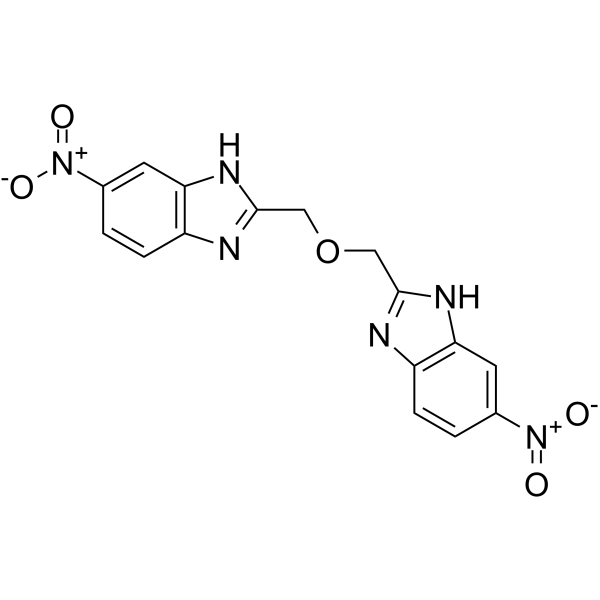
NS3861 is an agonist of nicotinic acetylcholine receptors (nAChRs) and binds with high affinity to heteromeric α3β4 nAChR. The binding Ki values of 0.62, 25, 7.8, 55 nM for α3β4, α3β2, α4β4, α4β2, respectively .
loading...
    loading...
1
1 Cited Publications
Cat. No.: HY-110121
CAS No.: 216853-60-0
Purity:  99.71%
Target:  

nAChR

Research Areas:  

Neurological Disease

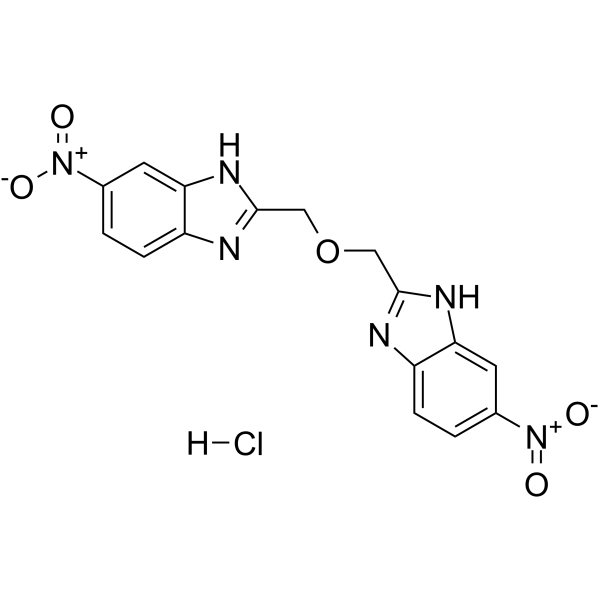
NS3861 fumarate is an agonist of nicotinic acetylcholine receptors (nAChRs) and binds with high affinity to heteromeric α3β4 nAChR. The binding Ki values of 0.62, 25, 7.8, 55 nM for α3β4, α3β2, α4β4, α4β2, respectively .
loading...
    loading...
Cat. No.: HY-178058A
Target:  

Potassium Channel

Research Areas:  

Others

VU6080824 (hydrochloride), a derivative of ML-133 (HY-100230), is an inward-rectifier potassium channel (Kir2.1) inhibitor with an IC50 of 0.35  μM. VU6080824 (hydrochloride) has superior thallium flux and manual patch clamp (MPC) functional potency .
loading...
    loading...
Cat. No.: HY-N9506
CAS No.: 5230-87-5
Anisatin, a pure toxic substance isolated from the seeds of a Japanese plant (Illicium anisatum) acts as a picrotoxin-like, non-competitive GABA antagonist. Anisatin suppresses GABA-induced currents in a concentration-dependent manner with an EC50 of ~1.10 μM .
loading...
    loading...
Cat. No.: HY-168377
CAS No.: 1199351-32-0
Target:  

Fluorescent Dye

Research Areas:  

Others

Fluo-4 potassium is a cell-impermeable Ca 2+ (calcium ion) indicator (λex=494 nm, λem=516 nm). Fluo-4 potassium can be introduced into cells using methods such as patch clamping and microinjection .
loading...
    loading...
Cat. No.: HY-144287
CAS No.: 1001417-92-0
Purity:  98.36%
Research Areas:  

Metabolic Disease

Glucokinase activator 3 is an orally active Glucokinase (GK) activator with an AC50 of 38 nM. Glucokinase activator 3 inhibits hERG channel and sodium channel in patch clamp assays. Glucokinase activator 3 exhibits high efficacy in reducing blood glucose in diet-induced obese (DIO) mice. Glucokinase activator 3 has the potential for the research of type 2 diabetes .
loading...
    loading...
Cat. No.: HY-178058
Target:  

Potassium Channel

Research Areas:  

Others

VU6080824 (Compound 5s), a derivative of ML-133 (HY-100230), is an inward-rectifier potassium channel (Kir2.1) inhibitor with an IC50 of 0.35  μM. VU6080824 has superior thallium flux and manual patch clamp (MPC) functional potency .
loading...
    loading...
Cat. No.: HY-126336
CAS No.: 2376051-91-9
HM12 is a covalent inhibitor of L-/T-type calcium channels. HM12 can strongly inhibit the Cav1.2 (L-type) and Cav3.2 (T-type) calcium channels, and has selectivity for the N-type channels. HM12 produces an irreversible inhibition that persisted after washout. HM12 can be used to study diseases such as hypertension, pain, epilepsy, etc .
loading...
    loading...
Cat. No.: HY-123803
CAS No.: 2213468-04-1
Target:  

Potassium Channel

Research Areas:  

Cardiovascular Disease

PF-06807656 is a selective renal outer medullary potassium channel (ROMK or Kir1.1) inhibitor. PF-06807656 has an IC50 of 61 nM against hROMK in patch-clamp assays. PF-06807656 exhibits high selectivity for inhibiting rat ROMK and is insensitive to N171D pore mutations. PF-06807656 may be used in cardiovascular disease research .
loading...
    loading...
Cat. No.: HY-120059
CAS No.: 273930-52-2
Target:  

Potassium Channel

Research Areas:  

Neurological Disease

NS4591 is a modulator of calcium-activated potassium channels with activity that enhances small (SK) and intermediate (IK) conductivity. NS4591 doubled IK-mediated currents in whole-cell patch-clamp experiments at a concentration of 45 +/- 6 nM, and doubled SK3-mediated currents at a concentration of 530 +/- 100 nM. NS4591 inhibits the number of action potentials generated by suprathreshold depolarizing pulses in acutely isolated bladder primary afferent neurons. NS4591 also reduced carbakol-induced detrusor ring contraction in the rat bladder, demonstrating sensitivity to apamin .
loading...
    loading...
Cat. No.: HY-121183
CAS No.: 132562-26-6
Synonyms: RP 52891
Target:  

Potassium Channel

Research Areas:  

Cardiovascular Disease

Aprikalim (RP 52891), a potassium channel opener (KCO), activates ATP-sensitive K+ (KATP) channels in guinea pig ventricular myocytes. Using patch-clamp techniques, it was found that aprikalim enhances KATP channel activity more effectively in Mg-NDP solution compared to standard solutions. In Mg-NDP solution, aprikalim reduced the sensitivity of KATP channels to ATP, increasing the concentration of ATP required to inhibit channel activity by half (K1) from 56 μM to 180 μM. However, this effect diminished over time. Aprikalim's ability to activate KATP channels in Mg-NDP solution suggests potential therapeutic implications in modulating cardiac excitability and may relate to changes in channel protein enzymatic activity under experimental conditions .
loading...
    loading...
Cat. No.: HY-184663
Target:  

Potassium Channel

Research Areas:  

Neurological Disease

Kv3.1 activator-1 is a Kv3.1 voltage-gated potassium channel activator. Kv3.1 activator-1 exhibits distinct activating efficacy in both thallium flux assays and automated patch-clamp electrophysiological assays .
loading...
    loading...
Cat. No.: HY-181481
Target:  

TRP Channel

Research Areas:  

Others

2'-Deoxyadenosine-5'-O-diphosphoribose sodium is a TRPM2 agonist. 2'-Deoxyadenosine-5'-O-diphosphoribose sodium enhances calcium-induced currents in inside-out patch-clamp experiments using HEK293 cells expressing human TRPM2. 2'-Deoxyadenosine-5'-O-diphosphoribose sodium is a substrate for Nucleoside Triphosphate Diphosphatase 9 (NUDT9) .
loading...
    loading...
Cat. No.: HY-183056
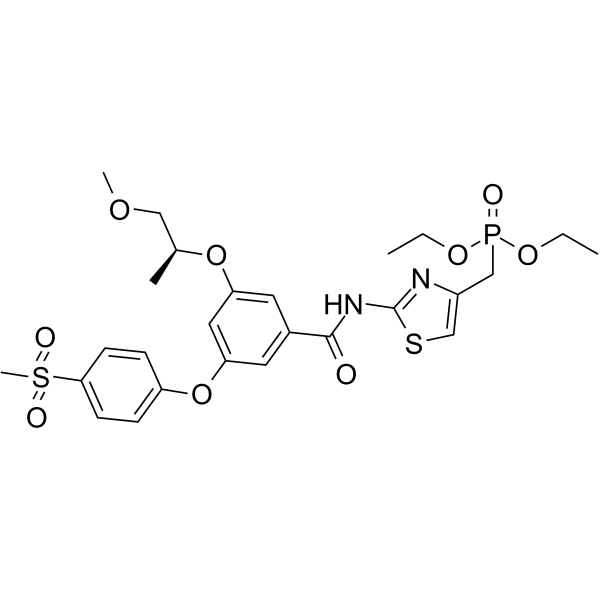
P2X3 antagonist 40 is a P2X3 antagonist with a human P2X3 receptor pIC50 < 4.52. P2X3 antagonist 40 can be used for research on ATP-mediated proinflammatory fingerprint, including overactive bladder, pain, and chronic cough .
loading...
    loading...
  • 1

