


Search Result
Results for "
alkane
" in MedChemExpress (MCE) Product Catalog:
4
Biochemical Assay Reagents
7
Isotope-Labeled Compounds
| Cat. No. |
Product Name |
Target |
Research Areas |
Chemical Structure |
-
- HY-W014069
-
|
11-Thioundecanoic acid; MUA; MUDA
|
Biochemical Assay Reagents
|
Others
|
|
11-Mercaptoundecanoic acid (11-Thioundecanoic acid; MUA; MUDA) is a self-assembled monolayer membrane composed of long-chain alkane chains and carboxyl-containing thioalcohols and can be used as a metal surface modifier. 11-Mercaptoundecanoic acid is widely applied in the research of molecular probes, self-assembled membranes, nanomaterials, and biological materials, etc .
|
-
-
- HY-W099580
-
|
n-Hexadecane; Cetane
|
Environmental Pollutants
|
Others
|
|
Hexadecane (n-Hexadecane; Cetane) is a long-chain n-alkane, oil component, and model hydrophobic compound. Hexadecane acts as a substrate for microbial degradation.Hexadecane induces microbial biosurfactant and bioemulsifier synthesis .
|
-
-
- HY-N7933
-
|
alkane C24
|
Apoptosis
|
Inflammation/Immunology
|
|
Tetracosane (ALKANE C24) is a natural product that can be found in Acrostichum aureum. Tetracosane hows cytotoxicity and induces Apoptosis. Tetracosane has the potential for the research of peptic ulcer .
|
-
-
- HY-W089845
-
|
|
Environmental Pollutants
Fungal
Sex Pheromone
|
Infection
Endocrinology
|
|
Heneicosane is a royal-specific pheromone of insects (such as subterranean termites) and is an identification signal for queens and kings in termites. Heneicosane mediates royal recognition and the maintenance of social division of labor by being sensed by worker ants and triggering vibrations and antennal behaviors. Heneicosane can exert anti-inflammatory, analgesic and antipyretic activities by inhibiting the release of inflammatory mediators (such as prostaglandins and cytokines). At the same time, Heneicosane can also inhibit the mycelial growth of aflatoxin-producing fungi and inhibit the production of aflatoxin. Heneicosane can be used in insect chemical ecology research to analyze the regulatory mechanism of termite social behavior, and is also a potential target for new anti-inflammatory drugs .
|
-
-
- HY-138887
-
|
DMNG
|
Biochemical Assay Reagents
|
Others
|
|
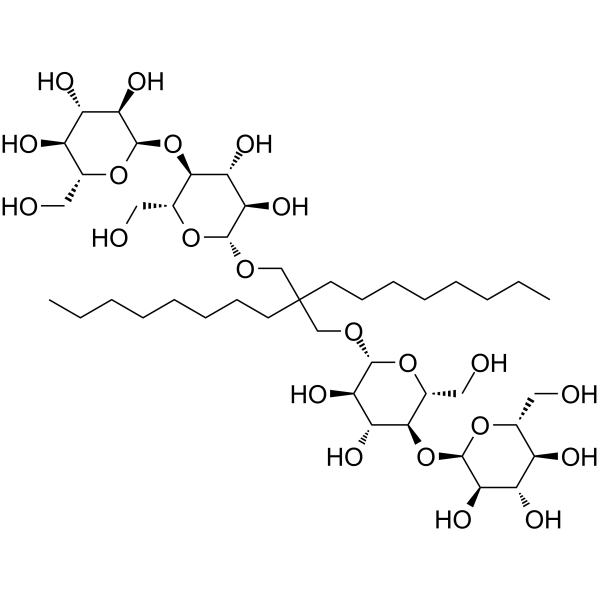
Decyl maltose neopentyl glycol (DMNG) is the neopentyl glycol detergent that does not disrupt the AlkB oligomeric state. AlkB is a nonheme di-iron alkane hydroxylase .
|
-
-
- HY-N6600
-
|
|
Environmental Pollutants
Biochemical Assay Reagents
|
Others
|
|
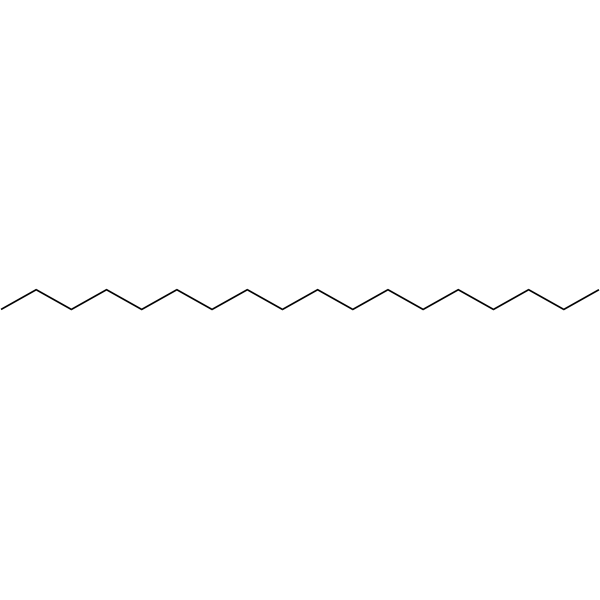
Octadecane is an alkane used as a phase change material for storing thermal energy at ambient temperature. Octadecane can endow pesticide formulations with environmental responsiveness in the field of agricultural nanomaterials, enabling precise and safe pesticide application .
|
-
-
- HY-W099580S1
-
|
n-Hexadecane-d34; Cetane-d34
|
Isotope-Labeled Compounds
Bacterial
|
Others
|
|
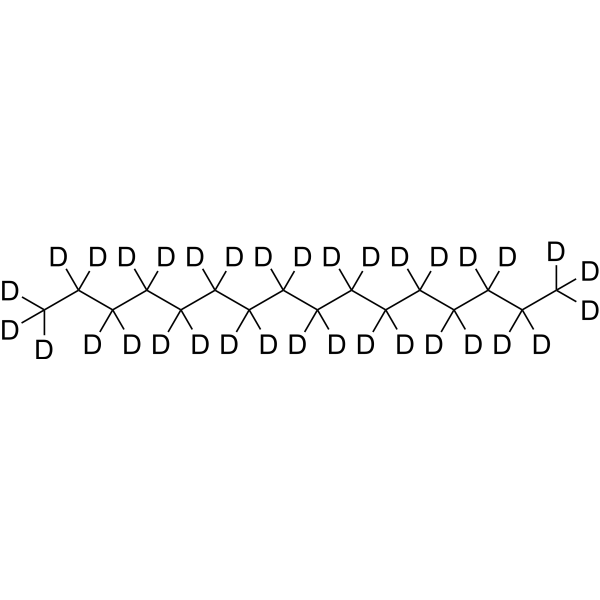
Hexadecane-d34 (n-Hexadecane-d34) is the deuterium labeled Hexadecane (HY-W099580). Hexadecane (n-Hexadecane) is a saturated hydrocarbon of alkanes or paraffins and can be used as an organic solvent. Hexadecane is a component of petroleum, belongs to hydrophobic substrates, and is a model substance for studying bacterial degradation of hydrophobic compounds .
|
-
-
- HY-W143531
-
|
NOV03; SHR8058
|
Biochemical Assay Reagents
|
Inflammation/Immunology
|
|
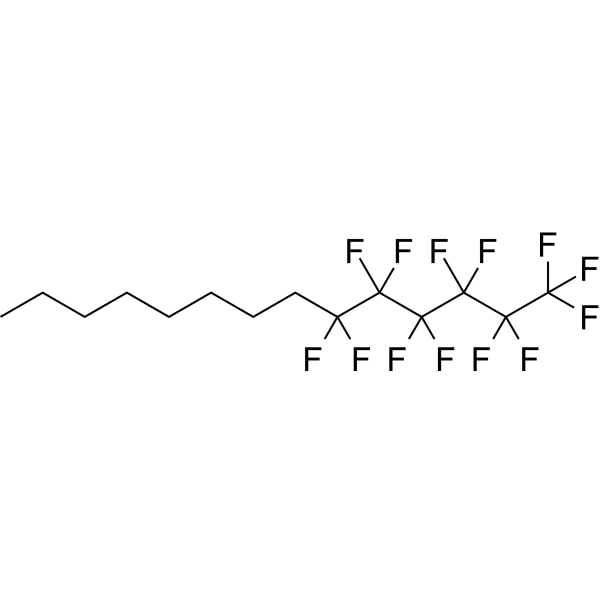
Perfluorohexyloctane (NOV03), a semifluorinated alkane, reduces tear film instability in Meibomian gland dysfunction and evaporative dry eye disease. Perfluorohexyloctane is a long-term tamponade agent. Perfluorohexyloctane increases tear film breakup time and lipid layer thickness .
|
-
-
- HY-W012001
-
|
|
PROTAC Linkers
|
Cancer
|
|
Boc-7-Aminoheptanoic acid can be used as a PROTAC linker in the synthesis of PROTACs and other conjugation applications. Boc-7-Aminoheptanoic acid is an alkane chain with terminal carboxlic acid and Boc-protected amino groups. The terminal carboxylic acid can react with primary amine groups in the presence of activators (e.g. EDC, or HATU) to form a stable amide bond. The Boc group can be deprotected under mild acidic conditions to form the free amine.
|
-
-
- HY-N7926
-
|
|
Environmental Pollutants
Apoptosis
Parasite
TNF Receptor
Interleukin Related
|
Infection
Inflammation/Immunology
|
|
Pentadecane is an orally active natural plant volatile alkane with anti-inflammatory, analgesic, antipyretic and anti-leishmanial activities. Pentadecane presents IC50 values of 65.3 μM, 60.5 μM and 194.8 μM against Leishmania infantum promastigotes, amastigotes and intracellular amastigotes, respectively. Pentadecane downregulates the mRNA expression of TNF-α and IL-12 and inhibits the release of inflammatory mediators. Pentadecane arrests the cell cycle of Leishmania infantum and induces apoptosis. Pentadecane can be applied to the research of inflammation and leishmaniasis .
|
-
-
- HY-N9929
-
|
|
Environmental Pollutants
Biochemical Assay Reagents
|
Others
|
|
Docosane is a straight-chain alkane. Docosane can be used to synthesize structural composites with thermal energy storage/release capabilities. Docosane can also be used to prepare thermosensitive antipyretic analgesics .
|
-
-
- HY-42773
-
|
1-Boc-1,8-diaminooctane
|
PROTAC Linkers
|
Cancer
|
|
tert-Butyl (8-aminooctyl)carbamate (1-Boc-1,8-diaminooctane) can be used as a PROTAC linker in the synthesis of PROTACs. tert-butyl (8-aminooctyl)carbamate is an alkane chain with terminal amine and Boc-protected amino groups. Amine group is reactive with carboxylic acids, activated NHS esters, carbonyls (ketone, aldehyde) etc. The Boc group can be deprotected under mild acidic conditions to form the free amine.
|
-
-
- HY-N7933S
-
|
alkane C24-d50
|
Apoptosis
|
Others
|
|
Tetracosane-d50 is the deuterium labeled Tetracosane .
|
-
-
- HY-N9971
-
-
-
- HY-W105744
-
|
|
PROTAC Linkers
|
Cancer
|
|
10-Aminodecanoic acid is an alkane chain with terminal carboxlic acid and amine groups. 10-Aminodecanoic acid can be used as a PROTAC linker in the synthesis of PROTACs and other conjugation applications. The amino group (NH2) is reactive with carboxylic acids, activated NHS esters, carbonyls (ketone, aldehyde) etc. The terminal carboxylic acid can react with primary amine groups of activated NHS ester to form a stable amide bond.
|
-
-
- HY-W097128
-
|
|
PROTAC Linkers
|
Cancer
|
|
Fmoc-12-aminododecanoic acid is an alkane chain with terminal Fmoc-protected amine and carboxylic acid groups. The compound can be used as a PROTAC linker in the synthesis of PROTACs. The Fmoc group can be deprotected under basic condition to obtain the free amine which can be used for further conjugations. The terminal carboxylic acid can react with primary amine groups in the presence of activators (e.g. EDC, or HATU) to form a stable amide bond.
|
-
-
- HY-W041856
-
|
Boc-8-aminooctanoic acid
|
PROTAC Linkers
|
Cancer
|
|
N-Boc-8-amino-octanoic acid (Boc-8-aminooctanoic acid) can be used as a PROTAC linker in the synthesis of PROTACs. N-Boc-8-amino-octanoic acid is an alkane chain with terminal carboxlic acid and Boc-protected amino groups. The terminal carboxylic acid can react with primary amine groups in the presence of activators (e.g. EDC, or HATU) to form a stable amide bond. The Boc group can be deprotected under mild acidic conditions to form the free amine.
|
-
-
- HY-W047688
-
|
1-Boc-1,10-diaminodecane
|
PROTAC Linkers
|
Cancer
|
|
tert-Butyl (10-aminodecyl) carbamate (1-Boc-1,10-diaminodecane) is a synthetic intermediate that serves as a PROTAC linker in PROTAC synthesis and other conjugation applications. tert-Butyl (10-aminodecyl) carbamate is an alkane chain with a terminal amine and a Boc-protected amino group. The amine group can react with carboxylic acids, active NHS esters, carbonyl groups (ketones, aldehydes), etc. The Boc group can be deprotected under mild acidic conditions to form a free amine .
|
-
-
- HY-W094847
-
-
-
- HY-W727466
-
|
|
Bacterial
|
Infection
|
|
4,6-Dimethyldodecane is an alkane. 4,6-Dimethyldodecane can be derived from the oil of T. decandra. 4,6-Dimethyldodecane can be used in bacterial infection research .
|
-
-
- HY-W105727
-
|
|
PROTAC Linkers
|
Cancer
|
|
9-Aminononanoic acid can be used as a PROTAC linker and other conjugation in the synthesis of PROTACs. 9-Aminononanoic acid is an alkane chain with terminal carboxlic acid and amine groups. The amino group (NH2) is reactive with carboxylic acids, activated NHS esters, carbonyls (ketone, aldehyde) etc. The terminal carboxylic acid can react with primary amine groups of activated NHS ester to form a stable amide bond.
|
-
-
- HY-W005828
-
|
|
PROTAC Linkers
|
Cancer
|
|
9-(Boc-amino)nonanoic Acid is an alkane chain with terminal carboxlic acid and Boc-protected amino groups. 9-(Boc-amino)nonanoic acid can be used as a PROTAC linker in the synthesis of PROTACs. The terminal carboxylic acid can react with primary amine groups in the presence of activators (e.g. EDC, or HATU) to form a stable amide bond. The Boc group can be deprotected under mild acidic conditions to form the free amine.
|
-
-
- HY-W009030
-
|
|
PROTAC Linkers
|
Cancer
|
|
N-Fmoc-8-aminooctanoic acid can be used as a PROTAC linker in the synthesis of PROTACs. N-Fmoc-8-aminooctanoic acid is an alkane chain with terminal Fmoc-protected amine and carboxylic acid groups. The Fmoc group can be deprotected under basic condition to obtain the free amine which can be used for further conjugations. The terminal carboxylic acid can react with primary amine groups in the presence of activators (e.g. EDC, or HATU) to form a stable amide bond.
|
-
-
- HY-W009056
-
|
|
PROTAC Linkers
|
Cancer
|
|
Fmoc-7-amino-heptanoic acid is an alkane chain with terminal Fmoc-protected amine and carboxylic acid groups. Fmoc-7-amino-heptanoic acid can be used as a PROTAC linker in the synthesis of PROTACs. The Fmoc group can be deprotected under basic condition to obtain the free amine which can be used for further conjugations. The terminal carboxylic acid can react with primary amine groups in the presence of activators (e.g. EDC, or HATU) to form a stable amide bond.
|
-
-
- HY-W131353
-
-
-
- HY-N6600S
-
|
|
Isotope-Labeled Compounds
Environmental Pollutants
Biochemical Assay Reagents
|
Others
|
|
Octadecane-d38 is the deuterium labeled Octadecane. Octadecane is an alkane used as a phase change material for storing thermal energy at ambient temperature. Octadecane can endow pesticide formulations with environmental responsiveness in the field of agricultural nanomaterials, enabling precise and safe pesticide application .
|
-
-
- HY-N6600R
-
|
|
Reference Standards
Environmental Pollutants
Biochemical Assay Reagents
|
Others
|
|
Octadecane is an alkane that is used to store thermal energy at ambient temperature as a phase change material. Octadecane is an alkane used as a phase change material for storing thermal energy at ambient temperature. Octadecane can endow pesticide formulations with environmental responsiveness in the field of agricultural nanomaterials, enabling precise and safe pesticide application.
|
-
-
- HY-W130307
-
-
-
- HY-N9600
-
|
|
Others
|
Others
|
|
Dotriacontane is an alkane substance that can be absorbed and metabolized by photosynthetic organisms. It can be labeled with 14C and used for carbon tracing .
|
-
-
- HY-N15641
-
|
Dalbegione
|
Biochemical Assay Reagents
Reactive Oxygen Species (ROS)
|
Others
|
|
Dalbergione (Dalbegione) (Compound 5) can be extracted from the Dalbergia Sissoo Linn. knot wood. Dalbergione exhibits antioxidant ability. Dalbergione can also be obtained from the methanol extract of Dalbergia odorifera heartwood and the alkane extract of Dalbergia parvifera heartwood .
|
-
-
- HY-W101722
-
|
|
PROTAC Linkers
|
Cancer
|
|
tert-Butyl (9-aminononyl)carbamate is an alkane chain with terminal amine and Boc-protected amino groups. The compound can be used as a PROTAC linker in the synthesis of PROTACs and other conjugation applications. Amine group is reactive with carboxylic acids, activated NHS esters, carbonyls (ketone, aldehyde) etc. The Boc group can be deprotected under mild acidic conditions to form the free amine.
|
-
-
- HY-W101723
-
|
|
PROTAC Linkers
|
Cancer
|
|
Boc-12-Ado-OH can be used as a PROTAC linker in the synthesis of PROTACs. Boc-12-Ado-OH is an alkane chain with terminal carboxlic acid and Boc-protected amino groups. The terminal carboxylic acid can react with primary amine groups in the presence of activators (e.g. EDC, or HATU) to form a stable amide bond. The Boc group can be deprotected under mild acidic conditions to form the free amine.
|
-
-
- HY-W089232
-
|
|
PROTAC Linkers
|
Cancer
|
|
Boc-10-Aminodecanoic acid can be used as a PROTAC linker in the synthesis of PROTACs and other conjugation applications. Boc-10-Aminodecanoic acid is an alkane chain with terminal carboxlic acid and Boc-protected amino groups. The terminal carboxylic acid can react with primary amine groups in the presence of activators (e.g. EDC, or HATU) to form a stable amide bond. The Boc group can be deprotected under mild acidic conditions to form the free amine.
|
-
-
- HY-W014069R
-
|
11-Thioundecanoic acid (Standard); MUA (Standard); MUDA (Standard)
|
Reference Standards
Biochemical Assay Reagents
|
Others
|
|
11-Mercaptoundecanoic acid (Standard) is an analytical standard of 11-Mercaptoundecanoic acid (HY-W014069R). This product is used for research and analytical applications. 11-Mercaptoundecanoic acid is a self-assembled monolayer membrane composed of long-chain alkane chains and carboxyl-containing thioalcohols and can be used as a metal surface modifier. 11-Mercaptoundecanoic acid is widely applied in the research of molecular probes, self-assembled membranes, nanomaterials, and biological materials, etc .
|
-
-
- HY-W131353R
-
-
-
- HY-133587
-
-
-
- HY-N9929R
-
|
|
Reference Standards
Biochemical Assay Reagents
|
Others
|
|
Docosane (Standard) is the analytical standard of Docosane (HY-N9929). This product is intended for research and analytical applications. Docosane is a straight-chain alkane. Docosane can be used to synthesize structural composites with thermal energy storage/release capabilities. Docosane can also be used to prepare thermosensitive antipyretic analgesics .
|
-
-
- HY-151788
-
|
|
ADC Linker
|
Others
|
|
MeO-PEG750-alkyne is a click chemistry reagent containing an alkyne group. It contains an azide group and can undergo copper-catalyzed azide-alkyne cycloaddition (CuAAc) with molecules containing alkyne groups. It can also undergo ring strain-promoted alkyne-azide cycloaddition (SPAAC) with molecules containing DBCO or BCN groups.
|
-
-
- HY-W269867S
-
-
-
- HY-W089845R
-
|
|
Reference Standards
Sex Pheromone
Fungal
|
Infection
Endocrinology
|
|
Heneicosane (Standard) is the analytical standard of Heneicosane (HY-W089845). This product is intended for research and analytical applications. Heneicosane is a royal-specific pheromone of insects (such as subterranean termites) and is an identification signal for queens and kings in termites. Heneicosane mediates royal recognition and the maintenance of social division of labor by being sensed by worker ants and triggering vibrations and antennal behaviors. Heneicosane can exert anti-inflammatory, analgesic and antipyretic activities by inhibiting the release of inflammatory mediators (such as prostaglandins and cytokines). At the same time, Heneicosane can also inhibit the mycelial growth of aflatoxin-producing fungi and inhibit the production of aflatoxin. Heneicosane can be used in insect chemical ecology research to analyze the regulatory mechanism of termite social behavior, and is also a potential target for new anti-inflammatory drugs .
|
-
-
- HY-W142744
-
|
2,2,4,4,6,8,8-Heptamethylnonane
|
Biochemical Assay Reagents
|
Others
|
|
Isocetane (2,2,4,4,6,8,8-Heptamethylnonane) is an alkane that can be determined using capillary flow techniques. Isocetane is a viscous solvent .
|
-
-
- HY-N9600R
-
|
|
Others
Reference Standards
|
Others
|
|
Dotriacontane (Standard) is the analytical standard of Dotriacontane. This product is intended for research and analytical applications. Dotriacontane is an alkane substance that can be absorbed and metabolized by photosynthetic organisms. It can be labeled with 14C and used for carbon tracing .
|
-
-
- HY-W722087
-
|
|
Endogenous Metabolite
|
Others
|
|
3,6-Dimethylundecane is a type of di-methyl alkanoid compound. 3,6-Dimethylundecane is one of the various branched alkanes identified in the metabolic products of the desert blue-green algae Microcoleus vaginatus .
|
-
-
- HY-N9971R
-
|
|
Reference Standards
NF-κB
Bacterial
|
Infection
Inflammation/Immunology
Cancer
|
|
Hentriacontane (Standard) is the analytical standard of Hentriacontane. This product is intended for research and analytical applications. Hentriacontane is a long-chain alkane. Hentriacontane exerts anti-inflammatory effects by inhibiting the NF-κB pathway. Hentriacontane has anti-inflammatory, antitumor and antibacterial activities .
|
-
-
- HY-W130307R
-
|
N-Tricosane (Standard)
|
Reference Standards
Bacterial
|
Infection
|
|
Tricosane (Standard) (N-Tricosane (Standard)) is the analytical standard of Tricosane (HY-W130307). This product is intended for research and analytical applications. Tricosane (N-Tricosane) is a straight-chain alkane. Tricosane exhibits a certain degree of antibacterial activity against E. coli.
|
-
-
- HY-N9929S
-
|
|
Isotope-Labeled Compounds
Biochemical Assay Reagents
|
Others
|
|
Docosane-d46 is the deuterium labeled Docosane. Docosane is a straight-chain alkane. Docosane can be used to synthesize structural composites with thermal energy storage/release capabilities. Docosane can also be used to prepare thermosensitive antipyretic analgesics .
|
-
-
- HY-W099580R
-
|
n-Hexadecane (Standard); Cetane (Standard)
|
Reference Standards
Biochemical Assay Reagents
|
Others
|
|
Hexadecane (Standard) (n-Hexadecane (Standard)) is the analytical standard of Hexadecane (HY-W099580). This product is intended for research and analytical applications. Hexadecane (n-Hexadecane) is a saturated hydrocarbon of alkanes or paraffins and can be used as an organic solvent. Hexadecane is a component of petroleum, belongs to hydrophobic substrates, and is a model substance for studying bacterial degradation of hydrophobic compounds .
|
-
-
- HY-23629
-
|
|
PROTAC Linkers
|
Cancer
|
|
16-Aminohexadecanoic acid is an alkane chain with terminal carboxlic acid and amine groups. 16-Aminohexadecanoic acid can be used as a PROTAC linker in the synthesis of PROTACs. The amino group (NH2) is reactive with carboxylic acids, activated NHS esters, carbonyls (ketone, aldehyde) etc. The terminal carboxylic acid can react with primary amine groups of activated NHS ester to form a stable amide bond.
|
-
-
- HY-W401143
-
|
|
PROTAC Linkers
|
Cancer
|
|
15-Aminopentadecanoic Acid can be used as a PROTAC linker in the synthesis of PROTACs. 15-Aminopentadecanoic Acid is an alkane chain with terminal carboxlic acid and amine groups. The amino group (NH2) is reactive with carboxylic acids, activated NHS esters, carbonyls (ketone, aldehyde) etc. The terminal carboxylic acid can react with primary amine groups of activated NHS ester to form a stable amide bond.
|
-
-
- HY-W099580S
-
|
n-Hexadecane-1,2-13C2; Cetane-1,2-13C2
|
Isotope-Labeled Compounds
Bacterial
|
Others
|
|
Hexadecane-1,2- 13C2 (n-Hexadecane-1,2- 13C2) is the 13C labeled Hexadecane (HY-W099580). Hexadecane (n-Hexadecane) is a saturated hydrocarbon of alkanes or paraffins and can be used as an organic solvent. Hexadecane is a component of petroleum, belongs to hydrophobic substrates, and is a model substance for studying bacterial degradation of hydrophobic compounds .
|
-
- HY-W131541
-
|
|
PROTAC Linkers
|
Cancer
|
|
tert-Butyl (11-aminoundecyl)carbamate is an alkane chain with terminal amine and Boc-protected amino groups. tert-Butyl (11-aminoundecyl)carbamate can be used as a PROTAC linker in the synthesis of PROTACs and other conjugation applications. Amine group is reactive with carboxylic acids, activated NHS esters, carbonyls (ketone, aldehyde) etc. The Boc group can be deprotected under mild acidic conditions to form the free amine.
|
-
- HY-W111228
-
|
|
PROTAC Linkers
|
Cancer
|
|
Fmoc-9-aminononanoic acid is an alkane chain with terminal Fmoc-protected amine and carboxylic acid groups. The compound can be used as a PROTAC linker in the synthesis of PROTACs and and other conjugation applications. The Fmoc group can be deprotected under basic condition to obtain the free amine which can be used for further conjugations. The terminal carboxylic acid can react with primary amine groups in the presence of activators (e.g. EDC, or HATU) to form a stable amide bond.
|
-
- HY-W591967
-
|
|
PROTAC Linkers
|
Cancer
|
|
N-Boc-15-aminopentadecanoic acid is an alkane chain with terminal carboxlic acid and Boc-protected amino groups. N-Boc-15-aminopentadecanoic acid can be used as a PROTAC linker in the synthesis of PROTACs. The terminal carboxylic acid can react with primary amine groups in the presence of activators (e.g. EDC, or HATU) to form a stable amide bond. The Boc group can be deprotected under mild acidic conditions to form the free amine.
|
-
- HY-W097110
-
|
|
PROTAC Linkers
|
Cancer
|
|
Fmoc-11-aminoundecanoic acid can be used as a PROTAC linker in the synthesis of PROTACs and other conjugation applications. Fmoc-11-aminoundecanoic acid is an alkane chain with terminal Fmoc-protected amine and carboxylic acid groups. The Fmoc group can be deprotected under basic condition to obtain the free amine which can be used for further conjugations. The terminal carboxylic acid can react with primary amine groups in the presence of activators (e.g. EDC, or HATU) to form a stable amide bond.
|
-
- HY-W591968
-
|
|
PROTAC Linkers
|
Cancer
|
|
14-(Fmoc-amino)-tetradecanoic acid can be used as a PROTAC linker in the synthesis of PROTACs. 14-(Fmoc-amino)-tetradecanoic acid is an alkane chain with terminal Fmoc-protected amine and carboxylic acid groups. The Fmoc group can be deprotected under basic condition to obtain the free amine which can be used for further conjugations. The terminal carboxylic acid can react with primary amine groups in the presence of activators (e.g. EDC, or HATU) to form a stable amide bond.
|
-
- HY-N7926S
-
|
|
Isotope-Labeled Compounds
Parasite
TNF Receptor
Interleukin Related
Apoptosis
|
Infection
Inflammation/Immunology
|
|
Pentadecane-d32 is the deuterium labeled Pentadecane (HY-N7926). Pentadecane is an orally active natural plant volatile alkane with anti-inflammatory, analgesic, antipyretic and anti-leishmanial activities. Pentadecane presents IC50 values of 65.3 μM, 60.5 μM and 194.8 μM against Leishmania infantum promastigotes, amastigotes and intracellular amastigotes, respectively. Pentadecane downregulates the mRNA expression of TNF-α and IL-12 and inhibits the release of inflammatory mediators. Pentadecane arrests the cell cycle of Leishmania infantum and induces apoptosis. Pentadecane can be applied to the research of inflammation and leishmaniasis .
|
-
- HY-N7926R
-
|
|
Parasite
Reference Standards
TNF Receptor
Interleukin Related
Apoptosis
|
Infection
Inflammation/Immunology
|
|
Pentadecane (Standard) is the analytical standard of Pentadecane (HY-N7926). This product is intended for research and analytical applications. Pentadecane is an orally active natural plant volatile alkane with anti-inflammatory, analgesic, antipyretic and anti-leishmanial activities. Pentadecane presents IC50 values of 65.3 μM, 60.5 μM and 194.8 μM against Leishmania infantum promastigotes, amastigotes and intracellular amastigotes, respectively. Pentadecane downregulates the mRNA expression of TNF-α and IL-12 and inhibits the release of inflammatory mediators. Pentadecane arrests the cell cycle of Leishmania infantum and induces apoptosis. Pentadecane can be applied to the research of inflammation and leishmaniasis .
|
-
- HY-N7933R
-
|
alkane C24 (Standard)
|
Reference Standards
Apoptosis
|
Inflammation/Immunology
|
|
Tetracosane (Standard) is the analytical standard of Tetracosane. This product is intended for research and analytical applications. Tetracosane (ALKANE C24) is a natural product that can be found in Acrostichum aureum. Tetracosane hows cytotoxicity and induces Apoptosis. Tetracosane has the potential for the research of peptic ulcer .
|
-
- HY-129928
-
|
Ethyl 2-cyclohexylacetate
|
Biochemical Assay Reagents
|
Others
|
|
Ethyl cyclohexylacetate (Ethyl 2-cyclohexylacetate) is a functionalized product. Ethyl cyclohexylacetate can be used in studies of alkane functionalization reactions .
|
-
- HY-W671472
-
|
|
Biochemical Assay Reagents
|
Others
|
|
10-Oxononadecanedioic acid is a long alkane linker with two terminal carboxylic acid groups. The terminal carboxylic acid groups can react with primary amine groups in the presence of activators (e.g. HATU) to form a stable amide bond.
|
-
- HY-W105737
-
|
|
Biochemical Assay Reagents
|
Others
|
|
18-Methoxy-18-oxooctadecanoic acid is a long alkane linker with a terminal carboxylic acid group. The terminal carboxylic acid group can react with primary amine groups in the presence of activators (e.g. HATU) to form a stable amide bond.
|
-
- HY-W800753
-
|
|
Biochemical Assay Reagents
|
Others
|
|
2,5-Dioxopyrrolidin-1-yl 6-bromohexanoate is an alkane linker with a terminal bromide and an NHS ester. The bromide is a very good leaving group for nucleophilic substitution reactions. The NHS ester can be used to label the primary amines (-NH2) of proteins, amine-modified oligonucleotides, and other amine-containing molecules.
|
-
- HY-W800754
-
|
|
Biochemical Assay Reagents
|
Others
|
|
8-Bromo-octanoic acid 2,5-dioxo-pyrrolidin-1-yl ester is an alkane linker with a terminal bromide and an NHS ester. The bromide is a very good leaving group for nucleophilic substitution reactions. The NHS ester can be used to label the primary amines (-NH2) of proteins, amine-modified oligonucleotides, and other amine-containing molecules.
|
-
| Cat. No. |
Product Name |
Type |
-
- HY-W014069
-
|
11-Thioundecanoic acid; MUA; MUDA
|
Biochemical Assay Reagents
|
|
11-Mercaptoundecanoic acid (11-Thioundecanoic acid; MUA; MUDA) is a self-assembled monolayer membrane composed of long-chain alkane chains and carboxyl-containing thioalcohols and can be used as a metal surface modifier. 11-Mercaptoundecanoic acid is widely applied in the research of molecular probes, self-assembled membranes, nanomaterials, and biological materials, etc .
|
-
- HY-W099580
-
|
n-Hexadecane; Cetane
|
Biochemical Assay Reagents
|
|
Hexadecane (n-Hexadecane; Cetane) is a long-chain n-alkane, oil component, and model hydrophobic compound. Hexadecane acts as a substrate for microbial degradation.Hexadecane induces microbial biosurfactant and bioemulsifier synthesis .
|
-
- HY-W014069R
-
|
11-Thioundecanoic acid (Standard); MUA (Standard); MUDA (Standard)
|
Biochemical Assay Reagents
|
|
11-Mercaptoundecanoic acid (Standard) is an analytical standard of 11-Mercaptoundecanoic acid (HY-W014069R). This product is used for research and analytical applications. 11-Mercaptoundecanoic acid is a self-assembled monolayer membrane composed of long-chain alkane chains and carboxyl-containing thioalcohols and can be used as a metal surface modifier. 11-Mercaptoundecanoic acid is widely applied in the research of molecular probes, self-assembled membranes, nanomaterials, and biological materials, etc .
|
-
- HY-W099580R
-
|
n-Hexadecane (Standard); Cetane (Standard)
|
Biochemical Assay Reagents
|
|
Hexadecane (Standard) (n-Hexadecane (Standard)) is the analytical standard of Hexadecane (HY-W099580). This product is intended for research and analytical applications. Hexadecane (n-Hexadecane) is a saturated hydrocarbon of alkanes or paraffins and can be used as an organic solvent. Hexadecane is a component of petroleum, belongs to hydrophobic substrates, and is a model substance for studying bacterial degradation of hydrophobic compounds .
|
| Cat. No. |
Product Name |
Category |
Target |
Chemical Structure |
-
- HY-W089845
-
|
|
Infection
Structural Classification
Natural Products
other families
Classification of Application Fields
Plants
Disease Research Fields
Source Classification
|
Environmental Pollutants
Fungal
Sex Pheromone
|
|
Heneicosane is a royal-specific pheromone of insects (such as subterranean termites) and is an identification signal for queens and kings in termites. Heneicosane mediates royal recognition and the maintenance of social division of labor by being sensed by worker ants and triggering vibrations and antennal behaviors. Heneicosane can exert anti-inflammatory, analgesic and antipyretic activities by inhibiting the release of inflammatory mediators (such as prostaglandins and cytokines). At the same time, Heneicosane can also inhibit the mycelial growth of aflatoxin-producing fungi and inhibit the production of aflatoxin. Heneicosane can be used in insect chemical ecology research to analyze the regulatory mechanism of termite social behavior, and is also a potential target for new anti-inflammatory drugs .
|
-
-
- HY-N7926
-
-
-
- HY-N9929
-
-
-
- HY-N9971
-
-
-
- HY-W094847
-
-
-
- HY-W727466
-
-
-
- HY-N9600
-
-
-
- HY-N15641
-
-
-
- HY-N9929R
-
-
-
- HY-W089845R
-
|
|
Structural Classification
Natural Products
other families
Plants
Source Classification
|
Reference Standards
Sex Pheromone
Fungal
|
|
Heneicosane (Standard) is the analytical standard of Heneicosane (HY-W089845). This product is intended for research and analytical applications. Heneicosane is a royal-specific pheromone of insects (such as subterranean termites) and is an identification signal for queens and kings in termites. Heneicosane mediates royal recognition and the maintenance of social division of labor by being sensed by worker ants and triggering vibrations and antennal behaviors. Heneicosane can exert anti-inflammatory, analgesic and antipyretic activities by inhibiting the release of inflammatory mediators (such as prostaglandins and cytokines). At the same time, Heneicosane can also inhibit the mycelial growth of aflatoxin-producing fungi and inhibit the production of aflatoxin. Heneicosane can be used in insect chemical ecology research to analyze the regulatory mechanism of termite social behavior, and is also a potential target for new anti-inflammatory drugs .
|
-
-
- HY-N9600R
-
-
-
- HY-W722087
-
-
-
- HY-N9971R
-
-
-
- HY-N7926R
-
|
|
Structural Classification
Natural Products
Kaempferia galanga L.
Plants
Source Classification
Zingiberaceae
|
Parasite
Reference Standards
TNF Receptor
Interleukin Related
Apoptosis
|
|
Pentadecane (Standard) is the analytical standard of Pentadecane (HY-N7926). This product is intended for research and analytical applications. Pentadecane is an orally active natural plant volatile alkane with anti-inflammatory, analgesic, antipyretic and anti-leishmanial activities. Pentadecane presents IC50 values of 65.3 μM, 60.5 μM and 194.8 μM against Leishmania infantum promastigotes, amastigotes and intracellular amastigotes, respectively. Pentadecane downregulates the mRNA expression of TNF-α and IL-12 and inhibits the release of inflammatory mediators. Pentadecane arrests the cell cycle of Leishmania infantum and induces apoptosis. Pentadecane can be applied to the research of inflammation and leishmaniasis .
|
-
| Cat. No. |
Product Name |
Chemical Structure |
-
- HY-W099580S1
-
|
|
|
Hexadecane-d34 (n-Hexadecane-d34) is the deuterium labeled Hexadecane (HY-W099580). Hexadecane (n-Hexadecane) is a saturated hydrocarbon of alkanes or paraffins and can be used as an organic solvent. Hexadecane is a component of petroleum, belongs to hydrophobic substrates, and is a model substance for studying bacterial degradation of hydrophobic compounds .
|
-
-
- HY-N7933S
-
|
|
|
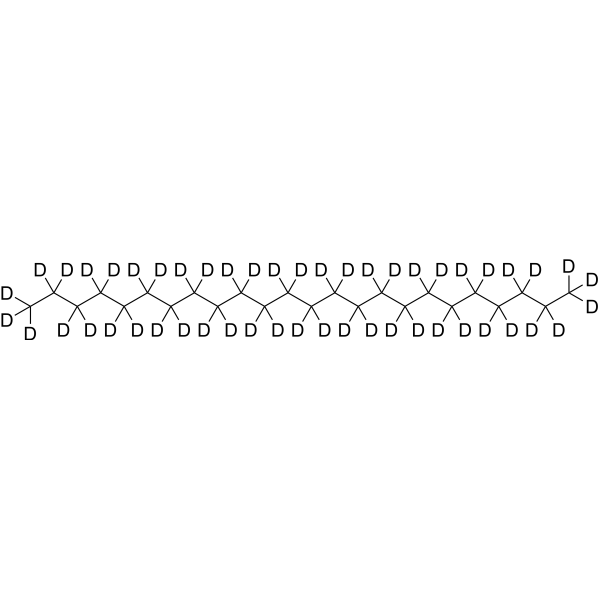
Tetracosane-d50 is the deuterium labeled Tetracosane .
|
-
-
- HY-N6600S
-
|
|
|
Octadecane-d38 is the deuterium labeled Octadecane. Octadecane is an alkane used as a phase change material for storing thermal energy at ambient temperature. Octadecane can endow pesticide formulations with environmental responsiveness in the field of agricultural nanomaterials, enabling precise and safe pesticide application .
|
-
-
- HY-W269867S
-
|
|
|
Tetratriacontane-d70 is the deuterium labeled Tetratriacontane .
|
-
-
- HY-N9929S
-
|
|
|
Docosane-d46 is the deuterium labeled Docosane. Docosane is a straight-chain alkane. Docosane can be used to synthesize structural composites with thermal energy storage/release capabilities. Docosane can also be used to prepare thermosensitive antipyretic analgesics .
|
-
-
- HY-W099580S
-
|
|
|
Hexadecane-1,2- 13C2 (n-Hexadecane-1,2- 13C2) is the 13C labeled Hexadecane (HY-W099580). Hexadecane (n-Hexadecane) is a saturated hydrocarbon of alkanes or paraffins and can be used as an organic solvent. Hexadecane is a component of petroleum, belongs to hydrophobic substrates, and is a model substance for studying bacterial degradation of hydrophobic compounds .
|
-
-
- HY-N7926S
-
|
|
|
Pentadecane-d32 is the deuterium labeled Pentadecane (HY-N7926). Pentadecane is an orally active natural plant volatile alkane with anti-inflammatory, analgesic, antipyretic and anti-leishmanial activities. Pentadecane presents IC50 values of 65.3 μM, 60.5 μM and 194.8 μM against Leishmania infantum promastigotes, amastigotes and intracellular amastigotes, respectively. Pentadecane downregulates the mRNA expression of TNF-α and IL-12 and inhibits the release of inflammatory mediators. Pentadecane arrests the cell cycle of Leishmania infantum and induces apoptosis. Pentadecane can be applied to the research of inflammation and leishmaniasis .
|
-
| Cat. No. |
Product Name |
|
Classification |
-
- HY-151788
-
|
|
|
Azide
Alkynes
|
|
MeO-PEG750-alkyne is a click chemistry reagent containing an alkyne group. It contains an azide group and can undergo copper-catalyzed azide-alkyne cycloaddition (CuAAc) with molecules containing alkyne groups. It can also undergo ring strain-promoted alkyne-azide cycloaddition (SPAAC) with molecules containing DBCO or BCN groups.
|
Your information is safe with us. * Required Fields.
Inquiry Information
- Product Name:
- Cat. No.:
- Quantity:
- MCE Japan Authorized Agent:

