1. Search Result
Search Result
Results for "

anionic site

" in MedChemExpress (MCE) Product Catalog:

17

Inhibitors & Agonists

1

Biochemical Assay Reagents

1

Peptides

3

Natural
Products

1

Isotope-Labeled Compounds

Targets Recommended:
Cat. No. Product Name Target Research Areas Chemical Structure
  • HY-Y0095

    2-Hydroxyethanesulfonic acid

    Environmental Pollutants Mitochondrial Metabolism Parasite Metabolic Disease
    Isethionic acid is a calcium binder and anionic detergent that enhances mitochondrial calcium binding capacity by competitively binding to calcium binding sites on the outer mitochondrial membrane. Isethionic acid can inhibit calcium-activated mitochondrial respiration. Isethionic acid inhibits barnacle (Balanus amphitrite) larvae with LC50s of 23 μg/mL (24 h) and 17 μg/mL (48 h), respectively. Isethionic acid can inhibit the attachment of barnacle larvae (complete inhibition at 10 μg/mL) and regulate mitochondrial calcium transport, and can enhance ATP-dependent calcium uptake at high calcium concentrations. Isethionic acid can be used to study the mechanism of mitochondrial calcium metabolism.
    Isethionic acid (80% in water)
  • HY-Y0504

    Hegzadesil; Trimethylamine hydrochloric acid; Trimethylamine monohydrochloride

    Environmental Pollutants Cholinesterase (ChE) Endogenous Metabolite Metabolic Disease
    Trimethylammonium chloride (Hegzadesil) is a non-competitive Acetylcholinesterase inhibitor. Trimethylammonium chloride reversibly blocks the deacetylation of acetylcholinesterase .
    Trimethylammonium chloride
  • HY-W284558

    Biochemical Assay Reagents Others
    Sodium hexadecyl sulfate is a long-chain anionic surfactant. Sodium hexadecyl sulfate can act as an interface-regulating substance to form a soft layer on the surface of carbon nanotubes, guide proteins to adsorb in the correct orientation with active sites facing outward through electrostatic interactions, and significantly enhance the activity of immobilized enzymes. Sodium hexadecyl sulfate can replace or supplement SDS (HY-Y0316) in capillary gel electrophoresis (CGE) .
    Sodium hexadecyl sulfate
  • HY-N1151

    Bacterial Cholinesterase (ChE) MMP TNF Receptor Infection Neurological Disease Inflammation/Immunology
    Thunberginol C is an orally active, selective, and non-competitive inhibitor of AChE and BChE, with IC50 values of 41.96 and 42.36 μM, respectively. Thunberginol C exerts cytoprotective, pro-collagen type I restorative, MMP-1 inhibitory, hyaluronic acid restorative, anti-photoaging effects in skin cells. Thunberginol C exerts neuroprotective, anxiolytic, TNF-α inhibitory, neuroinflammation inhibitory, and oxidative stress inhibitory effects. Thunberginol C can be used for the research of Alzheimer’s disease, UVB-induced skin photoaging, allergic reactions, oral bacterial infections, and stress-induced anxiety .
    Thunberginol C
  • HY-149484

    Cholinesterase (ChE) Neurological Disease
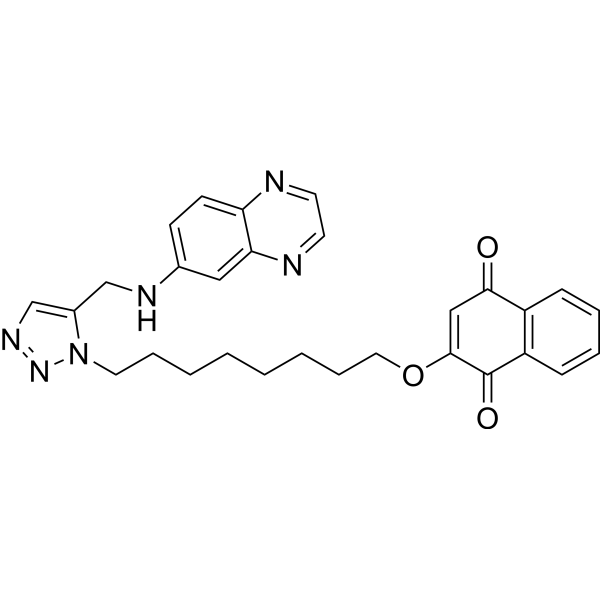
    AChE/BChE-IN-15 (Compound 6d) is an AChE/BChE inhibitor, with IC50s of 20 nM and 220 nM respectively. AChE/BChE-IN-15 binds to both catalytic anionic site (CAS) and peripheral anionic site (PAS) in the active sites of AChE and BChE. AChE/BChE-IN-15 can be used for research of Alzheimer’s disease .
    AChE/BChE-IN-15
  • HY-119292

    Cholinesterase (ChE) Amyloid-β Neurological Disease
    AP2238 is a dual-function acetylcholinesterase (AChE) inhibitor with Ki values for human AChE (HuAChE) and butyrylcholinesterase (BuChE) of 21.7 and 48.9 μM respectively. AP2238 blocks the pro-fibrotic interaction between the peripheral site of AChE and , and can inhibit Aβ aggregation. AP2238 can be used for the research of Alzheimer's disease .
    AP2238
  • HY-157527

    Cholinesterase (ChE) Beta-secretase Neurological Disease
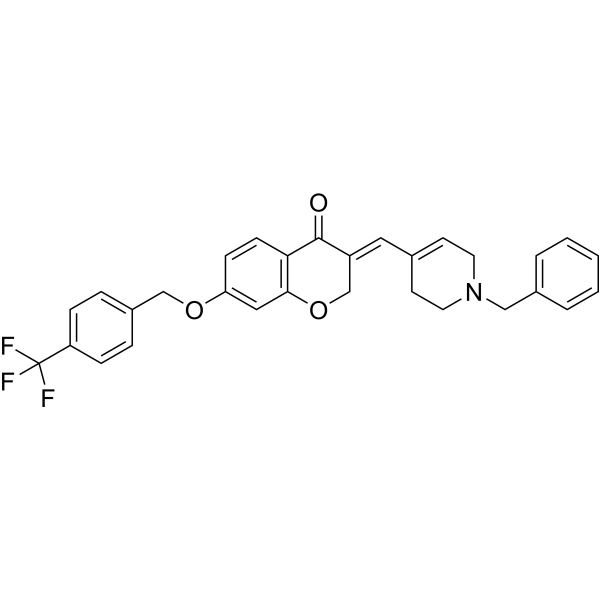
    hAChE-IN-7 (compound 5s) is a mixed inhibitor affecting both the catalytic active site (CAS) and peripheral anionic site (PAS) of hAChE. hAChE-IN-7 displays the balanced inhibitory effect on hAChE (IC50=69.8 nM) and hBuChE (IC50=68.0 nM), and exhibits inhibitory activity against β-secretase-1 (BACE-1) (IC50=3.6 μM). hAChE-IN-7 has the potential for Alzheimer's disease (AD) research .
    hAChE-IN-7
  • HY-151885

    Cholinesterase (ChE) Monoamine Oxidase Neurological Disease
    Dual AChE-MAO B-IN-3 (compound C10) is a potent dual AChE/MAO-B inhibitior, with IC50 values of 0.58 and 0.41 μM, respectively. Dual AChE-MAO B-IN-3 is a dual-binding inhibitor bound to both the catalytic anionic site and peripheral anionic site of AChE. Dual AChE-MAO B-IN-3 can be used for Alzheimer’s disease (AD) research .
    Dual AChE-MAO B-IN-3
  • HY-P1636A

    Thrombin Cardiovascular Disease
    Hirudin (54-65) TFA is a fragment of Hirudin with anticoagulant effects. Hirudin is a thrombin inhibitor with blood anticoagulant property .
    Hirudin (54-65) TFA
  • HY-150728

    Cholinesterase (ChE) Neurological Disease
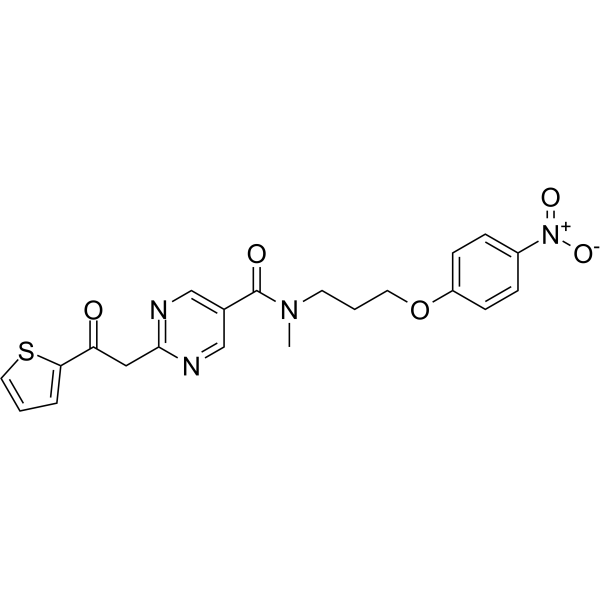
    AChE-IN-22 (compound 10q) is a selective acetylcholinesterase (AChE) inhibitor against AChE and BuChE with the IC50 values of 0.88 μM and 10 μM, respectively. AChE-IN-22 can bind to both the CAS (catalytic active site) and PAS (peripheral anionic site) of AChE and has the potential for the research of Alzheimer's disease .
    AChE-IN-22
  • HY-163746

    Cholinesterase (ChE) Neurological Disease
    BuChE-IN-11 (Compound 3b-1) is an selective BuChE inhibitor with an IC50 of 0.44 μM for hBuChE. BuChE-IN-11 has high blood-brain barrier permeability and exhibits strong antioxidant activity due to its free radical scavenging properties. BuChE-IN-11 interacts with the choline binding site, acetyl binding site, and peripheral anionic site, exhibiting submicromolar BuChE inhibitory activity and preventing β-amyloid (Aβ) self-aggregation. BuChE-IN-11 holds promise for research in the field of Alzheimer's disease .
    BuChE-IN-11
  • HY-W284558S

    Isotope-Labeled Compounds Biochemical Assay Reagents Others
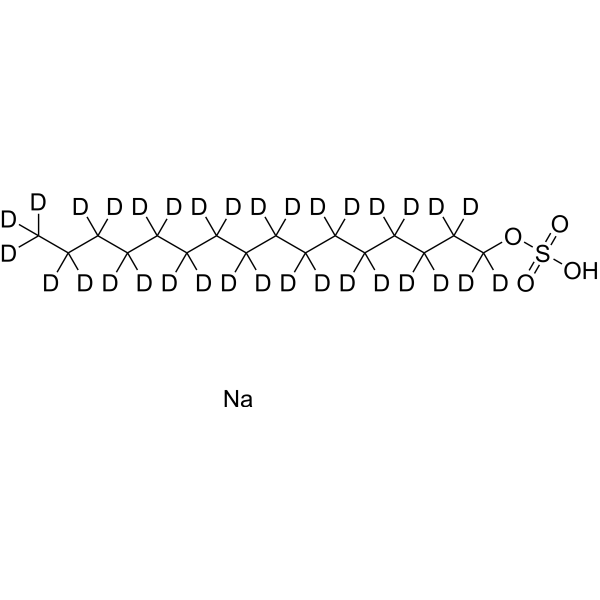
    Sodium hexadecyl sulfate-d33 is the deuterium labeled Sodium hexadecyl sulfate. Sodium hexadecyl sulfate is a long-chain anionic surfactant. Sodium hexadecyl sulfate can act as an interface-regulating substance to form a soft layer on the surface of carbon nanotubes, guide proteins to adsorb in the correct orientation with active sites facing outward through electrostatic interactions, and significantly enhance the activity of immobilized enzymes. Sodium hexadecyl sulfate can replace or supplement SDS (HY-Y0316) in capillary gel electrophoresis (CGE) .
    Sodium hexadecyl sulfate-d33
  • HY-181851

    Cholinesterase (ChE) Neurological Disease
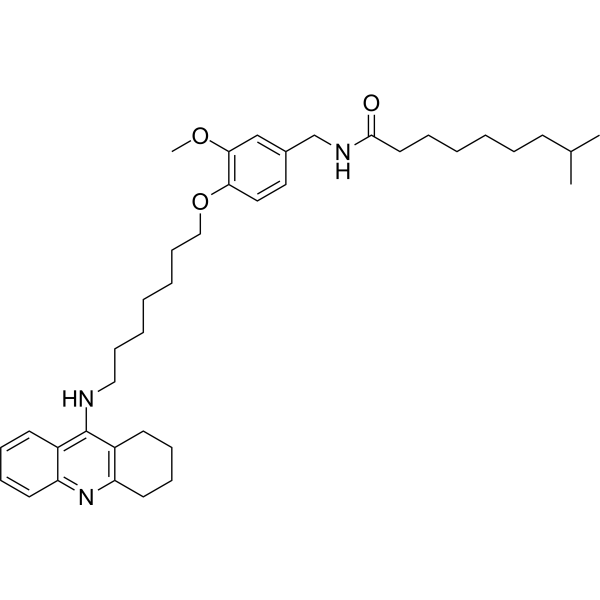
    AChE-IN-109 is a potent mixed-type cholinesterase inhibitor with significantly stronger inhibitory activity against AChE than BChE. AChE-IN-109 has IC50 values of 0.55 μM and 12.45 μM against AChE and BChE, respectively. AChE-IN-109 inhibits cholinesterases through a mixed-type mechanism, binds to both the catalytic active site (CAS) and peripheral anionic site (PAS) of AChE. AChE-IN-109 can be used for the study of Alzheimer’s disease (AD) .
    AChE-IN-109
  • HY-181161

    Cholinesterase (ChE) Neurological Disease
    AChE-IN-107 is a selective acetylcholinesterase (AChE) inhibitor with an IC50 of 0.22 μM and a Ki of 0.207 μM. AChE-IN-107 shows no inhibitory effect on equine serum BChE at 10 μM. AChE-IN-107 exhibits mixed-type inhibition of electric eel acetylcholinesterase, binding to both free enzyme and enzyme-substrate complex. AChE-IN-107 acts as a cytotoxin, reduces cell viability in hepatocellular carcinoma HepG2 cells.AChE-IN-107 can be used for the research of alzheimer's disease .
    AChE-IN-107
  • HY-182333

    Cholinesterase (ChE) Neurological Disease
    AChE-IN-112 is an acetylcholinesterase (AChE) inhibitor with an IC50 of 0.41 μM. AChE-IN-112 scavenges various reactive oxygen and reactive nitrogen species, including DPPH, ABTS, NO, hydroxyl and hydrogen peroxide free radicals. AChE-IN-112 can be used for the research of Alzheimer's disease .
    AChE-IN-112
  • HY-181744

    Cholinesterase (ChE) Neurological Disease
    AChE-IN-108 is a potent mixed-type acetylcholinesterase (AChE) inhibitor with an in vitro IC50 of 0.17 nM. AChE-IN-108 acts on both free AChE and the enzyme-substrate complex to exert mixed-type inhibition. AChE-IN-108 can be used for the study of acetylcholinesterase inhibition in Alzheimer’s disease (AD) .
    AChE-IN-108
  • HY-183303

    Cholinesterase (ChE) Reactive Oxygen Species (ROS) Neurological Disease
    AChE-IN-116 is a selective acetylcholinesterase (AChE) inhibitor with an electric eel AChE IC50 of 1.60 μM and Ki of 1.72 μM. AChE-IN-116 exhibits weak ability to scavenge DPPH radical. AChE-IN-116 can be used for the research of Alzheimer's disease .
    AChE-IN-116

Inquiry Online

Your information is safe with us. * Required Fields.

Salutation


Country or Region *

Applicant Name *


Organization Name *

Department *


Email Address *


Product Name *

Cat. No.


Requested quantity *

Phone Number *


Remarks

Inquiry Online

Inquiry Information

Product Name:
Cat. No.:
Quantity:
MCE Japan Authorized Agent:

