28 Results for "

basic amine

" in MedChemExpress (MCE) Product Catalog:
Products (28)

28 Results for "basic amine" in MCE Product Catalog:

1
1 Cited Publications
Cat. No.: HY-D1694
CAS No.: 1064123-31-4
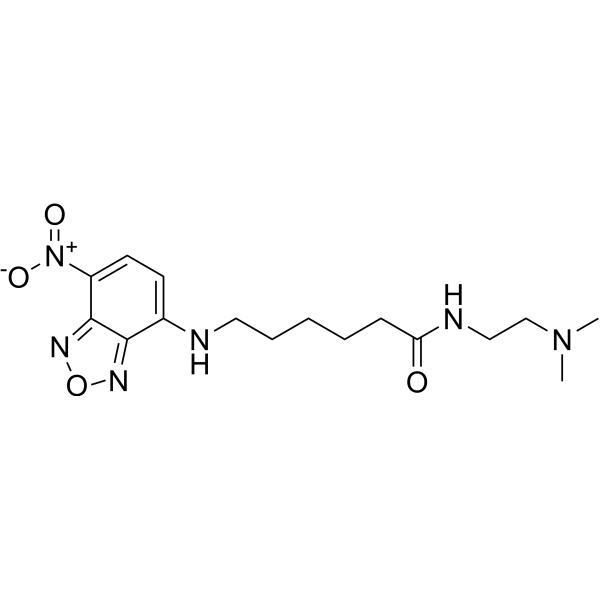
LysoTracker Yellow HCK 123 is a potent yellow membrane-permeable fluorescent probe. LysoTracker Yellow HCK 123 is a weakly basic amine that selectively accumulates in cellular compartments with low luminal pH .
loading...
    loading...
Cat. No.: HY-151835
CAS No.: 2765066-38-2
Purity:  95.25%
Target:  

ADC Linkers

Research Areas:  

Others

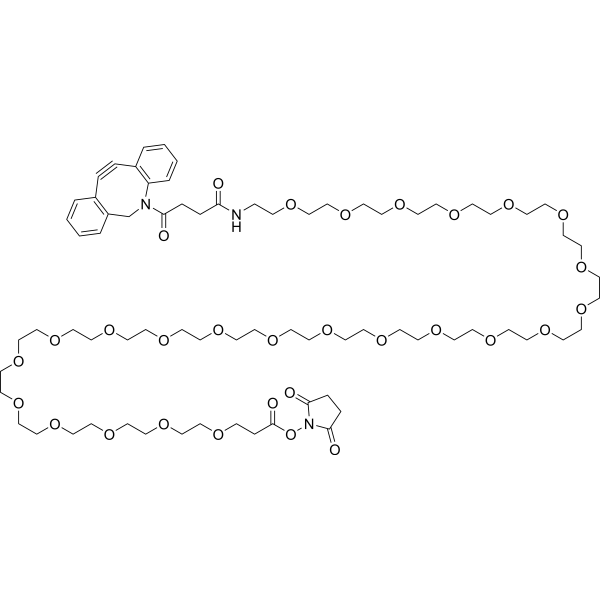
DBCO-PEG24-NHS ester is a click chemistry reagent. DBCO-PEG24-NHS ester is a click chemistry PEG reagent containing NHS ester that is able to react specifically and efficiently with primary amines (e.g. the side chain of lysine residues or aminosilane-coated surfaces) at neutral or slightly basic condition to form a covalent bond. The hydrophilic PEG spacer arm improves water solubility and provides a long and flexible connection that minimizes steric hindrance involved with ligation. DBCO is commonly used for copper-free Click Chemistry reactions. Reagent grade, for research use only .
loading...
    loading...
Cat. No.: HY-151827
CAS No.: 2585653-12-7
Purity:  ≥98.0%
Target:  

ADC Linkers

Research Areas:  

Others

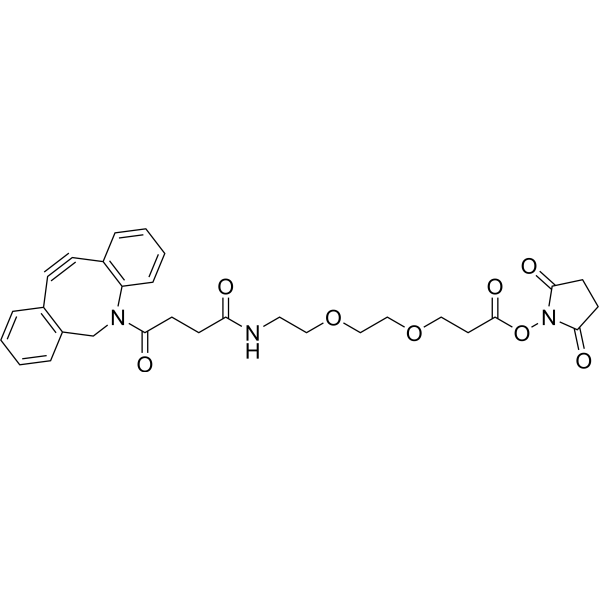
DBCO-PEG2-NHS ester is a click chemistry reagent containing an azide group. DBCO-PEG2-NHS ester is a click chemistry PEG reagent containing NHS ester that is able to react specifically and efficiently with primary amines (e.g. the side chain of lysine residues or aminosilane-coated surfaces) at neutral or slightly basic condition to form a covalent bond. The hydrophilic PEG spacer arm improves water solubility and provides a long and flexible connection that minimizes steric hindrance involved with ligation. DBCO is commonly used for copper-free Click Chemistry reactions. Reagent grade, for research use only .
loading...
    loading...
Cat. No.: HY-110028
CAS No.: 16496-99-4
Purity:  99.06%
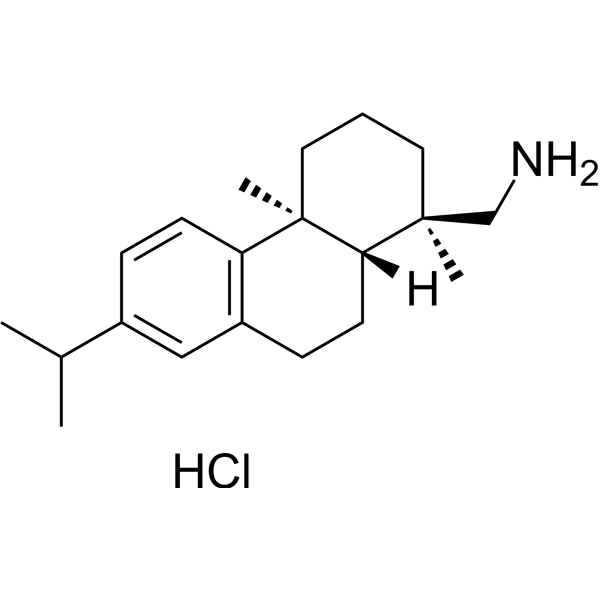
Leelamine hydrochloride is an orally active weakly basic amine that inhibits NPC1 and the androgen receptor AR-V7, and acts as a cannabinoid receptor agonist. Leelamine hydrochloride also functions as a lysosome affinity agent that blocks endocytosis, disrupts autophagic flux and cholesterol transport, thereby altering the RTK-AKT/STAT/MAPK signaling cascade. Leelamine hydrochloride induces cancer cell death and autophagosome accumulation, and can be used in research related to melanoma, castration-resistant prostate cancer and breast cancer .
loading...
    loading...
Cat. No.: HY-W097128
CAS No.: 128917-74-8
Target:  

PROTAC Linkers

Research Areas:  

Cancer

Fmoc-12-aminododecanoic acid is an alkane chain with terminal Fmoc-protected amine and carboxylic acid groups. The compound can be used as a PROTAC linker in the synthesis of PROTACs. The Fmoc group can be deprotected under basic condition to obtain the free amine which can be used for further conjugations. The terminal carboxylic acid can react with primary amine groups in the presence of activators (e.g. EDC, or HATU) to form a stable amide bond.
loading...
    loading...
Cat. No.: HY-W009030
CAS No.: 126631-93-4
Target:  

PROTAC Linkers

Research Areas:  

Cancer

N-Fmoc-8-aminooctanoic acid can be used as a PROTAC linker in the synthesis of PROTACs. N-Fmoc-8-aminooctanoic acid is an alkane chain with terminal Fmoc-protected amine and carboxylic acid groups. The Fmoc group can be deprotected under basic condition to obtain the free amine which can be used for further conjugations. The terminal carboxylic acid can react with primary amine groups in the presence of activators (e.g. EDC, or HATU) to form a stable amide bond.
loading...
    loading...
Cat. No.: HY-W009056
CAS No.: 127582-76-7
Target:  

PROTAC Linkers

Research Areas:  

Cancer

Fmoc-7-amino-heptanoic acid is an alkane chain with terminal Fmoc-protected amine and carboxylic acid groups. Fmoc-7-amino-heptanoic acid can be used as a PROTAC linker in the synthesis of PROTACs. The Fmoc group can be deprotected under basic condition to obtain the free amine which can be used for further conjugations. The terminal carboxylic acid can react with primary amine groups in the presence of activators (e.g. EDC, or HATU) to form a stable amide bond.
loading...
    loading...
Cat. No.: HY-W848699
CAS No.: 890090-41-2
FAM NHS ester, 6-isomer is a hydrophilic fluorophore. The NHS ester can react specifically and efficiently with primary amines such as the side chain of lysine residue or aminosilane-coated surfaces at neutral or slight basic conditions to form a covalent bond.
loading...
    loading...
Cat. No.: HY-W141765
CAS No.: 870487-04-0
Research Areas:  

Others

Fmoc-Cit-PAB-OH is a peptide linker containing an Fmoc-protected amine and citrulline residue. The Fmoc group can be deprotected under basic conditions to obtain the free amine, which can be used for further conjugations.
loading...
    loading...
Cat. No.: HY-W591479
CAS No.: 1895916-22-9
Target:  

ADC Linkers

Research Areas:  

Cancer

MC-Val-Ala-NHS ester is a cleavable ADC linker with a malimide group and an NHS ester group. The Val-Ala linkers can be cleaved by Cathepsin B. Maleimide group is reactive toward thiol groups. MC is reactive with thiol moieties. The NHS ester is able to react specifically and efficiently with amines (e.g. the side chain of lysine residues or aminosilane-coated surfaces) at neutral or slightly basic condition to form a covalent bond.
loading...
    loading...
Cat. No.: HY-118112
CAS No.: 64191-06-6
Research Areas:  

Others

4-N-Maleimidobenzoicacid-NHS is a PEG linker that finds utility in bioconjugation endeavors and protein labeling ventures. Specifically designed for selective reaction with thiol groups, the maleimide group establishes covalent linkages, thereby facilitating the coupling of proteins, peptides, or diverse molecules to thiol-bearing biomolecules. The NHS ester is able to react specifically and efficiently with primary amines (e.g. the side chain of lysine residues or aminosilane-coated surfaces) at neutral or slightly basic conditions to form a covalent bond.
loading...
    loading...
Cat. No.: HY-43781
CAS No.: 870487-06-2
Research Areas:  

Others

Fmoc-Lys(Boc)-PAB-OH is a peptide linker containing an Fmoc-protected amine and a Boc-protected lysine residue. The Fmoc group can be deprotected under basic condition to obtain the free amine which can be used for further conjugations.
loading...
    loading...
Cat. No.: HY-W111228
CAS No.: 212688-52-3
Target:  

PROTAC Linkers

Research Areas:  

Cancer

Fmoc-9-aminononanoic acid is an alkane chain with terminal Fmoc-protected amine and carboxylic acid groups. The compound can be used as a PROTAC linker in the synthesis of PROTACs and and other conjugation applications. The Fmoc group can be deprotected under basic condition to obtain the free amine which can be used for further conjugations. The terminal carboxylic acid can react with primary amine groups in the presence of activators (e.g. EDC, or HATU) to form a stable amide bond.
loading...
    loading...
Cat. No.: HY-W097110
CAS No.: 88574-07-6
Target:  

PROTAC Linkers

Research Areas:  

Cancer

Fmoc-11-aminoundecanoic acid can be used as a PROTAC linker in the synthesis of PROTACs and other conjugation applications. Fmoc-11-aminoundecanoic acid is an alkane chain with terminal Fmoc-protected amine and carboxylic acid groups. The Fmoc group can be deprotected under basic condition to obtain the free amine which can be used for further conjugations. The terminal carboxylic acid can react with primary amine groups in the presence of activators (e.g. EDC, or HATU) to form a stable amide bond.
loading...
    loading...
Cat. No.: HY-W591968
CAS No.: 1931109-55-5
Target:  

PROTAC Linkers

Research Areas:  

Cancer

14-(Fmoc-amino)-tetradecanoic acid can be used as a PROTAC linker in the synthesis of PROTACs. 14-(Fmoc-amino)-tetradecanoic acid is an alkane chain with terminal Fmoc-protected amine and carboxylic acid groups. The Fmoc group can be deprotected under basic condition to obtain the free amine which can be used for further conjugations. The terminal carboxylic acid can react with primary amine groups in the presence of activators (e.g. EDC, or HATU) to form a stable amide bond.
loading...
    loading...
Cat. No.: HY-W739603
CAS No.: 252255-42-8
Cy5-bifunctional dye potassium is a water soluble bifunctional dye possessing two terminal NHS ester functions. The NHS esters can react specifically and efficiently with primary amines such as the side chain of lysine residue or aminosilane-coated surfaces at neutral or slight basic conditions to form a covalent bond. The dye is useful for the cross-conjugation of amines, and for other advanced labeling applications.
loading...
    loading...
Cat. No.: HY-W591439
CAS No.: 870487-07-3
Research Areas:  

Others

Fmoc-Lys(Boc)-PAB-PNP is a Boc-protected Lysine linked to 4-aminobenzoiate (PAB) with terminal Fmoc and PNP groups. The Fmoc group can be deprotected under basic conditions to release the free amine which can be used for further conjugations.
loading...
    loading...
Cat. No.: HY-W800804
CAS No.: 873923-24-1
Research Areas:  

Others

Fmoc-Ala-PAB-OH is a peptide linker containing an Fmoc-protected amine and an alanine residue. The Fmoc group can be deprotected under basic condition to obtain the free amine which can be used for further conjugations.
loading...
    loading...
Cat. No.: HY-W479025
CAS No.: 1274891-99-4
Research Areas:  

Others

Fmoc-DODA hydrochloride is a linker with an Fmoc-protected amine and a terminal amine group. The Fmoc group can be deprotected under basic condition to obtain the free amine which can be used for further conjugations. The amino group is reactive with carboxylic acids, activated NHS esters, carbonyls (ketone, aldehyde) etc.
loading...
    loading...
Cat. No.: HY-W190934
CAS No.: 186023-44-9
Research Areas:  

Others

Fmoc-Ala-Pro-OH is a linker with an Fmoc-protected amine and a terminal carboxylic acid. The Fmoc group can be deprotected under basic condition to obtain the free amine which can be used for further conjugations. The terminal carboxylic acid can be reacted with primary amine groups in the presence of activators (e.g. EDC, or HATU) to form a stable amide bond.
loading...
    loading...

