
Search Result
Results for "
beetle
" in MedChemExpress (MCE) Product Catalog:
2
Biochemical Assay Reagents
2
Isotope-Labeled Compounds
| Cat. No. |
Product Name |
Target |
Research Areas |
Chemical Structure |
-
- HY-12591B
-
|
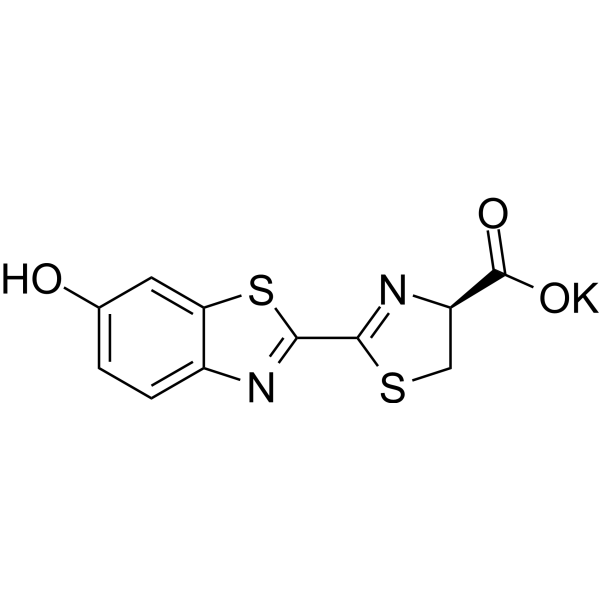
D-(-)-Luciferin potassium; Firefly luciferin potassium; beetle Luciferin potassium
|
Fluorescent Dye
|
Others
|
|
D-luciferin potassium is the natural substrate of the enzyme luciferase (Luc) that catalyzes the production of the typical yellowgreen light of fireflies. The 560 nm chemiluminescence from this reaction peaks within seconds, with light output that is proportional to luciferase concentration when the substrate luciferin is present in excess. The luciferase (luc) gene is a popular reporter gene for research and agent screening. Chemiluminescent techniques are virtually background-free, making the luc reporter gene ideal for detecting low-level gene expression. As little as 0.02 pg of luciferase can be reliably measured in a standard scintillation counter. In addition to its role as a reporter of gene expression, luciferase is commonly used in an extremely sensitive assay for ATP . We offer the firefly luciferase (HY-P1004A), luciferin free acid (HY-12591A), as well as its water-soluble sodium salts (HY-12591) and potassium salts (HY-12591B) .
|
-
-
- HY-12591
-
|
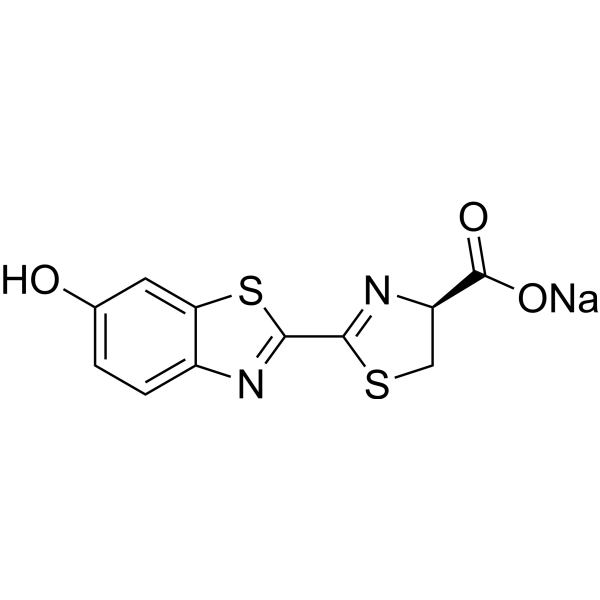
D-(-)-Luciferin sodium; Firefly luciferin sodium; beetle Luciferin sodium
|
Fluorescent Dye
|
Others
|
|
D-luciferin sodium is the natural substrate of the enzyme luciferase (Luc) that catalyzes the production of the typical yellowgreen light of fireflies. The 560 nm chemiluminescence from this reaction peaks within seconds, with light output that is proportional to luciferase concentration when the substrate luciferin is present in excess. The luciferase (luc) gene is a popular reporter gene for research and agent screening. Chemiluminescent techniques are virtually background-free, making the luc reporter gene ideal for detecting low-level gene expression. As little as 0.02 pg of luciferase can be reliably measured in a standard scintillation counter. In addition to its role as a reporter of gene expression, luciferase is commonly used in an extremely sensitive assay for ATP . We of er the firefly luciferase (HY-P1004A), luciferin free acid (HY-12591A), as well as its water-soluble sodium salts (HY-12591) and potassium salts (HY-12591B) .
|
-
-
- HY-12591A
-
D-Luciferin
Maximum Cited Publications
110 Publications Verification
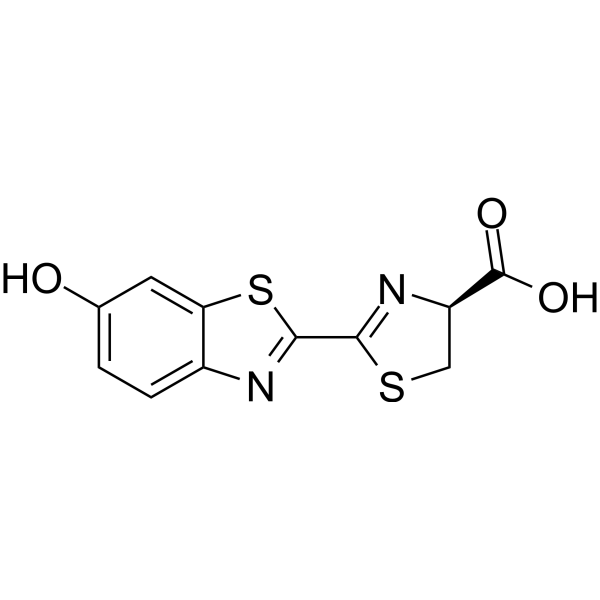
D-(-)-Luciferin; Firefly luciferin; beetle Luciferin
|
Fluorescent Dye
|
Others
|
|
D-luciferin is the natural substrate of the enzyme luciferase (Luc) that catalyzes the production of the typical yellowgreen light of fireflies. The 560 nm chemiluminescence from this reaction peaks within seconds, with light output that is proportional to luciferase concentration when the substrate luciferin is present in excess. The luciferase (luc) gene is a popular reporter gene for research and agent screening. Chemiluminescent techniques are virtually background-free, making the luc reporter gene ideal for detecting low-level gene expression. As little as 0.02 pg of luciferase can be reliably measured in a standard scintillation counter. In addition to its role as a reporter of gene expression, luciferase is commonly used in an extremely sensitive assay for ATP . We of er the firefly luciferase (HY-P1004A), luciferin free acid (HY-12591A), as well as its water-soluble sodium salts (HY-12591) and potassium salts (HY-12591B) .
|
-
-
- HY-W087952
-
|
|
Drug Intermediate
|
Endocrinology
|
|
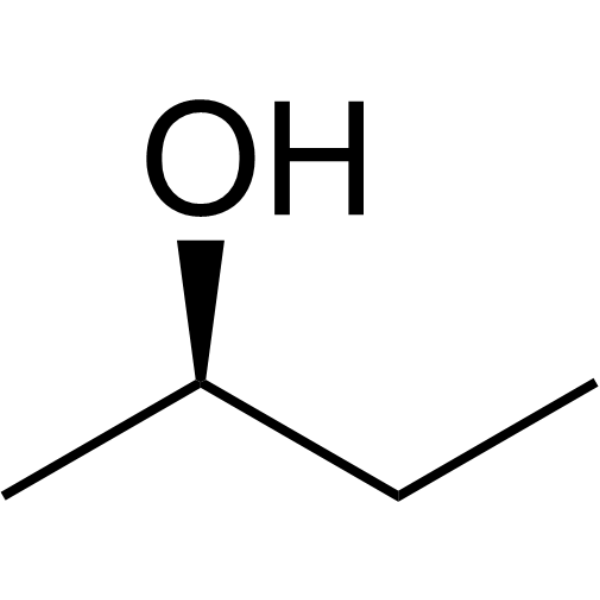
(R)-(-)-2-Butanol is the isomer of 2-Butanol, which is found in the females of the white grub beetle, Dasylepida ishigakiensis, to attract males. (R)-(-)-2-Butanol is an intermediate of pharmaceutical synthesis by coupling .
|
-
-
- HY-P1004A
-
|
|
Fluorescent Dye
|
Others
|
|
Luciferase, firefly is the light-emitting enzyme responsible for the bioluminescence of fireflies and click beetles. Luciferase, firefly catalytic substrate is D-luciferin (HY-12591B) .
|
-
-
- HY-N6661
-
|
(-)-Verbenone
|
Environmental Pollutants
Sex Pheromone
|
Infection
Others
|
|
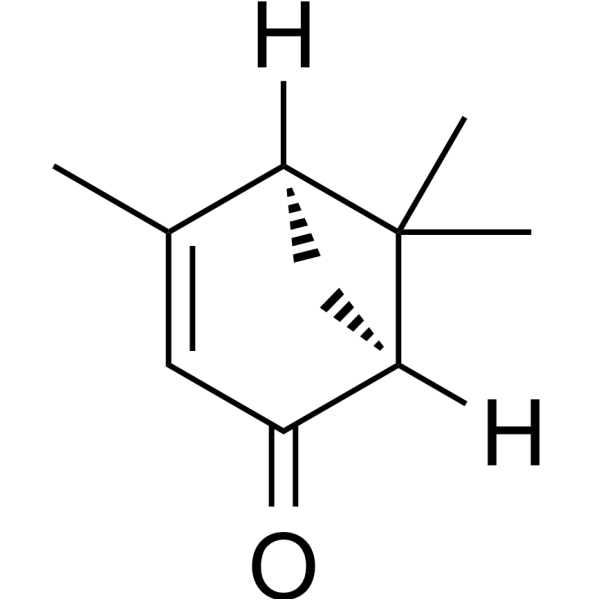
Verbenone is a naturally derived monoterpene ketone and an anti-aggregation pheromone/attractant inhibitor. Verbenone interferes with the responses of Dendroctonus brevicomis and Dendroctonus ponderosae to baited traps. Verbenone can be used in studies related to bark beetle infestations of trees .
|
-
-
- HY-B1881
-
-
-
- HY-W012846
-
-
-
- HY-B1647
-
|
|
Insecticide
|
Others
|
|
Ferric phosphate is used as food and feed supplement, particularly in bread enrichment. Ferric phosphate is also used as a fertilizer and as a molluscicide for a variety of slugs and snails including Deroceras reticulatum, D.laeve, Arion subfuscus .
|
-
-
- HY-N7927
-
|
|
Others
|
Others
|
|
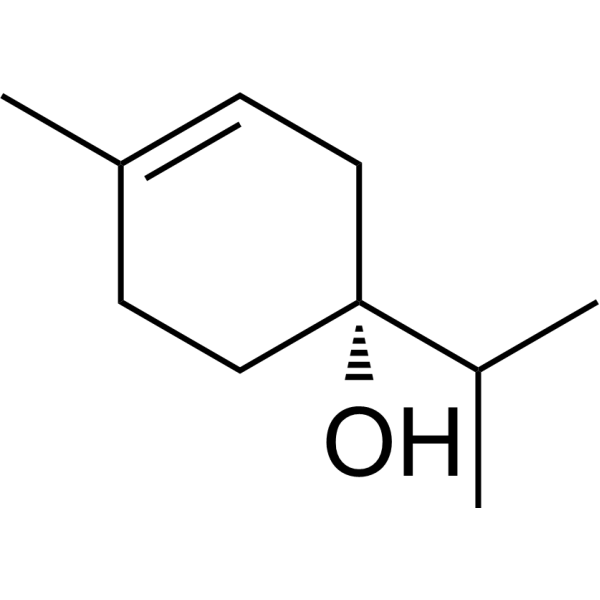
(-)-Terpinen-4-ol can be extracted from Bark Beetle Polygraphus poligraphus .
|
-
-
- HY-W613915
-
|
|
Sex Pheromone
|
Endocrinology
|
|
(±)-Ipsdienol is a sex pheromone with an inducing effect on male spruce beetles (Dendroctonus rufipennis Kirby), which can be isolated from the subspecies of spruce beetles (Ips tridens Mannerheim) .
|
-
-
- HY-115684
-
|
Undecan-2-ol
|
Endogenous Metabolite
|
Others
|
|
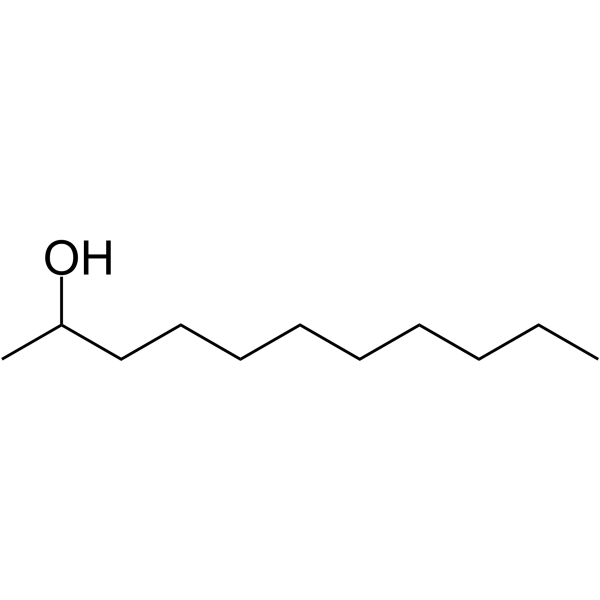
2-Undecanol (Undecan-2-ol) is a male specific volatile identified from the sap beetle Lobiopa insularis. 2-undecanol is a flower emitted volatile, used by various species of Hymenoptera as a pheromone component .
|
-
-
- HY-W099643
-
|
Erucyl alcohol
|
Endogenous Metabolite
|
Others
|
|
Cis-13-docosenol (Erucyl alcohol) is a long-chain alcohol pheromone in insects. Cis-13-docosenol exhibits attractive effects on both male and female adult Holotrichia parallela. Cis-13-docosenol can be used for the monitoring and control of adult Holotrichia parallela .
|
-
-
- HY-W087952R
-
|
|
Drug Intermediate
Reference Standards
|
Endocrinology
|
|
Ginsenoside Rg1 (Standard) is the analytical standard of Ginsenoside Rg1. This product is intended for research and analytical applications. Ginsenoside Rg1 is one of the major active components of Panax ginseng. Ginsenoside Rg1 ameliorates the impaired cognitive function, displays promising effects by reducing cerebral Aβ levels. Ginsenoside Rg1 also reduces NF-κB nuclear translocation.
|
-
-
- HY-Z8245
-
|
Progesterone EP impurity C
|
Drug Derivative
|
Others
|
|
20b-Dihydroprogesterone (Compond III) is a C-21 steroid found in water beetles Cybister limbatus, C. tripunctatus and C. confuses .
|
-
-
- HY-W674037
-
|
|
Sex Pheromone
|
Endocrinology
|
|
cis-Verbenol is a sex pheromone capable of inhibiting aggregation and inducing dispersion of mountain pine beetles (Dendroctonus ponderosae Hopkins) and can be isolated from pine engravers .
|
-
-
- HY-W098556
-
|
|
Insecticide
|
Infection
|
|
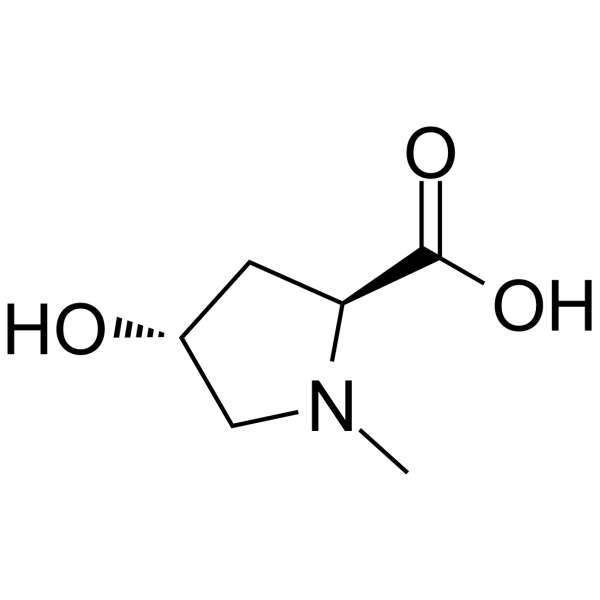
4-Hydroxyhygric acid is a compound isolated from leaves of five species of the leguminous tropical tree Copuiferq. 4-Hydroxyhygric acid is the inhibitor of larval development of the seed-feeding bruchid beetle Callosobruchus maculatus and to have significant feeding deterrence of the leaf-feeding lepidopteran Spodoprera littoralis .
|
-
-
- HY-B0828
-
|
|
Parasite
Cholinesterase (ChE)
|
Others
|
|
Triazophos, a non-systemic insecticide and acaricide that acts as an acetylcholinesterase (AChE) inhibitor, covalently and irreversibly binds to the acetylcholine binding site, thus blocking the hydrolysis of acetylcholine and leading to hyperexcitability; it is effective against a variety of soil insects and mites, including aphids, thrips, midges, beetles, Lepidoptera larvae, cutworms, and spider mites in crops such as ornamentals, cotton, rice, maize, soybeans, oil palms, olives, and coffee.
|
-
-
- HY-W979008
-
-
-
- HY-126118
-
|
Decachlor
|
Parasite
|
Infection
|
|
Dienochlor (Decachlor) is a miticide that inhibits Mexican bean beetle, Epilachna varivestis Mulsant, from laying eggs on pinto beans .
|
-
-
- HY-118751
-
|
Bancol
|
nAChR
|
Others
Neurological Disease
|
|
Bensultap (Bancol) is an insecticide, which can control Colorado beetle and some other insect pests. Bensultap is a modulator for nicotinic acetylcholine receptor (nAChR), and exhibits mild and temporary neuromodulatory efficacy on rat nervous system .
|
-
-
- HY-W717924
-
|
|
Endogenous Metabolite
|
Endocrinology
|
|
(Z)-14-Methyl-8-hexadecenal is a sex pheromone that can induce mating responses in male Trogoderma beetles, isolated from the spiracular exhalation distillates of female beetles .
|
-
-
- HY-W780813
-
-
-
- HY-B1881S
-
|
|
Isotope-Labeled Compounds
Insecticide
Cholinesterase (ChE)
Parasite
|
Infection
|
|
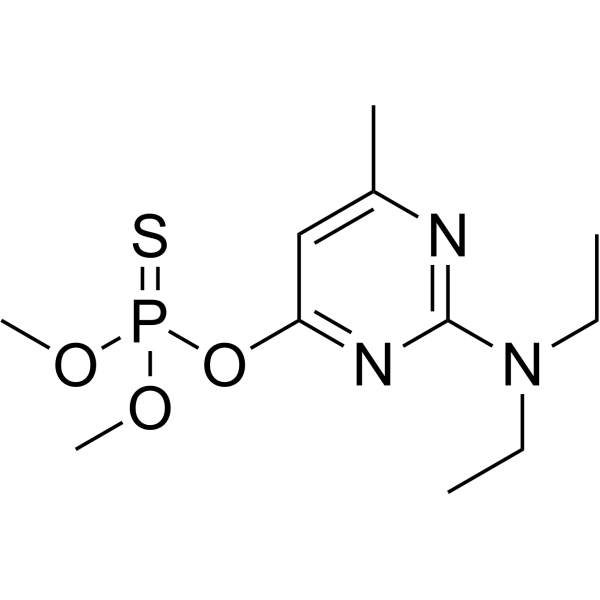
Pirimiphos-methyl-d6 is the deuterium labeled Pirimiphos-methyl (HY-B1881) . Pirimiphos-methyl is an organophosphorus insecticide and acaricide that can inhibit AChE in target organisms. Pirimiphos-methyl is often used for prevention and control of beetles, snout beetles, moths and Ephestia cautella during storage of agricultural grains .
|
-
-
- HY-B1881R
-
|
|
Reference Standards
Insecticide
Cholinesterase (ChE)
Parasite
|
Infection
|
|
Pirimiphos-methyl (Standard) is the analytical standard of Pirimiphos-methyl (HY-B1881). This product is intended for research and analytical applications. Pirimiphos-methyl is an organophosphorus insecticide and acaricide that can inhibit AChE in target organisms. Pirimiphos-methyl is often used for prevention and control of beetles, snout beetles, moths and Ephestia cautella during storage of agricultural grains.
|
-
-
- HY-N12920
-
|
Z3-12:Ac
|
Others
|
Endocrinology
|
|
(Z)-3-Dodecenyl acetate (Z3-12:Ac) is a specific sex pheromone attracting females, isolated from pentane extracts of mature unmated male yellow mealworm beetles .
|
-
-
- HY-N6661R
-
|
(-)-Verbenone (Standard)
|
Reference Standards
Others
|
Infection
|
|
Verbenone (Standard) is the analytical standard of Verbenone. This product is intended for research and analytical applications. Verbenone ((-)-Verbenone) is a natural terpene in leaves of the tree, Verbena officinalis . Verbenone has anti-aggregation pheromone and interrupts the attraction of bark beetles to their aggregation pheromones .
|
-
-
- HY-N7927R
-
|
|
Others
Reference Standards
|
Others
|
|
(-)-Terpinen-4-ol (Standard) is the analytical standard of (-)-Terpinen-4-ol. This product is intended for research and analytical applications. (-)-Terpinen-4-ol can be extracted from Bark Beetle Polygraphus poligraphus .
|
-
-
- HY-100196AR
-
|
PQQ disodium salt (Standard); Methoxatin disodium salt (Standard)
|
Reference Standards
Endogenous Metabolite
|
Inflammation/Immunology
|
|
Triazophos (Standard) is the analytical standard of Triazophos. This product is intended for research and analytical applications. Triazophos, a non-systemic insecticide and acaricide that acts as an acetylcholinesterase (AChE) inhibitor, covalently and irreversibly binds to the acetylcholine binding site, thus blocking the hydrolysis of acetylcholine and leading to hyperexcitability; it is effective against a variety of soil insects and mites, including aphids, thrips, midges, beetles, Lepidoptera larvae, cutworms, and spider mites in crops such as ornamentals, cotton, rice, maize, soybeans, oil palms, olives, and coffee.
|
-
-
- HY-B0828R
-
|
|
Parasite
Reference Standards
|
Others
|
|
Triazophos (Standard) is the analytical standard of Triazophos. This product is intended for research and analytical applications. Triazophos, a non-systemic insecticide and acaricide that acts as an acetylcholinesterase (AChE) inhibitor, covalently and irreversibly binds to the acetylcholine binding site, thus blocking the hydrolysis of acetylcholine and leading to hyperexcitability; it is effective against a variety of soil insects and mites, including aphids, thrips, midges, beetles, Lepidoptera larvae, cutworms, and spider mites in crops such as ornamentals, cotton, rice, maize, soybeans, oil palms, olives, and coffee.
|
-
-
- HY-181985
-
|
|
Insecticide
|
Infection
|
|
Insecticidal agent 30 is an orally active insecticidal agent. Insecticidal agent 30 induces rapid contact mortality in adult Brassicogethes aeneus, achieves 100% 24-hour contact mortality against Brassicogethes aeneus, and exhibits moderate insecticidal activity against Drosophila melanogaster. Insecticidal agent 30 can be used for the research of pollen beetle (brassicogethes aeneus) infestation .
|
-
-
- HY-N17847
-
|
|
Others
|
Others
|
|
Quercetin-3-O-β-D-xylosyl-(1→2)-β-D-galactoside (compound 2) is a flavonol glycoside. Quercetin-3-O-β-D-xylosyl-(1→2)-β-D-galactoside occurs in the leaves of horseradish Armoracia rusticana. Quercetin-3-O-β-D-xylosyl-(1→2)-β-D-galactoside serves as one of the feeding stimulants for the flea beetle Phyllotreta armoraciae .
|
-
-
- HY-N16456
-
|
|
Insecticide
|
Infection
|
|
3-Hydroxy-2-decanone is a minor component of sex pheromone in Xylotrechus quadripes beetles. 3-Hydroxy-2-decanone is promising for research of pests and diseases .
|
-
-
- HY-183066
-
|
|
Insecticide
Cholinesterase (ChE)
|
Infection
|
|
AChE-IN-115 is an acetylcholinesterase (AChE) inhibitor. AChE-IN-115 forms stable complexes with AChE from Spodoptera litura (tobacco cutworm) and Tribolium castaneum (red flour beetle). AChE-IN-115 exhibits insecticidal activity .
|
-
-
- HY-W142293
-
|
Methallylcarbinol
|
Drug Derivative
|
Others
|
|
3-Methyl-3-buten-1-ol (Methallylcarbinol), a semiterpenoid alcohol, is an aggregation pheromone that can be found in the venom glands of the European hornet (Vespa crabro) and our-eyed spruce bark beetle .
|
-
-
- HY-N16455
-
|
|
Insecticide
|
Infection
|
|
(S)-2-Hydroxy-3-decanone is the primary sex pheromone component of Xylotrechus quadripes beetles, functioning as a volatile olfactory agonist. (S)-2-Hydroxy-3-decanone is promising for research of pests and diseases .
|
-
-
- HY-W674037R
-
|
|
Sex Pheromone
Reference Standards
|
Endocrinology
|
|
cis-Verbenol (Standard) is the analytical standard of cis-Verbenol (HY-W674037). This product is intended for research and analytical applications. cis-Verbenol is a sex pheromone capable of inhibiting aggregation and inducing dispersion of mountain pine beetles (Dendroctonus ponderosae Hopkins) and can be isolated from pine engravers .
|
-
-
- HY-B0828S
-
|
Hostathion 40EC-d5; Hostathion-d5; Hostation-d5
|
Isotope-Labeled Compounds
Parasite
Cholinesterase (ChE)
|
Others
|
|
Triazophos-d5 (Hostathion 40EC-d5) is the deuterium labeled Triazophos(HY-B0828) . Triazophos, a non-systemic insecticide and acaricide that acts as an acetylcholinesterase (AChE) inhibitor, covalently and irreversibly binds to the acetylcholine binding site, thus blocking the hydrolysis of acetylcholine and leading to hyperexcitability; it is effective against a variety of soil insects and mites, including aphids, thrips, midges, beetles, Lepidoptera larvae, cutworms, and spider mites in crops such as ornamentals, cotton, rice, maize, soybeans, oil palms, olives, and coffee.
|
-
-
- HY-180505
-
-
-
- HY-W106720
-
|
|
Insecticide
|
Infection
|
|
(E)-11-Tetradecenyl acetate is a monounsaturated 14-carbon acetate insecticide and a component of the sex pheromone of the currant shoot borer. (E)-11-Tetradecenyl acetate triggers strong antennal responses in males and is used in combination with (Z)-11-tetradecenyl acetate to produce an attracting effect. (E)-11-Tetradecenyl acetate has important application value in the sustainable control of pests, and can be used to monitor population dynamics and implement mating disruption. (E)-11-Tetradecenyl acetate is highly species-specific, triggering only extremely weak responses and showing no attracting activity towards Melanotus communis beetles. (E)-11-Tetradecenyl acetate can be used in studies related to the currant shoot borer and targeted pest control .
|
-
-
- HY-171722
-
|
Asc-C9
|
Insecticide
PGC-1α
|
Infection
Cancer
|
|
Ascr#10 (Asc-C9) is an orally active thermogenesis inducer and insecticide that can be obtained from Monochamus alternatus. Ascr#10 binds to the insect adipokinetic hormone (AKH) receptor (Ka=272 µM) and stimulates mitochondrial biogenesis via the PGC1α-UCP4 axis. Consequently, Ascr#10 induces UCP4-mediated uncoupled respiration, reduces the ATP/ADP ratio and accelerates lipid mobilization, thereby driving the thermogenesis process. Ascr#10 delays pupation and exerts specific chemotaxis toward dispersive fourth-stage pinewood nematode LIV larvae. Ascr#10 promotes cold acclimation of Monochamus alternatus larvae through metabolic inhibition and cryoprotectant accumulation, enhancing their survival rate under cold stress. Ascr#10 also induces browning of white adipose tissue and activates brown adipose tissue in mice, thereby helping the body resist cold and tumor growth. Ascr#10 can be widely applied to research related to pine wilt disease, lung tumors and cold stress .
|
-
| Cat. No. |
Product Name |
Type |
-
- HY-12591B
-
|
D-(-)-Luciferin potassium; Firefly luciferin potassium; beetle Luciferin potassium
|
Fluorescent Dyes
|
|
D-luciferin potassium is the natural substrate of the enzyme luciferase (Luc) that catalyzes the production of the typical yellowgreen light of fireflies. The 560 nm chemiluminescence from this reaction peaks within seconds, with light output that is proportional to luciferase concentration when the substrate luciferin is present in excess. The luciferase (luc) gene is a popular reporter gene for research and agent screening. Chemiluminescent techniques are virtually background-free, making the luc reporter gene ideal for detecting low-level gene expression. As little as 0.02 pg of luciferase can be reliably measured in a standard scintillation counter. In addition to its role as a reporter of gene expression, luciferase is commonly used in an extremely sensitive assay for ATP . We offer the firefly luciferase (HY-P1004A), luciferin free acid (HY-12591A), as well as its water-soluble sodium salts (HY-12591) and potassium salts (HY-12591B) .
|
-
- HY-12591
-
|
D-(-)-Luciferin sodium; Firefly luciferin sodium; beetle Luciferin sodium
|
Fluorescent Dyes
|
|
D-luciferin sodium is the natural substrate of the enzyme luciferase (Luc) that catalyzes the production of the typical yellowgreen light of fireflies. The 560 nm chemiluminescence from this reaction peaks within seconds, with light output that is proportional to luciferase concentration when the substrate luciferin is present in excess. The luciferase (luc) gene is a popular reporter gene for research and agent screening. Chemiluminescent techniques are virtually background-free, making the luc reporter gene ideal for detecting low-level gene expression. As little as 0.02 pg of luciferase can be reliably measured in a standard scintillation counter. In addition to its role as a reporter of gene expression, luciferase is commonly used in an extremely sensitive assay for ATP . We of er the firefly luciferase (HY-P1004A), luciferin free acid (HY-12591A), as well as its water-soluble sodium salts (HY-12591) and potassium salts (HY-12591B) .
|
-
- HY-12591A
-
D-Luciferin
Maximum Cited Publications
110 Publications Verification
D-(-)-Luciferin; Firefly luciferin; beetle Luciferin
|
Fluorescent Dyes
|
|
D-luciferin is the natural substrate of the enzyme luciferase (Luc) that catalyzes the production of the typical yellowgreen light of fireflies. The 560 nm chemiluminescence from this reaction peaks within seconds, with light output that is proportional to luciferase concentration when the substrate luciferin is present in excess. The luciferase (luc) gene is a popular reporter gene for research and agent screening. Chemiluminescent techniques are virtually background-free, making the luc reporter gene ideal for detecting low-level gene expression. As little as 0.02 pg of luciferase can be reliably measured in a standard scintillation counter. In addition to its role as a reporter of gene expression, luciferase is commonly used in an extremely sensitive assay for ATP . We of er the firefly luciferase (HY-P1004A), luciferin free acid (HY-12591A), as well as its water-soluble sodium salts (HY-12591) and potassium salts (HY-12591B) .
|
-
- HY-P1004A
-
|
|
Fluorescent Dyes
|
|
Luciferase, firefly is the light-emitting enzyme responsible for the bioluminescence of fireflies and click beetles. Luciferase, firefly catalytic substrate is D-luciferin (HY-12591B) .
|
| Cat. No. |
Product Name |
Type |
-
- HY-B1647
-
|
|
Biochemical Assay Reagents
|
|
Ferric phosphate is used as food and feed supplement, particularly in bread enrichment. Ferric phosphate is also used as a fertilizer and as a molluscicide for a variety of slugs and snails including Deroceras reticulatum, D.laeve, Arion subfuscus .
|
-
- HY-W099643
-
|
Erucyl alcohol
|
Biochemical Assay Reagents
|
|
Cis-13-docosenol (Erucyl alcohol) is a long-chain alcohol pheromone in insects. Cis-13-docosenol exhibits attractive effects on both male and female adult Holotrichia parallela. Cis-13-docosenol can be used for the monitoring and control of adult Holotrichia parallela .
|
| Cat. No. |
Product Name |
Target |
Research Area |
-
- HY-P1004A
-
|
|
Fluorescent Dye
|
Others
|
|
Luciferase, firefly is the light-emitting enzyme responsible for the bioluminescence of fireflies and click beetles. Luciferase, firefly catalytic substrate is D-luciferin (HY-12591B) .
|
| Cat. No. |
Product Name |
Category |
Target |
Chemical Structure |
-
- HY-12591A
-
D-Luciferin
Maximum Cited Publications
110 Publications Verification
D-(-)-Luciferin; Firefly luciferin; beetle Luciferin
|
Natural Products
Animals
Other Diseases
Disease Research Fields
Source Classification
|
Fluorescent Dye
|
|
D-luciferin is the natural substrate of the enzyme luciferase (Luc) that catalyzes the production of the typical yellowgreen light of fireflies. The 560 nm chemiluminescence from this reaction peaks within seconds, with light output that is proportional to luciferase concentration when the substrate luciferin is present in excess. The luciferase (luc) gene is a popular reporter gene for research and agent screening. Chemiluminescent techniques are virtually background-free, making the luc reporter gene ideal for detecting low-level gene expression. As little as 0.02 pg of luciferase can be reliably measured in a standard scintillation counter. In addition to its role as a reporter of gene expression, luciferase is commonly used in an extremely sensitive assay for ATP . We of er the firefly luciferase (HY-P1004A), luciferin free acid (HY-12591A), as well as its water-soluble sodium salts (HY-12591) and potassium salts (HY-12591B) .
|
-
-
- HY-W087952
-
-
-
- HY-N6661
-
-
-
- HY-W012846
-
-
-
- HY-N7927
-
-
-
- HY-W613915
-
-
-
- HY-115684
-
-
-
- HY-W087952R
-
-
-
- HY-Z8245
-
-
-
- HY-W674037
-
-
-
- HY-W098556
-
-
-
- HY-W717924
-
-
-
- HY-W780813
-
-
-
- HY-N12920
-
-
-
- HY-N6661R
-
-
-
- HY-N7927R
-
-
-
- HY-100196AR
-
|
PQQ disodium salt (Standard); Methoxatin disodium salt (Standard)
|
Quinones
Structural Classification
Microorganisms
Benzene Quinones
Endogenous metabolite
Source Classification
|
Reference Standards
Endogenous Metabolite
|
|
Triazophos (Standard) is the analytical standard of Triazophos. This product is intended for research and analytical applications. Triazophos, a non-systemic insecticide and acaricide that acts as an acetylcholinesterase (AChE) inhibitor, covalently and irreversibly binds to the acetylcholine binding site, thus blocking the hydrolysis of acetylcholine and leading to hyperexcitability; it is effective against a variety of soil insects and mites, including aphids, thrips, midges, beetles, Lepidoptera larvae, cutworms, and spider mites in crops such as ornamentals, cotton, rice, maize, soybeans, oil palms, olives, and coffee.
|
-
-
- HY-N17847
-
-
-
- HY-N16456
-
-
-
- HY-W142293
-
-
-
- HY-N16455
-
|
|
Natural Products
Animals
Source Classification
|
Insecticide
|
|
(S)-2-Hydroxy-3-decanone is the primary sex pheromone component of Xylotrechus quadripes beetles, functioning as a volatile olfactory agonist. (S)-2-Hydroxy-3-decanone is promising for research of pests and diseases .
|
-
-
- HY-W674037R
-
-
| Cat. No. |
Product Name |
Chemical Structure |
-
- HY-B1881S
-
|
|
|
Pirimiphos-methyl-d6 is the deuterium labeled Pirimiphos-methyl (HY-B1881) . Pirimiphos-methyl is an organophosphorus insecticide and acaricide that can inhibit AChE in target organisms. Pirimiphos-methyl is often used for prevention and control of beetles, snout beetles, moths and Ephestia cautella during storage of agricultural grains .
|
-
-
- HY-B0828S
-
|
|
|
Triazophos-d5 (Hostathion 40EC-d5) is the deuterium labeled Triazophos(HY-B0828) . Triazophos, a non-systemic insecticide and acaricide that acts as an acetylcholinesterase (AChE) inhibitor, covalently and irreversibly binds to the acetylcholine binding site, thus blocking the hydrolysis of acetylcholine and leading to hyperexcitability; it is effective against a variety of soil insects and mites, including aphids, thrips, midges, beetles, Lepidoptera larvae, cutworms, and spider mites in crops such as ornamentals, cotton, rice, maize, soybeans, oil palms, olives, and coffee.
|
-
Your information is safe with us. * Required Fields.
Inquiry Information
- Product Name:
- Cat. No.:
- Quantity:
- MCE Japan Authorized Agent:

