



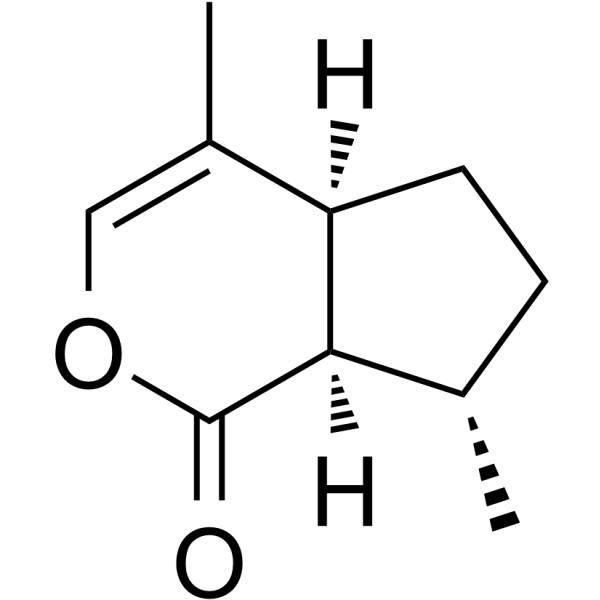
4aα,7α,7aα-Nepetalactone
Based on 1 publication(s) in Google Scholar
4aα,7α,7aα-Nepetalactone is an iridoid compound, a TRPA1 agonist, a repellent, and an attractant. 4aα,7α,7aα-Nepetalactone can be isolated from the oil of N. crispa. 4aα,7α,7aα-Nepetalactone induces repellent responses in three sap-sucking pests (Chinese psyllid, Asian citrus psyllid, and western flower thrips) via PKCα. Nepetalactone attracts two predatory lady beetles (Harmonia axyridis and Propylea japonica) through CaMKII. 4aα,7α,7aα-Nepetalactone causes mortality in Pogonomyrmex sp. ants. 4aα,7α,7aα-Nepetalactone can be used in studies related to bacterial infections and mandibulate pest infestations.
For research use only. We do not sell to patients.
- Purity : 99.56%
- CAS No.: 21651-62-7
- Formula: C10H14O2
- Molecular Weight:166.22
-
Storage:
4°C, protect from light, stored under nitrogen
* In solvent : -80°C, 6 months; -20°C, 1 month (protect from light, stored under nitrogen)

To place orders, for customer services and technical support, please contact: MedChemExpress USA
Tel: 609-228-6898 E-mail: [email protected] [email protected]


-
 Biological Activity
-
Chemical Information
-
Solvent & Solubility
- Purity & Documentation
- References
-
 Help & FAQs


Publications Citing Use of MedChemExpress (MCE) 4aα,7α,7aα-Nepetalactone
More

Biological Activity
Description
IC50 & Target
[2]|
PKCα |
CaMK II |
In Vitro
4aα,7α,7aα-Nepetalactone (100 μM; dose-response range) activates CcTRPA1, DcTRPA1, and MuTRPA1 in HEK293T cells with EC50 values of 283.0 μM, 698.4 μM, and 172.5 μM, respectively, via interaction with a conserved CVT binding motif[2].
4aα,7α,7aα-Nepetalactone (100 μM; 10 min) induces a calcium-dependent physical interaction and phosphorylation of CcPKCα by CcTRPA1 in HEK293T cells, mediating downstream repellent signaling in Cacopsylla chinensis[2].
4aα,7α,7aα-Nepetalactone (100 μM; 10 min) induces a calcium-dependent physical interaction and phosphorylation of HaCaMKII by HaTRPA1 in HEK293T cells, mediating downstream attraction signaling in Harmonia axyridis[2].
MedChemExpress (MCE) has not independently confirmed the accuracy of these methods. They are for reference only. .
-
Cell Line:HEK293T cells co-transfected with CcTRPA1 and CcPKCα (Cacopsylla chinensis orthologs)
-
Concentration:100 μM
-
Incubation Time:10 min
-
Result:Confirmed a nepetalactone-dependent physical interaction between CcTRPA1 and CcPKCα.
Induced rapid phosphorylation of CcPKCα, which was abolished by the calcium chelator EGTA.
-
Cell Line:HEK293T cells co-transfected with HaTRPA1 and HaCaMKII (Harmonia axyridis orthologs)
-
Concentration:100 μM
-
Incubation Time:10 min
-
Result:Confirmed a nepetalactone-dependent physical interaction between HaTRPA1 and HaCaMKII.
Induced rapid phosphorylation of HaCaMKII, which was abolished by the calcium chelator EGTA.
In Vivo
4aα,7α,7aα-Nepetalactone (0.5 µg; topical application to ant body; single dose) induces a 33.3% mortality rate in Pogonomyrmex sp. ants by 12 hours, with no additional mortality observed up to 144 hours in a body diffusion bioassay[3].
MedChemExpress (MCE) has not independently confirmed the accuracy of these methods. They are for reference only.
-
Animal Model:Pogonomyrmex sp. ants[3]
-
Dosage:0.1 mg
-
Administration:topical application to feeding substrate; single dose
-
Result:Recorded 0/12 mortality at 12 hours.
Recorded 0/12 mortality at 24 hours.
Recorded 2/12 mortality at 48 hours.
Recorded 8/12 (66.7%) mortality at 72 hours.
-
Animal Model:Pogonomyrmex sp. ants[3]
-
Dosage:0.5 µg
-
Administration:topical application to ant body; single dose
-
Result:Recorded 4/12 (33.3%) mortality at 12 hours.
Recorded 4/12 (33.3%) mortality at 48 hours.
Recorded 4/12 (33.3%) mortality at 96 hours.
Recorded 4/12 (33.3%) mortality at 144 hours.


Chemical Information
-
CAS No. 21651-62-7
-
Appearance Liquid (Density: 1.042 g/cm3)
-
Molecular Weight 166.22
-
Formula C10H14O2
-
Color Colorless to light yellow
-
SMILES
CC([C@]1([H])[C@@]2([H])[C@H](CC1)C)=COC2=O
-
Structure Classification
-
Initial Source
-
Shipping
Room temperature in continental US; may vary elsewhere.
-
Storage
4°C, protect from light, stored under nitrogen
* In solvent : -80°C, 6 months; -20°C, 1 month (protect from light, stored under nitrogen)


Publications (1)
-
Journal Impact Factor
-
Most Recent
-
J Adv Res
TRPA1-kinase axis polarization: Nepetalactone drives pest repulsion and predator attraction via divergent PKC/CaMKII signaling. [Abstract]2025 Jul 17:S2090-1232(25)00555-7. PMID: 40683383


Solvent & Solubility
In Vitro:
DMSO : 100 mg/mL (601.61 mM; Need ultrasonic; Hygroscopic DMSO has a significant impact on the solubility of product, please use newly opened DMSO)
Please refer to the solubility information to select the appropriate solvent. Once prepared, please aliquot and store the solution to prevent product inactivation from repeated freeze-thaw cycles.
Storage method and period of stock solution: -80°C, 6 months; -20°C, 1 month (protect from light, stored under nitrogen). When stored at -80°C, please use it within 6 months. When stored at -20°C, please use it within 1 month.
Please refer to the solubility information to select the appropriate solvent. Once prepared, please aliquot and store the solution to prevent product inactivation from repeated freeze-thaw cycles.
Storage method and period of stock solution: -80°C, 6 months; -20°C, 1 month (protect from light, stored under nitrogen). When stored at -80°C, please use it within 6 months. When stored at -20°C, please use it within 1 month.
Concentration (start) × Volume (start) = Concentration (final) × Volume (final)
In Vivo:
Select the appropriate dissolution method based on your experimental animal and administration route.
- For the following dissolution methods, please ensure to first prepare a clear stock solution using an In Vitro approach and then sequentially add co-solvents:
- To ensure reliable experimental results, the clarified stock solution can be appropriately stored based on storage conditions. As for the working solution for In Vivo experiments, it is recommended to prepare freshly and use it on the same day.
- The percentages shown for the solvents indicate their volumetric ratio in the final prepared solution. If precipitation or phase separation occurs during preparation, heat and/or sonication can be used to aid dissolution.
Add each solvent one by one: 10% DMSO 40% PEG300 5% Tween-80 45% Saline
Solubility: ≥ 2.5 mg/mL (15.04 mM); Clear solution
This protocol yields a clear solution of ≥ 2.5 mg/mL (saturation unknown).
Taking 1 mL working solution as an example, add 100 μL DMSO stock solution (25.0 mg/mL) to 400 μL PEG300, and mix evenly; then add 50 μL Tween-80 and mix evenly; then add 450 μL Saline to adjust the volume to 1 mL.
Preparation of Saline: Dissolve 0.9 g sodium chloride in ddH₂O and dilute to 100 mL to obtain a clear Saline solution.
Add each solvent one by one: 10% DMSO 90% (20% SBE-β-CD in Saline)
Solubility: ≥ 2.5 mg/mL (15.04 mM); Clear solution
This protocol yields a clear solution of ≥ 2.5 mg/mL (saturation unknown).
Taking 1 mL working solution as an example, add 100 μL DMSO stock solution (25.0 mg/mL) to 900 μL 20% SBE-β-CD in Saline, and mix evenly.
Preparation of 20% SBE-β-CD in Saline (4°C, storage for one week): 2 g SBE-β-CD powder is dissolved in 10 mL Saline, completely dissolve until clear.
In Vivo Dissolution Calculator
Please enter the basic information of animal experiments:
-
-
-
-
Recommended: Prepare an additional quantity of animals to account for potential losses during experiments.
Please enter your animal formula composition:
-
%DMSO +
Recommended: Keep the proportion of DMSO in working solution below 2% if your animal is weak.
-
%+
-
+%Tween-80 + +
-
%Saline +
The co-solvents required include: DMSO, . All of co-solvents are available by MedChemExpress (MCE). , Tween 80. All of co-solvents are available by MedChemExpress (MCE).
Working solution concentration: 0.22 mg/mL
Method for preparing stock solution: mg drug dissolved in μL DMSO. Stock solution concentration: mg/mL. * In solvent : -80°C, 6 months; -20°C, 1 month (protect from light, stored under nitrogen)
1. Take μL DMSO stock solution;
2. Add μL .
μL , mix evenly;
3. Then add μL Tween 80, mix evenly;
4. Then add μL
Please ensure that the stock solution in the first step is dissolved to a clear state, and add co-solvents in sequence. You can use ultrasonic heating (ultrasonic cleaner, recommended frequency 20-40 kHz), vortexing, etc. to assist dissolution.


Purity & Documentation
-
Data Sheet (299 KB)
-
SDS (252 KB)
- English - EN (252 KB)
- Français - FR (252 KB)
- Deutsch - DE (252 KB)
- Norwegian - NO (252 KB)
- Español - ES (252 KB)
- Swedish - SV (252 KB)
- Italian - IT (252 KB)
- Korean - KR (252 KB)
- Portuguese - PT (252 KB)
-
Handling Instructions (2659 KB)
References
[1]. Shafaghat A, et al. Nepetalactone content and antibacterial activity of the essential oils from different parts of Nepeta persica. Natural product communications. 2010 Apr;5(4):625-8. [Content Brief]
[2]. Li J, et al. TRPA1-kinase axis polarization: Nepetalactone drives pest repulsion and predator attraction via divergent PKC/CaMKII signaling. Journal of advanced research. 2026 Apr;82:141-153. [Content Brief]
[3]. Gkinis G, et al. Chemical composition and biological activity of Nepeta parnassica oils and isolated nepetalactones. Zeitschrift fur Naturforschung. C, Journal of biosciences. 2003;58(9-10):681-6. [Content Brief]


Complete Stock Solution Preparation Table
Please refer to the solubility information to select the appropriate solvent. Once prepared, please aliquot and store the solution to prevent product inactivation from repeated freeze-thaw cycles.
Storage method and period of stock solution: -80°C, 6 months; -20°C, 1 month (protect from light, stored under nitrogen). When stored at -80°C, please use it within 6 months. When stored at -20°C, please use it within 1 month.
| Optional Solvent | Concentration Solvent Mass | 1 mg | 5 mg | 10 mg | 25 mg |
|---|---|---|---|---|---|
| DMSO | 1 mM | 6.0161 mL | 30.0806 mL | 60.1612 mL | 150.4031 mL |
| 5 mM | 1.2032 mL | 6.0161 mL | 12.0322 mL | 30.0806 mL | |
| 10 mM | 0.6016 mL | 3.0081 mL | 6.0161 mL | 15.0403 mL | |
| 15 mM | 0.4011 mL | 2.0054 mL | 4.0107 mL | 10.0269 mL | |
| 20 mM | 0.3008 mL | 1.5040 mL | 3.0081 mL | 7.5202 mL | |
| 25 mM | 0.2406 mL | 1.2032 mL | 2.4064 mL | 6.0161 mL | |
| 30 mM | 0.2005 mL | 1.0027 mL | 2.0054 mL | 5.0134 mL | |
| 40 mM | 0.1504 mL | 0.7520 mL | 1.5040 mL | 3.7601 mL | |
| 50 mM | 0.1203 mL | 0.6016 mL | 1.2032 mL | 3.0081 mL | |
| 60 mM | 0.1003 mL | 0.5013 mL | 1.0027 mL | 2.5067 mL | |
| 80 mM | 0.0752 mL | 0.3760 mL | 0.7520 mL | 1.8800 mL | |
| 100 mM | 0.0602 mL | 0.3008 mL | 0.6016 mL | 1.5040 mL |


4aα,7α,7aα-Nepetalactone Related Classifications
HY-129434A Related Classifications
 Powered by Bioz