18 Results for "

biotransformation product

" in MedChemExpress (MCE) Product Catalog:
Products (18)

18 Results for "biotransformation product" in MCE Product Catalog:

Cat. No.: HY-W015590
CAS No.: 614-75-5
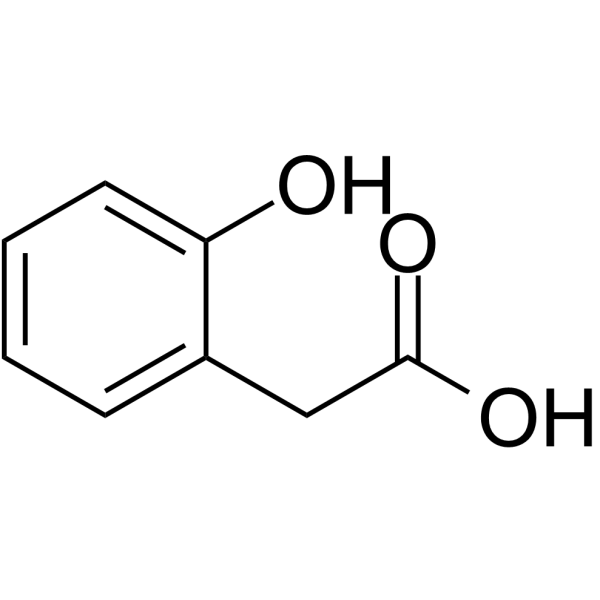
2-Hydroxyphenylacetic acid is a metabolite of Phenylalanine and Tyrosine, as well as a product of the biotransformation of Phenylacetonitrile by marine fungi. 2-Hydroxyphenylacetic acid acts as a potential biomarker for food. 2-Hydroxyphenylacetic acid slightly induces the expression of green fluorescent protein. 2-Hydroxyphenylacetic acid is used in the research of phenylketonuria and related hyperphenylalaninemia .
loading...
    loading...
Cat. No.: HY-W102516
CAS No.: 1162-56-7
Synonyms: Δ6-Progesterone
6-Dehydroprogesterone (Δ6-Progesterone) is a steroid compound that can be found in Botryodiplodia theobromae. 6-Dehydroprogesterone is a metabolic product of Progesterone (HY-N0437) after a microbial dehydrogenation reaction. 6-Dehydroprogesterone can be used to study steroid metabolism pathways, microbial dehydrogenase activity, and the biotransformation of steroids .
loading...
    loading...
Cat. No.: HY-N12033
CAS No.: 93780-84-8
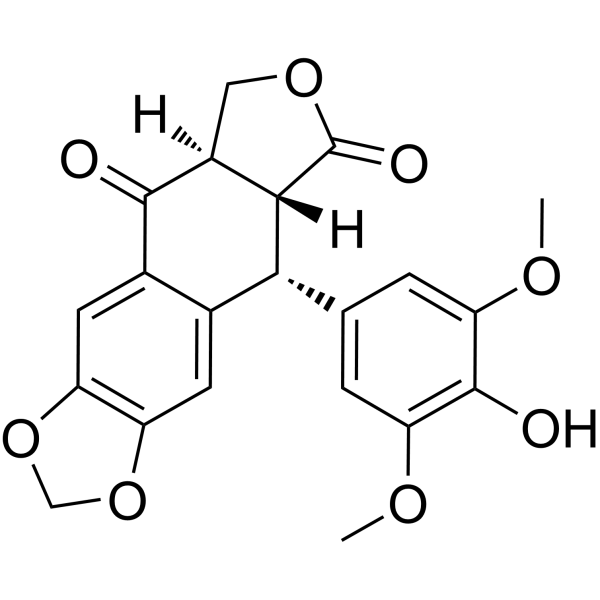
4'-Demethylpodophyllotoxone is an intermediate product of the biotransformation of Alternaria alternata S-f6. After 4'-Demethylpodophyllotoxone is modified with 4-(2,3,5,6-tetramethylpyrazine-1) (4-TMP), the resulting novel compound can strongly inhibit the growth of human gastric cancer cell line (BGC-823) .
loading...
    loading...
Cat. No.: HY-N8911
CAS No.: 121927-96-6
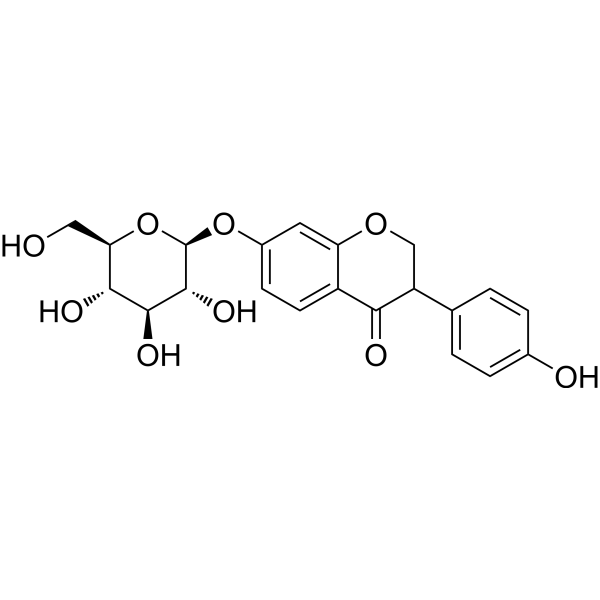
Dihydrodaidzin is an isoflavanone that can be isolated from Soybeans. Dihydrodaidzin is also a product of biotransformation by human intestinal bacteria .
loading...
    loading...
Cat. No.: HY-176935
CAS No.: 1141717-56-7
Research Areas:  

Others

BTP 414 is a biotransformation product. BTP 414 is probably formed from QUT sulfoxide (PTP2 400) .
loading...
    loading...
Cat. No.: HY-10275A
CAS No.: 433937-75-8
Synonyms: AR-H067637 TFA
Target:  

Thrombin

Research Areas:  

Cardiovascular Disease

Atecegatran TFA (AR-H067637 TFA) is an anticoagulant with selective direct thrombin inhibitory activity. Atecegatran TFA is commonly used to inhibit cardiovascular diseases. The biotransformation product of Atecegatran TFA, AR-H067637, is its active form and participates in the anticoagulation process .
loading...
    loading...
Cat. No.: HY-W015590R
CAS No.: 614-75-5
2-Hydroxyphenylacetic acid (Standard) is an analytical standard for 2-Hydroxyphenylacetic acid (HY-W015590). This product is intended for research and analytical applications. 2-Hydroxyphenylacetic acid is a metabolite of Phenylalanine and Tyrosine, and is also a product of the biotransformation of Phenylacetonitrile by marine fungi. 2-Hydroxyphenylacetic acid can be used as a potential biomarker for food. 2-Hydroxyphenylacetic acid can be used in the study of phenylketonuria and related hyperphenylalaninemias .
loading...
    loading...
Cat. No.: HY-106405R
CAS No.: 274925-86-9
Synonyms: BIA 3-202 (Standard)
Research Areas:  

Metabolic Disease

Nebicapone (Standard) is the analytical standard of Nebicapone. This product is intended for research and analytical applications. Nebicapone (BIA 3-202), a reversible catechol-O-methyltransferase (COMT) inhibitor, is mainly metabolized by glucuronidation. Nebicapone is mainly peripherally acting inhibitor that decreases the biotransformation of L-DOPA to 3-O-methyl-DOPA by inhibition of COMT, and it is potential for the treatment of Parkinson's disease .
loading...
    loading...
Cat. No.: HY-W153897R
CAS No.: 370-98-9
N-Methyltyramine (Standard) is the analytical standard of N-Methyltyramine (HY-W153897). This product is intended for research and analytical applications. N-Methyltyramine is an orally active α2-adrenoreceptor antagonist with an IC50 value of 5.53 μM against rat targets. N-Methyltyramine blocks α2-adrenoreceptors, while inhibiting lipolysis, hyperactivity responses and small intestinal peristalsis in mice. N-Methyltyramine promotes gastrin release and pancreatic juice secretion, upregulates appetite, blood pressure, myocardial contraction frequency and contraction intensity, and increases renal blood flow, renal vascular resistance and mean peripheral arterial resistance. N-Methyltyramine relaxes mouse small intestinal smooth muscle and undergoes biotransformation in vivo to produce adrenaline. N-Methyltyramine can be used in studies related to gastrointestinal diseases .
loading...
    loading...
Cat. No.: HY-118699
CAS No.: 59108-90-6
Target:  

Fungal

Research Areas:  

Infection

Indole-3-thio carboxamide is an antifungal agent. Indole-3-thio carboxamide is a biotransformation product of Camalexin (HY-119502) by plant pathogenic fungi Botrytis cinerea .
loading...
    loading...
Cat. No.: HY-N19842
CAS No.: 497-73-4
Neomethymycin (Compound5) is a 12-membered ring macrolide natural product. Neomethymycin can be found in engineered Streptomyces venezuelae ATCC 15439 strain DHS2001, where it forms via biotransformation of 10-deoxymethyonolide .
loading...
    loading...
Cat. No.: HY-N17509
CAS No.: 14605-16-4
3β-Hydroxy-oleana-11,13 (18)-dien-28-oic acid (compound 3) is a triterpenoid compound present in Paeonia japonica and peony calli. 3β-Hydroxy-oleana-11,13 (18)-dien-28-oic acid is also a biotransformation product of oleanolic acid .
loading...
    loading...
Cat. No.: HY-N21536
CAS No.: 90686-13-8
Synonyms: 2'-Hydroxylupalbigenin
Angustone A (2'-Hydroxylupalbigenin) is a diisoprenylated isoflavone with insect feeding inhibitory activity and moderate antifungal activity. Angustone A can be converted into various phenolic metabolites by Aspergillus flavus through modification of the isoprenyl side chains at the C-6 and C-3' positions. Angustone A can be used in studies on antifungal properties of natural products, insect feeding behavior, fungal biotransformation, and anticancer activity .
loading...
    loading...
Cat. No.: HY-N16838
CAS No.: 863329-67-3
cis-Oxyresveratrol-4'-O-glucoside (compound 2a) is a β-D-glucoside derivative of oxyresveratrol, whose parent compound possesses potential anti-inflammatory, antioxidant, free radical scavenging, and tyrosinase inhibitory activities, and can be used in anti-inflammatory, antioxidant, and whitening-related research. cis-Oxyresveratrol-4'-O-glucoside is a product obtained by the biotransformation of oxyresveratrol using cell suspension cultures of Solanum mammosum (a plant of the genus Solanum in the Solanaceae family) .
loading...
    loading...
Cat. No.: HY-134058
CAS No.: 589-82-2
Research Areas:  

Others

3-Heptanol is a biotransformation product of n-heptane. 3-Heptanol can act as the building block in the synthesis of 4-(3-adamantan-1-yl-ureido)-butyric acid and cyclohexanecarboxylic acid derivatives as sEH inhibitors. 3-Heptanol can be used as a solvent to form microenvironments around single-walled carbon nanotubes. 3-Heptanol can be used in the preperation of substituted pyrimidine derivatives as C1 domain-targeted isophthalate analogs to study their binding affinities towards PKCα isoform .
loading...
    loading...
Cat. No.: HY-134058S
Synonyms: Butylethylcarbinol-d4
3-Heptanol-d4 (Butylethylcarbinol-d4) is the deuterium labeled 3-Heptanol (HY-134058). 3-Heptanol is a biotransformation product of n-heptane. 3-Heptanol can act as the building block in the synthesis of 4-(3-adamantan-1-yl-ureido)-butyric acid and cyclohexanecarboxylic acid derivatives as sEH inhibitors. 3-Heptanol can be used as a solvent to form microenvironments around single-walled carbon nanotubes. 3-Heptanol can be used in the preperation of substituted pyrimidine derivatives as C1 domain-targeted isophthalate analogs to study their binding affinities towards PKCα isoform .
loading...
    loading...
Cat. No.: HY-131116R
CAS No.: 3572-64-3
Dihydrojasmonic acid (Standard) is the analytical standard of Dihydrojasmonic acid (HY-131116). This product is intended for research and analytical applications. Dihydrojasmonic acid is a pentacyclic oxygen-containing lipid plant growth regulator related to Jasmonic acid (HY-122464), with activities including growth inhibition, promotion of leaf senescence, and induction of the accumulation of some plant secondary metabolites . Dihydrojasmonic acid serves as a substrate for metabolic modification and undergoes biotransformation via side-chain hydroxylation, glycosylation, and amino acid conjugation in the aerial parts and seedlings of barley (Hordeum vulgare). Dihydrojasmonic acid inhibits the growth of dwarf rice seedlings and can induce the synthesis of secondary metabolites in some plant cell culture species, with its activity being species-dependent. Dihydrojasmonic acid is involved in studies related to the regulation of plant growth and development .
loading...
    loading...
Cat. No.: HY-W153159R
CAS No.: 13062-76-5
N-Methyltyramine (hydrochloride) (Standard) is the analytical standard of N-Methyltyramine (hydrochloride) (HY-W153159). This product is intended for research and analytical applications. N-Methyltyramine hydrochloride is an orally active α2-adrenoreceptor antagonist with an IC50 value of 5.53 μM against rat targets. N-Methyltyramine hydrochloride blocks α2-adrenoreceptors, while inhibiting lipolysis, hyperactivity responses and small intestinal peristalsis in mice. N-Methyltyramine hydrochloride promotes gastrin release and pancreatic juice secretion, upregulates appetite, blood pressure, myocardial contraction frequency and contraction intensity, and increases renal blood flow, renal vascular resistance and mean peripheral arterial resistance. N-Methyltyramine hydrochloride relaxes mouse small intestinal smooth muscle and undergoes biotransformation in vivo to produce adrenaline. N-Methyltyramine hydrochloride can be used in studies related to gastrointestinal diseases .
loading...
    loading...
  • 1

