13 Results for "

cell-wall peptidoglycan biosynthesis

" in MedChemExpress (MCE) Product Catalog:
Products (13)

13 Results for "cell-wall peptidoglycan biosynthesis" in MCE Product Catalog:

8
8 Cited Publications
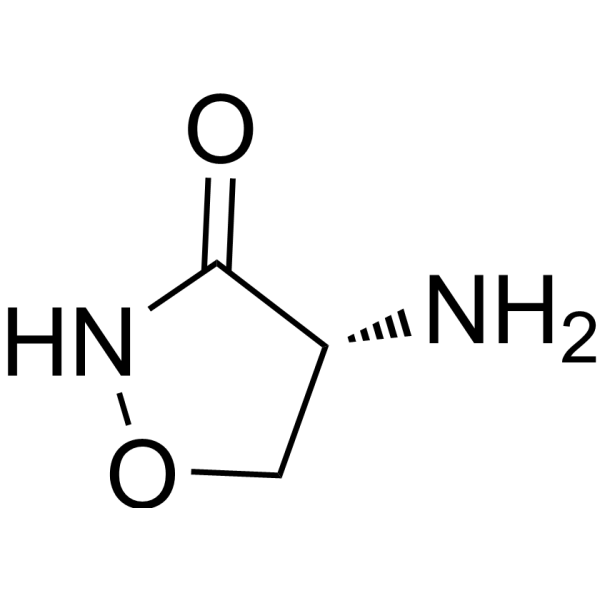
Cat. No.: HY-B0030
CAS No.: 68-41-7
D-Cycloserine is an antibiotic which targets sequential bacterial cell wall peptidoglycan biosynthesis enzymes, with blood-brain barrier permeability. D-Cycloserine is a partial NMDA agonist that can improve cognitive functions. D-Cycloserine can be used for multidrug-resistant tuberculosis research .
loading...
    loading...
Cat. No.: HY-138053
CAS No.: 92989-99-6
Synonyms: Ristomycin III
Target:  

Antibiotic

Research Areas:  

Cardiovascular Disease Infection

Ristocetin A (sulfate) (Ristomycin III) is a glycopeptide antibiotic that binds to von Willebrand factor (VWF) and bacterial cell wall components. Ristocetin A (sulfate) interferes with the biosynthesis of bacterial peptidoglycan by inhibiting transpeptidation. As an inducer of platelet adhesion and aggregation, Ristocetin A (sulfate) drives conformational changes by binding to the A1 domain of VWF, thereby activating downstream signaling pathways and promoting cytoskeletal rearrangement. Ristocetin A (sulfate) not only enhances platelet adhesion and spreading on immobilized VWF, but also induces the formation of asymmetric dimers with anticooperativity between platelets and plasma VWF. Ristocetin A (sulfate) is widely used in studies related to thromboembolic diseases and bacterial infections .
loading...
    loading...
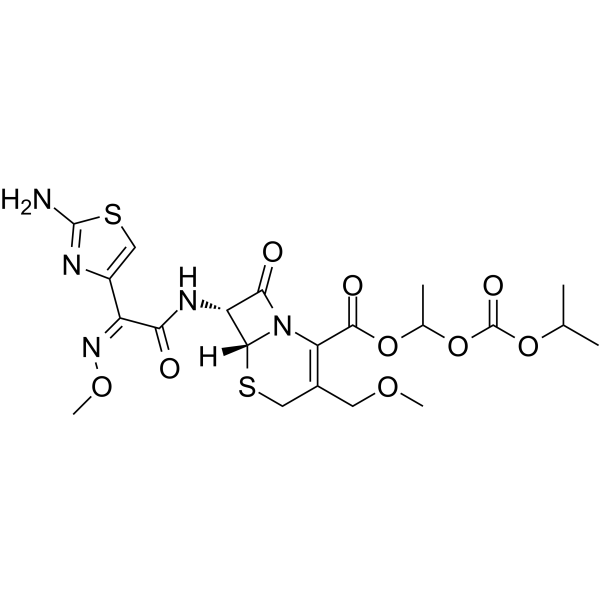
Cat. No.: HY-N7101
CAS No.: 87239-81-4
Synonyms: U-76,252; CS-807
Cefpodoxime Proxetil is an orally active broad spectrum third-generation cephalosporin with potent antibacterial activity against both Gram-positive and Gram-negative bacteria including staphylococci, streptococci, Haemophilus influenzae, Neisseria gonorrhoeae, Escherichia coli, Klebsiella pnuemoniae, Citrobacter spp, and Proteus spp. Cefpodoxime Proxetil binds to penicillin binding proteins (PBPs), which inhibits peptidoglycan synthesis, finally results in interfering bacterial cell wall biosynthesis. Cefpodoxime Proxetil can be used against skin structure infections, acute otitis media, pharyngitis, tonsillitis, upper respiratory tract infection, urinary tract infections and sexually transmitted diseases .
loading...
    loading...
Cat. No.: HY-W587753
CAS No.: 22601-59-8
Research Areas:  

Infection

Bacitracin A is an antibiotic with antibacterial activity against Gram-positive bacteria. Bacitracin A forms a ternary complex with divalent metal ions and C55-isopentenyl pyrophosphate, thereby inhibiting peptidoglycan biosynthesis and cell wall synthesis. Bacitracin A induces the formation of protoplasts and L-form bacteria, alters membrane permeability, regulates metal ion transport, inhibits in vitro enzyme biosynthesis, disrupts the cytoplasmic membrane and exerts bactericidal activity. Bacitracin A can be used in studies related to bacterial infections, fungal infections and amoebic infections .
loading...
    loading...
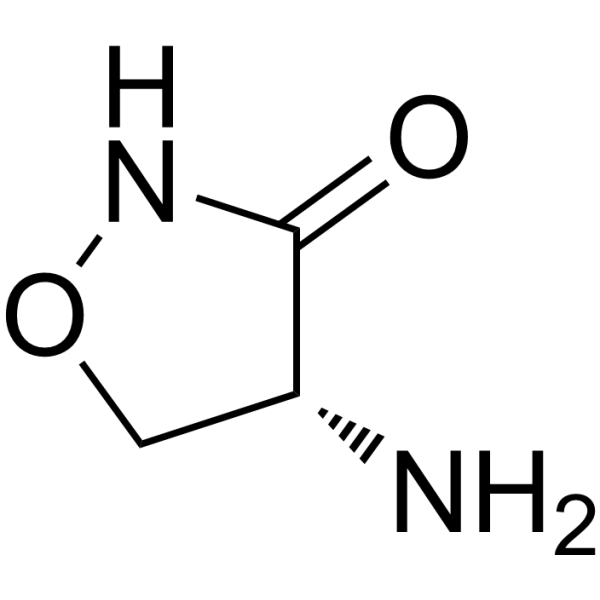
Cat. No.: HY-B0030R
CAS No.: 68-41-7
D-Cycloserine (Standard) is the analytical standard of D-Cycloserine. This product is intended for research and analytical applications. D-Cycloserine is an antibiotic which targets sequential bacterial cell wall peptidoglycan biosynthesis enzymes. D-Cycloserine is a partial NMDA agonist that can improve cognitive functions. D-Cycloserine can be used for multidrug-resistant tuberculosis research .
loading...
    loading...
Cat. No.: HY-N7101S1
Synonyms: U-76,252-d6; CS-807-d6
Cefpodoxime Proxetil-d6 (U-76,252-d6) is deuterium labeled Cefpodoxime Proxetil. Cefpodoxime proxetil is an orally administered broad spectrum third-generation cephalosporin. Cefpodoxime proxetil has anti-bacterial activity. Cefpodoxime proxetil binds to penicillin binding proteins (PBPs) which inhibits peptidoglycan synthesis, finally results in interfering bacterial cell wall biosynthesis .
loading...
    loading...
Cat. No.: HY-N7101R
CAS No.: 87239-81-4
Synonyms: U-76,252 (Standard); CS-807 (Standard)
Cefpodoxime Proxetil (Standard) is the analytical standard of Cefpodoxime Proxetil. This product is intended for research and analytical applications. Cefpodoxime Proxetil is an orally active broad spectrum third-generation cephalosporin with potent antibacterial activity against both Gram-positive and Gram-negative bacteria including staphylococci, streptococci, Haemophilus influenzae, Neisseria gonorrhoeae, Escherichia coli, Klebsiella pnuemoniae, Citrobacter spp, and Proteus spp. Cefpodoxime Proxetil binds to penicillin binding proteins (PBPs), which inhibits peptidoglycan synthesis, finally results in interfering bacterial cell wall biosynthesis. Cefpodoxime Proxetil can be used against skin structure infections, acute otitis media, pharyngitis, tonsillitis, upper respiratory tract infection, urinary tract infections and sexually transmitted diseases .
loading...
    loading...
Cat. No.: HY-N7101S
Synonyms: U-76-d7,252-d7; CS-807-d7
Cefpodoxime proxetil-d7 (U-76-d7,252-d7; CS-807-d7) is the deuterium labeled Cefpodoxime Proxetil (HY-N7101). Cefpodoxime Proxetil is an orally active broad spectrum third-generation cephalosporin with potent antibacterial activity against both Gram-positive and Gram-negative bacteria including staphylococci, streptococci, Haemophilus influenzae, Neisseria gonorrhoeae, Escherichia coli, Klebsiella pnuemoniae, Citrobacter spp, and Proteus spp. Cefpodoxime Proxetil binds to penicillin binding proteins (PBPs), which inhibits peptidoglycan synthesis, finally results in interfering bacterial cell wall biosynthesis. Cefpodoxime Proxetil can be used against skin structure infections, acute otitis media, pharyngitis, tonsillitis, upper respiratory tract infection, urinary tract infections and sexually transmitted diseases .
loading...
    loading...
Cat. No.: HY-D3390
sCy5DA is a is a fluorescent D-amino acid . sCy5DA incorporates into bacterial peptidoglycan layers and cross-links via transpeptidase action, replacing peptidoglycan stem peptide D-amino acids. sCy5DA labels live bacterial cell walls, nascent peptidoglycan biosynthesis sites, and diverse bacterial species including Gram-negative, Gram-positive, and mycobacteria (Ex/Em = 646/665 nm) .
loading...
    loading...
Cat. No.: HY-N21881
CAS No.: 695226-94-9
Muraminomicin F is a lipopeptide nucleoside antibiotic and MraY inhibitor (IC50 = 8.9 ng/mL). Muraminomicin F exerts antibacterial effects by inhibiting MraY, an essential key enzyme in bacterial cell wall peptidoglycan biosynthesis. Muraminomicin F can be used in research on bacterial infections .
loading...
    loading...
Cat. No.: HY-D3389
sCy5DL-amide is an amidated fluorescent D-amino acid conjugated to Sulfo-Cyanine 5, and a peptidoglycan labeling agent. sCy5DL-amide incorporates into bacterial peptidoglycan cell wall via transpeptidase-mediated reactions, replacing the fourth or fifth D-amino acid of the peptidoglycan stem peptide for visualization of nascent peptidoglycan biosynthesis. sCy5DL-amide produces clear cell outline, septum labeling, and high localization density in Bacillus subtilis, including a 'V-shape' pattern at cell-cell contact areas. sCy5DL-amide exhibits robust incorporation into Gram-positive bacteria and mycobacteria, with reduced incorporation into Gram-negative bacteria (Ex/Em = 646/666 nm) .
loading...
    loading...
Cat. No.: HY-D1737
RADA is a fluorescent D-amino acid (FDAA) with high photostability and thermostability, which emits yellow-to-orange fluorescence. RADA shows low outer membrane permeability in wild-type Gram-negative Escherichia coli, but it targets penicillin-binding proteins and L,D-transpeptidases, mimics the interaction between acyl acceptors and enzyme intermediates, and integrates into peptidoglycan during biosynthesis. As a peptidoglycan labeling reagent, RADA metabolically integrates into the nascent peptidoglycan of live bacterial cells, labels the peptidoglycan at the poles and lateral walls of mycobacteria, and enables visualization of peptidoglycan synthesis and remodeling processes. RADA serves as a non-specific stain for fixed cells, is non-toxic to bacterial cells, and its red-shifted excitation/emission spectra reduce phototoxicity. RADA also supports virtual pulse-chase labeling experiments and stochastic optical reconstruction microscopy for sub-diffraction-limited imaging of bacterial cell walls .
loading...
    loading...
Cat. No.: HY-N21929
CAS No.: 136660-70-3
Target:  

Bacterial

Plusbacin A3 is a cyclic lipodepsipeptide isolated from Pseudomonas sp. PB-6250 that inhibits bacterial cell wall biosynthesis and disrupts membrane integrity. Plusbacin A3 binds lipid intermediates, blocking transglycosylation and lipid intermediate formation in peptidoglycan synthesis. Plusbacin A3 inhibits teichoic acid biosynthesis. Plusbacin A3 exhibits activity against Gram-positive bacteria, including methicillin-resistant Staphylococcus aureus and vancomycin-resistant Enterococci, with low susceptibility to resistance, and is inactive against Gram-negative bacteria. Plusbacin A3 can be used in research on bacterial infections .
loading...
    loading...
  • 1

