17 Results for "

electroshock

" in MedChemExpress (MCE) Product Catalog:
Products (17)

17 Results for "electroshock" in MCE Product Catalog:

Cat. No.: HY-172431
CAS No.: 2376397-93-0
Synonyms: BHV-7000
Target:  

Potassium Channel

Research Areas:  

Neurological Disease

Opakalim (BHV-7000) is a selective Kv7.2/7.3 potassium channels activator with an EC50 of 0.6 μM. Opakalim shows minimal GABAA receptor activation and exhibits potent anti-seizure efficacy in the maximal electroshock seizure (MES) model. Opakalim can be used for the study of seizures .
loading...
    loading...
Cat. No.: HY-168773
CAS No.: 2506367-95-7
Target:  

EAAT

Research Areas:  

Neurological Disease

(R)-AS-1 is a selective positive allosteric modulator of the excitatory amino acid transporter 2 (EAAT2), with an EC50 of 11 nM. (R)-AS-1 (at doses of 60 and 90 mg/kg) increases spontaneous locomotor activity in mice. Additionally, it demonstrates anticonvulsant activity in mouse models of seizures induced by maximal electroshock (MES), pentylenetetrazole (PTZ), or electrical stimuli (32 or 44 mA), with ED50s of 66.3, 36.3, 15.6, and 41.6 mg/kg, respectively. (R)-AS-1 can be used in neurological disease research .
loading...
    loading...
Cat. No.: HY-123671
CAS No.: 1308833-36-4
Purity:  96.01%
Research Areas:  

Neurological Disease

CYM2503 is a putative GalR2-positive allosteric modulator. CYM2503 increases the latency to first electrographic seizure and decreases the total time in seizure. CYM2503 also attenuates electroshock-induced seizures in mice. Galanin receptors type 1 (GalR1) and/or type 2 (GalR2) represent unique pharmacological targets for the research of seizures and epilepsy .
loading...
    loading...
Cat. No.: HY-W012481
CAS No.: 631-07-2
Synonyms: Ethylphenylhydantoin; Phenylethyihydantoin; Desmethylmephenytoin
Target:  

Drug Metabolite

Research Areas:  

Neurological Disease

Nirvanol (Ethylphenylhydantoin) is a metabolite of Mephenytoin (HY-B1184) that exerts anticonvulsant effects in the maximal electroshock (M.E.S.) seizure model in mice. Nirvanol shows potential for research in epilepsy-related neurological disorders .
loading...
    loading...
Cat. No.: HY-W127668
CAS No.: 5957-17-5
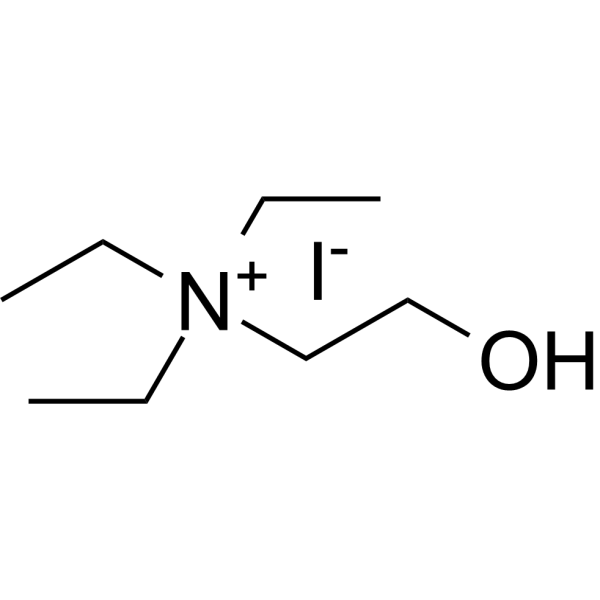
Triethylcholine iodide is a choline acetyltransferase inhibitor and a regulator of the acetylcholine synthesis pathway. Triethylcholine iodide inhibits acetylcholine synthesis in brain tissues and blocks neuromuscular and autonomic ganglionic transmission. Triethylcholine iodide exerts weak curare-like effects at extremely high concentrations. Triethylcholine iodide elevates the pentylenetetrazol seizure threshold, alters electroencephalogram patterns in Felis catus, but does not affect the maximal electroshock seizure threshold in Oryctolagus cuniculus. Triethylcholine iodide can be used in seizure-related research .
loading...
    loading...
Cat. No.: HY-W681659
CAS No.: 25967-29-7
Synonyms: KB-509
Target:  

GABA Receptor

Research Areas:  

Neurological Disease

Flutoprazepam (KB-509), a benzodiazepine drug, possesses anticonflict effect. Flutoprazepam (KB-509) prevents maximal electroshock, pentetrazol, and strychnine-induced convulsions in mice .
loading...
    loading...
Cat. No.: HY-W097106
CAS No.: 60846-91-5
Target:  

Drug Isomer

Research Areas:  

Neurological Disease

(S)-3-N-Cbz-Amino-succinimide (Compound 1d) is an antiepileptic agent that can inhibit pentylenetetrazole (PTZ) and maximal electroshock (MES)-induced tonic convulsions in mice .
loading...
    loading...
Cat. No.: HY-106424
CAS No.: 130403-08-6
Target:  

Drug Intermediate

Research Areas:  

Neurological Disease

Soretolide is an antiepileptic agent. Soretolide is effective in maximal electroshock-induced seizure (MES) test in rodents. Soretolide inhibits metabolism of Phenytoin (HY-B0448). Soretolide exhibits a good pharmacokinetic character in rats model .
loading...
    loading...
Cat. No.: HY-170833
Target:  

GABA Receptor

Research Areas:  

Neurological Disease

Anticonvulsant agent 8 (compound D4) is an anticonvulsant agent that inhibits GABAA currents with ED50 values of 2.23 and 24.60 mg/kg in the maximum electroshock (MES) and pentylenetetrazol (PTZ) tests in mouse models, respectively .
loading...
    loading...
Cat. No.: HY-W012481R
CAS No.: 631-07-2
Synonyms: Ethylphenylhydantoin (Standard); Phenylethyihydantoin (Standard); Desmethylmephenytoin (Standard)
Research Areas:  

Neurological Disease

Nirvanol (Ethylphenylhydantoin) is a metabolite of Mephenytoin (HY-B1184) that exerts anticonvulsant effects in the maximal electroshock (M.E.S.) seizure model in mice. Nirvanol shows potential for research in epilepsy-related neurological disorders .
loading...
    loading...
Cat. No.: HY-W012481S
CAS No.: 119458-27-4
Synonyms: Ethylphenylhydantoin-d5; Phenylethyihydantoin-d5; Desmethylmephenytoin-d5
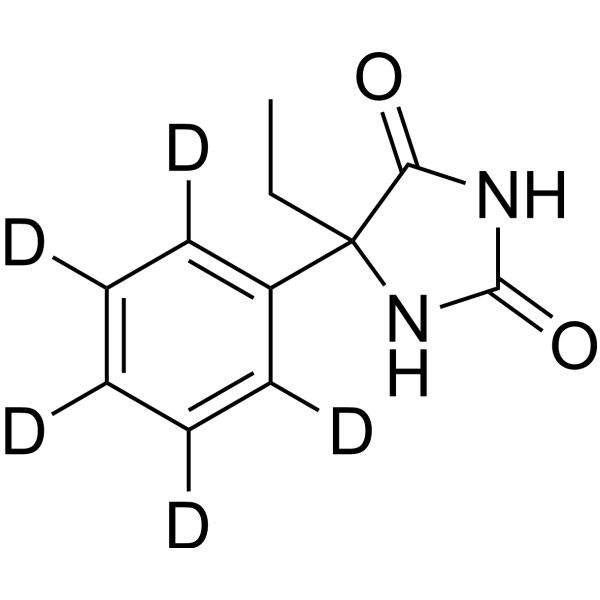
Nirvanol-d5 (Ethylphenylhydantoin-d5) is deuterium labeled Nirvanol (HY-W012481) . Nirvanol (Ethylphenylhydantoin) is a metabolite of Mephenytoin (HY-B1184) that exerts anticonvulsant effects in the maximal electroshock (M.E.S.) seizure model in mice. Nirvanol shows potential for research in epilepsy-related neurological disorders .
loading...
    loading...
Cat. No.: HY-148135
CAS No.: 694466-00-7
Purity:  ≥98.0%
Target:  

Carbonic Anhydrase

Research Areas:  

Neurological Disease

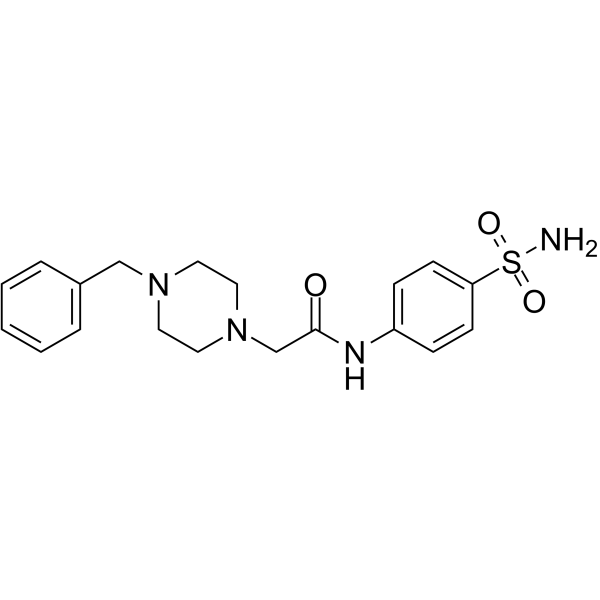
CAI/II-IN-6 is an orally active human carbonic anhydrase (hCA) inhibitor. CAI/II-IN-6 selectively inhibits hCA II and hCA VII isoforms with Ki values of 220, 4.9, 6.5 and >50000 nM for hCA I, hCA II , hCA VII and hCA XII respectively. CAI/II-IN-6 shows anticonvulsant activity and anti maximal electroshock (MES) activity in vivo. CAI/II-IN-6 can be used for the research of epilepsy .
loading...
    loading...
Cat. No.: HY-172887
Target:  

Potassium Channel

Research Areas:  

Neurological Disease

Kv7.2/Kv7.3 activator-2 is a BBB-penetrable Kv7.2/7.3 activator (EC50: 0.25 μM). Kv7.2/Kv7.3 activator-2 has good photostability. Kv7.2/Kv7.3 activator-2 has potently antiepileptic effects in maximal electroshock (MES) and sc-pentylenetetrazol (sc-PTZ)-induced acute mice seizure models .
loading...
    loading...
Cat. No.: HY-178016
CAS No.: 3097193-89-7
Target:  

Histamine Receptor

Research Areas:  

Neurological Disease

H3R antagonist 8 is a selective nonimidazole histamine H3 receptor antagonist (IC50 = 0.35 μM). H3R antagonist 8 exhibits hERG channel blockade activity (IC50 = 0.67 μM). H3R antagonist 8 inhibits seizures by antagonizing H3 receptor. H3R antagonist 8 reduces tonic hind limb extension (THLE) in mice in the maximal electroshock seizure (MES) model (ED50 = 20.21 mg/kg) and and shortens pentylenetetrazol (PTZ)-induced total movement distance in AB strain zebrafish larvae. H3R antagonist 8 can be used for the study of epilepsy .
loading...
    loading...
Cat. No.: HY-114833
CAS No.: 27591-01-1
Synonyms: (Rac)-Bunolol; dl-Bunolol
Bunolol ((Rac)-Bunolol) is a β-adrenergic receptor blocker. Bunolol antagonizes the β-receptor agonist activity induced by Isoproterenol (HY-B0468) and Dichloroisoproterenol. Bunolol reduces the heart rate and mean blood pressure of anesthetized dogs. Bunolol decreases spontaneous motor activity and Amphetamine-induced hyperactivity in rats, potentiates Pentobarbital-induced hypnosis in mice, and protects rats from extensor tonic convulsions induced by maximal electroshock .
loading...
    loading...
Cat. No.: HY-W550494
CAS No.: 32941-30-3
Target:  

Others

Research Areas:  

Neurological Disease

1-(Pyridin-4-yl)heptan-1-one (Compound R=n-C₆H₁₃) is an anticonvulsant agent. 1-(Pyridin-4-yl)heptan-1-one can protect mice from electroshock-induced convulsions. 1-(Pyridin-4-yl)heptan-1-one is promising for research of convulsion-related diseases such as epilepsy .
loading...
    loading...
Cat. No.: HY-15080
CAS No.: 143691-37-6
Synonyms: LY 293606
Target:  

iGluR

GYKI 53405 (LY 293606) is a non-competitive, orally active AMPA receptor antagonist. GYKI 53405 shows no significant binding affinity for GABAA, GABAB or benzodiazepine receptors. GYKI 53405 increases self-grooming behavior, induces wet dog-like shakes, reduces spontaneous activity, produces anxiolytic-like behavior, reverses the anxiogenic effect induced by mCPP, inhibits locomotor activity, suppresses sound-induced and maximal electroshock-induced seizures, prolongs survival in global cerebral ischemia models, and exhibits sustained anticonvulsant effects at doses below the sedation threshold. GYKI 53405 can be used in research related to absence epilepsy, anxiety disorders and global cerebral ischemia .
loading...
    loading...
  • 1

