15 Results for "

hCE1

" in MedChemExpress (MCE) Product Catalog:
Products (15)

15 Results for "hCE1" in MCE Product Catalog:

1
1 Cited Publications
Cat. No.: HY-106409
CAS No.: 914382-60-8
Purity:  99.65%
Synonyms: CHR-2845
Target:  

HDAC Apoptosis

Research Areas:  

Cancer

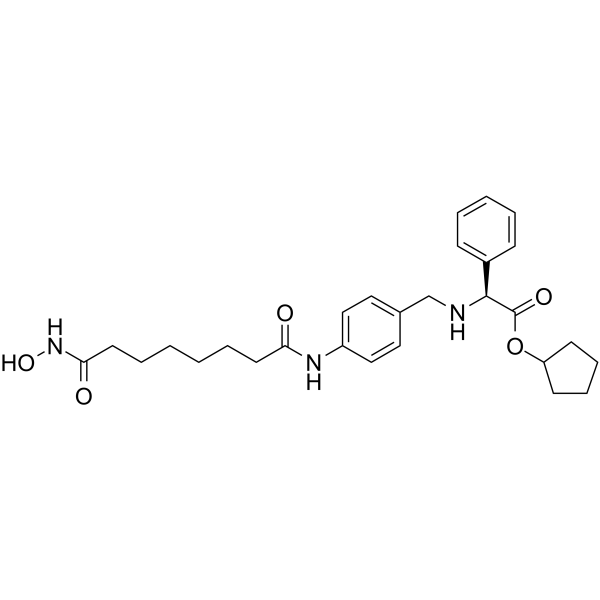
Tefinostat (CHR-2845) is a monocyte/macrophage targeted histone deacetylase (HDAC) inhibitor. Tefinostat can be cleaved into active acid CHR-2847 by the intracellular esterase human carboxylesterase-1 (hCE-1). Tefinostat can be used for the research of leukaemias [1].
loading...
    loading...
Cat. No.: HY-N1377
CAS No.: 10176-66-6
Synonyms: Lysionotin
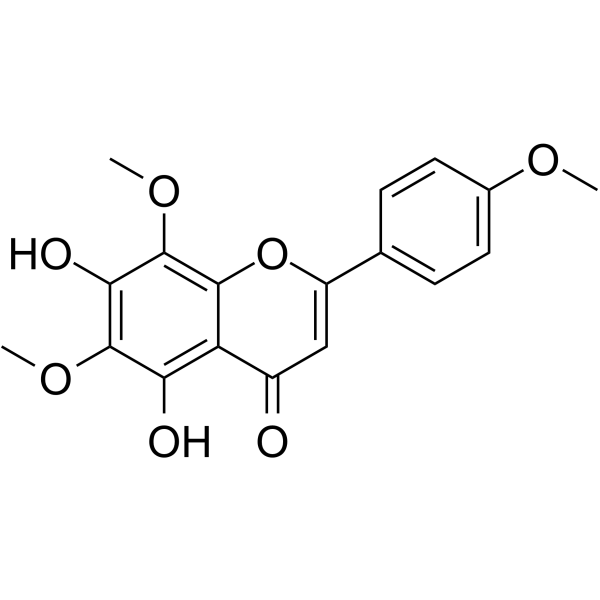
Nevadensin (Lysionotin), a natural flavonoid, is a selective human carboxylesterase 1 (hCE1) inhibitor with an IC50 of 2.64 μM. Nevadensin is more selective for hCE1 than hCE2 (IC50 of 132.8 μM). Nevadensin can induce apoptosis and DNA damage in cancer cells. Nevadensin has a variety of pharmacological effects such as anti-inflammatory, anti-tumour, anti-hypertensive, anti-tubercular, antitussive, antioxidant and anti-microbial activities [1] .
loading...
    loading...
Cat. No.: HY-N10686
CAS No.: 61077-78-9
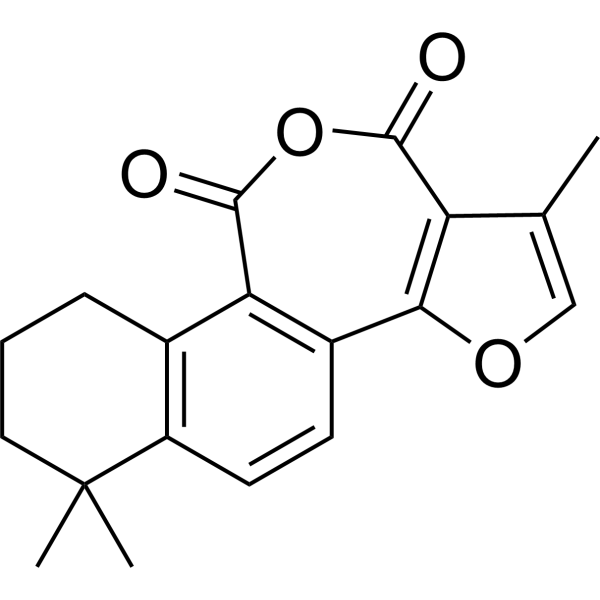
Tanshinone IIA anhydride, present in root extracts of Salvia miltiorrhiza, acts as an inhibitor of human carboxylesterase (CE). Tanshinone IIA anhydride has a Ki value of 1.9 nM against hCE1 and a Ki value of 1.4 nM against hiCE. Tanshinone IIA anhydride forms a stable covalent complex with serine Ser221 at the active site of hCE1, blocking the catalytic cycle of carboxylesterase, and the activity of the inactivated enzyme cannot recover spontaneously. Tanshinone IIA anhydride is applicable in metabolism-related studies [1].
loading...
    loading...
Cat. No.: HY-23148
CAS No.: 2058-74-4
Synonyms: N-Methylisatin
Research Areas:  

Others

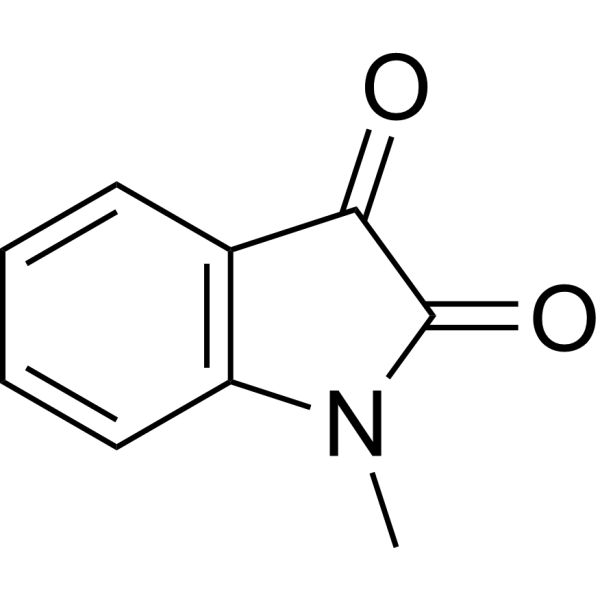
1-Methylisatin is a potent and selective CE (carboxylesterases) inhibitor, with Kis of 38.2 and 5.38 μM for hiCE and hCE1, respectively. 1-Methylisatin interacts with Hb (human adult hemoglobin) by hydrophobic binding and electrostatic attraction. 1-Methylisatin can be used in the study of regulation of agent metabolism in vivo [1] .
loading...
    loading...
Cat. No.: HY-124446
CAS No.: 523-88-6
Research Areas:  

Metabolic Disease

Dibromsalicil (Compound 31) is a carboxylesterase (CES) inhibitor with activity of 72.7 nM against hiCE (human intestinal carboxylesterase) and 53.5 nM against rCE (rabbit liver carboxylesterase). Dibromsalicil has almost no activity against hCE1 (human liver carboxylesterase) and cholinesterase [1].
loading...
    loading...
Cat. No.: HY-144809
CAS No.: 194235-21-7
Purity:  99.92%
Research Areas:  

Metabolic Disease

Pancreatic lipase/Carboxylesterase 1-IN-1 (Compound 39) is a potent dual inhibitor of pancreatic lipase (PL) and human carboxylesterase 1A (hCES1A) with IC50 values of 2.13 µM and 0.055  µM against PL and hCES1A [1].
loading...
    loading...
Cat. No.: HY-N1377R
CAS No.: 10176-66-6
Synonyms: Lysionotin (Standard)
Nevadensin (Standard) (Lysionotin (Standard)) is the analytical standard of Nevadensin (HY-N1377). This product is intended for research and analytical applications. Nevadensin, a natural flavonoid, is a selective human carboxylesterase 1 (hCE1) inhibitor with an IC50 of 2.64 μM. Nevadensin is more selective for hCE1 than hCE2 (IC50 of 132.8 μM). Nevadensin can induce apoptosis and DNA damage in cancer cells. Nevadensin has a variety of pharmacological effects such as anti-inflammatory, anti-tumour, anti-hypertensive, anti-tubercular, antitussive, antioxidant and anti-microbial activities.
loading...
    loading...
Cat. No.: HY-P83214
Synonyms: hCE; hCE1; hCAP; CAP1A

Host:  

Rabbit

Application:  

WB, ICC/IF, IP

Reactivity:  

Human, Rat

loading...
    loading...
Cat. No.: HY-P83214A
Synonyms: hCE; hCE1; hCAP; CAP1A

Host:  

Rabbit

Application:  

WB, ICC/IF, IP

Reactivity:  

Human, Rat

loading...
    loading...
Cat. No.: HY-106409R
CAS No.: 914382-60-8
Synonyms: CHR-2845 (Standard)
Research Areas:  

Cancer

Tefinostat (Standard) is the analytical standard of Tefinostat (HY-106409). This product is intended for research and analytical applications. Tefinostat (CHR-2845) is a monocyte/macrophage targeted histone deacetylase (HDAC) inhibitor. Tefinostat can be cleaved into active acid CHR-2847 by the intracellular esterase human carboxylesterase-1 (hCE-1). Tefinostat can be used for the research of leukaemias [1].
loading...
    loading...
Cat. No.: HY-RS12099
Research Areas:  

Others

RNGTT Human Pre-designed siRNA Set A contains three designed siRNAs for RNGTT gene (Human), as well as a negative control, a positive control, and a FAM-labeled negative control.

loading...
    loading...
Cat. No.: HY-RS02543
Research Areas:  

Others

CES1 Human Pre-designed siRNA Set A contains three designed siRNAs for CES1 gene (Human), as well as a negative control, a positive control, and a FAM-labeled negative control.

loading...
    loading...
Cat. No.: HY-P82583
Synonyms: ACAT; CE 1; CEH; CES1; CES2; CESDD1; Egasyn; ES-HTEL; ES-x; Es22; Esterase 22; hCE 1; HMSE; HMSE1; REH; SES1; TGH; Triacylglycerol hydrolase

Host:  

Rabbit

Application:  

WB, IP, FC

Reactivity:  

Human, Mouse, Rat

loading...
    loading...
Cat. No.: HY-P7730
Purity:  ≥ 95%, as determined by reducing SDS-PAGE.
Synonyms: rHuCarboxylesterase 1, His; CES1; Carboxylesterase 1; Cocaine Carboxylesterase; Serine Esterase 1; Triacylglycerol Hydrolase
Species:  
Source:  
loading...
    loading...
Cat. No.: HY-182517
CAS No.: 2225980-49-2
Target:  

TRP Channel

Research Areas:  

Inflammation/Immunology

AG1529 is a TRPV1 inhibitor and capsaicinoid-based soft agent with a human TRPV1 IC50 of 0.9-0.93 μM. AG1529 reversibly blocks capsaicin-evoked TRPV1 activation, binds to the TRPV1 capsaicin binding site, moderately affects pH-induced TRPV1 gating, and does not alter voltage- or heat-mediated TRPV1 responses. AG1529 suppresses TRPV1-mediated neuronal excitability, reduces capsaicin- and pH-evoked neuronal firing, abolishes histaminergic and inflammation-mediated TRPV1 sensitization. AG1529 exhibits anti-nociceptive and antipruritic effects, attenuates in vivo hyperalgesia and pruritus, dose-dependently reduces acute histaminergic itch in rodents, and mildly blocks hTRPA1 and hTRPM8 channel activity. AG1529 undergoes hydrolysis and dermal deactivation, minimizes TRPV1-associated side reactions, does not evoke capsaicin-like burning sensation, and does not disrupt physiological thermal regulation. AG1529 can be used for the research of inflammatory cutaneous nociception and acute histaminergic pruritus [1] .
loading...
    loading...
  • 1

