9 Results for "

mouse and rat liver microsomes

" in MedChemExpress (MCE) Product Catalog:
Products (9)

9 Results for "mouse and rat liver microsomes" in MCE Product Catalog:

  • Categories Recommended:
    More
1
1 Cited Publications
Cat. No.: HY-150508
CAS No.: 2641484-61-7
Purity:  98.60%
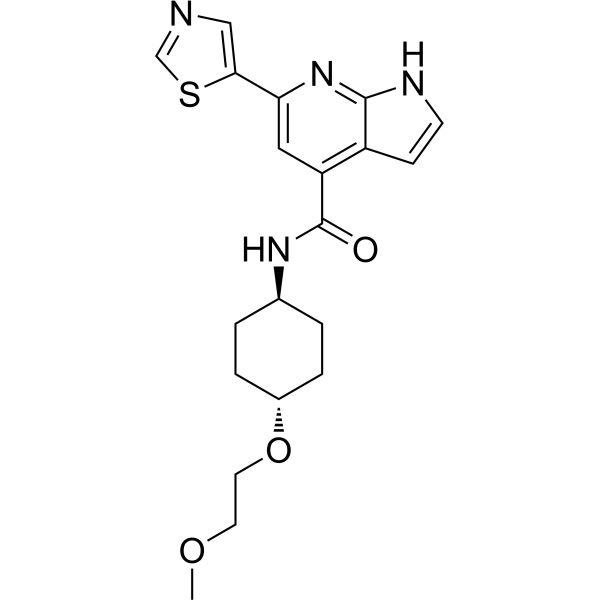
MK-0159 is an orally active, potent and selective CD38 inhibitor, with IC50 values of 22, 3, and 70 nM for human, mouse and rat CD38, respectively. MK-0159 also shows good microsomal stability for human and rodent liver microsomes. MK-0159 increases NAD + (nicotinamide adenine dinucleotide) and reduces ADPR (adenosine diphosphate ribose) in whole blood and heart .
loading...
    loading...
Cat. No.: HY-153508
CAS No.: 2098490-06-1
Target:  

Chloride Channel

Research Areas:  

Others

ANO1-IN-4 (Compound 10bm) is a reversible inhibitor for calcium-activated chloride channel transmembrane protein 16A (TMEM16A, also known as ANO1) with an IC50 of 0.030 µM. ANO1-IN-4 exhibits good metabolic stability in rat liver microsomes. ANO1-IN-4 inhibits spontaneous contraction in mouse isolated ileum .
loading...
    loading...
Cat. No.: HY-128268
CAS No.: 735303-62-5
Target:  

Parasite

Research Areas:  

Infection

PFK-IN-1 (compound 1) is a phosphofructokinase (PFK) inhibitor, with IC50 values of 0.41 and 0.23 μM against T.brucei and T.cruzi PFK, respectively, and an ED50 of 15.18 μg/mL for T.brucei. The half-lives of PFK-IN-1 in rat and mouse liver microsomes are 9.7 and 408 minutes, respectively .
loading...
    loading...
Cat. No.: HY-151229
CAS No.: 686-07-7
Purity:  99.77%
Synonyms: DETC-Me; DDTC-Me; Diethyldithiocarbamic acid methyl ester
Research Areas:  

Metabolic Disease

S-Methyl-N,N-diethylthiolcarbamate (DETC-Me; DDTC-Me) is the active metabolite of the aldehyde dehydrogenase inhibitor disulfiram (HY-B0240). It is produced by the methylation of the disulfiram metabolite diethyldithiocarbamate in mouse liver microsomes. S-Methyl-N,N-diethylthiolcarbamate (DETC-Me; DDTC-Me) inhibits rat liver low Km aldehyde dehydrogenase (ALDH) (ID50=15.5 mg/kg). When administered at a dose of 20.6 mg/kg, it decreases mean arterial pressure (MAP) and increases heart rate in rats during ethanol stimulation.
loading...
    loading...
Cat. No.: HY-B1341
CAS No.: 68-23-5
Synonyms: Enidrel; SC-4642; NSC 15432
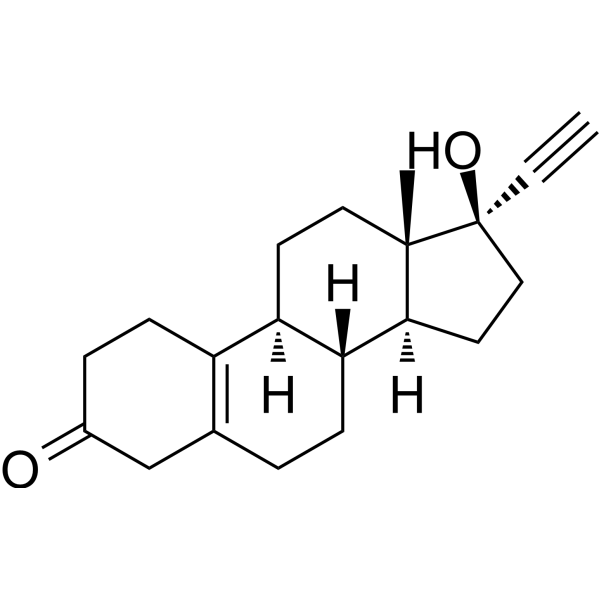
Norethynodrel (Enidrel; SC-4642) is an orally active progestogen analog that reduces estrogen-like effects and enhances progestogen-like responses in endometrial stromal cells. Norethynodrel also promotes cell maturation and predecidual cell formation by inducing organelle hyperplasia and glycogen accumulation. Norethynodrel competitively inhibits drug-metabolizing enzymes in rat liver microsomes, thereby prolonging Pentobarbital sleep time, while exhibiting multiple effects including reduced body weight gain, attenuated heart rate elevation and ovulation inhibition. In mouse models, Norethynodrel significantly increases the incidence of mammary adenocarcinoma, cervical cancer and pituitary tumors. Norethynodrel can be used for mechanism research on related diseases such as mammary adenocarcinoma, cervical cancer, ovarian tubular adenoma and pituitary adenoma .
loading...
    loading...
Cat. No.: HY-146410
CAS No.: 2709031-17-2
Target:  

Angiotensin Receptor

Research Areas:  

Others

AT2R antagonist 1 (compound 21) is a potent and high selective AT2R (angiotensin II AT2 receptor) ligand. AT2R antagonist 1 exhibits a fair AT2R affinity, with a Ki of 29 nM. AT2R antagonist 1 also inhibits common agent-metabolizing CYP enzymes. AT2R antagonist 1 shows high stability in human, rat and mouse liver microsomes .
loading...
    loading...
Cat. No.: HY-123639
CAS No.: 261766-32-9
Synonyms: N-(2-Phenylethyl)-indomethacin amide
Target:  

COX

Research Areas:  

Inflammation/Immunology Cancer

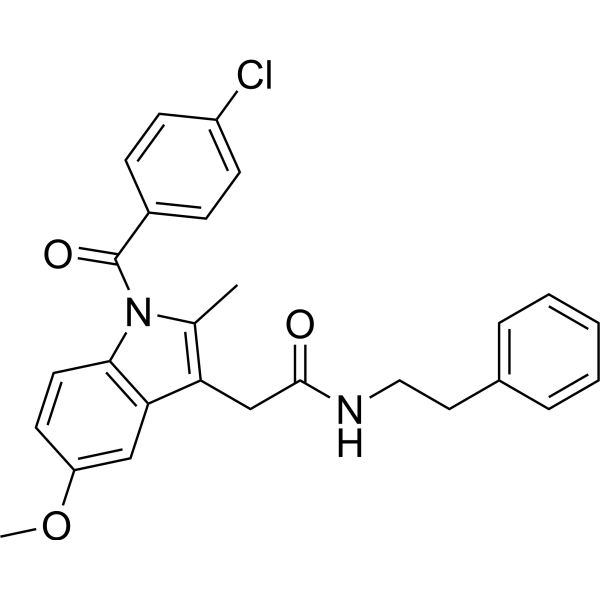
LM-4108 (N-(2-Phenylethyl)-indomethacin amide) is a selective and orally active COX-2 inhibitor with an IC50 of 0.06 μM for purified human COX-2. LM-4108 shows anti-inflammatory activity and may be effective in prevention of cancer. Half-lives for the disappearance of 10 μM LM-4108 in rat, human, and mouse liver microsomes were 11 min, 21 min, and 51 min, respectively .
loading...
    loading...
Cat. No.: HY-173024
CAS No.: 3053390-98-7
Target:  

TRP Channel

Research Areas:  

Neurological Disease

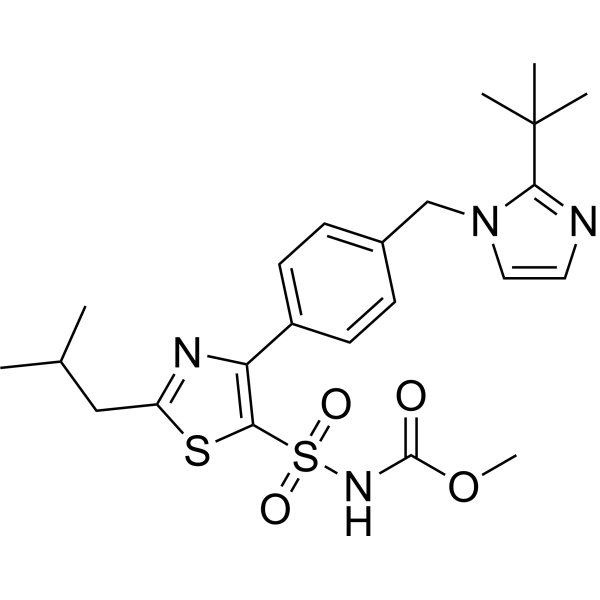
TRPC4/5-IN-3 (Compound 32) is the orally active inhibitor for transient receptor potential canonical channel 4/5 (TRPC4/5) with IC50 of 3.6 nM and 5.5 nM. TRPC4/5-IN-3 inhibits hERG channel with IC50 of 6.5 µM. TRPC4/5-IN-3 exhibits good metabolic stability in human/rat/mouse liver microsomes. TRPC4/5-IN-3 exhibits antidepressant and anxiolytic activity in mouse models, exhibits good pharmacokinetic characteristics in mouse with an oral bioavailability of 87% .
loading...
    loading...
Cat. No.: HY-182255
CAS No.: 217187-87-6
Target:  

Endogenous Metabolite

Research Areas:  

Others

ED-594 is the glucuronide form of NB-506. ED-594 is one of the major metabolites of NB-506 in rat bile, mouse liver microsomes, rat liver microsomes and human liver microsomes .
loading...
    loading...

