17 Results for "

novel object recognition

" in MedChemExpress (MCE) Product Catalog:
Products (17)

17 Results for "novel object recognition" in MCE Product Catalog:

2
2 Cited Publications
Cat. No.: HY-100784
CAS No.: 52497-36-6
Purity:  ≥99.0%
Target:  

EAAT

Research Areas:  

Neurological Disease

Dihydrokainic acid is a glutamate transporters (especially GLT1) inhibitor. Dihydrokainic acid targets GLT1 with high affinity, effectively inhibiting its transport function. Dihydrokainic acid exerts its effect by inhibiting the uptake of glutamate, leading to an increase in extracellular glutamate concentration, thereby affecting neuronal excitability and neurotransmission. Dihydrokainic acid is mainly applied in the field of neuroscience for research on glutamate-related neural functions, epilepsy, learning, and memory .
loading...
    loading...
1
1 Cited Publications
Cat. No.: HY-117604
CAS No.: 1257051-63-0
Purity:  98.75%
Research Areas:  

Neurological Disease

THPP-1, a SGC chemical probe, is a potent and orally bioavailable phosphodiesterase 10A (PDE10A) inhibitor, with Ki values of 1 nM and 1.3 nM for human and rat PDE10A, respectively. THPP-1 has excellent pharmacokinetic properties in preclinical species .
loading...
    loading...
Cat. No.: HY-179004
CAS No.: 2640753-22-4
Synonyms: VU6022856
Target:  

Potassium Channel

Research Areas:  

Neurological Disease

ONO-9517601 is a potent, orally active, selective and CNS penetrant dual TREK-1/TREK-2 inhibitor (TREK-1 IC50= 0.067 μM, TREK-2 IC50= 0.23 μM). ONO-9517601 displays robust efficacy in an MK-801 (HY-15084B) challenge rat novel object recognition (NOR) paradigm. ONO-9517601 can be used for research on neurological and cognitive disorders .
loading...
    loading...
Cat. No.: HY-100784R
CAS No.: 52497-36-6
Research Areas:  

Neurological Disease

Dihydrokainic acid (Standard) is the analytical standard of Dihydrokainic acid. This product is intended for research and analytical applications. Dihydrokainic acid (DHK) is a glutamate transporter GLT1 (EAAT2) inhibitor. Dihydrokainic acid impairs novel object recognition (NOR) memory performance in mice. Dihydrokainic acid also shows epileptogenic effects .
loading...
    loading...
Cat. No.: HY-107652
CAS No.: 118290-26-9
Purity:  98.0%
Target:  

mAChR

Research Areas:  

Neurological Disease

AF-DX 384 is a selective antagonist of M2 and M4 muscarinic acetylcholine receptors (Kis=6.03 and 10 nM, respectively) . AF-DX 384 reverses deficits in novel object recognition and passive avoidance in aged rats, as well as in young rats with impairments induced by scopolamine .
loading...
    loading...
Cat. No.: HY-170499
Synonyms: BI02982816
Target:  

mGluR

Research Areas:  

Neurological Disease

VU6024578 (BI02982816) is a selective, orally active positive allosteric modulator (PAM) for metabotropic glutamate receptor (mGluR1), that activates human mGluR1 and rat mGluR1 with EC50 of 54 nM and 46 nM. VU6024578 exhibits antipsychotic activity in rats amphetamine-induced hyperactivity models and MK-801 (HY-15084B)-induced novel object recognition (NOR) models. VU6024578 is blood brain barrier penetrable .
loading...
    loading...
Cat. No.: HY-179005
CAS No.: 2640753-27-9
Synonyms: VU6024391
Target:  

Potassium Channel

Research Areas:  

Neurological Disease

ONO-7927846 is a potent, orally active, selective and CNS penetrant dual TREK-1/TREK-2 inhibitor (TREK-1 IC50= 0.11 μM, TREK-2 IC50= 0.29 μM). ONO-7927846 displays robust efficacy in an MK-801 (HY-15084B) challenge rat novel object recognition (NOR) paradigm. ONO-7927846 can be used for research on neurological and cognitive disorders .
loading...
    loading...
Cat. No.: HY-120710
CAS No.: 1821107-98-5
Research Areas:  

Neurological Disease

DNS-8254 is an oral active and brain-penetrating PDE2a inhibitor with the IC50 of 8 nM. DNS-8254 shows memory enhancing effects in a rat model .
loading...
    loading...
Cat. No.: HY-133732
CAS No.: 60719-83-7
Synonyms: GEA 654 hydrochloride; A03 hydrochloride
Alaproclate (GEA 654) hydrochloride is a selective and orally active serotonin re-uptake inhibitor (SSRI). Alaproclate hydrochloride also acts as a potent, reversible and noncompetitive antagonist of the NMDA receptor coupled ion flow .
loading...
    loading...
Cat. No.: HY-117408
CAS No.: 2011034-33-4
Purity:  99.61%
Target:  

mAChR

Research Areas:  

Neurological Disease

VU6004256 is a potent and selective M1 muscarinic positive allosteric modulator (PAM) with an EC50 value of 155 nM. VU6004256 has the potential for the research of schizophrenia .
loading...
    loading...
Cat. No.: HY-P10435
CAS No.: 1393589-51-9
Target:  

Dopamine Receptor

Research Areas:  

Neurological Disease

KEMPFPKYPVEP is a 12-amino acids neuropeptide, which upregulates levels of dopamine (DA) and norepinephrine (NE) in the prefrontal cortex, exhibits spatial and object recognition memory promoting ability in Scopolamine (HY-N0296)-induced amnesia mouse model .
loading...
    loading...
Cat. No.: HY-124223
CAS No.: 118290-27-0
Target:  

mAChR

Research Areas:  

Neurological Disease

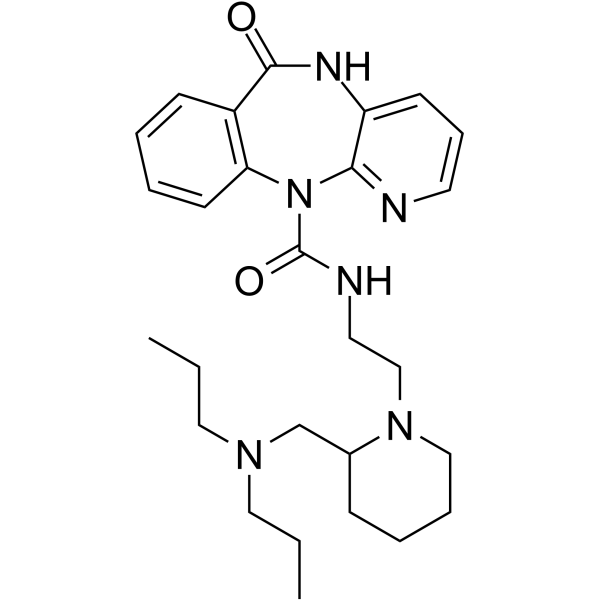
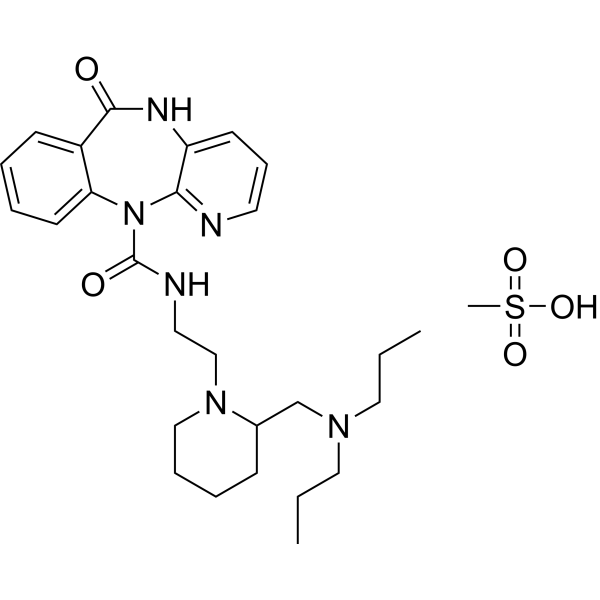
AF-DX 384 (methanesulfonate) is a selective antagonist of M2 and M4 muscarinic acetylcholine receptors (Kis=6.03 and 10 nM, respectively) . AF-DX 384 (methanesulfonate) reverses deficits in novel object recognition and passive avoidance in aged rats, as well as in young rats with impairments induced by scopolamine .
loading...
    loading...
Cat. No.: HY-120783
CAS No.: 1531592-40-1
Target:  

Endogenous Metabolite

Research Areas:  

Neurological Disease

Lu AF58801 is a potent, orally available, brain-penetrant positive allosteric modulator of α7 nicotinic acetylcholine receptors with efficacy in a novel object recognition task in mice. Lu AF58801 was shown to selectively enhance the activity of α7 nicotinic acetylcholine receptors. Lu AF58801 was able to improve cognitive function in mice treated with subchronic fluchlorothiazol (PCP) .
loading...
    loading...
Cat. No.: HY-155330
Research Areas:  

Neurological Disease

PZ-1922 (Compound 16) is a BBB-penetrable 5-HT6R/5-HT3R antagonist (Ki: 17 nM, 0.45 nM for 5-HT6R/5-HT3R respectively). PZ-1922 reversibly inhibits MAO-B (pIC50: 8.93). PZ-1922 reverses Scopolamine (SCOP) (HY-N0296) induced memory deficits in the novel object recognition (NOR) test in rats. PZ-1922 prevents Aβ-induced memory decline in the T-maze test .
loading...
    loading...
Cat. No.: HY-155330A
CAS No.: 1648745-65-6
Research Areas:  

Neurological Disease

PZ-1922 free base is a BBB-penetrable 5-HT6R/5-HT3R antagonist (Ki: 17 nM, 0.45 nM for 5-HT6R/5-HT3R respectively). PZ-1922 free base reversibly inhibits MAO-B (pIC50: 8.93). PZ-1922 free base reverses Scopolamine (SCOP) (HY-N0296) induced memory deficits in the novel object recognition (NOR) test in rats. PZ-1922 free base prevents Aβ-induced memory decline in the T-maze test .
loading...
    loading...
Cat. No.: HY-184052
CAS No.: 1809612-31-4
Target:  

5-HT Receptor

Research Areas:  

Neurological Disease

5-HT4R agonist-3 is a 5-HT4R agonist with an EC50 of 22 nM. 5-HT4R agonist-3 selectively modulates 5-HT4R and induces pro-cognitive activity. 5-HT4R agonist-3 can be used in research related to Alzheimer's disease .
loading...
    loading...
Cat. No.: HY-179724A
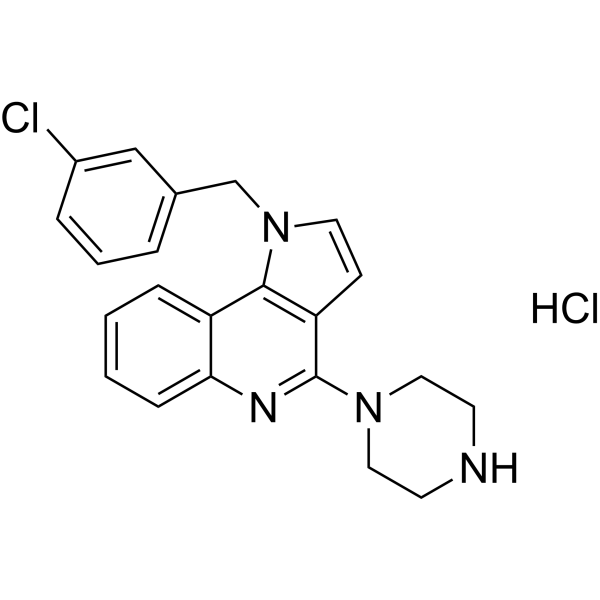
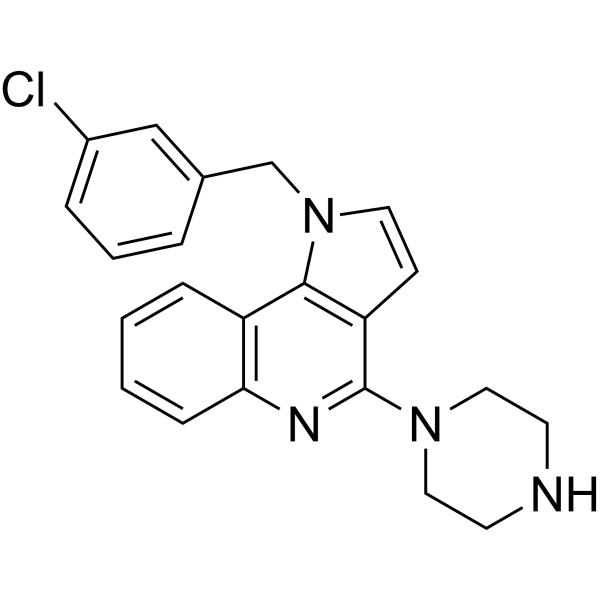
PZ-1657 hydrochloride (Compound 57) is a potent, selective and orally active 5-HT7 receptor inverse agonist with a Ki of 5 nM. PZ-1657 hydrochloride can inhibit the constitutive cAMP production mediated by the Gs signaling pathway (EC50 = 2.93 nM). PZ-1657 hydrochloride can significantly reduce the MMP-9 activity mediated by 5-HT7 receptors in the hippocampus of mice, and the effect is comparable to that of SB-269970 (HY-15370). PZ-1657 hydrochloride can reverse the cognitive deficits observed in the rat novel object recognition test induced by Phencyclidine without affecting the animals' spontaneous activities. PZ-1657 hydrochloride can be used for the research of emotional disorders, such as depression and bipolar disorder .
loading...
    loading...
  • 1

