17 Results for "

residence

" in MedChemExpress (MCE) Product Catalog:
Products (17)

17 Results for "residence" in MCE Product Catalog:

3
3 Cited Publications
Cat. No.: HY-12680
CAS No.: 1575818-46-0
Purity:  98.09%
Target:  

Itk

Research Areas:  

Inflammation/Immunology

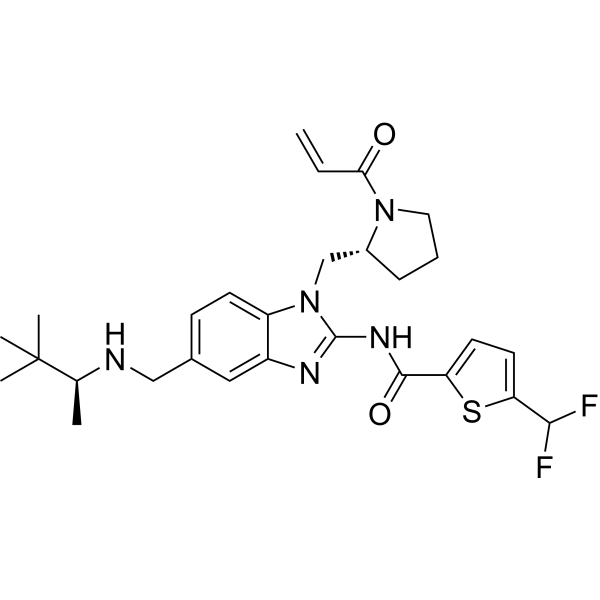
PRN694 is an irreversible, highly selective and potent covalent interleukin-2-inducible T-cell kinase (ITK) and resting lymphocyte kinase (RLK) dual inhibitor with IC50s of 0.3 nM and 1.4 nM, respectively. PRN694 exhibits extended target residence time on ITK and RLK, enabling durable attenuation of effector cells in vitro and in vivo .
loading...
    loading...
1
1 Cited Publications
Cat. No.: HY-112792
CAS No.: 1683534-96-4
Purity:  98.00%
Target:  

CCR

Research Areas:  

Endocrinology

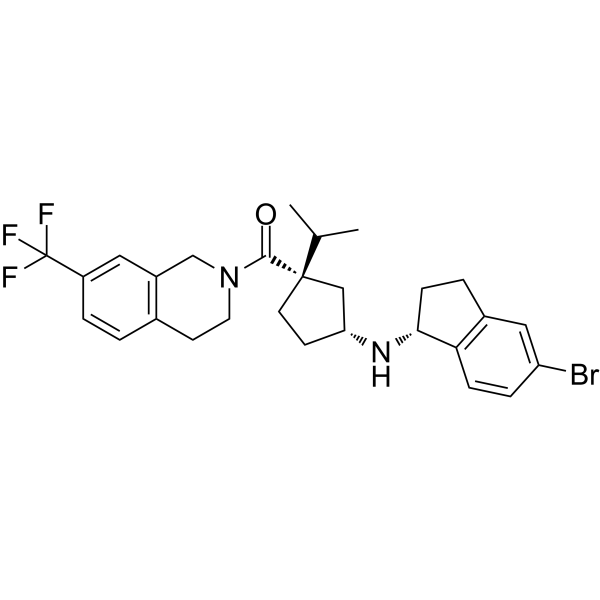
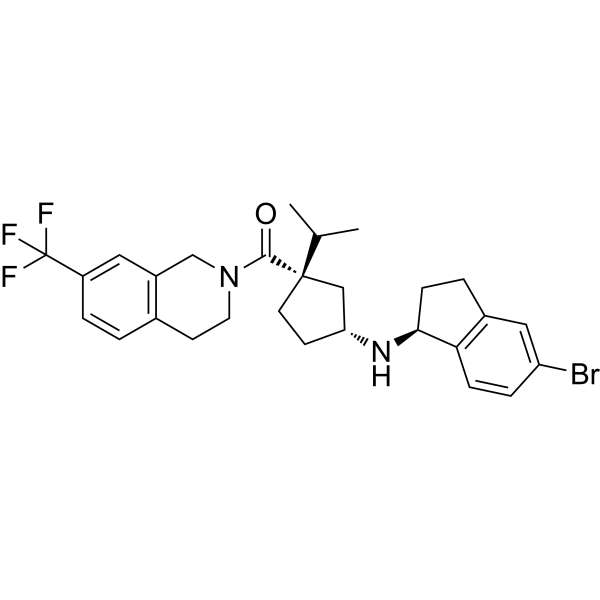
CCR2 antagonist 1 (compound 15a) is a high-affinity and long-residence-time CCR2 antagonist, with a Ki of 2.4 nM .
loading...
    loading...
Cat. No.: HY-B1597
CAS No.: 122-18-9
Synonyms: Benzyldimethylhexadecylammonium chloride
Target:  

Bacterial

Research Areas:  

Infection Inflammation/Immunology

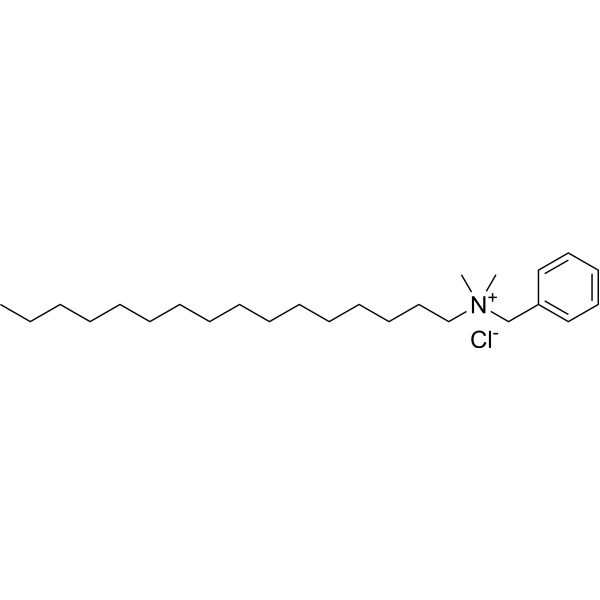
Cetalkonium chloride is an ammonium antiseptic agent used in many topical agents for infections of mouth, throat and eye. Cetalkonium chloride acts as anti-inflammatory amphiphilic agent. Cetalkonium chloride is a cationic surfactant, that improves the precorneal residence time and bioavailability of drugs. Cetalkonium chloride interacts with the negative charges on the bacterial cell membrane, disrupts the integrity of the cell membrane, causes leakage of cell contents and ultimately leading to bacterial death .
loading...
    loading...
Cat. No.: HY-100024
CAS No.: 1817791-73-3
Purity:  99.01%
Target:  

Mps1

Research Areas:  

Cancer

NTRC 0066-0 is a selective threonine tyrosine kinase (TTK) inhibitor (IC50=0.9 nM). NTRC 0066-0 can be used for the research of cancer .
loading...
    loading...
Cat. No.: HY-P990207
Anti-Mouse/Human Integrin β7 Antibody (FIB504) is an anti-mouse/human Integrin β7 IgG2a monoclonal antibody. Anti-Mouse/Human Integrin β7 Antibody (FIB504) can reduce the residence of type 2 innate lymphoid cells (ILC2s). Anti-Mouse/Human Integrin β7 Antibody (FIB504) can be used for researches on inflammation conditions and cancer such as lupus nephritis and glioma .
loading...
    loading...
Cat. No.: HY-158118
CAS No.: 2088426-96-2
Purity:  97.19%
Target:  

DNA-PK

Research Areas:  

Cancer

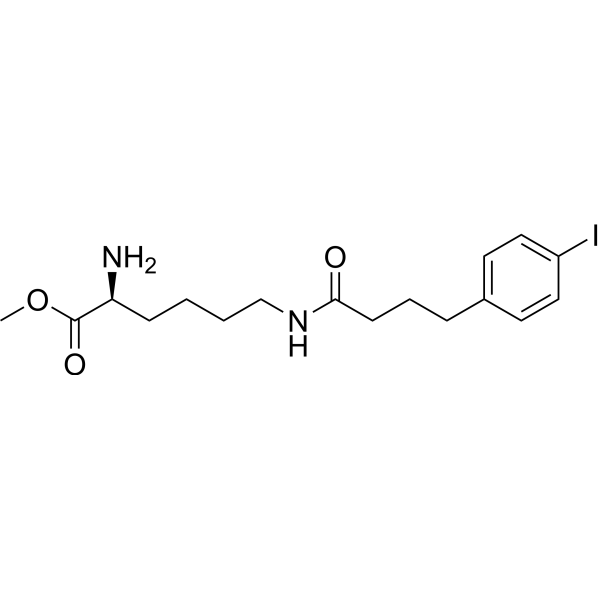
Lys(CO-C3-p-I-Ph)-OMe is a pharmacokinetic modifier (PK modifier) that can improve the PK properties of PSMA ligand molecules (such as Ac-PSMA-trillium). Lys(CO-C3-p-I-Ph)-OMe can increase the residence time of Ac-PSMA-trillium in plasma by increasing its binding capacity to albumin. Lys(CO-C3-p-I-Ph)-OMe also reduces salivary gland absorption of Ac-PSMA-trillium, potentially extending its half-life. Ac-PSMA-trillium is a suitable PSMA-targeting compound that has different biological applications after modification with different radioactive isotopes. If labeled with 111In, it can be used as DOTA chelating agent and imaging agent. Or labeled with 225Ac as a Macropa chelator for targeted radionuclide therapy (TRT) in the study of metastatic castration-resistant prostate cancer (mCRPC) .
loading...
    loading...
Cat. No.: HY-P4063
CAS No.: 1350661-05-0
Target:  

Peptides

Research Areas:  

Metabolic Disease

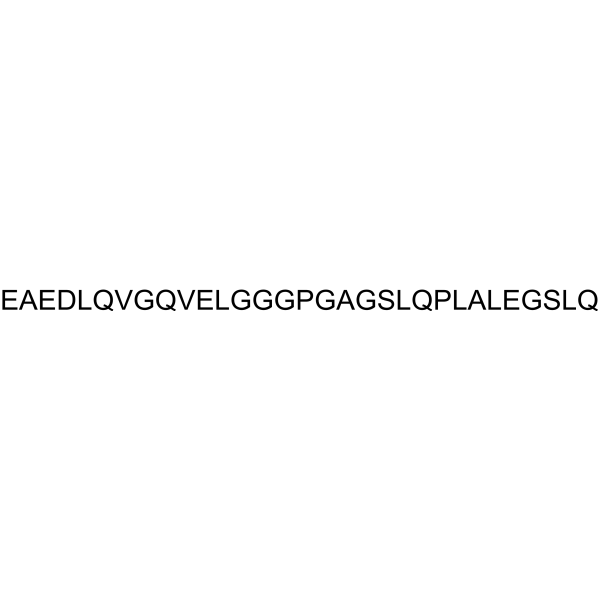
Pegylated synthetic human c-peptide retains bioactivity comparable to that of natural (i.e. non-polyethylene glycolated) C-peptides and has a prolonged circulating residence time in plasma for use in diabetic peripheral neuropathy studies .
loading...
    loading...
Cat. No.: HY-158122
CAS No.: 2703051-80-1
Purity:  98.14%
Target:  

DNA-PK

Research Areas:  

Cancer

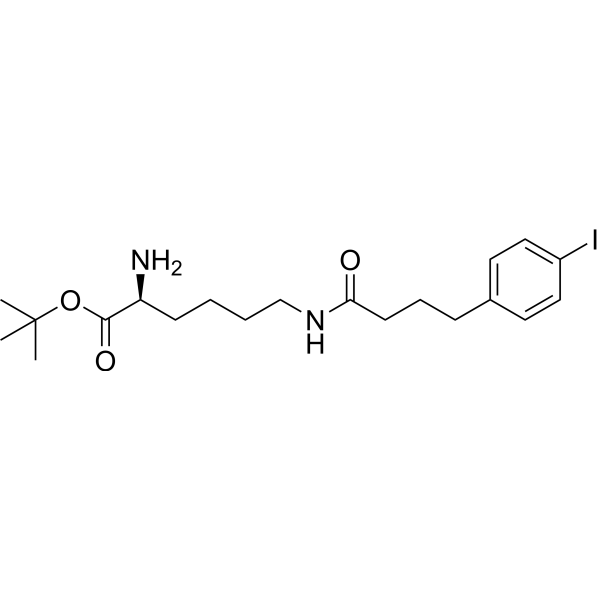
Lys(CO-C3-p-I-Ph)-O-tBu is a pharmacokinetic modifier (PK modifier) that can improve the pharmacokinetic properties of PSMA ligand molecules. Lys(CO-C3-p-I-Ph)-O-tBu can increase the residence time of PSMA ligand in plasma by increasing its binding capacity to albumin. Lys(CO-C3-p-I-Ph)-O-tBu also reduces salivary gland absorption, possibly extending the half-life of the active compound .
loading...
    loading...
Cat. No.: HY-D2314
CAS No.: 1650559-73-1
Cyanine 7-amine (chloride hydrochloride) can be used to label cationic nanoparticles (NPs) or to NP conjugates (NPCs). It can track the residence time and clearance of nanoparticles in the body .
loading...
    loading...
Cat. No.: HY-112792A
CAS No.: 1683534-97-5
Purity:  98.03%
Target:  

CCR

Research Areas:  

Endocrinology

(1S)-CCR2 antagonist 1 is a left-handed chiral body of CCR2 antagonist 1 (HY-112792). CCR2 antagonist 1 is a high-affinity and long-residence-time CCR2 antagonist, with a Ki of 2.4 nM .
loading...
    loading...
Cat. No.: HY-B1597R
CAS No.: 122-18-9
Synonyms: Benzyldimethylhexadecylammonium chloride (Standard)
Cetalkonium (chloride) (Standard) is the analytical standard of Cetalkonium (chloride). This product is intended for research and analytical applications. Cetalkonium chloride is an ammonium antiseptic agent used in many topical agents for infections of mouth, throat and eye. Cetalkonium chloride acts as anti-inflammatory amphiphilic agent. Cetalkonium chloride is a cationic surfactant, that improves the precorneal residence time and bioavailability of drugs. Cetalkonium chloride interacts with the negative charges on the bacterial cell membrane, disrupts the integrity of the cell membrane, causes leakage of cell contents and ultimately leading to bacterial death .
loading...
    loading...
Cat. No.: HY-159744
Research Areas:  

Inflammation/Immunology

Liposomal adjuvant (M103) is mainly composed of phospholipids and prepared with highly purified immunostimulatory substances (polysaccharides), with a pH value of 6.2-6.8. This adjuvant is safe, non-toxic, and metabolizable. It can induce cellular and humoral immunity, has a sustained-release effect, and can prolong the residence time of antigens in the body. This adjuvant is suitable for various veterinary vaccines, including inactivated vaccines and genetically engineered subunit vaccines. It is recommended for use in rabies, porcine circovirus, , foot-and-mouth disease (FMD), and blue ear disease, etc.
loading...
    loading...
Cat. No.: HY-172392
Research Areas:  

Cancer

HSND80 (Compound 1) is an orally active inhibitor of MNK/p70S6K, with Kd values of 44 nM against MNK1 and 4 nM against MNK2. HSND80 has a longer target residence time of 45 mins and 58 mins against MNK1 and MNK2 respectively. HSND80 can suppress non-small cell lung cancer (NSCLC) both in vitro and in vivo, and suppress Triple-Negative Breast Cancer (TNBC) in vitro .
loading...
    loading...
Cat. No.: HY-133031A
CAS No.: 474084-56-5
Research Areas:  

Others

CSV0C018875 hydrochloride is a G9a (EHMT2) inhibitor that inhibits G9a activity. CSV0C018875 can effectively inhibit G9a activity in both enzyme and cell-based assays, and its toxicity is much lower than that of the known G9a inhibitor BIX-01294. CSV0C018875 binds tightly to the active site cavity of G9a, thereby improving the binding firmness and prolonging the residence time of the compound, further enhancing the inhibitory effect of G9a. CSV0C018875 has the potential to improve its ADME (absorption, distribution, metabolism and excretion) and pharmacodynamic properties through further optimization .
loading...
    loading...
Cat. No.: HY-13552
CAS No.: 80841-48-1
Synonyms: CI-921 isethionate; NSC 343499 isethionate
Asulacrine isethionate (CI-921 isethionate) is a derivative of Amsacrine (HY-13551), a Topoisomerase II inhibitor and an anticancer agent. Asulacrine isethionate binds to DNA via intercalation, forming stable complexes with long residence times at DNA sites. Asulacrine isethionate mediates DNA breakage and DNA-protein cross-linking. Asulacrine isethionate exhibits anticancer activity against leukemia or lung cancer. Asulacrine isethionate can be used in research related to breast cancer, lung cancer, mouse solid tumors and leukemia .
loading...
    loading...
Cat. No.: HY-W724344
Synonyms: Benzyldimethylhexadecylammonium-d5 chloride
Cetalkonium-d5 chloride (Benzyldimethylhexadecylammonium-d5 chloride) is the deuterium labeled Cetalkonium chloride (HY-B1597). Cetalkonium chloride is an ammonium antiseptic agent used in many topical agents for infections of mouth, throat and eye. Cetalkonium chloride acts as anti-inflammatory amphiphilic agent. Cetalkonium chloride is a cationic surfactant, that improves the precorneal residence time and bioavailability of drugs. Cetalkonium chloride interacts with the negative charges on the bacterial cell membrane, disrupts the integrity of the cell membrane, causes leakage of cell contents and ultimately leading to bacterial death .
loading...
    loading...
Cat. No.: HY-LD004
14 million compounds

DEL technology enables the simultaneous screening of millions or billions of compounds in a single tube by covalently linking each small molecule with a unique DNA sequence. Traditional DEL screening primarily focuses on identifying non-covalent binding molecules, where interactions with the target are reversible. In contrast, DNA‑encoded covalent library is an ultra‑high‑throughput screening library developed on the basis of conventional DNA‑encoded library technology. It incorporates controllable electrophilic covalent warheads capable of forming irreversible covalent bonds with amino acid residues at the active sites of target proteins, including Cys, Lys, Ser, Tyr, and others. This covalent binding enhances binding affinity, prolongs residence time at the target site, and has the potential to overcome challenges associated with traditional non-covalent inhibitors, such as drug resistance or off-target effects.

Each compound in the library contains both a binding domain and an electrophilic warhead. It first recognizes and binds to the target through non covalent interactions, and then forms a stable covalent bond with key amino acid residues to achieve irreversible inhibition. This library is specifically designed for the discovery of potent, long lasting, and highly selective covalent inhibitors, particularly for undruggable targets such as kinases, GPCRs, proteases, and mutant oncoproteins. Each molecule is uniquely labeled with a DNA barcode for molecular identification and sequencing decoding.

This library is an advanced and highly diverse collection, consists of 35 independent sub-libraries with a total scaleof 14 million compounds, It incorporates over 14 experimentally validated covalent warheads capable of targeting cysteine, lysine, arginine, aspartic acid and glutamic acid. This library is constructed with diverse drug like core scaffolds and integrated controllable covalent warheads, it features structural diversity, reaction spec

  • 1

